Home » Broadband Speed » Recent Articles:

Time Warner Cable’s Halloween Nightmare: 3% of Customers Left This Summer, With More to Follow

Phillip Dampier October 31, 2013 Broadband Speed, Competition, Consumer News 2 Comments

pumpkinTime Warner Cable’s summer was “horrible,” to quote one analyst, after three percent of customers left over programming disputes and increasing prices for broadband and telephone service, with more likely to follow as price promotions expire and rates increase further.

Cable analysts were shocked Time Warner Cable lost 308,000 customers in the last three months, most leaving over interruptions of CBS and Showtime over a contract dispute. But customers were also ready to leave over increasing modem rental fees, rate increases, and the company’s growing pullback on promotional pricing. Time Warner Cable’s poor results have ironically caused its stock price to increase this morning, but only because investors suspect a shareholder value-boosting merger with Charter Communications could come within months.

“Just horrible,” MoffetNathanson analyst Craig Moffett wrote in a note to investor clients this morning. “The CBS dispute apparently took a much larger toll than anyone would have imagined, and this colored all the results.”

Sources have told Reuters that cable billionaire John Malone has approached Time Warner Cable about a full takeover by Charter Communications, but has been rebuffed by Britt so far. But with Britt exiting and Time Warner Cable’s underperformance, shareholder pressure for a deal with Charter will only increase.

“This enhances Malone’s appeal to Time Warner Cable shareholders that they would be better off with another management team,” Brean Capital analyst Todd Mitchell told Reuters.
When promotional prices end, a growing percentage of TWC customers drop services or take their business elsewhere.

When promotional prices end, a growing percentage of TWC customers drop services or take their business elsewhere.

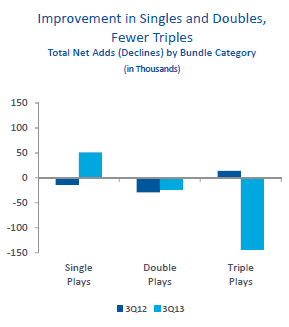
The subscriber losses pushed profits down 34 percent at the cable company, to $532 million. The triple play tragedy saw subscriber losses for all the company’s residential services. At a time when other cable companies cannot process High Speed Internet sign ups fast enough, at least 24,000 Time Warner Cable broadband customers left over rate hikes and equipment fees. Analysts had expected the company to pick up more than 46,000 broadband customers during the last three months, not lose them. The company’s phone service is also in decline. Only rate increases and customers upgrading to higher speed tiers delivered a slight revenue boost.

Outgoing CEO Glenn Britt set the stage for the current forced retreat on its revenue forecast for the year:

  • Time Warner Cable executives made the decision at the end of 2012 to stop heavily discounting service and cut back on promotions. Their theory was the company would attract a larger base of stable customers willing to pay non-promotional rates and tolerate rate increases;
  • Executives announced as Time Warner’s phone service was brought “in-house,” the company would stop aggressively pricing triple play bundles that included phone service. That turned out to be a bad decision for growth because customers, already prone to landline cord-cutting, downgraded their bundle or left when promotions expired and ditched the phone line;
  • A year of broadband price increases and the introduction of a modem rental fee rubbed customers the wrong way. “We have raised prices recently in the form of modem rental fees, but it’s really just broadband price increase,” again admitted Britt this morning. Future rate increases on modem rentals will give broadband customers another push to shop around for a better deal. At least 24,000 did that over the summer and left, mostly for AT&T U-verse in the midwest and Verizon FiOS in the east.

The lengthy dispute between Time Warner and CBS did the most damage and not just to customers directly affected by channel losses. A major increase in call volumes from alienated customers overwhelmed national call centers, creating long hold times for everyone calling in.

Time Warner expects 40 percent of the cable company’s service area will be overlapped by major competitors AT&T U-verse (now 27%) and Verizon FiOS (now 13%). That represents one million more homes than last year.
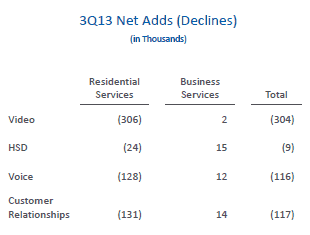
Bye Bye: Time Warner Cable lost residential customers for all of its services during the third quarter.

Bye Bye: Time Warner Cable lost residential customers for all of its services during the third quarter.

Incoming CEO Robert Marcus said he was dissatisfied with subscriber results from current promotions and rates. New Time Warner Cable customers, Marcus noted, are paying higher prices for fewer or less robust services as part of current promotional packages. Although that has driven a “dramatic improvement in recurring revenue” among customers actually signing up, many choose the lower-priced competition instead.

Marcus also noted customers are taking fewer services and are resistant to upgrading to double or triple play packages, reducing the potential average revenue per customer (ARPU).

“To a great extent, these are expected outcomes of our pricing and packaging strategy and the trade-off between ARPU and volume, but I’m confident we can do better on volume without giving up the ARPU benefits we’ve been achieving,” Marcus told analysts on a morning conference call.

Instead of getting more aggressive on pricing, the company plans to trot out free gifts and pitch discounted slow speed Internet to attract price-resistant DSL customers.

“Next week, we’ll launch our holiday offer, which includes a free Samsung tablet loaded with all of our apps, including TWC TV, with the purchase of higher-end packages,” Marcus said. “I think this will generate lots of interest and really highlight TWC TV and the value it adds to our service offerings.”

Marcus called it inconceivable and unacceptable that at least 4.5 million people are still subscribed to telephone company DSL in Time Warner Cable service areas. The company plans an advertising blitz to steal customers away from companies like AT&T, Verizon, Frontier, CenturyLink, Windstream and FairPoint.

At the center of that effort is the recently announced 2/1Mbps Lite package, which will sell at the everyday price of $14.95 a month. Marcus wants at least 500,000 DSL customers switched to Time Warner over the next 18 months.

“Over time, as these customers’ speed and capacity needs increase, we’ll be well positioned to sell them higher-end product,” Marcus said.

Or they will switch back to the phone company if Time Warner increases the price.

Millenicom Customers Lose Unlimited Wireless Data (Again); Sprint Re-Terminates Agreement

muymMillenicom customers have had their ups and downs over the last two weeks coping with e-mail notifications they would lose, keep, and once again lose their unlimited wireless data plan.

Just a day after Millenicom heard that Sprint would allow them to continue selling Unlimited and Bring Your Own Device plans, the wireless carrier best known for its “unlimited for life” offer changed its mind:

We are very sorry to report that Sprint has reversed their decision from yesterday and terminated their agreement with the gateway for our Unlimited and BYOD accounts.

We are not certain how long until the accounts will be closed.

sprintnextelWe will be shipping out Hotspot devices to those clients who had opted for that solution and BMI.net is ready to fulfill orders for those choosing to go with them.

We have attempted to keep you informed every step of the way and avoid any abrupt transition. We apologize that we weren’t able to come through.

Thank you for allowing us to be of service and please accept our sincere wish for your future success.

Dennis Castle
Owner

millenicomIt is not the first time Millenicom has had problems with Sprint, which has proved to be a difficult carrier to deal with with respect to unlimited use plans.

Sprint’s decision is a major blow to rural Americans who lack access to cable or DSL broadband and are forced to consider satellite-delivered Internet access or pay even more for wireless data plans that come with puny usage caps, overlimit fees or speed throttles.

There are a few alternatives, but since these providers resell access to Sprint-owned networks, all are potentially vulnerable to Sprint’s evolving views on resellers:

bmi-logoBlue Mountain Internet (BMI) offers an “unlimited plan” that isn’t along with several usage allowance plans. BMI strongly recommends the use of their Mobile Broadband Optimizer software that compresses web traffic, dramatically improving speeds and reducing consumption:

Monthly Plans

  • $39.99/Month – 1 Gig Data (** up to 3GB compressed) ($25/GB Overlimit Fee)
  • $59.99/Month – 3 Gig Data (** up to 9GB compressed) ($20/GB Overlimit Fee)
  • $79.99/Month – 5 Gig Data (** up to 15GB compressed) ($20/GB Overlimit Fee)
  • $99.99/Month – 10 Gig Data (** Up to 45GB compressed) ($15/GB Overlimit Fee)
  • $79.99/Month – Unlimited (Bring Your Own Device) – BYOD
  • $99.99/Month – Unlimited Data (S Network) ***

evdousaThere is a $100 maximum on overlimit fees, but BMI reserves the right to suspend accounts after running 3-5GB over a plan’s allowance to limit exposure to the penalty rate. The compression software is for Windows only and does not work with MIFI devices or with video/audio streaming. BMI warns its wireless service is not intended for video streaming. Customers are not allowed to host computer applications including continuous streaming video and webcam posts that broadcast more than 24 hours; automatic data feeds; automated continuous streaming machine-to-machine connections; or peer-to-peer (P2P) file-sharing.
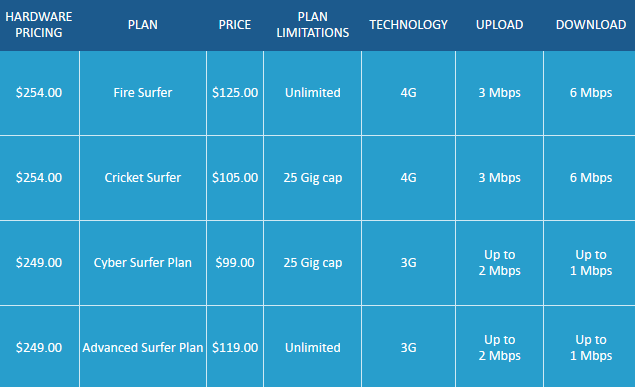

EVDODepotUSA offers two truly unlimited use plans starting at $119 a month. The company is only contracted to offer access to Sprint’s woefully congested 3G network and the Clear 4G WiMAX network that typically does not offer much coverage in rural areas. LTE access is not currently available. There is a six month contract obligation, but the company also offers a 10-day free trial.

Their current plans:

evdo

wireless n wifiWireless ‘n Wifi offers two partly unlimited plans with no contract commitment. The company charges a refundable deposit on devices, but they become yours to keep after two years:

  • Unlimited 4G Sprint/Clear WiMAX with 3G Fallback ($58.99) offers unlimited WiMAX service but has a 5GB cap on Sprint’s 3G network, the network rural customers will encounter the most. Total start-up fee is $194.93 which includes an activation fee, modem deposit (refunded upon modem return or after 24 months of service), the first month of service, and shipping for the wireless device.
  • Unlimited 4G LTE with WiMAX and 3G Fallback ($79.99) offers unlimited Sprint 4G LTE and Sprint/Clear WiMAX service with a 35GB cap on Sprint’s 3G network. Customers can select a dual-band device that supports LTE and 3G service for $246.93 (includes activation fee, modem upcharge fee, first month of service, shipping, and refundable $100 modem deposit). Customers looking for access to LTE, 3G, and WiMAX can choose a tri-band device for $315.93 (includes activation fee, modem upcharge, first month of service, shipping and refundable deposit.) Keep in mind Sprint’s 4G LTE network is still very spotty.

VDSL2 Vectoring and G.Fast: “Pixie Dust” or Pathway to Gigabit Copper?

Phone companies looking for a cheap way to increase broadband speeds are turning away from fiber optics and towards advanced forms of DSL that don’t bring cost objections from shareholders.

Whether your provider is AT&T or an ISP in Europe or Australia, financial pressure to improve broadband on the cheap is fueling research to wring the last kilobit out of decades-old copper phone wiring.

Alcatel-Lucent suggests VDSL2 Vectoring is one such technology that can enable download speeds up to 100Mbps using noise-cancelling technology to suppress interference.

Print

But the advice doesn’t impress fiber optic fans who suggest any reliance on deteriorating copper phone lines simply postpones an inevitable fiber upgrade that could come at a higher cost down the road.

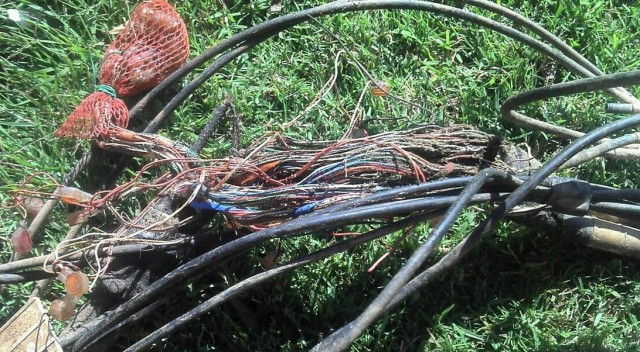
VDSL2 Vectoring and G.Fast are only as good as the copper wiring that extends to each customer. Up to 45 percent of North American wire pairs are in some state of disrepair.

VDSL2 Vectoring and G.Fast are only as good as the copper wiring that extends to each customer. Up to 45 percent of North American wire pairs are in some state of disrepair.

Vectoring has been described as “pixie dust” by Australia’s former Communications Minister Stephen Conroy. Conroy was overseeing Australia’s switch to fiber service as part of the National Broadband Network. But a change in government has scrapped those plans in favor of a cheaper fiber to the neighborhood broadband upgrade advocated by the new Communications Minister Malcolm Turnbull that resembles AT&T’s U-verse.

“Malcolm can sprinkle pixie dust around and call it vectoring and he can do all that sort of stuff but he cannot guarantee upload speeds,” Conroy told Turnbull.

As with all forms of DSL, speed guarantees are extremely difficult to provide because the technology only performs as well as the copper wiring that connects a neighborhood fiber node to a customer’s home or office. Upload speeds are, in practical terms, significantly slower than download speeds with VDSL2. Turnbull expected download and upload speeds on Australia’s VDSL2 network to be around a ratio of 4:1, which means a customer who has a download speed of 25Mbps per second would receive an upload speed of around 6Mbps.

In the lab, VDSL2 Vectoring delivers promising results, with speeds as high as 100Mbps on the download side. DSL advocates are excited about plans to boost those speeds much higher, as much as 1,000Mbps, using G.Fast technology now under development and expected in 2015. VDSL2 Vectoring and G.Fast both require operators to minimize copper line lengths for best results. Unfortunately, dilapidated copper networks won’t work well regardless of the line length, and with many telephone companies cutting back upkeep budgets for the dwindling number of customers still using landlines, an estimated 15-45 percent of all line pairs are now in some state of disrepair.

Assuming lab-like conditions, G.Fast can deliver 500Mbps over copper lines less than 100 meters long and 200Mbps over lines between 100 and 200 meters in length.

G.Fast also allows for closer symmetrical speeds, so upload rates can come close or match download speeds.

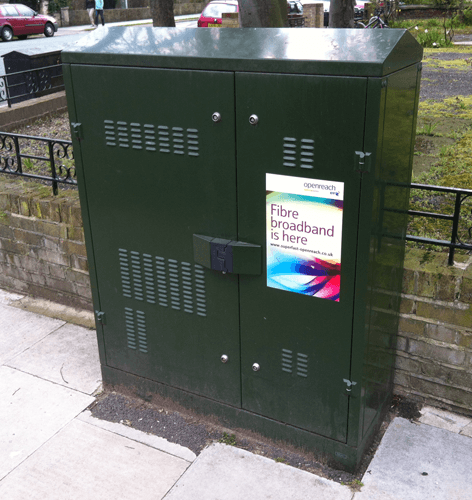
This cabinet houses the connection between the fiber optic cable and the copper phone wiring extending to dozens of customers.

This cabinet houses the connection between a fiber optic cable and copper phone wiring.

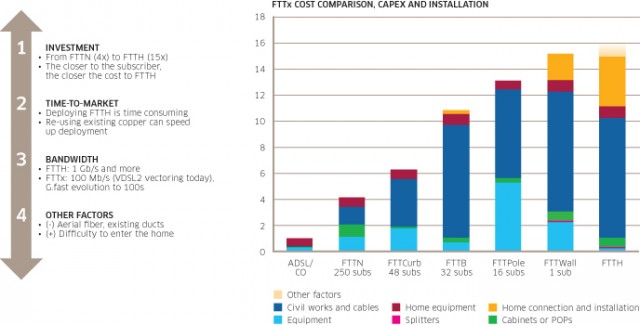
Providers prefer the copper-fiber approach primarily for cost reasons. There are estimates deploying a G.Fast-capable VDSL service to a home would cost around 70 percent less than fiber to the home service. Workers would not need to enter customer homes either, offering less-costly self-install options.

Telekom Austria and Swisscom are among providers committed to launching the technology. Both countries are mountainous and have many rural areas to serve. Fiber rich providers are also looking at the technology for rural customers too costly or too remote to service with fiber.

Critics question the real world performance of both VDSL2 Vectoring and G.Fast on compromised copper landline networks. Decades of repairs, deteriorating insulation, corroded wires, water ingress, and RF interference can all conspire to deliver a fraction of promised speeds.

Many critics also point to the required aggressive deployment of fiber/VDSL cabinets — unsightly and occasionally loud “lawn refrigerators” that sit either in the right of way in front of homes or hang from nearby utility poles. To get the fastest possible speeds, one cabinet may be needed for every four or five homes, depending on lot size. Australia’s VDSL network, without Vectoring or G.Fast requires at least 70,000 cabinets, each powered by the electric grid and temporary backup batteries that keep services running for 1-2 hours in the event of a power failure. The batteries need to be decommissioned periodically and, in some instances, have caused explosions.

The costs of electric consumption, backup batteries, infrastructure, and maintenance of copper lines must be a part of the cost equation before dismissing fiber to the home as too expensive.

How Overland Park Blew Google Fiber; Bureaucratic Ineptitude Stalls Project Indefinitely

lucyAfter nine months of foot dragging-negotiations between Overland Park officials and Google Fiber, a last-minute protest by a city council member over an indemnification clause that turned out to be insignificant was the last straw.


Now residents of Overland Park are off Google’s upgrade list for gigabit broadband indefinitely.

Service providers often face a minefield negotiating with local governments over issues like zoning, performance guidelines, franchise agreements, and minimizing disruption to the community. Some also face confusion about technology or a lack of understanding that infrastructure projects require careful scheduling and seasonal construction limitations.

In Overland Park, it was “all of the above” say infuriated residents who watched the fiber project slip away at an Oct. 14 city council meeting when lawyers representing Google requested an indefinite continuance.

“Clearly Google was saying to Overland Park and other cities: if you make this process too difficult for us, we will pick up our ball and go play somewhere else,” said Overland Park resident Robert Walch.

Walch said city council members appeared shocked when Google’s representative broke the news. Just a month earlier, council members including Terry Goodman, Curt Skoog, and Richard Collins seemed intent to pelt Google with a range of objections and unusual questions that suggested a lack of basic knowledge about fiber broadband.

Phillip Dampier

Phillip Dampier

According to those in attendance, Skoog in particular seemed far out of his depth, questioning if 1,000/1,000Mbps was fast enough to provide connections for 6-12 computer terminals inside a local school.

Council member Park Lyons patronizingly told Google representatives Overland Park was one of the best cities in the country and he was glad Google recognized as much.

“There is so much excitement about Google Fiber, and I know people think we should blindly go forward, but I think we need to look at this in a dispassionate way and have due diligence,” Lyons explained.

As Google’s representatives continued to field questions about the project even as the 2013 construction season began to wind down, Skoog sensed Google’s growing exasperation, finally asking at an earlier meeting if they were prepared to walk away over what Skoog characterized as a “minor detail.”

The answer, apparently, was yes, much to the surprise of a stunned city council witnessing a privately funded, multi-million dollar broadband improvement project collapsing before their eyes. Damage control for exposed council members likely to face the wrath of voters began immediately, starting with a symbolic, but largely empty resolution expressing the council’s profound interest in the fiber project they just buried.

“It’s disappointing because it would have been nice to have in the schools and the libraries and stuff. I know that the Internet is really spotty at the school,” Katie Lehn, an Overland Park mother told KCTV-5.

“Overland Park made it really, really hard for Google, and Google has a lot of other cities and towns to work with,” noted Walch. “I have to say, if you’re on Overland Park Council now, you have to know that this is your last term.”

overland parkIndustry observers agree with Walch.

“Google maybe wanted to send a louder message that they wanted faster response from other communities to come,” said Donna Jaegers, a telecommunications analyst for D.A. Davidson & Co. “A month delay would not be enough to put off a design like that.”

“Google is sending a negotiating message to any other city: You take our terms, or we’re going to walk,” said Steve Effros, an industry analyst who headed the Cable Telecommunications Association for two decades.

Effros told the Associated Press Google was obviously making an example out of Overland Park, while getting special treatment from other nearby communities that incumbent cable and phone companies never got.

The message that Google is willing to walk away from lucrative, upscale communities like Overland Park over bureaucratic headaches has an impact on both Google and local government. Overland Park is an upscale community of 176,000 within metro Kansas City. The community’s median household income is more than $66,500 a year — excellent prospects to sign up for Google service.

blew itBut now Overland Park will have to wait even as neighborhoods around the community get the fiber optic service first.

“Overland Park wants Google Fiber,” said Overland Park Mayor Carl Gerlach. “The city council is ready to sign on the dotted line. … We’re willing to wait as long as it takes.”

Google isn’t ready to forgive and forget just yet, and communities like Overland Park cannot say they were never warned.

Milo Medin, Google’s vice president of access services, told the media in May that Google was picking communities that make their life easier as the fiber infrastructure is installed.

“In general, we go where it’s easy to build,” Medin said. “If you make it hard for me to build, and there are other places where it’s easy to build, I will probably go to those other places.”

Six months later, nothing has changed.

“We need to refocus our energy and our resources on the communities that are waiting for fiber,” said Google spokeswoman Jenna Wandres.

[flv width=”640″ height=”380″]http://www.phillipdampier.com/video/KCTV Kansas City Overland Park on Hold With Google 10-25-13.mp4[/flv]

KCTV in Kansas City reports Overland Park residents are unhappy Google Fiber is popping up everywhere, but not in Overland Park.  (3 minutes)

Time Warner Cable Doubles Premium Broadband Speeds in Los Angeles, New York, Hawaii

Phillip Dampier October 29, 2013 Broadband Speed, Competition, Data Caps 1 Comment

timewarner twcTime Warner Cable customers in Los Angeles, New York, and Hawaii subscribed to the company’s top 50/5Mbps Ultimate speed tier will get a free upgrade to 100/5Mbps between now and the end of this year.

“Residential customers in Los Angeles who subscribe to our Ultimate 50 tier are being automatically upgraded to Ultimate 100 at no extra cost,” said Time Warner’s Andrew Russell. “Ultimate 50 residential customers in New York City and Hawaii will be upgraded by year’s end. By early 2014, all customers in these markets will have access to Ultimate 100, with more TWC markets to follow next year.”

“Consumers are adding more and more connected devices into their digital lifestyle,” said Steve Cook, general manager of Time Warner Cable residential Internet. “These new ultra-fast Internet speeds are designed to satisfy their growing demand to stream, download and connect simultaneously across multiple devices.”

Time Warner Cable announced several speed upgrades over the last year, but it still remains the least aggressive major cable operator in the speed category. Among the largest five cable operators, Time Warner Cable’s premium speed tiers are the slowest, with top upstream speeds of just 5Mbps and a maximum downstream speed of 50Mbps for most. But Time Warner Cable has no compulsory usage caps or consumption billing.

Over the last year, Time Warner Cable increased speeds for all but their Extreme customers (30/5Mbps), the only plan to have not seen any major speed boost in most markets since being standardized as an entry level DOCSIS 3 tier.

Time Warner also announced a speed improvement for their budget-conscious Lite tier, now 1/1Mbps in most markets.

Priced at $14.99 per month, the new offering will deliver 2/1Mbps — adequate for basic web browsing, e-mail and limited multimedia use — and becomes available nationwide beginning Nov. 4.

“We’re making our entry-level product even better and more affordable for the casual Internet user and cost-conscious consumer,” said Cook. “At both ends of our speed options and everything in between, we’re focused on giving our customers the best experience at the best value.”

Time Warner Cable will now offer most customers seven different speed tiers, all unlimited use (except when opting in to usage limited plans in return for a discount):

  • Lite: 2/1Mbps
  • Basic: 3/1Mbps
  • Standard: 15/1Mbps
  • Turbo: 20/2Mbps
  • Extreme: 30/5Mbps
  • Ultimate: 100/5Mbps

Search This Site:

Contributions:

Recent Comments:

Your Account:

Stop the Cap!