Home » Broadband Speed » Recent Articles:

U.S. Cable Broadband Market Saturated; Low-Income Customer Growth Opportunities Remain

Phillip Dampier November 12, 2013 Broadband Speed, Comcast/Xfinity, Competition Comments Off on U.S. Cable Broadband Market Saturated; Low-Income Customer Growth Opportunities Remain
Moffett

Moffett

Wall Street is worried the cable industry will not be able to report major subscriber gains going forward because just about every middle/upper-income customer that wants broadband within cable’s footprint already has the service from either the phone or cable company.

Cable analyst Craig Moffett from MoffettNathanson Research predicts singing up the last 20% of Americans who don’t subscribe to broadband service will be challenging. As of today, 73% have the service, up 2.5% from last year. An increasingly anemic growth rate is a sign the marketplace is getting saturated, with only low-income Americans underrepresented, primarily because they can’t afford the asking price. Most of the rest don’t own or want computers or Internet access or live in a rural area where the service is unavailable.

Under these circumstances, it is no surprise broadband providers are reporting lower new customer gains. Time Warner Cable and Cablevision actually lost broadband customers in the third quarter, mostly to Verizon FiOS. For the last five years, the cable industry has picked up most of its broadband customers from phone companies offering only DSL service.

“To be sure cable is still taking share [from telco DSL] but it is doing so at a much more modest pace,” Moffett said.

The industry’s best chance for new subscriber growth appears to be bundling computers or tablets with an entry-level broadband offering targeting the poor.

Although cable companies are not supplying free PCs just yet, many are introducing relatively slow, budget-priced broadband tiers to attract lower-income subscribers.

Time Warner Cable introduced a $14.95 2/1Mbps broadband tier this month the company hopes will attract price-sensitive customers, especially those now subscribed to low-speed DSL.

Comcast has Internet Essentials, a $10 slow speed broadband service for families with children enrolled in the federal student lunch program. It is also rolling out a “prepaid Internet service” directly targeting low-income customers. Prepaid customers pay $69.95 for an activation kit containing a DOCSIS 3 modem and a month of broadband service. Renewals are priced at $15 for a week or $45 for a month for 3Mbps service with a 768kbps upload rate.

Most other cable providers offer entry-level broadband speeds, but usually only as a retention tool. Even if the industry custom-targets low-speed tiers to low-income homes, many customers may never make it past the cable industry’s credit check procedure. Comcast’s prepaid offering avoids that problem.

Keeping Providers Honest: FCC to Announce New Crowdsourced Mobile Broadband Speed Test

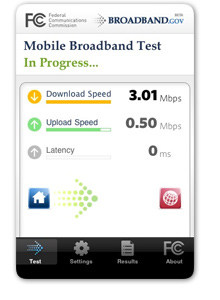
fcc_appAre you getting the mobile broadband speeds your provider advertises for its whiz-bang 4G network? How do you know which carrier really delivers?

The Federal Communications Commission is hoping you can help them find out with a free Android app to be unveiled on Thursday.

The FCC has successfully used volunteer crowdsourcing before to keep wired Internet Service Providers honest through its “TestMyISP” speed measurement project for home broadband connections. When the first results were announced, an embarrassingly bad rating for Cablevision forced the cable company to quickly beef up its broadband infrastructure to match the speeds it promised customers.

Now the FCC’s new chairman Tom Wheeler hopes a similar effort will help the federal agency understand whether the promises wireless carriers make to customers are actually being kept.

With wireless broadband gaining in prominence, the FCC wants to do a better job monitoring a service most Americans use in some form while on-the-go. If providers like AT&T and Verizon Wireless are caught dramatically underperforming in coverage and speed, the agency may take that into account as part of its mission of regulatory oversight.

Consumers will also benefit from having an unbiased source that can offer regular analyses on the speed and performance of each carrier — useful information to have before being locked into a two-year contract.

Verizon, AT&T, T-Mobile, and Sprint are among the carriers agreeing to take part in the speed test project.

The FCC Speed Test app will initially be available for Android smartphones. There are no details about the release date of an Apple iOS version of the app, but the FCC’s Mobile Broadband Speed Test home page shows links (not yet active) for both versions of the app.

Wishing Well: LA Wants Gigabit Fiber to the Home Service for All Residents (and I Want a Golden Calf)

Phillip "Reality Check" Dampier

Phillip “Reality Check” Dampier

The city of Los Angeles believes if they ask for it, they will get it – gigabit fiber broadband, that is. It is too bad we have to run a reality check.

In December, the city plans to issue an ambitious Request for Proposals (RFP) inviting at least one private company to run fiber service to all 3.5 million residents (and businesses and public buildings) within the city limits. The idea, which won unanimous support from the City Council, does not exactly come with many risks for the city. The Council acknowledges the project is likely to cost up to $5 billion (we suspect more), and the city has made it clear it won’t be contributing a penny.

“The city is going into it and writing the agreement, basically saying, ‘we have no additional funding for this effort.’ We’re requiring the vendors that respond to pay for the city resources needed to expedite any permitting and inspection associated with laying their fiber,” Los Angeles IT Agency general manager Steve Reneker told Ars Technica. “If they’re not willing to do that, our City Council may consider a general fund transfer to reimburse those departments, but we’re going in with the assumption that the vendor is going to absorb those up-front costs to make sure they can do their buildout in a timely fashion.”

That is wishful thinking.

The winning vendor is not just on the hook for the cost of building the network. It also has to comply with a city requirement to give away basic 2-5Mbps broadband service, possibly recouping the lost revenue with advertising. Customers wanting faster access will pay for it. Although not required to offer phone or television service, Reneker anticipates the winning vendor will offer both to earn more revenue to pay off construction costs.

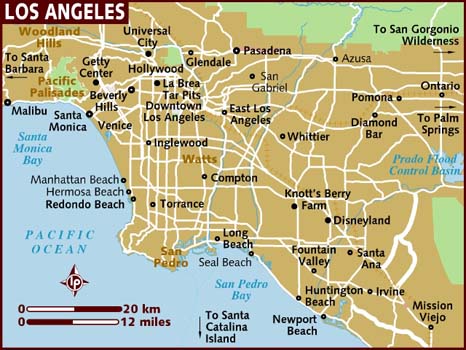
Greater Los Angeles is now served by a mix of AT&T, Time Warner Cable, Verizon, Cox, and Charter. Only Verizon has a history of providing a significant fiber optic broadband service, but it has suspended further expansion of its network. AT&T is the dominant landline provider, but considers its U-verse fiber-to-the-neighborhood design adequate for southern California. It seems unlikely any incumbent provider is likely to seriously contemplate such an expensive fiber project, especially because the city requires the winner to build an open access network that competitors can also use. Cable operators have also stated repeatedly that their existing infrastructure is more than adequate. The question providers are likely to ask is, “why do we need to partner with the City Council to build a fiber network we could build ourselves, on our own terms, that we ultimately own and control?”

map_of_los-angelesThe city can offer some incentives to attract an outsider, such as promising a lucrative contract to manage the city government’s telecom needs. It can also ease bureaucratic red tape that often stalls big city infrastructure projects. But Los Angeles is not exactly prime territory for a fiber build. Its notorious sprawling boundaries encompass 469 square miles, with many residents and businesses in free-standing buildings, not cheaper to serve multi-dwelling units.

Google avoided California for its fiber project reportedly because of environmental law and bureaucracy concerns. Even Google cherry-picks neighborhoods where it will deploy its fiber project in Austin, Provo, and Kansas City. The Los Angeles RFP will likely require universal coverage for the fiber network, although it will probably allow a lengthy amount of time for construction.

The City Council’s RFP comes close to promising Gigabit Fiber-to-the-Press Release.

Private providers govern their expansion efforts by an increasingly stiff formula to recover construction costs by measuring potential Return On Investment (ROI), which basically means when a company can expect to earn back the amount initially invested. Spending $5 billion on a fiber network that could actually cut expected Average Revenue Per User (ARPU) with a free broadband offer is going to raise eyebrows. Convincing investors to chip in on a fiber network “open to competitors” will also elicit a lot of frowning faces.

Wall Street analysts rolled their eyes when Verizon rolled out FiOS. It was “too expensive” and provided too few avenues for a quick ROI. ‘Verizon built a Lamborghini Aventador fiber network when a Honda Accord would have done just fine in the absence of fierce competition,’ analysts complained. Why spend all this money on fiber when fat profits were waiting to be harvested from high-ARPU wireless service? Verizon got the message and ceased expansion. AT&T never walked that Wall Street plank in the first place, delivering a less capable Chevrolet Spark network known as U-verse.

The city is likely to be disappointed with the proposals they receive, in much the same way local governments begging for competition from other cable companies get no positive results. The economics and expectations of today’s private broadband market makes it extremely unlikely an incumbent provider is going to rock a boat that has delivered comfortable broadband profits with a minimum of investment.

Breaking the broadband duopoly of high prices for slow service is only likely in the private sector if deep-pocketed revolutionaries like Google can self-finance game-changing projects. Los Angeles will likely have to sweeten its invitation to attract interest from players serious enough to spend $5 billion. It will likely have to invest some money of its own in a public-private partnership. Perhaps an even better idea is to take control of the city’s broadband destiny more directly with a community project administered by a qualified broadband authority with proven experience in the telecom business.

There is no reason private companies cannot be active participants in whatever project is ultimately built, but these companies are not charities and if their financial backers don’t see a pathway to profit running fiber rings around LA today, an RFP to build a fiber network with city strings-attached isn’t likely to garner serious interest tomorrow.

Frontier Has Capacity to Spare for Broadband Users; Grabbing Customers from Cable Operators

Phillip Dampier November 6, 2013 Broadband Speed, Competition, Frontier, Online Video, Public Policy & Gov't, Rural Broadband Comments Off on Frontier Has Capacity to Spare for Broadband Users; Grabbing Customers from Cable Operators

frontierFrontier Communications’ new simplified pricing with no equipment fees or surprise contracts was well-timed for the phone company as it picked up a growing number of disgruntled Comcast and Time Warner Cable customers fed up with increasing modem rental fees.

Frontier depends a great deal on its residential broadband service to win back revenue the company has lost from years of landline cord-cutting. The company reported slowing revenue losses, now down to less than one percent for the quarter ending Sept. 30. Frontier’s profits reached $35.4 million this quarter, reduced by increased investment in broadband upgrades and pension fund-related expenses.

The independent phone company is still losing residential and business phone customers, but those losses have begun to stabilize. Frontier has 2.82 million residential customers and 275,000 business customers. While Time Warner Cable lost customers during the recent quarter, Frontier picked up 27,000 new ones. For all of 2013, Frontier added 84,500 new broadband customers. Nearly 84 percent of them added broadband as part of a bundle, which leads analysts to suspect most of Frontier’s new broadband customers are located in rural areas that never had access to broadband speeds before.

Frontier’s greatest opportunity is in the rural residential broadband business, and the company’s investment in improved broadband speeds has made a major difference in growing market share especially where it has a cable competitor. Currently, Frontier has 20-25 percent market share in most of its service areas. It wants 40%, but is unlikely to achieve it selling broadband speeds that often top out at around 10Mbps. Winning customers back to a landline provider has also proved difficult without an attractive bundled offer. In all but a few cities, Frontier bundles landline service with DSL broadband and a satellite television package.

Wilderotter

Wilderotter

In rural markets, Frontier has had better success, particularly in areas formerly served by Verizon.

With help from the federal government’s Connect America Fund (CAF), Frontier invested over $21 million to expand rural broadband service in 2013. In the third quarter, the company expanded service to another 37,000 possible homes and businesses, with 30,000 more on the way in the fourth quarter. The company applied for $71.5 million in CAF funding for 2014.

Broadband speeds have also gradually increased in an expanding number of communities. As of today, 45 percent of homes can receive 20Mbps or better, 58 percent are capable of 12Mbps. A year-end commitment to offer at least 3Mbps speeds to 85% of customers in the most rural areas also appears within reach. Customers can upgrade to the next speed level in $10 increments.

But not every customer has gotten speed upgrades. In their largest legacy market — Rochester, N.Y., DSL speeds have remained unchanged in many areas. At the headquarters of Stop the Cap!, Frontier pre-qualified us this afternoon for the same 3.1Mbps DSL speed they offered in 2009, despite being blocks away from the city line.

Those increasing speeds have led to more traffic on Frontier’s broadband network, but the company says it has enough capacity to handle it.

“The average usage of all our customers across both fiber and the copper has grown to about 24GB per month at this point, and we see that increasing and people are comfortable with [our] facilities as well as our backhaul to support that growth,” said chief operating officer Dan McCarthy. “We’ve seen that grow virtually every month as we move forward.”

Frontier analyzes what customers do with their broadband connection and found 30 percent of customer usage is online video. That number is growing. Customers upgrading to the fastest speeds are often telecommuters or have a home full of avid broadband users.

“On the residential side [these high-end customers] are usually working at home, they are VPNing, they are gamers, and they are very active on video services and social media as well,” said CEO Maggie Wilderotter.

The average Frontier DSL customer still subscribes to 6Mbps service, which Wilderotter said was adequate for Netflix, web surfing, and e-mail. But the company is preparing to market speed upgrades to these customers to earn extra revenue.

So far, Frontier’s broadband growth has gone relatively unnoticed by their cable competitors.

“We really haven’t seen any sustainable programs that cable has put against us in the market and we do know that several cable operators have said they’re going to do more in those areas,” said Wilderotter. “We are very well prepared for that. We are giving everyday low pricing to the customer that’s simple and predictable and there are no add-on fees or modem rental costs.”

Most Frontier customers are offered $19.99 or $29.99 broadband pricing that can be bundled with other products for discounts. There is no term contract.

“Time Warner Cable has increased their modem fees [to] between $6 and $9 a month,” said Wilderotter. “That’s a huge price increase for a lot of customers. You compare that with Frontier which has no modem cost and customers understand where price value lies.”

Wilderotter noted Comcast has raised rates as well. Frontier intends to remind cable customers they have a choice, and will tailor offers to continue to increase market share.


Time Warner Cable Announces TWC Max: Feast for Some, Famine for Everyone Else

Next generation cable or a spray-on solution to a really bad quarter.

Next generation cable or a spray-on solution to a really bad quarter?

Time Warner Cable has a plan for multi-gigabit broadband speeds over a state of the art network that, for the first time, might include fiber to the home service.

TWC Max is Time Warner Cable’s code name for selected markets where customers will be given first class treatment and provided what incoming CEO Rob Marcus calls “best-in-class reliability and service.”

Marcus made it clear in a conference call to investors this morning that TWC Max will only be available in specially chosen markets, most likely those facing intense competition from Google Fiber (Austin, Kansas City), Verizon FiOS (New York, parts of Dallas, etc.) or upgraded AT&T U-verse.

TWC Max might also be offered in cities where community-owned fiber-to-the-home providers best TWC’s broadband speeds and prices. North Carolina, in particular, would be a logical choice as Time Warner Cable recently acquired DukeNet, a major commercial fiber broadband provider headquarted in Charlotte, also a major hub for Time Warner Cable’s data services. Wilson, Salisbury, Mooresville, Davidson and Cornelius are all served by publicly-owned broadband providers.

Beginning next year and over the next several years, those chosen will get major broadband speed upgrades — up to several gigabits, totally new customer equipment, and an all-digital experience.

“We will replace modems with state-of-the-art DOCSIS 3 modems and advanced wireless gateways, so we can meaningfully increase broadband speeds,” said Marcus. “And by the way, we’re not talking about tweaks here but rather quantum changes to our speed tiers. We’ll also replace standard definition and older HD set-top boxes and roll out new DVRs, better user interfaces and more advanced versions of our TWC TV apps to fundamentally improve the video experience.”

If the competition is DSL, you may have a really long wait to be considered a TWC Max city.

If the competition is DSL, you may have a really long wait to be considered a TWC Max city.

Marcus added that in some mixed business/residential areas, fiber to the home service is increasingly possible because of declining costs and pre-existing fiber infrastructure already serving commercial customers and cell towers.

But Marcus was quick to stress that his philosophy about upgrades is to provide them in focused markets, not share them with every city where Time Warner Cable provides service.

“The goal here is, really, to fundamentally change the customer experience in a given market, said Marcus. “So rather than spread our efforts like peanut butter throughout the footprint, I’m very anxious to deliver a complete experience.”

“That means not only going all-digital but also ensuring that we have state-of-the-art modems in every customer’s home, ensuring that they have the best video and that the overall experience is really optimal,” Marcus added.

“So we’re going to concentrate market by market rather than take individual components and run them through the entire footprint.”

So what are the chances your city will be designated a TWC Max target area?

After reviewing the transcript for this morning’s conference call,  Stop the Cap! has created this handy-dandy, simple to use guide:

  • If your community has or was chosen for Google Fiber: A VIRTUAL CERTAINTY!
  • If your community is served by Verizon FiOS or AT&T’s Next Generation U-verse: EXCELLENT
  • If your community has a fiber to the home provider competing with Time Warner Cable: VERY GOOD
  • If your community is served by copper-based DSL from the phone company with no prospect of getting U-verse or FiOS: WHEN PIGS FLY!

Search This Site:

Contributions:

Recent Comments:

Your Account:

Stop the Cap!