Home » Broadband Speed » Recent Articles:

Time Warner Cable to Boost Austin Broadband Speeds Up to 300Mbps as Competition Arrives

Austin is getting an upgrade just in time for competition with AT&T and Google.

Austin is getting an upgrade just in time for competition with AT&T and Google.

There is no market for super-fast broadband speeds, unless your competitor decides to offer them.

Time Warner Cable customers in Austin will benefit from major Internet speed increases that the company insists have nothing to do with its competition.

Google is planning to offer gigabit broadband in select neighborhoods and AT&T is delivering 300Mbps service to a limited number of Austin customers over its slowly expanding fiber network. Coincidentally, Time Warner Cable now plans to match AT&T’s current top speed of 300Mbps beginning this summer.

“Our Austin network allows us to implement the speed increases quickly, and since it’s a rapidly growing market where we know there is demand for faster speeds, we’re moving forward with this aspect right away,” a spokeswoman for Time Warner Cable wrote in an email to CED.

“These substantial speed increases mean Time Warner Cable Internet customers have incredibly powerful new choices for services and features to meet their needs,” said Kathy Brabson, area vice president of operations for Time Warner Cable in Central Texas. “In stark contrast to our competitors, upon completion of this short roll out phase, these faster speeds and choices will be available to every Time Warner Cable customer in every area we serve in the Austin market, not just select neighborhoods.”

Time Warner has also been furiously expanding its Wi-Fi service, available at no cost to Internet customers with Standard Internet or above. To date the company has installed more than 1,300 hotspots with another 1,000 scheduled for installation this year.

Residential Plans Current Speeds New Speeds
(Downstream/Upstream) (Downstream/Upstream)
Everyday Low Price 2×1 3×1
Basic 3×1 10×1
Standard 15×1 50×5
Turbo 20×2 100×10
Extreme 30×5 200×20
Ultimate 50×5 300×20

Along with Austin, the other areas that will get new speeds include Round Rock, Cedar Park, Leander, San Marcos, Elgin, Marble Falls, Lockhart, Bastrop, Fredericksburg, Taylor, Smithville, Wimberley, Liberty Hill, Lago Vista, Buda, Kyle, Elroy, and Lakeway.

Business Services customers in the area will also have access and can upgrade their service as the new plans are introduced starting this summer. TWC Business Services will introduce the new speed plans of 100 x 10, 200 x 20 and 300 x 20 as add-on options to its existing Wideband plans.

Current Standard Internet and above customers will receive new modems, likely produced by Arris or Technicolor. More information will be sent to customers as the launch dates approach. It is unclear if customers will have to pay to rent the new modems, will get to use them for free, and/or if they will be available separately for purchase.

Unlike Here, British Broadband Customers Satisfied With Their Broadband Providers

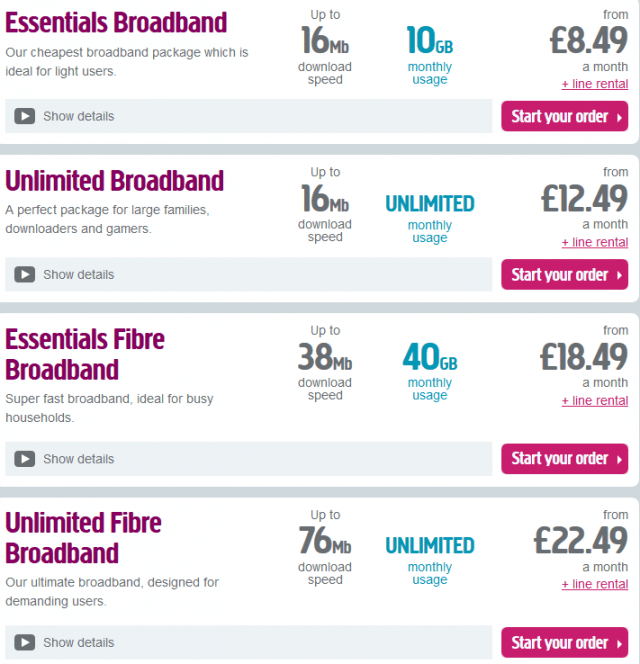
Plusnet offers DSL and fiber broadband plans (in some areas) that offer budget-priced capped or unlimited use plans.

Plusnet offers DSL and fiber broadband plans (in some areas) that offer budget-priced capped or unlimited use plans.

While North American cable and phone broadband providers are among the most-hated companies on the continent, in the United Kingdom, customers gave generally high scores to their Internet providers.

PC Advisor partnered with Broadband Genie, an impartial, independent, and consumer-focused commercial broadband comparison service. Together they engaged an independent survey company (OnPoll) to survey 3,000 broadband users, chosen at random, in late 2013 and early 2014. They asked those users how happy they were with their ISP, tested the speed and reliability of their connections, and found out other valuable tidbits, such as how much they were paying, and for what exactly. Altogether, more than 10,000 U.K. broadband users contributed to the data that made an in-depth assessment of British broadband possible.

The results might stun those on the other side of the Atlantic. Unlike in Canada and the U.S., British broadband users are satisfied overall with their providers, and are enthusiastic about recommending many of them to others. Even the worst-performing provider – BE – still had a 46% recommendation rating, and the company was sold to BSkyB well over a year ago and is in the process of being merged with Sky’s broadband service.

Around 68 percent of British broadband users responding still rely primarily on various flavors of DSL for Internet service. But BT, the national telephone company, is in the process of upgrading facilities and dramatically increasing the amount of fiber optics in its network. The result is what the Brits call “Super Fast Broadband.” Back here, we call it fiber to the neighborhood service similar to AT&T’s U-verse or Bell’s Fibe. In many cases, improved service is providing speeds much closer to 25Mbps vs. the 1-6Mbps many customers used to receive. The upgrade is an important development, especially in rural Britain, often left without Internet access.

Cable broadband is much more common in North American than in the United Kingdom. While cable television became dominant here, the British favored small satellite dishes like those used by DirecTV or Dish customers. With BT dominating wired infrastructure, the government required the company to open its landline network to third-party providers. Some cable companies do exist in England, but they hold only a 12% broadband market share, even lower than fiber to the home service now at nearly 20%.

Great Britain treats broadband as a national priority, and although the current government has controversially settled for a hybrid fiber-copper network instead of delivering fiber straight to every British home, it’s a considerable improvement over what came before, especially in rural areas. Usage caps that used to dominate British broadband plans are now an option for the budget-minded. Unlimited use plans are becoming more mainstream.

With all the upgrade activity and improved service, the Brits have gotten optimistic about their broadband future. Only 12% of those surveyed loathe their broadband supplier. Another 20% were neutral about recommending their ISP, but 51% considered themselves satisfied and another 17% considered their provider top rate. Many in Britain even expect their Internet bill will decrease in 2014, and compared with North American prices, it’s often very low already.

The average price paid by customers of various British ISPs (excluding line rental)

The average price paid by customers of various British ISPs (excluding line rental)

Average speed received by customers varies depending on the technology. Virgin operates cable broadband, Plusnet uses a mix of DSL and fiber, while the slower performers are primarily ADSL.

Average speed test results per ISP (kbps)

  • Virgin: 27,266

    virgin-media-union-logo

    Was top-rated for broadband reliability.

  • Plusnet: 24,529
  • BT: 13,164
  • TalkTalk: 6,910
  • EE: 6,818
  • Demon: 6,586
  • Sky: 5,942
  • Eclipse: 5,786
  • O2: 5,642
  • Be: 5,458
  • AOL: 3,809
  • Post Office: 3,255

Overall ratings and reviews from PC Advisor found Virgin Media (cable) and Plusnet (DSL/Fiber) near tied for top ratings.

[flv]http://www.phillipdampier.com/video/PC Advisor Best cheapest fastest broadband UK ISPs rated 2-19-14.mp4[/flv]

PC Advisor talks about this year’s British ISP review, which reveals Brits are generally satisfied with their broadband speeds and pricing. (3:51)

Broadband Monopolies/Duopolies Against the Public Interest, Declares China

Phillip Dampier February 20, 2014 Broadband Speed, Competition, Consumer News, Public Policy & Gov't Comments Off on Broadband Monopolies/Duopolies Against the Public Interest, Declares China

chinatelChina’s top economic planning agency is assessing a monopoly case involving two large telecom companies and will make a ruling soon as the Beijing government declares uncompetitive broadband against the interests of the people.
The National Development and Reform Commission (NDRC) began to investigate the duopoly of China Telecom and China Unicom in the broadband business two years ago. The two companies, fearing reprisals, promised to end the questionable practices that brought scores of complaints from Chinese citizens over network incompatibilities, rising prices, and slow service.

The two companies together maintain a 90 percent market share of Chinese broadband, and both could face fines up to 10 percent of their annual Internet revenues if the NDRC finds they are acting as an abusive duopoly.

The Chinese government passed strict anti-monopoly laws in 2008 and has enforced them. Beijing has been particularly concerned about price discrimination against other Internet Service Providers and relentless rate hikes, even as costs to offer the service have dropped dramatically.

The NDRC said on Wednesday that the two companies submitted evidence that suggested both had significantly raised network integration, extended the direct-link bandwidth of their backbone networks, raised broadband speeds and lowered prices.

Although the Chinese government’s free market policies have brought investment and economic change to China, the government has grown increasingly concerned about leaving vital sectors of the economy unregulated. In several instances, the result has been bad for consumers and generally reduced innovation, as handfuls of conglomerates found it easier to enforce market power, reduce investment, and raise prices. The Chinese consider the country’s online networks critical to its participation in the global digital economy, with the NDRC acting as a check against uneven playing fields and abusive business practices.

Danish Telco TDC Offers Customers 100% Speed Guarantees; No More “Up To” Speeds

Phillip Dampier February 20, 2014 Broadband Speed, Competition, Consumer News 2 Comments

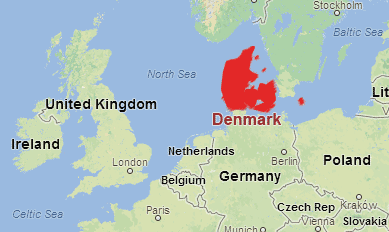
tdcDenmark’s TDC telephone company is so confident about their network upgrades, they are ready to guarantee customers will get the broadband speeds advertised, or their money back and a commitment to fix the problem.
Most phone companies selling DSL service have always had to qualify their speed marketing claims with words like “up to” because customers further away from central switching offices or remote hubs won’t necessarily get the speeds on offer. The further away a customer lives from a telephone company facility, the slower the speeds on copper-based networks. Total network capacity can also create problems during peak usage periods, but not for TDC, which says it has a network robust enough to handle demand.

denmarkGoogleMapsTDC’s Guaranteed Speed Tiers (US$):

  • Basic: 20/2Mbps $47
  • Enhanced: 30/5Mbps $49.50
  • Superior: 40/10Mbps $53
  • Extreme: 50/10Mbps $55

“With this initiative we want [to show] how communication to broadband customers can be further improved,” said Rene Brochner, director of TDC’s residential service division. “With the new products we now offer we guarantee that the speed is always [as advertised]. For example, the 40Mbps/10Mbps speed is always 40Mbps/10Mbps.”

Two-thirds of Denmark will be upgraded to 20/2Mbps service by the middle of this year, with another 750,000 households qualified for 50Mbps service because of TDC’s investment in fiber and pair bonding. Next year, TDC will add Vectoring technology, which will improve speeds on existing copper lines to as much as 100Mbps.

Google Fiber Proposes Major Expansion, But Continues to Ignore the Northeast/Mid-Atlantic

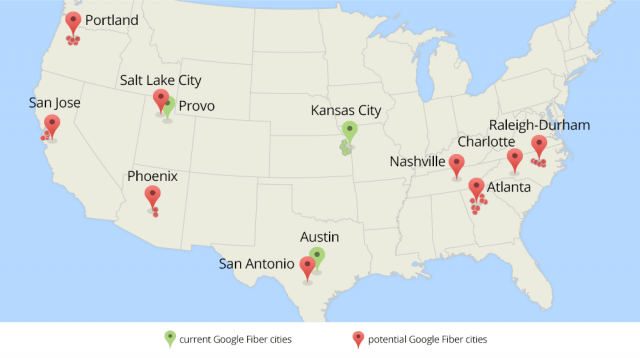
Google has proposed expanding its gigabit fiber network to nine metropolitan areas around the United States, but none of them include cities in the Mid-Atlantic and Northeast dominated by Time Warner Cable, Comcast, and Verizon FiOS.

google fiber

Altogether, the expansion project could bring fiber to the home Internet service to 34 new cities:

  • Arizona: Phoenix, Scottsdale, Tempe
  • California: San Jose, Santa Clara, Sunnyvale, Mountain View, Palo Alto
  • Georgia: Atlanta, Avondale Estates, Brookhaven, College Park, Decatur, East Point, Hapeville, Sandy Springs, Smyrna
  • North Carolina: Charlotte, Carrboro, Cary, Chapel Hill, Durham, Garner, Morrisville, Raleigh
  • Oregon: Portland, Beaverton, Hillsboro, Gresham, Lake Oswego, Tigard
  • Tennessee: Nashville-Davidson
  • Texas: San Antonio
  • Utah: Salt Lake City

Google’s Fiber Blog:

google fiberNow that we’ve learned a lot from our Google Fiber projects in Kansas City, Austin and Provo, we want to help build more ultra-fast networks. So we’ve invited cities in nine metro areas around the U.S.—34 cities altogether—to work with us to explore what it would take to bring them Google Fiber.

We aim to provide updates by the end of the year about which cities will be getting Google Fiber. Between now and then, we’ll work closely with each city’s leaders on a joint planning process that will not only map out a Google Fiber network in detail, but also assess what unique local challenges we might face. These are such big jobs that advance planning goes a long way toward helping us stick to schedules and minimize disruption for residents.

We’re going to work on a detailed study of local factors that could affect construction, like topography (e.g., hills, flood zones), housing density and the condition of local infrastructure. Meanwhile, cities will complete a checklist of items that will help them get ready for a project of this scale and speed. For example, they’ll provide us with maps of existing conduit, water, gas and electricity lines so that we can plan where to place fiber. They’ll also help us find ways to access existing infrastructure—like utility poles—so we don’t unnecessarily dig up streets or have to put up a new pole next to an existing one.

While we do want to bring Fiber to every one of these cities, it might not work out for everyone. But cities who go through this process with us will be more prepared for us or any provider who wants to build a fiber network. In fact, we want to give everyone a boost in their thinking about how to bring fiber to their communities; we plan to share what we learn in these 34 cities, and in the meantime you can check out some tips in a recent guest post on the Google Fiber blog by industry expert Joanne Hovis. Stay tuned for updates, and we hope this news inspires more communities across America to take steps to get to a gig.

Google does not guarantee every community will actually get the service, and a read between the lines makes it clear that a close working relationship between Google and city officials and utilities will be essential for projects to move forward. Bureaucratic red tape could be a fiber-killer in some of these communities, as could an intransigent utility fighting to keep Google fiber off utility-owned poles.

Google continues to completely ignore the northeastern United States for fiber expansion. Analysts suggest Google will not enter areas where fiber broadband service already exists, and this region of the country is home to the largest deployment of Verizon’s FiOS. Despite the fact Verizon has canceled further expansion, and large sections of the region have little chance of seeing a fiber upgrade anytime soon, Google seems more interested in serving the middle of the country and fast growing areas including North Carolina, Georgia, Phoenix and Texas. Its choice of San Jose obviously reflects the presence of Silicon Valley.

Search This Site:

Contributions:

Recent Comments:

Your Account:

Stop the Cap!