Home » Broadband Speed » Recent Articles:

Peer Wars: Netflix SuperHD Streaming May Explain Video Traffic Slowdowns for Some Customers

The largest drops in streaming speeds are coming from ISPs that may be stalling necessary upgrades at the expense of their customers' online experience.

The largest drops in Netflix streaming speeds are coming from ISPs that may be stalling necessary upgrades at the cost of their paying customers’ online experience.

Netflix performance for Verizon customers is deteriorating because Verizon may be delaying bandwidth upgrades until it receives compensation for handling the growing amount of traffic coming from the online video provider.

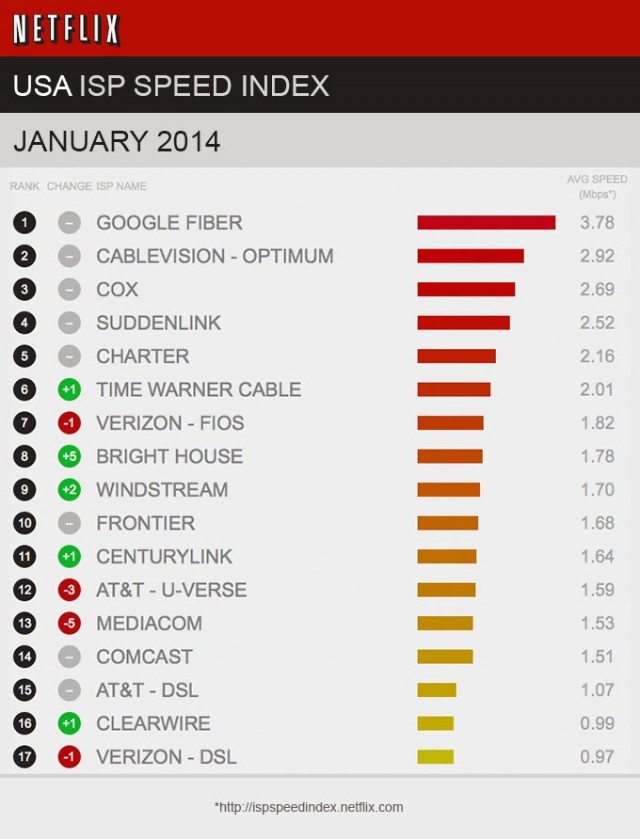
Verizon customers have increasingly complained about Netflix slowdowns during prime-time, especially in the northeast, and Netflix’s latest statistics confirm FiOS customers have seen average performance drop by as much as 14% in the last month alone.

Verizon told Stop the Cap! a few weeks ago the company was not interfering with Netflix traffic or degrading its performance, but there is growing evidence that may not be the whole story. The Wall Street Journal reports Netflix and at least one bandwidth provider suspect phone and cable companies are purposely stalling on upgrading connections to handle traffic growth from Netflix until they are compensated for carrying its video traffic.

The dispute involves the plumbing behind parts of the Internet that are invisible to consumers. As more people stream movies and television, that infrastructure is getting strained, intensifying the debate over who should pay for upgrades needed to satisfy America’s online-video habit.

Netflix wants broadband companies to hook up to its new video-distribution network without paying them fees for carrying its traffic. But the biggest U.S. providers—Verizon, Comcast, Time Warner Cable and AT&T Inc. —have resisted, insisting on compensation.

The bottleneck has made Netflix unwatchable for Jen Zellinger, an information-technology manager from Carney, Md., who signed up for the service last month. She couldn’t play an episode of “Breaking Bad” without it stopping, she said, even after her family upgraded their FiOS Internet service to a faster, more expensive package. “We tried a couple other shows, and it didn’t seem to make any difference,” she said. Mrs. Zellinger said she plans to drop her Netflix service soon if the picture doesn’t improve, though she will likely hold on to her upgraded FiOS subscription.

She and her husband thought about watching “House of Cards,” but she said they probably will skip it. “We’d be interested in getting to that if we could actually pull up the show,” she said.

Netflix relies on third-party traffic distributors to deliver much of its streamed programming to customers around the country. Cogent Communications Group is a Netflix favorite. Cogent maintains two-way connections with many Internet Service Providers. When incoming and outgoing traffic are generally balanced, providers don’t complain. But when Cogent started delivering far more traffic to Verizon customers than what it receives from them, Verizon sought compensation for the disparity.

“When one party’s getting all the benefit and the other’s carrying all the cost, issues will arise,” Craig Silliman, Verizon’s head of public policy and government affairs told the newspaper. The imbalance is primarily coming from the growth of online video, and as higher definition video grows more popular, traffic imbalances can grow dramatically worse.

A spat last summer between Cogent and some ISPs is nearly identical to the current slowdown. Ars Technica reported the traditional warning signs providers used to start upgrades are increasingly being ignored:

“Typically what happened is when the connections reached about 50 percent utilization, the two parties agreed to upgrade them and they would be upgraded in a timely manner,” Cogent CEO Dave Schaeffer told Ars. “Over the past year or so, as we have continued to pick up Netflix traffic, Verizon has continuously slowed down the rate of upgrading those connections, allowing the interconnections to become totally saturated and therefore degrading the quality of throughput.”

Schaeffer said this is true of all the big players to varying degrees, naming Comcast, Time Warner, CenturyLink, and AT&T. Out of those, he said that “AT&T is the best behaved of the bunch.”

Letting ports fill up can be a negotiating tactic. Verizon and Cogent each have to spend about $10,000 for equipment when a port is added, Schaeffer said—pocket change for companies of this size. But instead of the companies sharing equal costs, Verizon wants Cogent to pay because more traffic is flowing from Cogent to Verizon than vice versa.
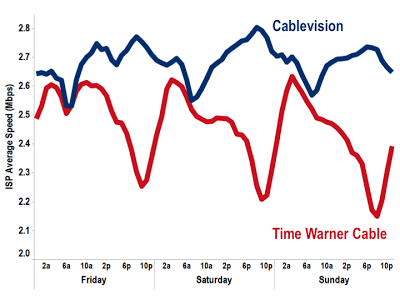
Cablevision, which participates in Netflix's Open Connect program experiences no significant speed degradation during prime time. The same cannot be said with Time Warner Cable, which refuses to participate.

Cablevision, which participates in Netflix’s Open Connect program, experiences no significant speed degradation during prime time. The same cannot be said of Time Warner Cable, which refuses to take part.

Netflix offered a solution to help Internet Service Providers manage its video traffic. Netflix’s Open Connect offers free peering at common Internet exchanges as well as free storage appliances that ISPs can connect directly to their network to distribute video to customers. Free is always good, and Netflix claims many ISPs around the world have already taken them up on the offer, slashing their transit costs along the way.

A few major North American ISPs have also agreed to take part in Open Connect, including Frontier Communications, Clearwire, Telus, Bell, Cablevision and Google Fiber. Open Connect participating ISPs also got an initial bonus for participating they could offer customers – exclusive access to SuperHD streaming.

But most Americans would not get super high-resolution streaming because the largest ISP’s refused to participate, seeking direct compensation from content providers to carry traffic across their digital pipes instead.

On Sep. 26, 2013 Netflix decided to offer SuperHD streaming to all customers, regardless of their ISP. As a result, one major ISP told the newspaper Netflix traffic from Cogent at least quadrupled. ISPs taking Netflix up on Open Connect saw almost no degradation from the increased traffic, but not so for Verizon, AT&T, Time Warner Cable, and Comcast customers.

Net Neutrality advocates fear the country’s largest phone and cable companies are making an end-run around the concept of an Open Internet. Providers can honestly guarantee not to interfere with certain web traffic, but also refuse to keep up with needed upgrades to accommodate it unless they receive payment. The slowdowns and unsatisfactory performance are the same in the end for those caught in the middle – paying customers.

“Customers are already paying for it,” said industry observer Benoît Felten. “You sell a service to the end-user which is you can access the Internet. You make a huge margin on that. Why should they get extra revenue for something that’s already being paid for?”

Some of the web’s biggest players including Microsoft, Google and Facebook may have already capitulated — agreeing to pay major providers for direct connections that guarantee a smoother browsing experience. Netflix has, thus far, held out against paying ISPs to properly manage the video content their subscribers want to watch but in some cases no longer can.

How Charter Communications Let Time Warner Cable Slip from its Grasp

Phillip Dampier February 18, 2014 Broadband Speed, Charter Spectrum, Comcast/Xfinity, Competition, Consumer News, Data Caps, Editorial & Site News, Net Neutrality, Online Video, Public Policy & Gov't Comments Off on How Charter Communications Let Time Warner Cable Slip from its Grasp

surpriseFew were surprised more by the sudden announcement that Comcast was seeking to acquire Time Warner Cable all by itself than the negotiating team from Charter Communications.

Working for weeks to settle how Comcast and Charter would divide the second largest cable company in the country between them, they learned about the sudden deal with Comcast the same way the rest of the country heard about it — over Comcast-owned CNBC.

After Charter endured weeks of rejection from Time Warner Cable executives over what they called “a lowball offer,” Comcast had entered the fray to help Charter boost its offer and bring more cash to the table to change Time Warner Cable’s mind. In return, Comcast expected to acquire Time Warner’s east coast cable systems and much more.

That is where the trouble began.

Charter_logoAccording to Bloomberg News, the talks broke down because Charter wanted to hold onto as many Time Warner Cable assets as possible. Comcast chief financial officer Michael Angelakis expected Charter to divest more than just the New England, New York, and North Carolina Time Warner Cable systems. Angelakis also wanted control of Time Warner’s valuable regional sports networks in Los Angeles. When he didn’t get them, he stormed out of a meeting threatening to do a deal for Time Warner Cable without involving Charter at all.

The Wall Street Journal confirms the account, adding that both Comcast CEO Brian Roberts and Angelakis agreed the talks with Charter seemed to be going nowhere.

Roberts

Roberts

Roberts called a secret meeting with top Comcast executives including Angelakis, Comcast Cable head Neil Smit, Comcast’s lobbying heavyweight David Cohen, and NBCUniversal CEO Steven Burke. Roberts asked each about the options on the table and their conclusion was to buy Time Warner Cable by themselves and cut Charter out of the deal.

Within days, Comcast CEO Brian Roberts reinitiated talks with Time Warner Cable CEO Robert Marcus. The two companies had talked off and on ever since Charter Communications set its sights on acquiring Time Warner Cable. It was clear from the beginning Marcus and his predecessor Glenn Britt were cool to Charter’s overtures. Not only was Charter a much smaller operation, it also had a checkered past including a recent bankruptcy that wiped out shareholder value and was loaded with debt again.

The alliance between Charter and Liberty Global’s John Malone was also unsettling. Those in the cable industry had watched how ruthless Malone could be back in the 1990s when a then much-smaller Comcast secretly attempted to acquire control of Tele-Communications, Inc. (TCI) — then the nation’s largest cable operator run by Malone. Malone was furious when he learned about the effort and went all out to kill the deal, acquiring the stake Comcast sought himself.

Malone’s cable empire would eventually fall with the sale of TCI to AT&T just a few years later. When AT&T decided it didn’t to stay in the cable business, it sold TCI’s old territories to Comcast, making it the largest cable operator in the country.

Malone

Malone

Malone’s brash attitude has also occasionally rubbed the cable industry’s kingpins the wrong way, especially in his public comments. Last year, Malone criticized Roberts’ more conservative operating style, which means Comcast pays a higher tax rate. Malone specializes in deals that leave his acquisitions with enormous debt loads, manipulating the tax code to stiff the Internal Revenue Service. In June, Malone was back again criticizing the lack of a unified national cable cartel better positioned to defeat the competition.

Under his leadership at TCI, many cable programmers didn’t get on TCI’s cable dial unless they sold part-ownership to TCI. Competitors were dispatched ruthlessly — home satellite dish service, then the most viable competitor, strained under TCI-led efforts to enforce channel encryption.

TCI-owned networks routinely required satellite subscribers to sign up with the nearest TCI cable system, which often billed them at prices higher than what cable subscribers paid. Subscribers had to buy not one, but eventually two decoder modules for several hundred dollars apiece before they could even purchase programming. The cable industry also worked behind the scenes to promote and defend enhanced zoning laws that made installing satellite dishes difficult if not impossible, and denied access to some programming at any price, unless it was delivered by a cable system.

Comcast-LogoMalone called today’s divided industry “Snow White and the Seven Dwarfs” and insisted on a new major consolidation wave to enhance “value creation” and deliver some major blows to satellite and telephone company competitors.

Despite Liberty Global’s ongoing consolidation wave of European cable systems, his lack of financial resources to put his money where his mouth was left Time Warner Cable executives cold.

Already loaded with debt, Malone’s part ownership stake in Charter could not make up for Charter’s current status — a medium-sized cable operator with dismal customer ratings primarily serving smaller communities bypassed by larger operators.

A deal with Charter would mean Time Warner Cable's bonds would be downgraded to junk status.

A deal with Charter would mean Time Warner Cable’s bonds would be downgraded to junk status.

Moody’s Investor Service warned Charter’s offer to acquire Time Warner Cable was primarily financed with the equivalent of a credit card, and would leave the combined entity with $60 billion in debt with bonds promptly downgraded to junk level. Time Warner Cable had always considered its bonds “investment grade.”

Charter’s first clue something was wrong came when Comcast stopped returning e-mail and phone calls. That’s always cause for alarm, but Charter officials had no idea Comcast was secretly negotiating with Time Warner Cable one-on-one. In fact, Comcast’s Roberts was negotiating with Time Warner Cable over a cell phone while attending the Sochi Olympics.

Malone finally got the word the deal was off just a short while before Comcast and Time Warner Cable leaked the story to CNBC.

Ironically, it was Malone who convinced Comcast to seek out a deal with Time Warner Cable. Comcast’s thinking had originally been it had grown large enough as a cable operator and sought out expansion in the content world, acquiring NBCUniversal. But Malone warned online video competitors like Netflix would begin to give customers a reason to cut cable’s cord or at the very least take their business to AT&T or Verizon’s competing platforms.

Comcast executives were convinced that gaining more control over content and distribution was critical to protect profits. Only with the vast scale of a supersized Comcast could the cable company demand lower prices and more control over programming. By dominating broadband, critics of the deal warn Comcast can also keep subscribers from defecting while charging higher prices for Internet access and imposing usage limits that can drive future revenue even higher.

Just like the “good old days” where customers had to do business with the cable company at their asking price or go without, a upsized Comcast will dominate over satellite television, which cannot offer broadband or phone service, as well as the two largest phone companies — AT&T, which so far cannot compete with Comcast’s broadband speed and Verizon, which has pulled the plug on further expansion of FiOS to divert investment into its highly profitable wireless division. If Comcast controls your Internet connection, it can also control what competitors can effectively offer customers. Even if Comcast agrees to voluntarily subscribe to Open Internet principles like Net Neutrality, its usage cap can go a long way to protect it from online video competitors who rely on cable broadband to deliver HD video in the majority of the country not served by U-verse or FiOS.

Sticker Shock for Time Warner Customers: A Review of Comcast’s Rates & Packages

comcast twcShould a deal to merge Time Warner Cable with Comcast be approved by regulators, Time Warner Cable customers can expect a number of changes to their cable, Internet, and phone service because of Comcast’s much more involved rate plans¹.
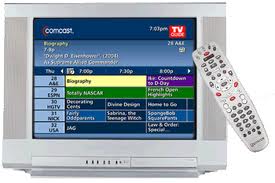
Customers should expect to pay significantly higher prices for a package comparable to what Time Warner Cable offers today, especially for cable television.

Broadband speeds will be faster with Comcast, but also likely usage-capped at 300GB a month, with overlimit fees applied to “heavy users.”

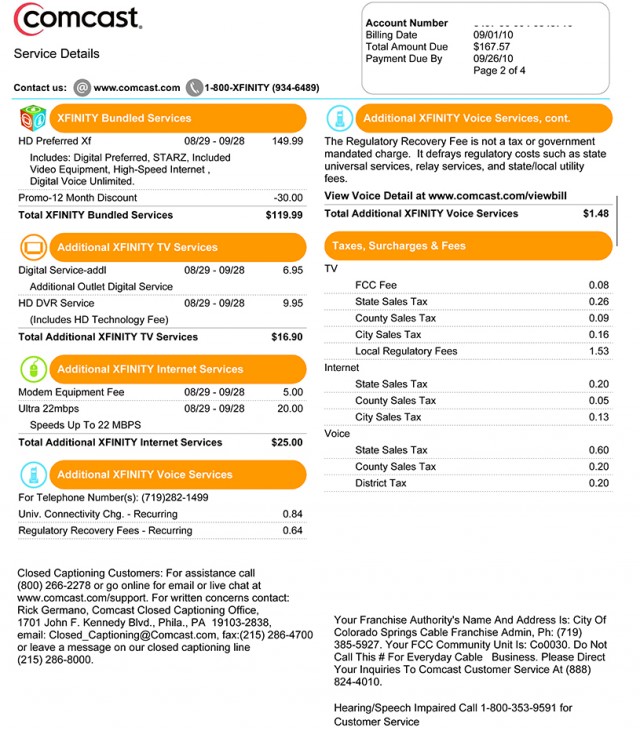
A sample Comcast bill

A sample Comcast bill

Customers may also be surprised to discover Comcast levies a number of ancillary fees that Time Warner does not, especially for various tasks completed by a Comcast customer service representative.

Comcast and Time Warner Cable have very different operating philosophies. Comcast is quickly moving customers to all-digital cable television service, so those Time Warner customers without set-top boxes or CableCARDs should be ready for a rapid transition to all-digital TV. Time Warner Cable, in comparison, has moved slowly towards digital service and uses a stop-gap technology that delivers some digital channels to neighborhoods only when being watched as a bandwidth conservation measure. Comcast will likely scrap that technology in favor of an all-out drive to switch to digital service.

Comcast’s television packages are very different from what TWC customers are used to buying. Time Warner customers can expect significant channel losses with Comcast’s nearest equivalent basic cable service. If you enjoy a lot of sports or old movies, Comcast will make you spend nearly $20 more on a higher-cost tier to get back the networks that Time Warner used to bundle as part of their basic cable service. But Comcast makes adding “whole home” DVR service look a lot more affordable than the $30+ unbundled fee Time Warner Cable has traditionally charged for the equipment and service.

In general Time Warner Cable customers should expect a higher bill for cable television, unless they want to downgrade service (for which Comcast also charges a service fee).

Broadband service from Comcast is also very different from what Time Warner Cable has offered. Most TWC customers now get 15/1Mbps service. Most Comcast customers get 25/5 or 50/15Mbps service. However, TWC doesn’t force usage caps on customers and Comcast is systematically reimposing them on theirs city by city, usually 300GB a month. The tradeoff with Comcast is faster advertised speed that comes usage-limited vs. slower speeds you can use as much as you want. Comcast also charges the highest modem rental fees in the country — now $8 a month in most places. Customers can and should buy their own modems. Those Time Warner Cable customers who already have better double-check to make certain Comcast will still support that equipment.

Phone service isn’t much different between the two companies, so we’re not covering it here.

Television Packages

Comcast offers a bigger variety of television packages than Time Warner Cable. Comcast likes to bundle premium channels into some of their higher end packages. Time Warner Cable’s prefers an a-la-carte approach with HBO and other similar networks.

tvComcast customers start with Limited Basic service, comparable to Time Warner Cable’s Broadcast Basic package. It primarily features over the air local television stations and often runs under $10 a month. Effective this year, there is also a $1.50/month Broadcast TV surcharge applicable to all cable TV customers.

A new concept for Time Warner Cable customers is Comcast’s Digital Economy package that includes Limited Basic, Digital Economy channels, and a standard definition cable box and remote. Consider this barely promoted tier the economy bare bones basic cable package. In addition to local channels, Digital Economy offers a lineup of home shopping channels, CNN, HSN, Cartoon Network, Lifetime, History, A&E, E!, Comedy Central, Spike TV, USA Network, Fox News Channel, The Weather Channel, Food Network, Animal Planet, TLN, BET, TV Guide Network, Discovery Channel, Comcast Network, CSPAN, EWTN, Jewelry Television, and Music Choice. This package is $40 a month, although promotions may cut the cost. For some, this may be more than enough.

But most Comcast cable TV customers choose the Digital Starter package that also includes Limited Basic, Expanded Basic, MoviePlex, and Music Choice. The lineup includes just over 80 channels. This $69.95 package is still smaller than what Time Warner Cable offers its digital cable customers, leaving out networks including Cloo, CNBC World, Al Jazeera America, Discovery Fit & Health, Disney XD, DIY, a range of ESPN’s extra networks, EWTN, Fine Living, Fox Business News, Great American Country, IFC, Investigation Discovery, Lifetime Real Women, Military Channel, MLB, most of MTV’s extra networks, NBA, National Geographic Channel, NFL Network, NHL Network, most of Nickelodeon’s extra networks, OWN, Oxygen, Sundance, Turner Classic Movies, The Science Channel, and VH1’s extra networks. There are other channels left out of the lineup as well. But Digital Starter customers do get the full lineup of Encore movie channels, for which TWC charges extra. However, sports and old movie fans will be dismayed to find so many sports networks and Turner Classic Movies excluded. Comcast customers have to pay more to get them back in the lineup.

Those who can’t live without sports networks and TCM, among other networks noted above, will have to pay for Comcast’s 150+ channel Digital Preferred package. This tier brings back the cable channels you used to get with Time Warner Cable (plus Encore), but it costs an extra $17.95 a month. Check your current Time Warner Cable TV bill. Compare it against Comcast’s total combined charge of $87.89 a month for a comparable lineup. How much is your cable TV bill going to increase after Comcast takes over?

special reportFor those who want even more, Comcast offers Digital Premier, with more than 190 channels. This package includes Digital Preferred, HBO, Showtime, Starz, Cinemax and Comcast’s Sports Entertainment Package. It adds an extra $57.45 a month on top of the $69.95 Digital Starter package. That is $127.40 a month just for television service.

Time Warner customers looking for a DVR will probably be mystified by the way Comcast charges for DVR service. Comcast markets “whole house” DVR service much more aggressively than TWC. This service, dubbed AnyRoom, lets customers watch recorded shows on any set-top box-equipped television in the home, along with managing recordings. DVR service with Comcast costs an extra $8-10 a month, but Comcast also charges an “HD Technology Fee” of $9.95 a month to enable “whole house” service. Many higher end bundled packages incorporate the DVR service into the package, along with the Technology Fee.

At regular prices, a Comcast triple play customer should expect to pay $141.99 for the most bare bones TV, phone, and broadband package, $154.99 for the most popular package without premium channels, and $164.99 a month for a bundle that brings along a similar lineup to what TWC offers, along with Starz. Comcast’s nearest equivalent to Time Warner Cable’s $200 Signature Home service costs $239.99 a month and offers no better Internet speeds than what “regular” customers get.

Internet Plans

comcast-splash-internetComcast does offer faster Internet service than what Time Warner Cable has sold for the last 3-4 years, but it will likely come with a usage cap of 300GB per month, with overlimit fees applied to those who exceed their allowance. Internet-only customers are going to find higher prices for broadband service than what Time Warner Cable charges. Comcast prefers bundled service customers, and deters cord-cutters with extremely high Internet-only pricing.

Comcast’s Internet Tiers (The first price is for Internet-only service followed by the price, when different, for customers subscribing to more than broadband)

  • Economy: 1.5Mbps/384kb (N/A)
  • Economy Plus: 3Mbps/768kbps ($39.95 $29.95)
  • Performance Starter: 6/1Mbps ($49.95)
  • Performance: 25/5Mbps ($64.95 $51.95)
  • Blast: 50/15Mbps ($74.95 $61.95)
  • Extreme 105: 105/20Mbps ($114.95 $99.95)

Modem fees are extra unless you buy your own equipment.

Other Comcast Fees You Better Know About

fine printComcast charges a number of extra fees and surcharges that raise customer bills without affecting Comcast’s advertised prices. The ones we have not already covered are included below. Among our favorites: Comcast charging $20 to hound you at your front door for a past due payment, charging shipping/handling and other fees for “self-install” kits that save Comcast money not having to dispatch a technician to your home, installation -and- activation fees for extra outlets, and that $249 “go away” service charge for their 105Mbps broadband tier. It is important to note not everyone will pay these fees and promotions often waive some of them. Customer service representatives will also drop some of them when asked, and may remove them from your bill if you complain loudly enough.
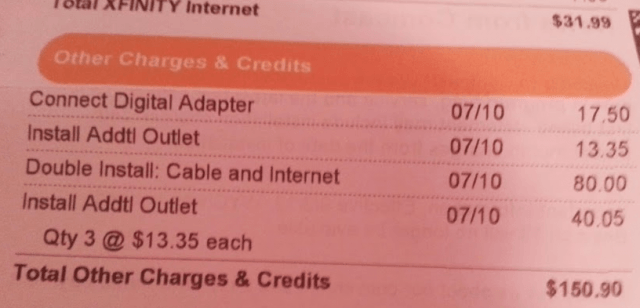
Ancillary Service Fees You May Encounter

  • Reactivation fees: Shut off for non-payment or vacation? Comcast charges $5 to reactivate Internet service, $5 to reactivate a phone line, and $1.99 to turn back on your cable television;
  • Field Collection Charge: If Comcast sends someone to your residence to collect a past due balance or pick up unreturned equipment, there is a $20 charge per visit;
  • Returned Payment Fee: $20 per returned payment;
  • Late Fee: 5% of your account balance;
  • Name Change Fee: $1.99;
  • Pay by Phone Convenience Fee: Making a payment by phone with a customer care representative will cost $5.99 per payment;
  • Copy of Bill: For bill statement copy requested by phone or in person, there is a $5 charge per bill;
  • Unreturned/Damaged Equipment: Charged at the suggested manufacturer’s replacement cost.

Common Equipment Fees

  • Signal Amplifier: $35/each
  • Self-Install Kit Convenience Fee: $40
  • Self-Install Kit Shipping & Handling: $9.95 (Standard Delivery)
  • Self-Install Kit Shipping & Handling: $29.95 (Priority Mail)
  • Remote Control Replacement by Mail (Separate Shipping): $5.95/each
  • other chargesVoice/Data Modem (Used for customers with phone and Internet service): $8/mo²
  • Wireless Gateway (Provides Wi-Fi service): $8/mo²
  • Cienna 3931 Modem & Netgear Wireless Router: $19.95/mo
  • Wireless Adapter (each, one-time charge): $30.00
  • Limited Basic Only Service Converter: $1/mo
  • Digital Converter: $2.50/mo
  • Remote Control: $0.18/mo
  • HD Digital Converter (Limited Basic Only): $2.20/mo
  • Digital Adapter (Limited Basic Only): $0.50/mo each
  • CableCARD: 1st card is free, each additional is $1/mo
  • Customer-Owned Video Equipment Credit: $2.50/mo

Installation and Service Calls (May vary with promotions)

  • Installation fee for one product: $32
  • Installation fee for two products: $80
  • Installation fee for three products: $90
  • In-Home Service Call: $32.10
  • Service Charge for Custom Installation Work: $33.20/hr
  • Installation fee for additional outlets: $13.35/ea at time of new customer visit, $32.15/ea for existing customers
  • Activation fee for additional outlets: $5.60/ea for new customers, $22.05/ea for existing customers
  • Relocation fee for additional outlets: $13.60/ea for new customers, $28.55/ea for existing customers
  • VCR/DVD Connection Charge: $7.90 for new customers, $16.35 for existing customers
  • Upgrade/Downgrade Service Fee (no in-home visit required): $1.99 per instance
  • Upgrade/Downgrade Service Fee (in-home visit required): $26.30 per instance of an upgrade, $12.05 per instance of a downgrade
  • payment centerUpgrade Standard Definition DVR or HD DVR Service: $26.30

Broadband-Specific Installation/Service Charges

  • Additional IP Address (first): $4.95/mo
  • Additional IP Addresses (second and/or third) $9.00/mo each
  • Professional Internet Installation: $99.95
  • Wireless Networking On-Site Professional Set-up (up to 4 devices per trip): $49.95
  • Wireless Networking On-Site Professional Set-Up (extra trips): $99.95/ea
  • Wireless Networking On-Site Professional Set-Up (each additional device over 4): $29.95/ea
  • Broadband-related In-Home Service Visit: $40/per trip
  • Extreme 105Mbps Broadband Professional Installation/Activation Surcharge: $249.00

¹The rates and services quoted in this piece were taken from Comcast’s current rate card for Cambridge, Mass. Rates and services may vary slightly in other markets. The rate card was effective June 2013.
²Comcast charges $7 a month for their modem rental in certain other markets.

From the Frying Pan Into the Fire: Time Warner Customers to Be Burned by Comcast Buyout

Phillip "Ouch!" Dampier

Phillip “Ouch!” Dampier

Spending the day watching cable business news channels gush approval of last night’s surprise announcement that Comcast would acquire Time Warner Cable is just one excellent reason this deal should never be approved.

CNBC, owned by Comcast, particularly fell all over itself praising the transaction. Some of the reporters — many Time Warner Cable customers — actually believed Comcast would be a significant improvement over TWC. It is, if you want higher modem rental fees, higher cable TV bills, and faster broadband speeds you can’t use because of the company’s looming reintroduction of usage caps. CNBC didn’t bother to mention any of that, and why should they? CNBC reporter David Faber was the first to break the story of the merger last evening and among the first this morning to score an extended, friendly interview with the CEOs of both Comcast and Time Warner Cable, pitching softball questions to the two of them for nearly 15 minutes.

That’s a problem. How often do you hear news reports that include the fact the parent company of the channel has an ownership interest in one of the players. Do you think you are getting the full story when a Comcast employee asks Comcast’s CEO about a multi-billion dollar deal on a network owned and operated by Comcast. Incorporating Time Warner Cable and its news operations into Comcast only makes the problem worse.

As far as cable business news networks and the parade of Wall Street analysts are concerned, this is a fine deal for shareholders, consumers, and the cable business. Ironically, several on-air reporters and commentators defended the merger claiming it isn’t an antitrust issue because Comcast and Time Warner Cable never compete with each other. They never asked why that is so.

They're here!

They’re here!

Comcast is hoping the government will give its merger a pass with few conditions for the same reason, without bothering to note the cable industry has existed as a cartel in the United States for decades, each company with a territory they informally agree not to cross. With this deal, Comcast’s fiefdom will now cover about half of all cable subscribers in the U.S., covering 43 of the 50 largest metropolitan markets, and have about a 30% total market share among all competing providers — by far the largest. An 800 pound gorilla is born.

Three million current Time Warner Cable subscribers will not be coming along for the ride and will likely be auctioned off to Charter or another cable operator in a token gesture to keep Comcast’s total market share at the 30% mark the FCC formerly insisted on as an absolute ownership limit — before Comcast successfully sued to have that limit overturned.

The rest of us can say goodbye to our unlimited broadband plans and get ready to pay substantially more for cable and broadband service. Despite claims from remarkably shallow media reports, an analysis of Comcast and Time Warner Cable’s rates clearly show TWC charges lower prices with fewer “gotcha” fees.

Reviewing some recent promotional offers for new customers, Comcast customers pay nearly $35 more for a triple play package than Time Warner customers pay:

Time Warner Cable's Rob Marcus gets a $56.5 million golden parachute after 43 days on the job as CEO.

Time Warner Cable’s Rob Marcus gets a $56.5 million golden parachute after 43 days on the job as CEO.

The Comcast Starter plan costs $99 per month for the first 12 months with a 2-year agreement that includes a nasty divorce penalty. After 12 months, your price increases to $119.99 for the remaining year. The $99 plan accidentally doesn’t bother to mention that customers renting a Comcast cable modem/gateway will pay an extra $8 a month, which raises the price. Since many cable subscribers also want HD DVR service, that only comes free for the first six months, after which Comcast slaps on a charge ranging from $16-27 a month for the next 18 months. Assuming you are happy with the limited channel lineup of the Starter package (and many are not), you will pay up to $154 a month. Oh, we forgot to mention the Broadcast TV surcharge just introduced that increases the bill another $1.50 a month.

Time Warner Cable’s new customer promotions typically cost around $96 a month, including their annoying modem rental fee. DVR service can range from free to $23 a month depending on the promotion, making your monthly rate around $119 a month for 12 months, with no contract and no penalty if you decide to cancel.

“It is pro-consumer, pro-competitive, and strongly in the public interest,” said Comcast CEO Brian Roberts, defending the deal.

Actually, it is in Comcast’s interest. If approved, the biggest investment Comcast will make is spending $10 billion — not to upgrade Time Warner Cable systems — but to launch a major stock buyback program that will directly benefit shareholders.

“On a personal level, it’s never easy to cede control of a company,” said Rob Marcus, Time Warner Cable’s chief executive. “However in this case, it just makes too much sense.”

Before reaching for a Kleenex to wipe any tears away, consider the fact Marcus will do just fine giving up his leadership of TWC just over a month after taking over. His generous goodbye package is worth $56.5 million, not bad for 43 days of work. Time Warner Cable employees won’t share that bounty. In fact, with $1.5 billion in promised savings from the deal’s “synergies” — code language for layoffs, among other things — a substantial number of Time Warner Cable employees can expect to be fired during the first year of the combined company.

The biggest impact of this deal is a further cementing of the duopoly of cable and phone companies into their cozy positions. Instead of encouraging competition, Comcast’s new size-up will guarantee fewer competitors thanks to the concept of volume discounts. The largest providers get the best prices from cable programmers, while smaller ones pay considerably more for access to CNN, ESPN, and other popular channels. Comcast will benefit from reduced pricing for cable programming, which we suspect will never reach customers through price reductions. But any potential startup will have to think twice before selling television programming at all because the prices they will pay make it impossible to compete with Comcast.

Another satisfied customer

Another satisfied customer

Frontier discovered this problem after acquiring FiOS systems from Verizon in Indiana and the Pacific Northwest. When Verizon’s volume discount prices expired, Frontier’s much smaller customer base meant much higher programming costs on renewal. They were so high, in fact, Frontier literally marketed FiOS customers asking them to give up fiber optic television in favor of satellite.

Unless you have pockets as deep as Google, offering cable TV programming may be too expensive for Comcast’s competitors to offer.

Broadband is already immensely profitable for both Time Warner Cable and Comcast, but now it can be even more profitable as Comcast persuades customers to adopt their wireless gateway/modems (for a price) and imposes a usage cap of around 300GB per month. Yes, Comcast will deliver speed increases Time Warner Cable couldn’t be bothered to offer, but with a pervasive usage cap, the value of more Internet speed may prove limited. It’s a case of moving away from Time Warner’s argument that you don’t need faster Internet speed to Comcast’s offer of faster speed that you can’t use.

Customers hoping for a better customer service experience may have been cheered by this misleading passage in today’s New York Times:

Nonetheless, about 8 million current Time Warner Cable customers will become Comcast customers. That may be a good thing for those customers, as Comcast is seen as an industry leader in terms of providing high-quality television and Internet services, while Time Warner Cable has a reputation for poor customer service.

It may be seen as an industry leader by Comcast itself, but consumers despise Comcast just as much as they hate Time Warner Cable. In fact, the American Consumer Satisfaction Index found Comcast was hardly a prize:

  • ACSI’s lowest rated ISP
  • Second-lowest ranked TV service
  • Third-lowest ranked phone service

Comcast consistently scores as one of the lowest rated companies across all the segments it participates in. It has the dubious description of being the lowest rated company in the lowest rated industry.

So why the near universal disdain for ISPs? Even cable companies have to compete with satellite providers. That’s not the case here. Add to that the relatively few companies, regional near-monopolies, high costs, and unreliable service and speed and you have a recipe for bad customer service and little incentive to improve it.

Customers particularly dislike their experiences with call centers, and the range and pricing of available plans.

Higher prices, usage caps, surcharges, and fewer channels for more money. What’s not to love about that?

Just about a week ago, Rob Marcus unveiled his vision of an upgraded Time Warner Cable that looked good to us, and retained unlimited use broadband service. Apparently this is all a case of “never mind.”

The fact is, a merger of Comcast and Time Warner Cable will only benefit the companies, executives, and shareholders involved, while doing nothing to improve customer service, expand broadband, increase speeds, cut prices, and give customers the service they want. It is anti-consumer, further entrenches Comcast’s enormous market power (it also owns NBC and Universal Studios), and gives one company far too much control over content and distribution, particularly for customers who don’t have AT&T U-verse or Verizon FiOS or a community-owned provider as an alternative.

This deal needs to be rejected. When T-Mobile found itself out of a deal with AT&T, it survived on its own even better than expected. So can Time Warner Cable, with the right management team.

Verizon Introduces 2-Yr Price Guarantee, Free Upgrade to Quantum 50/25Mbps Broadband

Phillip Dampier February 10, 2014 Broadband Speed, Competition, Consumer News, Verizon, Video 4 Comments

fiosVerizon has introduced a two-year price guarantee offer and a free broadband speed upgrade for new customers signing up for FiOS Internet, TV and voice service before April 19.
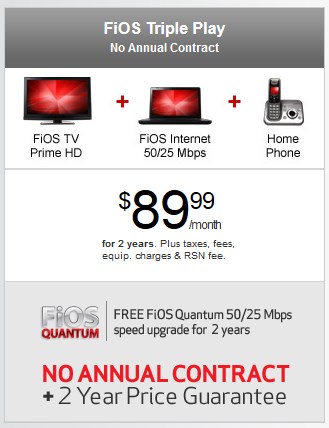
It’s the latest marketing salvo fired against Verizon’s cable competitors with the hope customers will cut cable’s cord and switch to FiOS.

All new customers will receive a two-year price guarantee with a triple play package costing as little as $89.99 a month.  The offers also include a free upgrade to FiOS Quantum 50/25Mbps Internet; FiOS TV Prime HD with more than 215 channels (more than 55 in HD); and FiOS Digital Voice home phone service with unlimited nationwide calling. As a further incentive, customers who choose a two-year agreement also receive a $250 Visa prepaid card. New customers who order online receive an extra $10 per month savings. Those ordering service from Verizon’s website will have the $49.99 activation fee waived.

Such aggressive promotions are not new for Verizon or its cable competition. The best prices are often reserved for new customers.

Former Time Warner Cable CEO Glenn Britt reflected last fall on the competitive environment between cable and phone companies and noted loyal, long-term customers don’t typically benefit much from pricing competition.

fios triple play“The current form of competition in this entire sector is essentially focused on promotional pricing, which allows customers who jump from provider to provider to get the best deal,” said Britt.

In an effort to control customers hopping back and forth between the cable and phone company (known as ‘subscriber churn’ in the industry), Verizon’s marketing is now trying to convince customers they won’t have to shop around for a better deal over the next two years, but aren’t restricted by a contract with termination penalties either.

“We’re responding to feedback from prospective customers who told us they want to switch to FiOS for the faster speed, greater reliability and clearer images, but they struggle with the notion of signing up for a multiyear contract,” said Mike Ritter, chief marketing officer for the consumer and mass business unit of Verizon. “We’ve also heard from prospective customers that they want price assurance when they switch providers. Our offer gives new customers the peace of mind to know their base rate will not change for two years. With no contract, and a two-year price guarantee, new customers can switch to FiOS with confidence.”

Verizon also provides evidence that broadband speed does matter. At of the end of 2013, 46 percent of all Verizon FiOS customers upgraded to FiOS Quantum speeds ranging from 50/25 to 500/100Mbps. Verizon says video streaming, multiplayer gaming, and uploading photos to social media sites are all contributing to consumer demand for faster Internet speeds. FiOS broadband remains the company’s grand jewel with 6.1 million subscribers. Around 5.3 million customers are signed up for FiOS TV.

At the end of last year, Verizon had 6.1 million FiOS Internet subscribers and 5.3 million FiOS TV customers.

Verizon’s new FiOS promotions (for new customers only):

  • Online with no annual contract: $89.99 per month for two years, free FiOS Quantum 50/25Mbps upgrade for two years and a two-year price guarantee.
  • Online with a two-year agreement: $89.99 per month for two years, free FiOS Quantum 50/25Mbps upgrade for two years, two-year price guarantee and a $250 Visa prepaid card.
  • Offline order (purchased through any means other than online) with no annual contract: $99.99 per month for two years, free FiOS Quantum 50/25Mbps upgrade for two years, and a two-year price guarantee.
  • Offline order with a two-year agreement: $99.99 per month for two years, free FiOS Quantum 50/25Mbps upgrade for two years, two-year price guarantee and a $250 Visa prepaid card.

 [flv]http://www.phillipdampier.com/video/Verizon FiOS Internet 2-2014.mp4[/flv]

Verizon argues America needs fiber to the home service to meet the needs of the digital economy. “It’s time to take fiber optics to the last mile,” says the video. That’s fine news for 18 million households that can today buy fiber optic FiOS service, but Verizon indefinitely suspended further expansion of its fiber network in 2010. (3:30)

Search This Site:

Contributions:

Recent Comments:

Your Account:

Stop the Cap!