Home » Broadband Speed » Recent Articles:

TDS Telecom Ditches Copper, Fires Up 1,000Mbps Fiber Service in New Hampshire

fiberville-cardThe town of Hollis, N.H., population 7.600, is the first community in New Hampshire to receive gigabit broadband, courtesy of the local telephone company.

TDS Telecom charges less than $100 a month (when bundled with other services) for gigabit broadband speeds on the fiber to the home network TDS introduced after scrapping obsolete copper telephone wiring.

“What can you do with 1Gig? Whatever you want,” says Matt Apps, manager of Internet product management and development at TDS. “This state-of-the art connection is one hundred times faster than the average connection. It’s only available in only a few communities across the country. With 1Gig, you experience the Internet full-throttle.”

The 1,000/400Mbps service is an upgrade for Hollis, which used to receive speeds up to 300Mbps. TDS bundles its Internet package with 260-channel cable television service delivered over its all-digital Mediaroom platform, and telephone service.

TDS’ 1Gig Internet service includes a free subscription to Remote PC Support which provides unlimited access to technical expertise. Remote PC Support technicians help with device setup, Internet troubleshooting, plus computer optimization and safety.
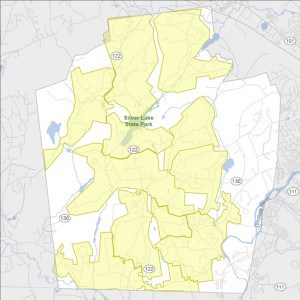
All of these areas in Hollis now have fiber service available.

All of these areas in Hollis now have fiber service available.

Customers looking for more budget-priced packages will still find plenty-fast Internet access available for less on the fiber network:

  • 1,000/400Mbps: $99.95/mo
  • 300/120Mbps: $75.00/mo
  • 100/40Mbps: $35.00/mo
  • 50/20Mbps: $25.00/mo
  • 15/2Mbps: $19.95/mo
  • 2-5Mbps/512kbps: $14.95/mo

Customers bundling a TV package with Internet service get a $20 monthly discount off the total price of both packages.

TDS’ Fiberville is already established in Hollis, but will also be forthcoming in Farragut, Tenn., and other New Hampshire communities including: Andover, Boscawen, New London, Salisbury, Springfield, Sutton, and Wilmot.

Click on each community name to learn the current status of the fiber project.

Customers who enroll as fiber service first becomes available get free whole-house installation and special discounts for being early adopters.


Deutsche Telekom Agrees to Sell T-Mobile USA to Sprint, But Regulators May Balk

Phillip Dampier May 29, 2014 Broadband Speed, Competition, Consumer News, Public Policy & Gov't, Sprint, T-Mobile, Video, Wireless Broadband Comments Off on Deutsche Telekom Agrees to Sell T-Mobile USA to Sprint, But Regulators May Balk
And then there were three?

And then there were three?

Deutsche Telekom has agreed to sell T-Mobile USA to the Japanese parent company of Sprint in a deal that would combine the third and fourth largest wireless companies in the United States under the Sprint brand.

Japan’s Kyodo News Agency said they learned about the buyout agreement from industry sources, but did not reveal any further details.

SoftBank CEO and Sprint chairman Masayoshi Son and his lobbyists have been promoting such a merger for weeks, so the outlines of a deal between the two companies come as no surprise.

SoftBank son

Softbank CEO Masayoshi Son

U.S. regulators have repeatedly signaled their discomfort with any merger between Sprint and T-Mobile, however. Both the heads of the Federal Communications Commission and the U.S. Justice Department have repeatedly raised concerns about the emergence of just three national wireless competitors in the U.S.

AT&T is largely responsible for that perception after its failed attempt to buy T-Mobile in 2011. The large breakup fee and spectrum T-Mobile received after the deal collapsed helped T-Mobile relaunch as a feisty competitor that has forced competitors to cut prices. To regulators, it demonstrated the importance of having at least four national competitors, if only to check the dominance of leaders AT&T and Verizon Wireless. Both the FCC and Justice Department fear any additional mergers would lead to increased prices for U.S. consumers.

Son has argued that the four-competitor policy has left AT&T and Verizon dominant against their two much-weaker competitors. An enlarged Sprint would force broadband speeds upwards as a combined Sprint and T-Mobile launch a massive network upgrade that would force prices down.

Both Softbank and Deutsche Telekom seem eager to close a deal. Softbank is already arranging financing for the estimated $50 billion Deutsche Telekom is expected to ask for T-Mobile USA and the German owner of T-Mobile has sought to exit the U.S. market for at least two years, with the proceeds of any sale used to improve its operations in Germany and eastern Europe, where the company has been more profitable.

So far, Wall Street has had only a muted reaction to the merger news. Many analysts still expect U.S. regulators to shoot down any deal that proposes merging any of the four current large wireless carriers.

SoftBank CEO and Sprint chairman Masayoshi Son was interviewed at this week’s Code Conference. On the current state of wireless: “Oh my god, how can Americans live like this?” (1:23)

AT&T’s Answer for Rural America: $80/Month for Wireless Landline Replacement, 10GB Internet

AT&T’s solution for rural Americans without access to broadband service arrived this week with the introduction of an $80/month plan bundling a mandatory wireless home landline with a 10GB usage-capped Internet plan.

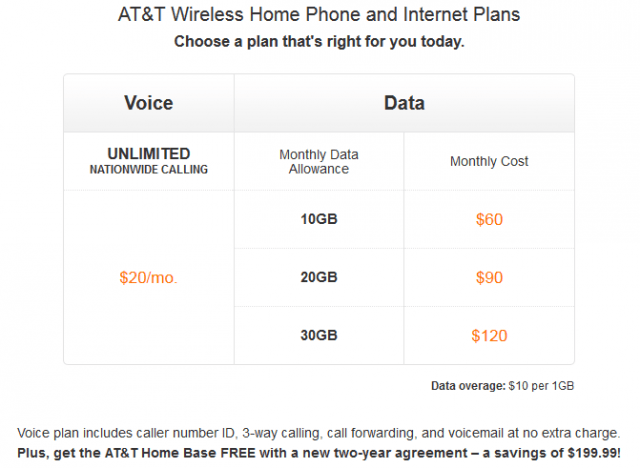
AT&T Wireless Home Phone and Internet has undergone market testing in selected northeastern areas (largely outside of AT&T’s landline service territory). This week the service became available nationwide and is marketed to customers disconnected (or soon will be if regulators approve) from AT&T’s traditional landline service. AT&T is petitioning to dismantle its rural and outer suburban wired landline network and transfer customers to wireless service. But AT&T’s wireless replacement is both expensive and usage capped with an allowance that is just a fraction of what AT&T DSL offers:

att wireless plan

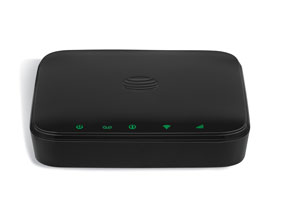
  • Customers start with a $20/month wireless landline phone replacement, powered by AT&T’s wireless network. Customers will keep their current phone number and home phones and will be sent a “Home Base” device that will interface between AT&T’s wireless network and up to two telephones. AT&T does not permit its device to be connected to your existing home phone wiring, so it strongly urges customers to buy cordless phones. The device is portable so it can be taken with you when traveling. The standalone service offers unlimited nationwide calling, Voicemail, caller ID and call waiting;
  • Those interested in also purchasing broadband can add one of three different data plans: $60 for 10GB, $90 for 20GB and $120 for 30GB. AT&T charges a $10 overlimit fee for each extra gigabyte. You cannot buy broadband service unless you also subscribe to AT&T’s wireless landline product. That means the lowest possible price for rural broadband is $80 a month for up to 10GB of usage. Access may be over AT&T’s 4G LTE network (5-12Mbps maximum speeds) or their much-slower, but more common 3G network. In contrast, AT&T sells DSL for as little as $15 a month with a 150GB usage allowance included.

[flv]http://www.phillipdampier.com/video/ATT Wireless Home Phone Internet Intro 5-2014.flv[/flv]

AT&T introduces its new solution for rural America — wireless home phone and Internet service, at a price much higher than what urban customers pay. (1:42)

AT&T's Home Base

AT&T’s Home Base

AT&T’s Wireless Home Phone and Internet includes plenty of fine print and disclaimers:

  • A two-year service commitment is required to avoid a $199 charge for the Home Base device;
  • 911 service is not guaranteed and you will be required to give your physical location to the 911 operator so they can send help to the proper address;
  • A backup battery powers the Home Base allowing up to 1.5 hours of talk time and 18 hours of standby time. However, a standard corded phone that does not need electric power to operate is required to place or receive calls (including 911) during a power outage;
  • Not compatible with wireless messaging services/text messaging, home security systems, fax machines, medical alert & monitoring systems, credit card machines, IP/PBX Phone systems, or dial-up Internet service. May not be compatible with DVR/Satellite systems;
  • Call quality, wireless coverage, and service reliability are not guaranteed;
  • Well-qualified credit approval required;
  • An activation fee (undisclosed) also applies.

There are many surcharges that also may apply, including a $35 restocking fee, federal, state, and local taxes and the universal service fee. Customers must also pay AT&T-originated fees kept by AT&T, including a $1.25 “cost recovery charge,” a gross receipts surcharge, administrative fees and any government-originated assessments that AT&T passes on to customers in various states.

[flv]http://www.phillipdampier.com/video/ATT Wireless Home Phone Internet Setup 5-2014.flv[/flv]

AT&T explains how to set up and configure its Home Base to receive phone and broadband service wirelessly. (3:16)

NY Times’ Reality Check: Feds Should Block the Godzilla-Sized Time Warner Cable-Comcast Merger

Phillip Dampier May 27, 2014 Broadband Speed, Comcast/Xfinity, Competition, Consumer News, Public Policy & Gov't Comments Off on NY Times’ Reality Check: Feds Should Block the Godzilla-Sized Time Warner Cable-Comcast Merger

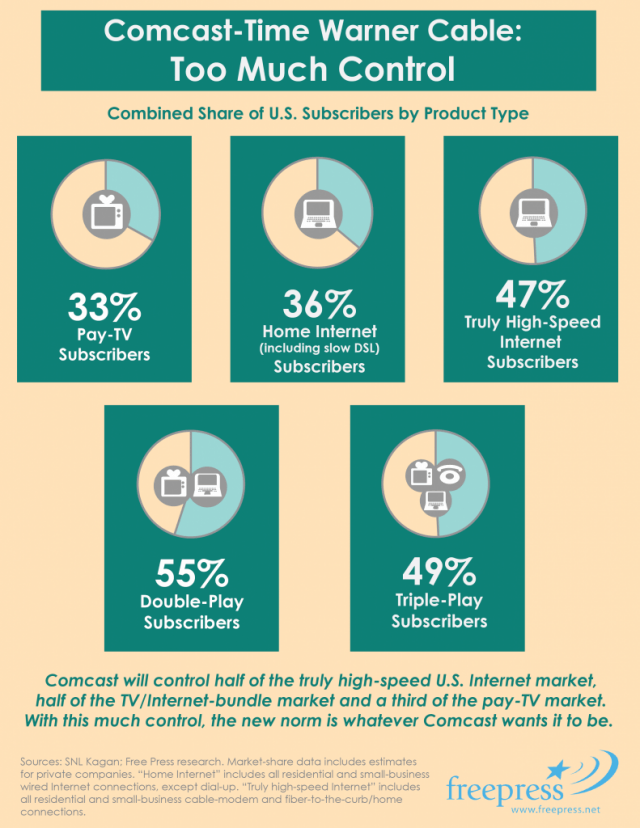
free_press_comcast_twc_market_shares-791x1024The New York Times recommends the Justice Department and Federal Communications Commission reject Comcast’s $45 billion purchase of Time Warner Cable, if only because the combined company will have an unregulated choke-hold on telecommunications services not seen since the days of the regulated AT&T/Bell monopoly.

In an editorial published Sunday, the newspaper called out many of the “merger benefit”-talking points claimed by the two cable giants as specious at best, hinting some even bordered on misleading:

By buying Time Warner Cable, Comcast would become a gatekeeper over what consumers watch, read and listen to. The company would have more power to compel Internet content companies like Netflix and Google, which owns YouTube, to pay Comcast for better access to its broadband network. Netflix, a dominant player in video streaming, has already signed such an agreement with the company. This could put start-ups and smaller companies without deep pockets at a competitive disadvantage.

There are also worries that a bigger Comcast would have more power to refuse to carry channels that compete with programming owned by NBC Universal, which it owns. Comcast executives say that they would not favor content the company controls at the expense of other media businesses.

The company argues that this deal would not reduce choice because the company does not directly compete with Time Warner Cable anywhere. Comcast would face plenty of competition in high-speed Internet service, they say, from telephone and wireless companies.

The reality is far different. At the end of 2012, according to the FCC, 64 percent of American homes had only one or at most two choices for Internet service that most people would consider broadband. Wireless services can handle streaming video, but many customers of Verizon or AT&T would blow through their monthly wireless data plan by streaming just one two-hour high-definition movie, at which point they would have to fork over extra fees.

Comcast executives argue that companies like Sprint are planning to provide very fast Internet service that will compete with wired broadband. But wireless companies have been working on such services for more than a decade with little success.

Those wireless services that do exist uniformly impose low usage caps and cost considerably more than traditional wired broadband plans, especially when considering the cost compared to the actual speed delivered to consumers.

The Times doesn’t believe imposing a litany of conditions in return for approving the deal, similar to those involving Comcast’s purchase of NBCUniversal, would be sufficient to protect consumers from monopoly abuse.

“This merger would fundamentally change the structure of this important industry and give one company too much control over what information, shows, movies and sports Americans can access on TVs and the Internet,” concluded the newspaper. “Federal regulators should challenge this deal.”

Time Warner Cable Unsurprisingly Chooses Austin as Its Next 300Mbps Upgrade City

Greater Austin, a city served by up to four different broadband providers — three either offering or promising fiber to the home service — is getting a speed upgrade from the one company that is sticking with its fiber-coax network — Time Warner Cable.

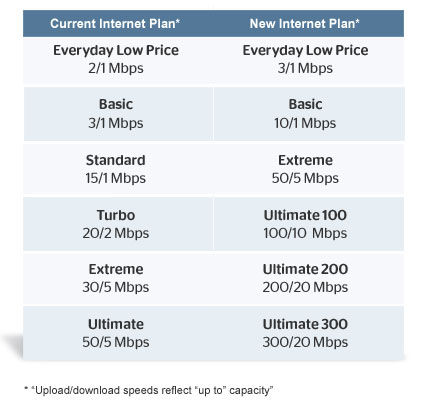
Starting June 3, Time Warner Cable customers who receive letters regarding the upgrade will see major broadband speed boosts at no additional charge:

speed-plan-chart-2014


Austin: Keeping the good broadband all to themselves. (Image courtesy: Kong)

Austin: Keeping the good broadband all to themselves. (Image courtesy: Kong)

The upgraded speeds will be offered to approximately 40 percent of customers in Austin and surrounding communities in June, with the remaining customers in the area getting upgraded through early fall. Here is the upgrade schedule:

June Speed Upgrade: Downtown Austin, West Campus, Hyde Park, Clarksville, Old Enfield, North Loop, Terrytown, Highland Park West, Central East Austin, Windsor Hills, Copperfield, Springdale Heights, Harris Branch, Edinburgh Gardens, Rollingwood, West Lake Hills, Lost Creek, Barton Creek, Jollyville, Anderson Mill, Brushy Creek, Bull Creek Park, Steiner Ranch, River Place, Canyon Creek, and the Reserve at Twin Peaks, as well as these communities: Manor, Cedar Park, Jonestown, Bee Cave, Kyle, Mountain City, and Uhland.

Fall Speed Upgrade: Round Rock, Leander, San Marcos, Elgin, Marble Falls, Lockhart, Bastrop, Fredericksburg, Taylor, Smithville, Wimberley, Liberty Hill, Lago Vista, Buda, Kyle, Elroy, and Lakeway.

“These significant speed increases will allow all our Internet customers in the greater Austin area to enjoy TWC Internet better,” said Kathy Brabson, area vice president of operations for Time Warner Cable in Central Texas.

Time Warner says it is spending about $60 million to upgrade its Austin-area network. That investment may help the cable company withstand competition from providers like Grande Communications, AT&T, and Google. For most in Austin, Time Warner Cable will be the first provider to dramatically boost Internet speeds. Google Fiber has postponed its launch until this fall, AT&T’s U-verse fiber to the home service is more press release than reality, and Grande Communications, although offering 1,000Mbps service for $65, only has that service available in parts of the greater Austin area.

Some customers will need to upgrade and/or exchange their current cable modem to receive the full speed upgrade. Customers leasing a modem can get information about whether an upgrade is needed from Time Warner’s Speed Increase website. We still strongly recommend customers consider purchasing their own modem — it will pay for itself in no time. Communication to the first group of customers about the new speeds and details about equipment is being delivered to homes this week.

Separately, Time Warner also announced it is expanding its local Wi-Fi hotspot network, but did not share any specific details.

Stop the Cap! will not be surprised to see Kansas City the next upgrade choice for Time Warner Cable — Google Fiber is up, running, and competing there. The rest of us will have to wait up to two years for faster speeds to arrive.

Search This Site:

Contributions:

Recent Comments:

Your Account:

Stop the Cap!