AT&T’s claim it wants to expand gigabit fiber to the home service to as many as 100 cities nationwide requires closer inspection on news this week it has slashed spending on its wireline business.
Investors knocked AT&T’s share price today as they learned earnings from AT&T’s wired networks will be lower than expected.
TheStreetreported this morning the spending cuts are so significant, they are creating a financial risk for a number of AT&T’s major vendors.
Research firm Jefferies issued a research note warning that AT&T’s spending cuts began last month and seem to be ongoing. As a result the companies that have the most exposure to AT&T’s wireline business are at increased financial risk. Those suppliers include optical fiber equipment manufacturer Alcatel-Lucent, as well as Ciena, Juniper, ADTRAN, Finisar, and JDS Uniphase. As a result, all but Finisar saw their share prices drop significantly in morning trading.
Earlier today, AT&T reported it was ahead of schedule to complete its Project VIP expansion of its 4G LTE wireless and U-verse networks. As U-verse expansion nears an end, vendor orders may be in decline. Wall Street analysts see no evidence AT&T is preparing to spend much on any other expansion efforts, including fiber to the home service.
As Broadband Reports’notes, without significant capital to invest in fiber upgrades, they are not going to happen.
These cuts make it hard to take the company’s claims of meaningful 1 Gbps fiber expansion seriously as there’s simply no budget cordoned off for such a project (“Project VIP” funds are already in use on other efforts). While AT&T has the press believing they’re deploying 1 Gbps to “up to 100 cities,” AT&T’s shrinking CAPEX tells a different story entirely.
Fiber to the home service is more costly than AT&T U-verse’s fiber to the neighborhood service because it requires a fiber cable be brought directly to each home or business — a more costly endeavor that requires careful cable burial or overhead drop line replacement, as well as the possibility of in-home wiring adjustments. Considering the billions spent on U-verse expansion to date, at least as much will be required to upgrade to fiber to the home service and there are no signs AT&T is ready to invest in anything beyond press releases.
CenturyLink does not believe it will face much of a competitive threat from AT&T and Verizon’s plans to decommission rural landline service in favor of fixed wireless broadband because the two companies’ offers are too expensive, overly usage-capped and too slow.
Both AT&T and Verizon have proposed mothballing traditional landline service in rural areas because both companies claim wireline financial returns are too low and ongoing maintenance costs are too high. In its place, both companies are developing rural fixed wireless solutions for voice and broadband service that will rely on 4G LTE networks.
CenturyLink does not traditionally compete against either AT&T or Verizon because their landline service areas do not overlap. But as both AT&T and Verizon Wireless continue to emphasize their nationwide wireless networks, independent phone companies are likely to face increased competition from wireless phone and broadband services.
CenturyLink isn’t worried.
“About two-thirds of our customers can get access to 10Mbps or higher [from us and] that continues to increase year by year,” CenturyLink chief financial officer Stewart Ewing told attendees at Bank of America Merrill Lynch’s 2014 Global Telecom & Media Conference. “Our belief is that with the increasing demands customers have for bandwidth — the Netflix bandwidth requirement — just the increasing amount of video that customers are watching and downloading over their Internet pipes, we believe will drive customers to using a provider that basically has a wire in their home because we believe you will get generally higher bandwidth and a much better experience at lower cost.”
Ewing
CenturyLink customers consume an average of slightly less than 50GB of Internet usage per month, and that number is growing. Ewing said that CenturyLink has long believed that as bandwidth demand increases, wireless becomes less and less capable of providing a good customer experience.
“At this point, we don’t really have any concerns because people on the margin — the folks that don’t use much bandwidth — probably use a wireless connection today to download,” Ewing said. “But as the bandwidth demands grow, the wireless connection becomes more and more expensive and that could tend to drive people our way. So as long as we have 10Mbps or better to the customers, we don’t really think there is that much exposure.”
CenturyLink does not measure the difference in Internet usage between urban and rural residential customers, but the company suspects rural customers might naturally use more because alternative outlets are fewer in number outside of urban America.
“Folks in rural areas might actually can use Internet more for buying things that they can’t source [easily], but it’s hard to really count,” said Ewing. “I think our customers in the rural areas probably are not that much different from folks in urban areas.”
Prism is CenturyLink’s fiber to the neighborhood service, similar to AT&T U-verse. It is getting only a modest expansion in 2014.
CenturyLink’s largest competitor remains Comcast, which co-exists in about 40% of CenturyLink’s markets. The merger with Time Warner Cable won’t have much impact on CenturyLink, increasing Comcast’s footprint in CenturyLink territory by only about only 6-7%. CenturyLink believes most of any new competition will come in the small business market segment. Comcast’s residential pricing is unlikely to attract current CenturyLink customers in Time Warner Cable territory to consider a switch to Comcast if the merger is approved.
Ewing also shared his thinking about several other CenturyLink initiatives that customers might see sometime this year:
Don’t expect CenturyLink to expand Wi-Fi hotspot networks. The company found they are difficult to monetize and is unlikely to expand them further;
Any change in the FCC’s definition of minimum broadband speed to qualify for federal broadband expansion funds would slow rural broadband expansion. Ewing admitted a 10Mbps speed minimum is considerably more difficult to achieve over DSL than a 4 or 6Mbps minimum;
Don’t expect any more merger/acquisition activity from CenturyLink in the Competitive Local Exchange Carrier business. CenturyLink shows no sign of pursuing Frontier, Windstream, FairPoint, or other independent phone companies. It is focused on expanding business services, where 60% of CenturyLink’s revenue now comes;
CenturyLink fiber expansion will primarily be focused on reaching business offices and commercial customers in 2014;
CenturyLink will only modestly expand PrismTV, its fiber-to-the-neighborhood service, to an additional 300,000 homes this year. The company now offers the service to two million of its customers, with 200,000 signed up nationwide. Last year, CenturyLink expanded PrismTV availability to 800,000 homes.
Phillip “How far will $20 get me in your office?” Dampier
Congress is famous for obfuscation when it comes to introducing legislation that promises one thing and delivers something quite different. Take the 2003 “Clear Skies Initiative,” which would have allowed the energy industry to increase polluting emissions, or “The Disclosure of Hydraulic Fracturing Fluid Composition Act,” which allows frackers to keep secret the ingredients of millions of gallons of chemicals pumped into the ground to displace natural gas, and potentially your potable drinking water.
So it shouldn’t be much of a surprise that Rep. Bob Latta (R-Ohio) wants to “protect” the open and free Internet by introducing a new bill that opens and frees the telecom companies that steadfastly support his campaign coffers to install paid Internet toll booths. Like many pieces of legislation coming from some House Republicans these days, “freedom” only extends to corporate interests, not to you or I (unless we want to start a corporation of our own.)
Reclassifying broadband as a telecommunications service under Title II of the Communications Act is the Holy Grail for Net Neutrality supporters. It offers clear oversight authority that would make future lawsuits from Comcast, Verizon and other telecom companies untenable. Earlier court decisions have laid a foundation for broadband oversight under Title II, but the FCC itself must take advantage of that opportunity, and so far it has not.
Congressman Latta has introduced legislation to make sure the FCC can never take that step. His bill would specifically prohibit the FCC from reclassifying broadband Internet access as anything beyond an unregulated “information service.”
According to Latta, only with his legislation can America be assured the Internet will stay “open and free.” — “Open and free” for the picking by companies who dream of new revenue monetizing Internet traffic. Not satisfied charging some of the world’s highest prices for Internet access, many of the largest cable and phone companies in the country now want the right to “double-dip” — charging consumers to reach Internet content andcontent producers for delivering it. It would be like paying postage to mail a letter and having it arrive postage due or letting the phone company charge both the caller and the person called for a long distance telephone call.
“The legislation comes after the FCC released a proposal to reclassify broadband Internet access under Title II as a telecommunications service rather than an information service,” says a press release from Latta’s office.
Would I lie to you? Rep. Bob Latta (R-Ohio)
That is patently false. In fact, FCC chairman Thomas Wheeler has twisted himself into a human pretzel with clever language and a clear determination notto reclassify broadband under Title II. Wheeler prefers sticking to the rickety Section 706 faux-authority for Net Neutrality — the same section that keeps handing FCC lawyers loss after loss in federal court. After Wheeler announced his intention to propose allowing Internet companies to build paid fast lanes for Internet traffic, the resulting backlash from content companies and the public made him grudgingly offer a “discussion” about utilizing Title II.
That kind of “discussion” will be familiar to every 16-year old teenage girl who is told “we’ll talk about it” after asking mom and dad if she can take her new 22-year old boyfriend on vacation and stay in their own hotel room.
Ironically, detractors like Latta are the ones that usually accuse Net Neutrality of solving a problem that doesn’t exist. But that didn’t stop Congressman Latta from introducing legislation to stop the current ex-telecom lobbyist chairman of the FCC from going all Elizabeth Warren on us, suddenly imposing draconian pro-consumer regulations against those job creators at the cable companies Wheeler used to represent. But on the bright side, when Wheeler doesn’t do what Latta’s bill wouldn’t let him do, Latta can still declare victory against “big government.” If you live in Latta’s district, you can read all about it in the forthcoming government-subsidized, no-postage-needed “newsletter” he and other members of Congress will pelt your mailbox with right before election time.
“In light of the FCC initiating yet another attempt to regulate the Internet, upending long-standing precedent and imposing monopoly-era telephone rules and obligations on the 21st Century broadband marketplace, Congress must take action to put an end to this misguided regulatory proposal,” said Latta. “The Internet has remained open and continues to be a powerful engine fueling private enterprise, economic growth and innovation absent government interference and obstruction. My legislation will provide all participants in the Internet ecosystem the certainty they need to continue investing in broadband networks and services that have been fundamental for job creation, productivity and consumer choice.”
Consumers not included. Maybe he just forgot.
“At a time when the Internet economy is thriving and driving robust productivity and economic growth, it is reckless to suggest, let alone adopt, policies that threaten its success. Reclassification would heap 80 years of regulatory baggage on broadband providers, restricting their flexibility to innovate and placing them at the mercy of a government agency. These businesses thrive on dynamism and the ability to evolve quickly to shifting market and consumer forces. Subjecting them to bureaucratic red tape won’t promote innovation, consumer welfare or the economy, and I encourage my House colleagues to support this legislation, so we can foster continued innovation and investment within the broadband marketplace.”
Guess not. The Internet should only be about business in Latta’s mind. Consumers that support Net Neutrality are nothing more than parasites sucking away valuable potential profits from the dynamic, flexible and innovative world of traffic shaping, usage caps, and double-dipping.
Latta isn’t interested that your provider is turning your weekend Netflix binge into an exercise of maddening rebuffering futility as your cable/phone company waits for protection racket proceeds a paid peering agreement with Netflix. That is because he doesn’t represent you. He represents AT&T, Time Warner Cable, Comcast, and CenturyLink.
Latta can afford to travel through the Internet toll booth when one considers who his top contributors keeping his campaign flush with cash are:
More than $32,000 in contributions from AT&T and its executives;
$29,500 from Tom Wheeler’s old haunt — the National Cable & Telecommunications Association (Big Cable lobby);
$15,000 from the American Cable Association (Small Cable lobby);
$21,000 from Time Warner Cable and its executives;
$16,000 from Verizon and its executives;
$11,400 from CenturyLink;
$11,000 from Comcast (they are ditching Ohio customers to Charter after merging with Time Warner Cable so why throw good money after bad).
Latta’s close friendship with Big Telecom is so obvious, it has made co-sponsoring his fact-free bill about as popular as Justin Bieber at an NAACP convention. Even his like-minded Congressional colleagues are staying away. But his industry friends sure appreciate his efforts on their behalf.
One wonders why his constituents return him to office when he would be obviously much more comfortable in his next job — lobbying for AT&T or Comcast. Before our Internet connections slow, let’s hope his constituents hasten a much-needed turbo-speed departure for the congressman, already a shadow employee of AT&T.
Oliver points out President Obama is very close to Comcast’s top lobbyist (and Democratic fundraiser) David Cohen.
John Oliver, host of HBO’s “Last Week Tonight,” took nearly 15 minutes out of his show last night to present a detailed and unusually apt explanation of why Net Neutrality should matter to Americans.
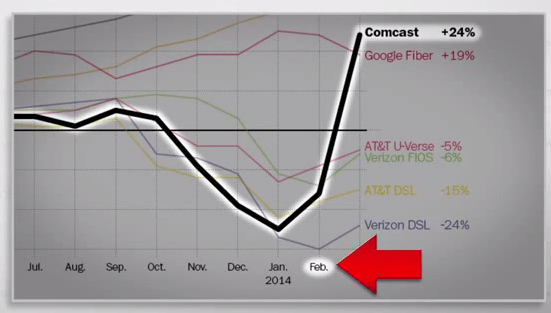
Using a timely chart depicting Comcast’s Al Capone-like Internet protection racket, Oliver showed how Netflix performance rapidly deteriorated for Comcast customers until Netflix agreed to pay Comcast for a direct connection in February. Within days, performance rebounded to new highs.
In essence, Oliver explains, Net Neutrality is about the controversy of allowing Internet toll lanes.
Oliver shows an industry mouthpiece defending the concept as a “fast lane for everybody and a hyper speed lane for others,” to which Oliver responds, “Bullsh*t!”
“If we let cable companies offer two speeds of service, they won’t be [Jamaican sprinter] Usain Bolt and Usain Bolt on a motor bike,” Oliver warns. “They’ll be Usain Bolt and Usain Bolted to an anchor.”
Oliver added he was concerned most Americans were not paying attention to the issue, proclaiming it “boring.”
“And that’s the problem. The cable companies have figured out the great truth of America: if you want to do something evil, put it inside something boring,” he said. “Advocates should not be talking about protecting Net Neutrality. They shouldn’t even use that phrase. They should call it preventing cable company fuc*ery. Because that is what it is.”
Comcast’s Internet protection racket. Netflix watched customer streaming performance degrade on Comcast’s network until it signed a paid peering agreement with the cable company in February.
Oliver’s prescription for change is somewhat more dubious, however. He wants Internet trolls to overwhelm the FCC’s Net Neutrality comment mailbox:
I would like to address the Internet commenters out there directly. Good evening monsters, this may be the moment you spent your whole lives training for.
You’ve been out there ferociously commenting on dance videos of adorable 3-years-olds, saying things like, “Every child could dance like this little loser after one week of practice.” Or you’d be polluting Frozen’s Let It Go with comments like, “Ice Castle would give her hypothermia and she dead in an hour.” Or, and I know you’ve done this one commenting on this show: “F*ck this a**hole anchor […] ur just friends with terrorists xD.”
This is the moment you were made for commenters. Like Ralph Macchio, you’ve been honing your skills waxing cars and painting fences, well guess what? Now it’s time to do some f*king karate.
For once in your life we need you to channel that anger.
[flv]http://www.phillipdampier.com/video/HBO Last Week Tonight with John Oliver Net Neutrality 6-1-14.flv[/flv]
John Oliver’s Last Week Tonight addresses Net Neutrality to viewers who probably don’t understand a thing about it. Warning: Strong language. (13:17)
Comcast is using an offline console game that misrepresents the speed and performance of its Internet service in its latest advertising.
Eagle-eyed game fans were annoyed to find Comcast promoting its speedy Internet service with a mall demo of Ubisoft’s Trials Fusion, a game that has no online multiplayer mode.
“If you’re a real gamer then you need the speed of XFINITY Internet,” advises a Comcast spokesman in the 30-second ad.
“Do you find that when you’re playing games online with your current service that it’s slow, a Comcast representative asks gamers.
“Yes,” says one, they do! “I get some lag,” says another.
“Do you want to try XFINITY Internet,” asks the employee.
“Sure.”
“Do you notice any buffering,” asks the employee.
“No sir.” “There is certainly no lag at all.”
The smooth game play and responsiveness looks impressive, until one realizes the game was never connected to XFINITY Internet. Without an online mode, there is no Internet connection with slow speeds and lag to worry about while playing. Games like บาคาร่าจ่ายจริง, which don’t require high-speed connections for complex graphics or fast reaction times, would run just as smoothly. The game would work just as well in the middle of a Kansas wheat field, 50 miles from the nearest DSL connection.
But Comcast’s Internet service does eventually come into play when game enthusiasts want to download software updates, which can be enormous for many titles.
XFINITY Internet does not come with infinite usage. The company is now testing a return of usage allowances tied to overlimit fees in several cities and a senior vice-president predicted Comcast will be limiting how much Internet usage customers get without paying more within five years. So while you may not notice any buffering issues when using your offline content with XFINITY Internet, the more you do go online, the closer you get to Comcast’s arbitrary usage allowance.
[flv]http://www.phillipdampier.com/video/Xfinity Internet – Gamers Tent May 2014.flv[/flv]
False Advertising: Comcast uses offline game play to prove the speed and responsiveness of their Internet service. Your Keurig coffeemaker is also 50% faster when inside a home powered by XFINITY Internet. So are your cats. (0:30)
Be Sure to Read Part One: Astroturf Overload — Broadband for America = One Giant Industry Front Group for an important introduction to what this super-sized industry front group is all about. Members of Broadband for America Red: A company or group actively engaging in anti-consumer lobbying, opposes Net Neutrality, supports Internet Overcharging, belongs to […]
Astroturf: One of the underhanded tactics increasingly being used by telecom companies is “Astroturf lobbying” – creating front groups that try to mimic true grassroots, but that are all about corporate money, not citizen power. Astroturf lobbying is hardly a new approach. Senator Lloyd Bentsen is credited with coining the term in the 1980s to […]
Hong Kong remains bullish on broadband. Despite the economic downturn, City Telecom continues to invest millions in constructing one of Hong Kong’s largest fiber optic broadband networks, providing fiber to the home connections to residents. City Telecom’s HK Broadband service relies on an all-fiber optic network, and has been dubbed “the Verizon FiOS of Hong […]
BendBroadband, a small provider serving central Oregon, breathlessly announced the imminent launch of new higher speed broadband service for its customers after completing an upgrade to DOCSIS 3. Along with the launch announcement came a new logo of a sprinting dog the company attaches its new tagline to: “We’re the local dog. We better be […]
Stop the Cap! reader Rick has been educating me about some of the new-found aggression by Shaw Communications, one of western Canada’s largest telecommunications companies, in expanding its business reach across Canada. Woe to those who get in the way. Novus Entertainment is already familiar with this story. As Stop the Cap! reported previously, Shaw […]
The Canadian Radio-television Telecommunications Commission, the Canadian equivalent of the Federal Communications Commission in Washington, may be forced to consider American broadband policy before defining Net Neutrality and its role in Canadian broadband, according to an article published today in The Globe & Mail. [FCC Chairman Julius Genachowski’s] proposal – to codify and enforce some […]
In March 2000, two cable magnates sat down for the cable industry equivalent of My Dinner With Andre. Fine wine, beautiful table linens, an exquisite meal, and a Monopoly board with pieces swapped back and forth representing hundreds of thousands of Canadian consumers. Ted Rogers and Jim Shaw drew a line on the western Ontario […]
Just like FairPoint Communications, the Towering Inferno of phone companies haunting New England, Frontier Communications is making a whole lot of promises to state regulators and consumers, if they’ll only support the deal to transfer ownership of phone service from Verizon to them. This time, Frontier is issuing a self-serving press release touting their investment […]
I see it took all of five minutes for George Ou and his friends at Digital Society to be swayed by the tunnel vision myopia of last week’s latest effort to justify Internet Overcharging schemes. Until recently, I’ve always rationalized my distain for smaller usage caps by ignoring the fact that I’m being subsidized by […]
In 2007, we took our first major trip away from western New York in 20 years and spent two weeks an hour away from Calgary, Alberta. After two weeks in Kananaskis Country, Banff, Calgary, and other spots all over southern Alberta, we came away with the Good, the Bad, and the Ugly: The Good Alberta […]
A federal appeals court in Washington has struck down, for a second time, a rulemaking by the Federal Communications Commission to limit the size of the nation’s largest cable operators to 30% of the nation’s pay television marketplace, calling the rule “arbitrary and capricious.” The 30% rule, designed to keep no single company from controlling […]
Less than half of Americans surveyed by PC Magazine report they are very satisfied with the broadband speed delivered by their Internet service provider. PC Magazine released a comprehensive study this month on speed, provider satisfaction, and consumer opinions about the state of broadband in their community. The publisher sampled more than 17,000 participants, checking […]


 Subscribe
 AT&T’s claim it wants to expand gigabit fiber to the home service to as many as 100 cities nationwide requires closer inspection on news this week it has slashed spending on its wireline business.
 CenturyLink does not believe it will face much of a competitive threat from AT&T and Verizon’s plans to decommission rural landline service in favor of fixed wireless broadband because the two companies’ offers are too expensive, overly usage-capped and too slow.



 Guess not. The Internet should only be about business in Latta’s mind. Consumers that support Net Neutrality are nothing more than parasites sucking away valuable potential profits from the dynamic, flexible and innovative world of traffic shaping, usage caps, and double-dipping.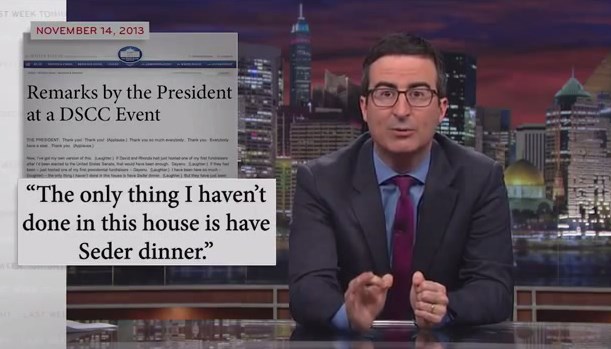
 Comcast is using an offline console game that misrepresents the speed and performance of its Internet service in its latest advertising.