Home » Broadband Speed » Recent Articles:

Comcast’s Gain, Our Pain: New Yorkers Flood PSC With Comments Opposing Merger Deal

Phillip Dampier June 30, 2014 Broadband Speed, Comcast/Xfinity, Competition, Consumer News, Net Neutrality, Public Policy & Gov't, Rural Broadband, Video Comments Off on Comcast’s Gain, Our Pain: New Yorkers Flood PSC With Comments Opposing Merger Deal

Nearly 2,000 New York residents and counting have urged the state Public Service Commission to reject the proposed merger of Time Warner Cable and Comcast.

A review of the comments finds little interest in compromise and setting conditions in return for merger approval. Those commenting overwhelmingly want nothing to do with Comcast even if the company agrees to broaden its Internet Essentials program for the poor or agrees to continue voluntarily supporting Net Neutrality principles.
comcast no

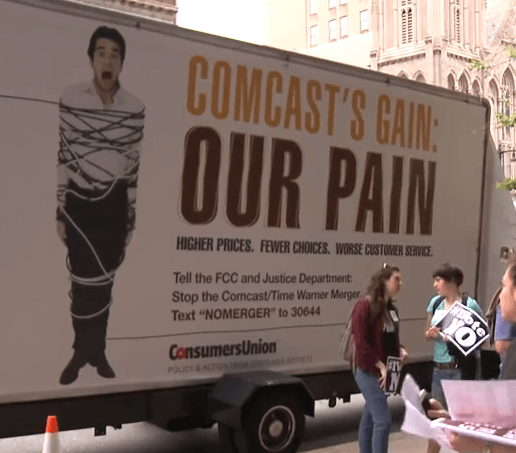
Consumers Union stormed the streets of Philadelphia during Comcast’s annual shareholder meeting to protest its merger deal with Time Warner Cable.

“There are ample examples of the rottenness of Comcast,” wrote I. VanKeuren from Wallkill. “It seems to me that instead of holding hearings on a possible merger of these two bad companies, the PSC should be investigating why Comcast has been so bad for so long.”

VanKeuren is hardly alone in his thinking.

A new survey from the Consumer Reports National Research Center found scant support for the merger among Americans.

The survey found 56% of Americans oppose the merger, and only 11% of respondents were in favor of it, with the rest either undecided or resigned to the belief it is out of their hands.

Cable companies rank among the least trusted organizations that most Americans do business with, so it’s not surprising that the people are concerned. Seventy-four percent of the public says they believe that prices will rise if the merger goes through, and two-thirds say that Comcast will have less incentive to improve customer service. The study, which drew on a nationally representative pool of 1,573 people, was conducted on behalf of the Consumers Union, the policy and advocacy arm of Consumer Reports.

“Most Americans don’t have time to follow complicated corporate mergers but this deal has definitely captured the public’s attention,” Delara Derakhshani, policy counsel for Consumers Union, said. “Consumers are tired of rising monthly bills and lousy customer service for cable and Internet and have little faith that this mega merger will make things any better.”  The new Comcast would control more than two-thirds of all cable television subscribers in the country, and nearly 40 percent of the high-speed Internet market.

Those statistics and past experiences dealing with Comcast have New York consumers like VanKeuren concerned.

“If […] the PSC approves this merger, then the PSC itself should [itself] be investigated with a complete reorganization as its goal,” said VanKeuren.

[flv]http://www.phillipdampier.com/video/No ComcastTime Warner Mega Merger 5-23-14.mp4[/flv]

Consumers Union protested outside of Comcast’s annual meeting in Philadelphia in opposition to its proposed merger with Time Warner Cable. (1:48)
France’s Bouygues Telecom Announces 1Gbps Fiber, TV, Phone Package for $35/Month

Phillip Dampier June 26, 2014 Broadband Speed, Competition, Consumer News 1 Comment

173x116_Logo-BT_WSCustomers of Paris-based Bouygues Telecom in some of France’s largest cities will soon have access to 400Mbps fiber to the home broadband (with an upgrade to 1Gbps later this year), as well as a television and phone package that combined will cost $35.43 a month.
The company’s new fiber offer commences June 30 and comes as a result of fierce competition for the French broadband customer.

Bbox Sensation Fiber is available from both fiber to the home and fiber to the building connections throughout urban areas in France, including Paris, Lyon, Marseille, Nice, Toulouse and Bordeaux.

Fiber continues to gradually replace older copper-base wire networks in France. But unlike in North America, European telephone companies believe their future isn’t only in selling wireless. Upgrading those networks to fiber to the home service allow companies to sell bundled packages of phone, wireless, television and broadband Internet access.

Bouygues Telecom’s fiber to the home network now reaches 3.3 million French homes with more to come. Its older fiber to the neighborhood network reaches another 5 million customers.

Customers who sign up for the fiber to the home service by the end of August will get two months free

Here are the details:

macgpic-1402559468-29638698693873-sc-opBbox Sensation Fiber (first phase) includes:
Internet

  • 400Mbps service with upgrade to 1Gbps by the end of this year;
  • 50GB cloud storage

Television

  • Up to 170 TV channels, including 29 HD channels
  • DVR with 300GB storage
  • Bbox Video on Demand: Thousands of multilingual titles available in HD and DTS
  • Bbox Games: Over 50 multiplayer video games accessible on the network at any one time
  • Multi-Screen: Watch on portable devices

Telephone

  • Unlimited calls to mobiles in France and the French commonwealth, U.S.A., Canada, China, Singapore and South Korea;
  • Unlimited calls to fixed landlines in 120 countries.

Availability

This fiber offer available in Paris, Lyon, Villeurbanne, Marseille, Toulouse, Nice, Bordeaux, Issy les Moulineaux, Boulogne Billancourt, Courbevoie, Aubervilliers, Charenton le Pont, Saint Maurice, Alfortville, Maisons Alfort, Neuilly sur Seine, Puteaux, Chatillon Montrouge Vanves Malakoff, Levallois-Perret, Cergy Saint-Cloud, Garches, Palaiseau, Antony, Clamart, Rueil Malmaison, and Sèvres.

Albania Says Goodbye to Usage Caps: 1-100Mbps Broadband in the Land of Sheep

ABCom is Albania's largest ISP.

ABCom is Albania’s largest ISP.

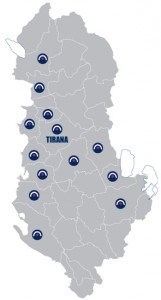
Albanians no longer have to watch usage meters while browsing the Internet and downloading movies and music. The country’s largest ISP – ABCom – has eliminated data caps on all but its cheapest broadband plans (4Mbps service with a 2GB cap: $4.81 for 15 days or 4Mbps service with a 5GB cap: $9.69 for 30 days). Now residents of Tirana, Durrës, Shkodër, Elbasan, Vlorë, and Gjirokastër can browse the Internet at self-selected speeds between 1-100Mbps with no usage-based billing or fixed caps.

It is remarkable progress for Europe’s poorest country. For much of the 20th century, Albania was infamous for its oppressive Communist dictatorship under the leadership of Enver Hoxha, a man who felt Stalin was the Soviet Union’s last true Communist leader and who courted and later cut ties with both the U.S.S.R. and the People’s Republic of China over what he called their “revisionist Marxist-Leninist” policies that betrayed true socialism. Hoxha’s idea of a worker’s paradise was to force huge numbers of both blue and white color workers into the fields every summer to help harvest the country’s strawberry crop.

During Hoxha’s 40 years in power, telecommunications for most Albanians consisted of a portable radio (and occasionally an imported television). Only 1.4 out of 100 had basic telephone service. If more wanted it, they could not get it. A long waiting list guaranteed an installation date years in the future. Albania began its transformation into a democracy with just 42,000 telephone lines, despite a population of nearly three million.

After the Communist government fell in 1991, life changed little in rural Albania. Peasants found initiatives to improve rural telephone service so irrelevant they knocked out service to about 1,000 villages after commandeering telephone wire to build fences to keep their sheep herds from straying. Even in the capital city Tirana, telecommunications infrastructure was decrepit at best. Even the wealthiest Albanians had to contend with rotary dial telephones produced in a forgotten factory in Bulgaria or Romania. Many preferred refurbished telephones rebuilt with scrap parts obtained from Italy.

Today, like many other countries lacking wired infrastructure, Albanians depend mostly on their cell phones to communicate. In 2012, there were 312,000 landlines in use, but 3.5 million cell phones were active. More than a half million wireless users rely entirely on their phones for Internet access.

no limit internet

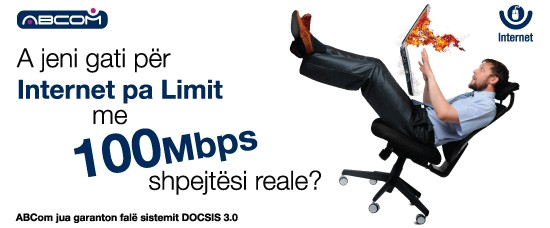
“Are you ready for unlimited Internet with guaranteed 100Mbps speed?”

In 1998, ABCom launched its Internet Service Provider business, initially selling DSL and wireless broadband. With Albania’s economy always in difficulty, the country chose the cheaper path followed by North America — adopting Hybrid Fiber-Coax (HFC) network technology instead of fiber to the home, common elsewhere in southern Europe. HFC Internet access is better known by most of us as broadband from our local cable company. Expansion of wired broadband has been very slow in Albania. The concept of delivering television, broadband, and phone service over ABCom’s cable system in a triple play package only began in 2009.

The biggest attractions to wired broadband include no data caps and more reliable fixed broadband speeds the country’s wireless providers cannot deliver. Because of wide income disparity, ABCom offers a large range of speed plans for different budgets: 1, 2, 4, 8, 12, 30, and 100Mbps.

In response, competition from wireless providers has stepped up recently. Vodafone Albania is offering five mobile Internet options for users of its 3G network. Customers can opt to pay for daily, weekly or monthly bundles. The 40MB daily bundle costs $0.58; the 250MB weekly bundle costs $2.91; the 500MB monthly bundle costs $4.85, and the 1GB monthly bundle costs $7.76. The speeds are much slower than the plans offered by ABCom, however.

[flv]http://www.phillipdampier.com/video/ABCom Mesazh Promocional nga ABCom March 2013.mp4[/flv]

ABCom produced this television ad introducing its new triple play TV, broadband, and telephone package for Albanian customers. (Albanian) (0:31)

Complete Video of NY Public Service Commission Meeting in Buffalo

[flv]http://www.phillipdampier.com/video/psc-meeting-tweaked-audio.flv[/flv]

My apologies for the poor audio. You will need to stay close to the volume control on this one because the volume may suddenly change between speakers. We had less than ideal recording conditions and no access to the microphone output. Testimony from Comcast begins 5:40 into the video. Our testimony starts at 36:30, which closely follows the transcript already published. Q&A follows me and then the public input session begins.

Note if you wish to receive a copy of this in higher resolution for rebroadcast on a public access channel or for other purposes, please use the Contact Us button and we’ll be able to provide a copy. File size will exceed 1GB, however. (1 hour, 35 minutes)

We’ve Been Robbed: Slovak Telecom Announces Free Speed Upgrade: 300/30Mbps for $27 a Month

Phillip Dampier June 18, 2014 Broadband Speed, Competition, Consumer News, Data Caps 3 Comments

Slovak_Telekom_(logo)While your Internet bill is likely north of $50 a month, customers of Slovak Telecom in the eastern European nation of Slovakia will get a free speed upgrade to 300/30Mbps effective Aug. 1, with no change in price.
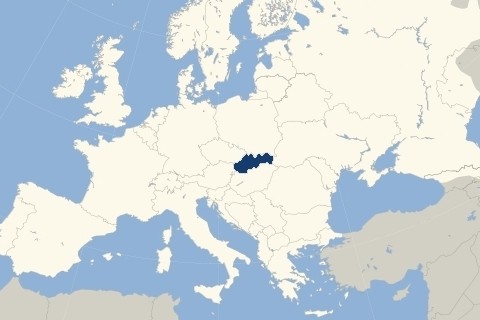
Slovak Telecom customers on its fiber to the home network subscribed to the super premium “Magi Internet XL” plan will continue to pay just over $27 a month for the service. Customers will see the speed upgrades gradually roll out across the service area over the summer and fall. Customers will be given new equipment to support the new speeds.

map-slovakiaMeanwhile, a competing fixed line provider, Slovanet, is taking a cue from Google Fiber and polled residents of the city of Dunajska Streda where it should deploy its fiber to the home service first. Slovanet customers will be able to buy 100Mbps fiber broadband through its subsidiary MadNet, along with a 100-channel TV package and phone service.

The broadband package alone costs $31 a month, more expensive than Slovak Telecom, but it comes with some stunning promotions for customers, starting with a $1.36 installation fee. The other generous offers: a Lenovo brand tablet for $1.36, a cordless phone for $1.36, and a choice of wireless routers as low as $1.36. An add on wireless package is also promotionally priced at $1.36.

Slovanet offers a 20-channel basic cable TV package at no charge to current customers and a 35-channel TV package that includes many of the most popular channels in Slovakia for $12 a month. Phone service is free if you are willing to pay 5¢ per minute to numbers of non-Slovanet customers (calling other Slovanet customers is free).

If you want unlimited local/regional calling, the phone service costs $5.29 a month. Unlimited long distance can be added for $10.77 a month.

Search This Site:

Contributions:

Recent Comments:

Your Account:

Stop the Cap!