Home » Broadband Speed » Recent Articles:

Not Only Was Comcast’s Customer Retentions Guy Annoying, He Was Also Factually Wrong

astound-broadband-logoNearly two million people have listened to the Comcast customer service call from hell since it went viral earlier this week.

Comcast quickly decided it was best to apologize:

We are very embarrassed by the way our employee spoke with Mr. Block and Ms. Belmont and are contacting them to personally apologize. The way in which our representative communicated with them is unacceptable and not consistent with how we train our customer service representatives. We are investigating this situation and will take quick action. While the overwhelming majority of our employees work very hard to do the right thing every day, we are using this very unfortunate experience to reinforce how important it is to always treat our customers with the utmost respect.

csrSetting aside all that, we decided to investigate why Mr. Block was willing to subject himself to 18 minutes of phone hell to cancel his service.

At one point, we learn he is switching to Astound, a provider of cable TV, broadband internet, and telephone services on the West Coast, serving over 325,000 residential and business customers within communities in the San Francisco Bay area. Astound is an overbuilder, which means it is one of those rare instances where Comcast faces head to head competition with a company that can deliver more than DSL.

Although Comcast’s rep swore Comcast had the fastest Internet speeds (it doesn’t) and can deliver maximum savings (also wrong), it turns out Astound offers both cheaper and faster Internet service. We’d probably switch too, although we wish Astound would dump its 1TB monthly usage cap. How many customers even come close to that isn’t known, but it is likely under 1%, which makes us wonder why they bother with a cap at all?

We collected pricing information from both Astound and Comcast’s websites and here is what we found:

Stop the Cap! will include this incident in our formal filings with the FCC and New York State Public Service Commission in opposition to the merger of Time Warner Cable and Comcast. Comcast customers tell us Mr. Block’s experiences, although extreme, are not uncommon when dealing with Comcast’s customer retention department.

Canceling Comcast Is Like a Bad Breakup – Listen and Cringe As Comcast Desperately Begs You to Stay

Comcast-LogoDo you remember that high school love that killed you when they decided it was time to move on? You begged, you pleaded for them to change their mind to no avail. Nothing you said made any difference.

Some people never get over that teenage tragedy… and then they go to work for Comcast’s customer retention department indefatigably browbeating departing customers in a misguided effort to salvage damaged relationships with the cable company.

Stop the Cap! reader Bryan shares with us several minutes of the Block family’s life they’ll never get back. After 10 minutes on the phone repeatedly requesting to cancel Comcast service, Block and his wife decided to record the ongoing absurdity to share with the world. The result is eight more minutes of cringing embarrassment as an increasingly exasperated retention representative repeatedly demands to know why they want to leave.

never leaveIt all sounds like eavesdropping on your roommate’s breakup with their boyfriend. Or leaving a cult. This guy just can’t understand what the heck you were thinking when you decided Comcast was no longer right for you. Block was in no mood to explain himself, but for the benefit of others, we’d love to arm you with a few reasons to explain why you don’t want anything more to do with Comcast:

“Being that we are the number one provider of Internet and TV service in the entire country, why is that you are not wanting to have the number one rated Internet service available,” the retention rep demanded to know.

Our answer: Because you want to cap our broadband experience, you charge outrageous prices for renting a cable modem, and your speed claims mean nothing if we don’t actually get those speeds because of yet another outage or service problem.

“So you’re not interested in the fastest Internet in the country,” Comcast’s rep asks.

Our answers: Sure I am, which is why I am switching to the fiber competitor that delivers those speeds -0r- Not if you are putting a usage cap on me. Who wants a Ferrari they are told can’t be driven beyond the block?

“You don’t want something that works? …So why don’t you want something that’s good service and something that works,” asks Comcast’s rep.

Our answer: Do you actually subscribe to Comcast yourself? You guys didn’t win Worst Company in America honors for nothing.

“I’m really ashamed to see you go to something that can’t give you what we can,” argues the rep.

Our answer: That’s right. My long ongoing nightmare of bad service, high prices, and usage capped Internet is finally over. See ya.

If you really want Comcast to convince you to stay, tell them you want a permanent waiver in writing from any usage limits and/or overlimit fees. Demand aggressive discounts that deliver real savings, and never take their first offer. If they can waste 18 minutes of Ryan Block’s time, you can be just as ruthless when demanding a better deal for yourself.

As Ryan indicates, this retention representative is the perfect example of how Comcast won its reputation as one of most hated companies in America.

Here’s How to Tell the N.Y. Public Service Commission to Reject the Comcast/TWC Merger

ny pscThe New York Public Service Commission needs to hear from you about the Comcast-Time Warner Cable merger. Unlike some of the southern and midwestern states that have utility commissions that basically rubber stamp the agenda of Big Telecom companies, New York’s PSC has a reputation for being tougher and more customer-oriented. But the PSC cannot act in your interest if you don’t share your views.

It is incredibly easy to file your own comments with the PSC. Nearly 2,300 New Yorkers have done so thus far, but we need to make sure they understand our serious objections to Comcast’s usage caps, its expensive service, and customer abuse.

We have provided a sample letter below. We hope you will write your own, but offer ours as a guide that includes some of our biggest concerns. We may prepare another one soon outlining other concerns.

How to file your comment:

  • E-Mail: [email protected]
  • Mail: Hon. Kathleen H. Burgess, Secretary, Public Service Commission, Three Empire State Plaza, Albany, New York 12223-1350.
  • Phone: 1-800-335-2120 (press “1” to leave a recorded comment)

All comments should refer to “Case 14-M-0183, Petition of Comcast Corporation and Time Warner Cable Inc.”

Hon. Kathleen H. Burgess
Secretary
Public Service Commission
Three Empire State Plaza
Albany, New York 12223-1350

Re: Case 14-M-0183, Petition of Comcast Corporation and Time Warner Cable Inc.

Dear Ms. Burgess,

I am writing to ask the Public Service Commission to reject the merger proposal of Comcast and Time Warner Cable on the ground the companies have failed to show such a merger would be in the best interests of New York and its residents.

Although Time Warner Cable has never been a prize, Comcast’s reputation for bad service, high prices, rationed Internet access, and customer abuse is well documented in just about every community the company serves. Comcast has repeatedly been voted the “Worst Company in America” by Consumer Union’s Consumerist.com. The American Consumer Satisfaction Index has documented so many complaints about Comcast, it declared it the worst company it has ever scored, performing even worse than the Internal Revenue Service. For more than three years running, Harris Interactive has called Comcast one of the least reputable companies in America.

That alone should be enough to reject this merger out of hand. Permitting it would reward this company’s appalling behavior towards its own customers and expose New Yorkers to an even bigger monopoly problem than we deal with now. Unless you live in a Verizon FiOS service area, cable is your only real choice for true broadband speeds. DSL is rapidly losing favor and market share and Verizon has shown no interest in expanding it.

Comcast already uses its market power to its advantage by raising prices… a lot. Time Warner Cable charges less for its services than Comcast does.

For example, Time Warner Cable offers a standard television service package that provides all the popular cable networks for one price. Comcast offers a similar package but stripped out cable networks including Cloo, CNBC World, Al Jazeera America, Discovery Fit & Health, Disney XD, DIY, a range of ESPN’s extra networks, EWTN, Fine Living, Fox Business News, Great American Country, IFC, Investigation Discovery, Lifetime Real Women, Military Channel, MLB, most of MTV’s extra networks, NBA, National Geographic Channel, NFL Network, NHL Network, most of Nickelodeon’s extra networks, OWN, Oxygen, Sundance, Turner Classic Movies, The Science Channel, and VH1′s extra networks.

Customers who want these networks, like Turner Classic Movies, National Geographic, and IFC will have to pay a stunning price of up to $86 a month — just for television. Many of these networks are especially popular with fixed income older residents, who will now face an even larger cable TV bill.

Comcast promotes the fact its Internet speeds are faster than Time Warner Cable, but that is not true as Time Warner Maxx upgrades arrive. Comcast Internet service costs more, is slower, and increasingly usage-capped. Time Warner Cable has made clear it will not limit customers’ Internet usage. Comcast has made clear it will, predicting usage limits/usage-based pricing will be imposed on customers across its entire footprint within five years. That is no improvement for New York. That is literally a downgrade. We can do better in New York with Time Warner Cable.

In fact, the company has promised extremely little to New York after winning your approval to merge. Comcast is so arrogant, it already announced it will not share any cost savings with customers, promising even higher cable bills for New York with the merger. Even its touted X1 set top system will cost New Yorkers — it comes with a steep installation price of almost $100. Again, how does this serve the public interest?

Comcast’s public service programs are also woefully inadequate. Its Internet Essentials is a bureaucratic nightmare that only provides temporary discounts to a small percentage of customers (with school age children) who need an affordable Internet option. I guess childless couples and the elderly poor don’t matter. Time Warner Cable offers a $14.99 discount program available to anyone who wants it, no paperwork or waiting periods required.

It is my understanding Comcast must prove this merger is in the public interest to win your approval. It has utterly failed to do so, and I expect my state’s Public Service Commission to reject this merger. This is one deal that can never be modified sufficiently to make it acceptable for people like myself. You are doing us no favors trying to negotiate for an Internet discount program or expanding Comcast’s service area by a small amount in rural upstate New York. The end result is that millions of New Yorkers will get worse service than we get today, at a higher price, with little/no competition on the horizon.

This is a rare opportunity for our state, which lost most of its oversight powers over the cable industry years ago. Cable operators have abused their deregulated status and have raised prices, provided dreadful customer service, and have kept competition away. Letting Comcast into New York from Buffalo to the Bronx will only encourage more abuse, wreaking havoc on New York’s growing digital economy. Let’s send a clear message to Comcast New York isn’t willing to put our broadband future in the hands of “the worst company in America.” Let’s make it clear enough is enough.

Sincerely,

 

Cox Cable’s Anachronistic World of Nonsense About Data Caps: Inventing New Ways to Bill You More

Cox is behind the times.

Cox is behind the times.

While the rest of the world is moving towards gigabit broadband and unlimited access, Cox Cable continues to live in the past with a regime of data caps the company blames on increased data usage. Your only solution is to upgrade to a bigger data plan you may not want or really need.

Somehow, the folks at Cox can’t seem to manage the natural growth of the Internet while start-ups ranging from Google Fiber to a local fiber provider just getting started in our own community goes out of their way to point out how unnecessary usage limits and usage billing really are.

At Stop the Cap!, we’ll let you in on a little secret the “tech wonder twins” at Cox forgot to mention: data caps are not about managing Internet traffic, they are about managing to control costs, protect cable-TV revenue, and eventually empty customers’ wallets.

Since data caps don’t make much sense in the 21st century reality-based community, Cox attempted a longer-form rationale for data caps in a video that resembles a bad VHS copy of an interrogation by your local homicide squad. Don’t worry, only the truth gets murdered by the ironically named “Tech Talk with Todd and Sarah.” Six minutes later, you still know they’re full of it.

Tip: Next time, bring “the tech.”

[flv]http://www.phillipdampier.com/video/Cox Tech Talk with Todd and Sarah Internet Usage Trends.mp4[/flv]

What Cox still fails to understand (and what Google will have to teach them when they invade Cox’s biggest territories, including Phoenix) is that data caps and usage billing are as anachronistic as those 1978 limited edition Diana Prince/Wonder Woman glasses Sarah is still wearing. (6:17)

Antitrust Us: Is ComVerizablAsT&TWCDirecTV Really Best for American Broadband?

Phillip Dampier July 2, 2014 Astroturf, AT&T, Broadband "Shortage", Broadband Speed, Comcast/Xfinity, Competition, Consumer News, Data Caps, DirecTV, Editorial & Site News, Net Neutrality, Public Policy & Gov't, Rural Broadband, Video Comments Off on Antitrust Us: Is ComVerizablAsT&TWCDirecTV Really Best for American Broadband?
Bad enough

Bad enough

A big company needs a big name, and so what if you can’t say it out loud, so long as your check reaches the cable cartel on time to avoid those inconvenient late fees.

The shock waves of the $45 billion dollar proposed merger of Comcast and Time Warner Cable (not to mention AT&T and DirecTV) have reached as far as Great Britain where appalled editorial writers in the British press are pondering whether Washington has lost its mind or just its integrity… or a combination of both, by actually contemplating the unthinkable rebirth of the American Robber Baron.

Only instead of railroads powering America’s early 20th century economy, today its broadband. Overseas, broadband is plentiful, fast, and cheap. Back home, cable operators are hard at work in a comfortable monopoly/duopoly working on excuses to justify Internet rationing with usage caps, outrageous equipment rental fees, rate hikes, and usage billing for a product about as cheap to offer as a phone call on one of those unlimited calling plans you probably already have.

From The Economist:

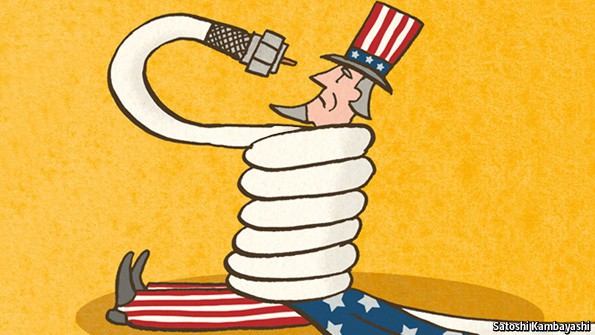
“On “OUTLAW”, a drama that aired on NBC, a Supreme Court justice leaves the bench to join a law firm. In real life he might have begun working for Comcast, America’s largest cable company, which owns NBC. Many of Washington’s top brass are on Comcast’s payroll, including Margaret Attwell Baker, a former commissioner of the Federal Communications Commission (FCC), America’s telecoms regulator, who in government had helped approve Comcast’s takeover of NBCUniversal in 2011. Even Barack Obama has Comcast ties. “I have been here so much, the only thing I haven’t done in this house is have seder dinner,” he quipped at a fundraiser hosted last year at the home of David Cohen, Comcast’s chief lobbyist.

“It helps to have influential friends, especially if you are seeking to expand your grip on America’s pay-TV and broadband markets.

“[…] The deal would create a Goliath far more fearsome than the latest ride at the Universal Studios theme park (also Comcast-owned). Comcast has said it would forfeit 3m subscribers, but even with that concession the combination of the two firms would have around 30m—more than 30% of all TV subscribers and around 33% of broadband customers. In the cable market alone (ie, not counting suppliers of satellite services such as DirecTV), Comcast has as much as 55% of all TV and broadband subscribers.

Worse

Worse

“Comcast will argue that its share of customers in any individual market is not increasing. That is true only because cable companies decided years ago not to compete head-to-head, and divided the country among themselves. More than three-quarters of households have no choice other than their local cable monopoly for high-speed, high-capacity internet.

“For consumers the deal would mean the union of two companies that are already reviled for their poor customer service and high prices. Greater size will fix neither problem. Mr Cohen has said, “We’re certainly not promising that customer bills are going to go down or even that they’re going to increase less rapidly.” Between 1995 and 2012 the average price of a cable subscription increased at a compound annual rate of more than 6%.”

Before blaming it all on President Obama’s close relationship with Comcast’s top executives, it was the Republicans in Washington that set this tragic monopolistic farce into motion. Michael Powell, President George W. Bush’s idea of the best man in America to protect the public interest at the FCC, represented the American people about as well as ‘Heckuva Job Brownie.’ Instead of promoting competition, Powell used his time to beef-up his résumé for a very cushy post-government job heading America’s top cable lobby – the National Cable & Telecommunications Association. Attwell-Baker was even more shameless, departing the FCC for her sweet new executive digs at Comcast just a short time after enthusiastically voting in favor of its NBCUniversal merger deal.

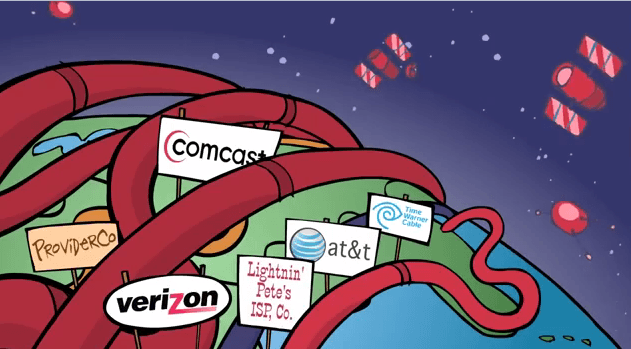
snakePowell and others made certain that Internet Service Providers would not be classified as “common carriers,” which would require them to rent their broadband pipes at a reasonable wholesale rate to competitors. The industry and their well-compensated friends in the House and Senate argued such a status would destroy investment in broadband expansion and innovation. Instead it destroyed the family budget as prices for mediocre service in uncompetitive markets soared. Today, consumers in common carrier countries including France and Britain pay a fraction of what Americans do for Internet access, and get faster speeds as well.

Letting Comcast grow even larger, The Economist argues, will allow one company to dominate not just your Internet experience, but also the content consumers access and at what speed.

“There is plenty for Mr Obama and Mr Cohen to discuss at their next dinner,” concludes the magazine. “But better yet, officials could keep their distance from Comcast, and reject a merger that would reduce competition, provide no benefit to consumers and sap the incentive to innovate.”

Considering the enormous sums of money Comcast has shown a willingness to spend on winning over supporters for its business agenda, restraint on the part of Washington will need voter vigilance, much the same way calling out non-profits who gush over Comcast while quietly cashing their contribution checks must also be fully exposed to regulators who will ultimately decide the fate of the merger.

[flv]http://www.phillipdampier.com/video/Antitrust Us.mp4[/flv]

Antitrust Us: Cartoonist Mark Fiore takes on the corporate idea that merging cable companies together creates more competition. (1:50)

Search This Site:

Contributions:

Recent Comments:

Your Account:

Stop the Cap!