Home » Broadband Speed » Recent Articles:

New Zealand Getting 200/200Mbps Uncapped Fiber Broadband

Phillip Dampier October 21, 2014 Broadband Speed, Competition, Consumer News, Data Caps, Public Policy & Gov't Comments Off on New Zealand Getting 200/200Mbps Uncapped Fiber Broadband

Snap-Logo-2-300x300New Zealanders want faster broadband and they want it without a usage cap, and Snap is ready to offer both.

Snap’s nationwide 200/200Mbps Ultra-Fast Broadband commenced this week providing the fastest broadband on offer throughout New Zealand, priced at $111.50 a month with an unlimited use add-on available for an extra $8 a month. To date, the service had only been available in Auckland.

Kiwis can sign up for Snap on the Chorus network for the fastest 200/200Mbps speeds. Those served by Enable or UltraFast Fibre will see upload speeds reduced to 20Mbps for now, but will also be compensated with a lower monthly price: $87.71.

A wireless gateway to support the faster speeds will be provided at no extra cost to customers signing up for 200Mbps service.

no limitsSnap’s new service comes as a result of New Zealand’s deployment of fiber networks and an end to usage caps, consumption billing, and/or bandwidth throttling. Snap has been well received in New Zealand because it guarantees no traffic shaping, traffic management schemes, or mandatory usage caps. This comes at a time when North American providers are trying to force customers into usage-capped broadband plans and wireless carriers insist on using traffic shaping and caps.

“There is no faster commercially available service across the whole country today,” said James Koers, general manager, Snap Retail. “We’ve built our own network to ensure customers receive the fastest, most reliable service possible. We don’t cache or proxy or shape traffic in any way, giving customers peace of mind that they’re getting the service they expected and paid for.”

Koers adds there is a clear demand for fiber optic broadband across the country.

“Today, two out of every three of our sign-ups are for a fibre service which shows New Zealanders’ appetite is increasing for UltraFast Broadband as it becomes available,” said Koers. “200Mbps is just the beginning though as we’re now trialling Chorus’ new 1Gbps residential service.”

PC Magazine has rated Snap the fastest broadband provider in the country.

Comcast Invites Customers to Upgrade to New $10 Modem Fee, Or Else Watch Your Speed Degrade

Phillip Dampier October 20, 2014 Broadband Speed, Comcast/Xfinity, Consumer News, Data Caps 13 Comments

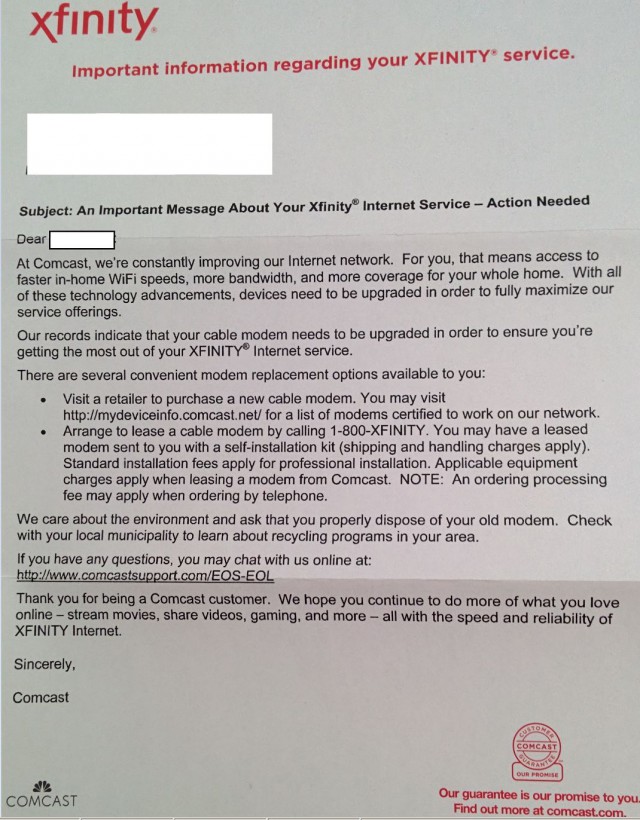
Some Comcast customers with older cable modems are receiving letters from the cable company warning they will need an upgraded modem to “get the most out of your XFINITY Internet service.”

comcast upgrade

Customers are asked to “properly dispose” of old equipment while contemplating either buying a new modem or leasing one from Comcast. Sticking with cable company-provided leased equipment is the choice of more than 90 percent of cable Internet subscribers, despite the fact cable operators charge hefty rental fees. In parts of the Pacific Northwest, Comcast has introduced its newest price for rented cable modems: $10 a month, which amounts to $120 a year — more than the cost of buying a modem outright.

Comcast’s letter may be premature for customers with DOCSIS 2 equipment subscribed to speeds under 38Mbps (the top-rated speed for DOCSIS 2 equipment). Although DOCSIS 2 is not fast enough for Comcast’s 50Mbps Blast Internet plan, it’s more than adequate for the 25Mbps Performance Internet plan and other lower speed plans.

Customers in Illinois are also getting the letter, arriving as the company boosts speeds. Most are being sent to customers using cable modems more than 3-4 years old. Customers can find a new compatible modem on Comcast’s Approved Device List. We strongly recommend customers buy a modem and avoid renting one from Comcast. Monthly modem rental fees, now $8 and likely to increase to $10 across the country in the future, are a major earner for Comcast, bringing in $275-300 million quarterly.

Rural America: Welcome to Verizon LTE Broadband – $120/Mo for 5-12Mbps With 30GB Cap

They are coming.

With both AT&T and Verizon petitioning various state regulators for permission to switch off rural landline phone and broadband customers and force customers to use wireless alternatives, getting affordable broadband in the countryside is becoming increasingly difficult.

Last week, Millenicom — a reseller of wireless broadband service specializing in serving rural, long-haul truckers, and recreational vehicle users notified customers it was transferring their accounts directly to Verizon Wireless and will no longer have any role selling discounted Verizon Wireless broadband service.

Reports indicate that Millenicom’s contract renewal negotiations with Verizon did not go as expected and as a result customers are facing potential price increases and long-term contracts to continue their wireless broadband service.

Both AT&T and Verizon have told regulators they can satisfactorily serve rural customers with wireless LTE broadband service as an alternative to maintaining rural landline infrastructure. Neither company likes to talk about the price rural customers will pay if they want to keep broadband in their homes or businesses.

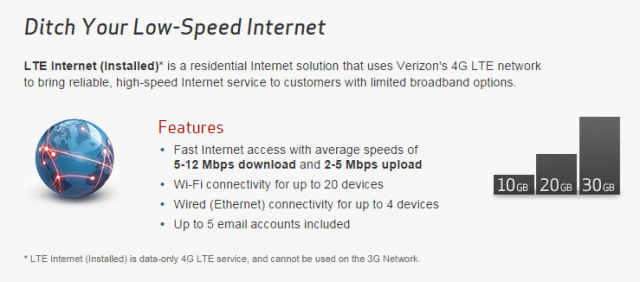
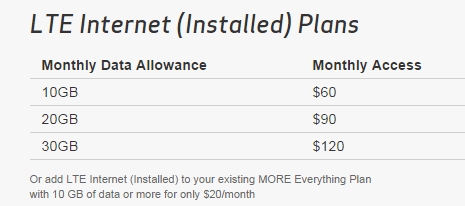
Some Millenicom customers have been invited to preview Verizon Wireless’ Home LTE Installed Internet plans (formerly known as HomeFusion) and many are not too pleased with their options:

lte1

lte2

Verizon’s overlimit fee is $10/GB for those that exceed their plan limit. According to several Amazon.com reviews of the service (it received 1.5 stars), customers are quickly introduced to “Verizon’s shady usage meter” that consistently measures phantom usage. Bills of $400-500 a month are not uncommon. One customer was billed for 18GB ($180) in extra usage despite following Verizon’s suggestion to stop using the service when it reported he reached 29GB of usage.

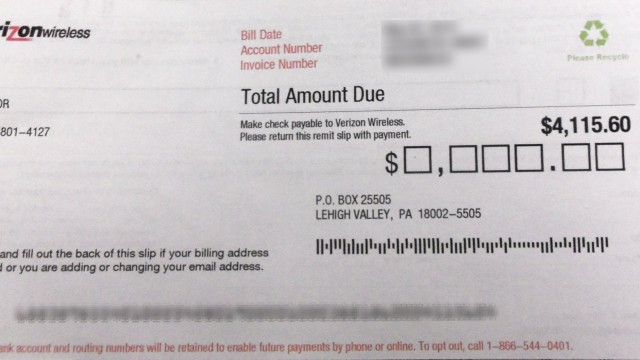
verizon bill

This bill includes more than $3,000 in data overlimit fees.

“The bill came with the bogus data charges, and it was twice as much as the meter detected,” the customer reported.

In fact, the phantom usage has become so pervasive, Verizon customers have dubbed the phenomenon “ghost data,” but the overlimit fees Verizon expects customers to pay are very real.

“[It] went out more than my DSL and my first bill from Verizon was $1300+,” reported Jill Kloberdanz. “I want this demon out of my house.”

“According to [Verizon], I used over 65GB in just one week,” reported Aron Fox. “And they want almost $800 for it. My wife and I are two 60-somethings that never game and rarely stream.”

“Definitely stay away […] unless you like to see your data charges skyrocket (in my case more than doubling) when your use doesn’t,” reported Richard Thompson. “I’ve pulled the plug on it — literally.”

“We have the same problem – huge data overages, meter does not match our usage,” writes Heather Comer. “We turn the router off at night and when we check the next morning, it is still accumulating data.”

There are close to a dozen more complaints about Verizon’s usage meter, all stating they were charged for usage even when the equipment was switched off.

While both Verizon and AT&T stand to save millions disconnecting rural landline customers, they stand to earn even more switching rural customers to their more costly (and profitable) wireless alternatives.

Frontier Faces Lawsuit in West Virginia Alleging False Advertising, Undisclosed DSL Speed Throttling

The slow lane

The slow lane

Frontier Communications customers in West Virginia are part of a filed class-action lawsuit alleging the phone company has violated the state’s Consumer Credit and Protection Act for failing to deliver the high-speed Internet service it promises.

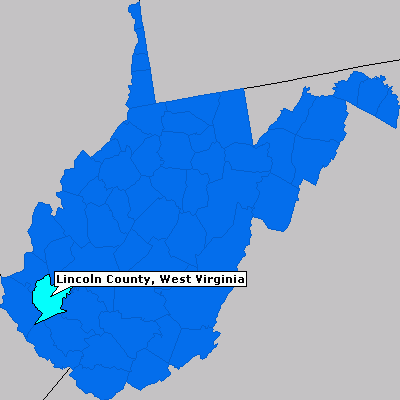
The lawsuit, filed in Lincoln County Circuit Court, claims Frontier is advertising fast Internet speeds up to 12Mbps, but often delivers far less than that, especially in rural areas where the company is accused of throttling broadband speeds to less than 1Mbps. The suit also alleges Frontier’s broadband service is highly unreliable.

“The Internet service provided by Frontier does not come anywhere close to the speeds advertised,” wrote Benjamin Sheridan, the Hurricane lawyer filing the lawsuit on behalf of three Frontier customers. The attorney is seeking to have the case designated a class action lawsuit that would cover Frontier customers across the state.

“Although we cannot guarantee Internet speeds due to numerous factors, such as traffic on the Internet and the capabilities of a customer’s computer, Frontier tested each plaintiff’s line and found that in all cases the service met or exceeded the ‘up to’ broadband speeds to which they subscribed,” Frontier spokesperson Dan Page told the Charleston Gazette. “Nonetheless, the plaintiffs filed their case in Lincoln County, where none of them lives. If necessary, we are prepared to defend ourselves in court and bring the facts to light.”

Frontier’s general manager in West Virginia, Dana Waldo, may have helped the plaintiffs when he seemed to admit Frontier was purposely throttling the Internet speeds of its customers, a move Sheridan claims saves Frontier “a fortune” in connectivity costs with wholesale broadband providers like Sprint and AT&T.

Sheridan

Sheridan

“If as you suggest, we ‘opened up the throttle’ for every served customer, it could create congestion problems resulting in degradation of speed for all customers,” according to Waldo as part of an email exchange with one of the class members cited in the lawsuit.

The lawsuit also cites a state report issued over the summer that found just 12 percent of Frontier customers receive Internet speeds that actually qualify as “broadband” under federal and state standards. Frontier’s speed ranking is the slowest of any provider in the state. That is especially significant because Frontier is the largest ISP in West Virginia, and is often the only choice rural residents have for broadband service.

Frontier dismissed the state’s report claiming it was based on voluntary speed tests performed by disgruntled customers.

“As we’ve said before, the speed tests are the result of self-selected, self-reported samples,” Page said. “People who take speed tests tend to be those with speed problems or low speeds.”

“Even if that were true, it doesn’t account for Frontier’s poor performance,” said Frontier customer William Henley. “If every person that ran a speed test in West Virginia was annoyed with their provider, Frontier still came in last place.”

Frontier’s competitors scored better:

  • lincoln countyComcast: 88% of customers met or exceeded state and federal standards;
  • Suddenlink Communications: 80%
  • Time Warner Cable: 77%
  • Shentel: 71%
  • Armstrong Cable: 67%
  • LUMOS Networks: 44%

“…Frontier’s practice of overcharging and failing to provide the high-speed, broadband-level of service it advertises has created high profits for Frontier but left Internet users in the digital Dark Age,” Sheridan wrote. “As a result, students are prevented from being able to do their homework, and rural consumers are unable to utilize the Internet in a way that gives them equal footing with those in an urban environment.”

Sheridan also accused Frontier of delivering its fastest speeds only in areas where it faces competition. Where there is none, Frontier can afford to go slow.

But slow speed is not the only issue. One plaintiff — April Morgan in Marion County — says she has to reset her modem up to 10 times a day to stay connected to the Internet. Her modem has been replaced several times by Frontier, but that has done little to solve her problem.

Frontier customers who check the company’s terms of service agreement may question whether Sheridan can get very far suing the company. A clause in the contract states customers must settle disputes only through binding arbitration or small claims court. Individual lawsuits, jury trials, and class-action cases are prohibited.

Sheridan points out customers have to go online to read the agreement – it is not provided to customers signing up for Internet service. A contract that forces customers to agree to its terms without getting informed consent may turn out not very binding under West Virginia law.

Lincoln County Judge Jay Hoke, assigned to hear the case, will likely face that matter in pre-trial motions.

West Virginia residents interested in the class action case can register here for updates.

The Capitol Forum’s Insightful Review of the Comcast-Time Warner Merger Deal: A Tough Sell

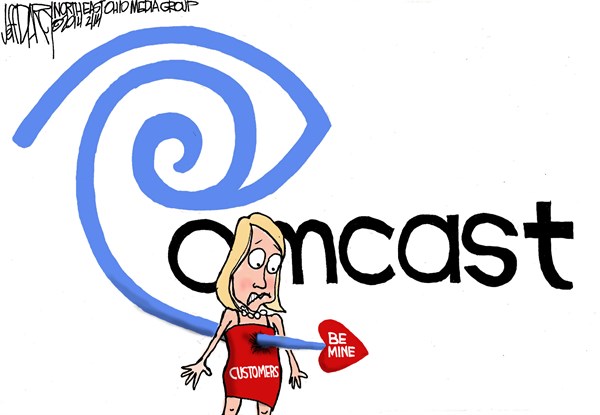
be mineWall Street is increasingly pessimistic about Comcast and Time Warner Cable pulling off their merger deal as regulators stop the clock to take a closer look at the transaction.

The Capitol Forum, an in-depth news and analysis service dedicated to informing policymakers, investors, and industry stakeholders on how policy affects market competition, specializes in examining marketplace mergers and their potential impact on American consumers and the general economy. The group has shared a copy of their assessment — “Comcast/Time Warner Cable: A Closer Look at FCC, DOJ Decision Processes; Merits and Politics May Drive Merger Challenge, Especially as Wheeler Unlikely to Embrace Title II Regulation for Net Neutrality” — with Stop the Cap! and we’re sharing a summary of the report with our readers.

The two most important government agencies reviewing the merger proposal are the Federal Communications Commission and the Department of Justice. The FCC is responsible for overseeing telecommunications in the United States and is also tasked with reviewing telecom industry mergers to verify if they are in the public interest. The Department of Justice becomes involved in big mergers as well, concerned with compliance with antitrust and other laws.

In many instances, the two agencies work separately and independently to review merger proposals, but not so with Comcast and Time Warner Cable.

Sources tell Capitol Forum there is a high level of coordination and information sharing between DOJ and the FCC, potentially positioning the two agencies in a stronger legal position if they jointly challenge the merger. Readers may recall AT&T’s attempt to buy T-Mobile was thwarted in 2011 when the FCC followed the DOJ’s lead in jointly challenging the merger on competition and antitrust grounds. With a united front against the deal in Washington, AT&T quickly capitulated.
comcast cartoonDespite a blizzard of Comcast talking points claiming the cable industry is fiercely competitive, Capitol Forum’s report indicates the DOJ staff level believes the cable industry suffers dearly from a lack of competition already, and allowing further marketplace concentration would exacerbate an already difficult problem.

Capitol Forum reports the DOJ’s staff is inclined to “take an aggressive posture with regards to [antitrust] enforcement.”

The DOJ would certainly not be walking the beltway plank to its political doom if it ultimately decides to oppose the merger.

Few on Capitol Hill are likely to fiercely advocate for a cable company generally despised by their constituents. The Capitol Forum report notes that Comcast faces powerful opposition and its political support is overstated. Comcast’s lobbying efforts and ties to President Obama and several high level Democrats have also been widely exposed in the media, which makes it more difficult for D.C.’s powerful to be seen carrying Comcast’s water.

In fact, the report indicates a regulatory challenge against Comcast and Time Warner Cable would face considerably less political opposition than what the FCC faces if it reclassifies broadband as a “telecommunications service,” protecting Net Neutrality and exposing the industry to stronger regulatory oversight.

The report suggests FCC Chairman Thomas Wheeler, who seems intent on opposing reclassification of broadband under Title II, may appease his critics by taking a stronger stance on the Comcast/Time Warner deal instead.

Wheeler has already expressed concern about the state of competitiveness of American broadband. He considers providers capable of delivering at least 25Mbps part of broadband’s key market, which in many communities means a monopoly for the local cable operator.

Understanding “The Public Interest” and the Implications of a Combined Comcast/Time Warner Cable on Competition
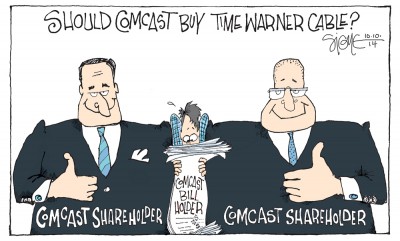
comcastbuy_400_241The FCC will review the transaction pursuant to Sections 214 and 310(d) of the Communications Act of 1934, in order to ensure that “public interest, convenience, and necessity will be served thereby.”

The merger proposal must also demonstrate it does not violate antitrust laws.

It is here that merger opponents have a wealth of arguments to use against Comcast and Time Warner Cable.

Despite Comcast’s insistence the deal would have no competitive implications, the Capitol Forum reports the merger’s potential anticompetitive effects are “widely recognized and evidence from the investigation could provide DOJ and FCC with a solid foundation to challenge the merger.”

Although the two cable companies don’t directly compete with each other (itself a warning sign of an already noncompetitive marketplace), the report finds “a wide array of anti-competitive effects and several antitrust theories” that would implicate the cable company in a Clayton Act violation.

Comcast is betting heavily on its surface argument that by the very fact customers will not see any change in the number of competitors delivering service to their area, the merger should easily clear any antitrust hurdles. That argument makes it more difficult for the DOJ to fall back on the usual market concentration precedents that would prevent such a colossal merger deal. To argue excessive horizontal integration — the enlarging of Comcast’s territory — the DOJ would first have to prove Comcast’s size in comparison with other cable companies is a reason for the courts to shoot down the deal. Or it could bypass Comcast’s favorite argument and move to the issue of vertical integration — one company’s ability to control not just the pipes that deliver content, but also the content itself.
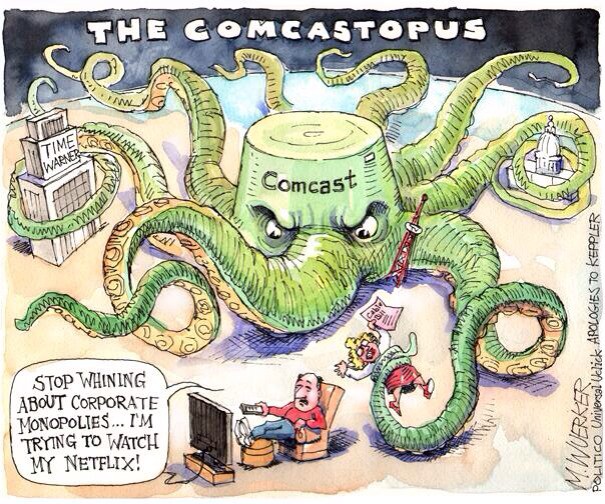
octopusHere the examples of potential abuse are plentiful:

  • Comcast would enjoy increased power to force cable programmers to favor Comcast in cable programming pricing and policies while allowing it to demand restrictions on competitive online video competitors or restrict access to popular cable programming;
  • Comcast could impose data caps and usage-based pricing to deter online viewing while exempting its own content by delivering it over a Wi-Fi enabled gateway, game console or set top box, claiming all are unrelated to Comcast’s broadband Internet service or network;
  • Force consumers to use Comcast set top boxes that would not support competing providers’ online video;
  • Use interconnection agreements as a clever way to bypass the paid prioritization Net Neutrality debate. Netflix and other content producers would be forced to compensate Comcast for reliable access to its broadband customers;
  • Noting AT&T has declared U-verse can not effectively succeed in the cable television business without combining its customer base with DirecTV to qualify for better volume discounts, there is clear evidence that a super-sized Comcast could command discounts new entrants like Google Fiber could never hope to get, putting them at a distinct price disadvantage.

The FCC’s scrutiny of Comcast’s merger deal has already uncovered evidence previously unavailable because of non-disclosure agreements which show Comcast’s heavy hand already at work.

The report notes Michael Mooney, a senior vice president and group general counsel at Level 3, told the Capitol Forum the dispute earlier this year between Netflix and Comcast could have been resolved in about five minutes had Comcast added a port to relieve congestion at an interconnection point. The cost? Just $5,000. Had Comcast been willing to spend the money, millions of Comcast customers would have never experienced problems using Netflix.

Whether Comcast is ultimately deemed too large to permit another consolidating merger or whether it is given conditional approval to absorb Time Warner Cable remains a close call, according to the Capitol Forum, despite the fact consumers have urged regulators for something slightly more concrete – a single sentence, total denial of its application.

[flv]http://www.phillipdampier.com/video/Capitol Forum The Consumer Welfare Test.mp4[/flv]

The Capitol Forum broadly explores how the “consumer welfare standard” has become a part of the antitrust review process over the last 30 years. Sometimes, a strict antitrust test is not sufficient to protect “the public interest” of consumers, and allows the dominant player(s) to harm competition. In the digital economy, corporate mergers that empower companies to restrict innovation can prove far more damaging than classic monopoly abuse. (15:52)


Search This Site:

Contributions:

Recent Comments:

Your Account:

Stop the Cap!