Home » Broadband Speed » Recent Articles:

AT&T Adds Atlanta, Chicago and Decatur for GigaPower Gigabit Fiber Most Won’t See Anytime Soon

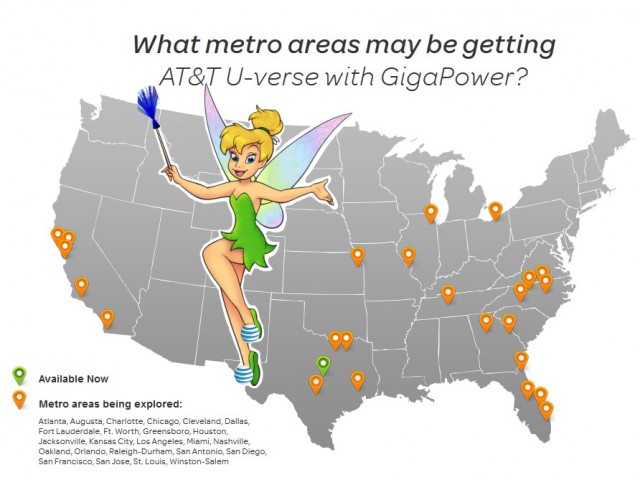
Notice the word "may"

Notice the word “may”

AT&T has promised an undisclosed number of customers in Chicago, Ill., and Atlanta, Decatur, and Newnan, Ga., will eventually get GigaPower upgrades to AT&T’s U-verse service, after moving customers to an all-fiber network that will deliver up to 1Gbps service.

“As a city that prides itself on creating a favorable environment for investment and innovation, I am happy to see AT&T bringing its ultra-high speed fiber network to the City of Atlanta,” said Atlanta Mayor Kasim Reed. “This is a great opportunity for our residents, businesses and visitors, who all stand to benefit from this new service. The City of Atlanta is one of the fastest growing tech hubs in the United States and a hotbed for entrepreneurial activity.  U-verse with AT&T GigaPower service will complement this engine of economic growth and help pave the way for future opportunities.”

But before the mayor gets too excited, he should consider AT&T’s track record for GigaPower upgrades in other cities where the service is offered. Customers complain the gigabit upgrade is difficult to get in single family homes, with most of the upgrades targeting multi-dwelling units like large condos or apartment blocks or new housing developments.

Customers in Austin complain to Stop the Cap! AT&T GigaPower looks more like a demonstration project than a serious effort at expanding super fast fiber broadband. Although pockets of service are established in some upscale areas, nobody at AT&T is willing to answer customers’ questions about exactly when service will arrive in unserved neighborhoods. Technicians are privately telling readers it will take more than a year for serious expansion efforts to begin across Austin.

While AT&T drags its feet on fiber expansion, it has no trouble hurrying out press releases suggesting cities including Atlanta, Augusta, Charlotte, Chicago, Cleveland, Fort Worth, Fort Lauderdale, Greensboro, Houston, Jacksonville, Kansas City, Los Angeles, Miami, Nashville, Oakland, Orlando, San Antonio, San Diego, St. Louis, San Francisco, and San Jose will soon see GigaPower in their areas. But AT&T isn’t putting much money where its mouth is, failing to significantly increase capital spending to upgrade the U-verse network.

In fact, AT&T executives have repeatedly reassured investors the company has no plans for a significant uptick in wireline capital spending — exactly what would be required to complete the gigabit expansion effort AT&T promises in press releases. In contrast, AT&T’s 2012 $14 billion Project Velocity IP (or VIP) was the company’s most visible and ambitious network build out initiative in wired service since the introduction of U-verse. Project VIP delivered a clear expansion of U-verse into new areas and brought new fiber connections to buildings, many that are now in use to offer GigaPower service in Austin.

Fiber broadband expansion is not cheap, and even after AT&T committed $14 billion to its expansion effort two years ago, the results are modest for U-verse because a considerable portion of the funds spent were invested in AT&T’s wireless network instead — always a priority:

State / City Investment amt. (wireless & wireline) U-verse locations Business connections On-net buildings Total investment (2010-2012)
California $1.15 billion 127,700 30,400 800 $7 billion
 — San Diego 15,950 2,900 90 $750 million
Texas $1 billion 138,300 24,200 600 $7 billion
Georgia $675 million $2.5 billion
 — Atlanta 12,100 11,450 400
Florida $425 million 25,050 18,450 550 $2.8 billion
Indiana $325 million 18,000 1,300 60 $1.3 billion
Michigan $275 million 35,550 2,150 70 $1.55 billion
Missouri $250 million 27,300 3,650 150 not reported
North Carolina $250 Million 9,900 1,800 50 $1.5 billion
Ohio $225 million 31,200 1,100 40 $1.5 billion
Alabama $200 million 6,600 600 20 $1.4 billion
Louisiana $175 million not reported 2,100 35 $1.2 billion
Mississippi $175 million 5,800 175 4 $975 million
Tennessee $175 million 13,600 325 9 $1.4 billion
Connecticut $140 million 6,600 1,100 40 $750 million
South Carolina $140 million 21,100 250 9 $850 million
Wisconsin $140 million N/A 525 20 $725 million
Oklahoma $120 million 13,850 875 25 $700 million
Kansas $110 million 10,150 650 30 $725 million
Nevada $110 million not reported 200 7 $600 million
Arkansas $90 million 8,750 1,000 25 $700 million

Chart courtesy: FierceTelecom

Data compiled from publicly released company information.

Reflecting on the numbers, it would take an investment at least equal, if not greater, than AT&T spent on Project VIP for AT&T to significantly upgrade the communities it claims will soon have access to GigaPower. Instead, it is more likely AT&T will introduce a handful of gigabit show projects and then incrementally upgrade selected neighborhoods over the next 3-5 years.

Existing competition makes all the difference as to what customers will pay for gigabit service from AT&T, assuming they can buy it at any price. As Google Fiber tears up the streets of Austin, it is clear Google will deliver real competition in that city, forcing AT&T to price its gigabit service at $70 a month (for customers willing to have their online activities tracked by AT&T). In nearby Dallas, where competition isn’t as robust, customers will have to pay at least $120 a month for the service.

South Korea Prepares for 10Gbps Broadband; Transfer 1GB File in 0.8 Seconds

Phillip Dampier October 14, 2014 Broadband Speed, Consumer News, Public Policy & Gov't 35 Comments

sk 10 gigWhile AT&T and Verizon argue over an FCC proposal that would set 10Mbps as America’s new minimum speed to qualify as “broadband,” South Korea is positioning itself to introduce 10Gbps fiber service.

SK Broadband will introduce its new 10 gigabit per second Internet service at the Oct. 20 Plenipotentiary Conference of the International Telecommunications Union to be held at Busan’s BEXCO Center, in partnership with the Ministry of Science, ICT and Future Planning and the National Information Society Agency.

With the latest advances in broadband technology coming mostly from Asian countries like Japan and South Korea, citizens of both countries are proud of the fact they are way ahead of the United States.

“In the 1960s the world watched NASA send men to the moon and many of us grew up amazed at the constant advancements of the Americans,” said Natsuki Kumagai. “Now the Americans watch us.”

“In my travels to the United States, it is very plain they have lost their way in advancing broadband technology,” said Pyon Seo-Ju. “Internet access is terribly slow and expensive because American politicians have sacrificed Americas’s technology leadership to protect conglomerates and allow them to flourish. Although unfortunate for America, this has given Korea a chance to promote our own industry and enhance the success of companies like Samsung that are well-known in the United States today.”

SK Broadband says its 10Gbps will be 100 times faster than Korea’s current average broadband speed of 100Mbps. Downloading a 1GB file takes 80 seconds with Korea’s average broadband connection today. SK’s new 10Gbps service will download the same file in 0.8 seconds.

The broadband company’s booth doesn’t hold back touting its global leadership in broadband, with the slogan “World’s Fastest, World’s First” seen throughout the conference center.

Earthlink Customers Benefit from Time Warner Cable Maxx Broadband Upgrades

earthlink_logoEarthlink customers in New York, Los Angeles and Austin are receiving letters from Time Warner Cable advising them they qualify for the same speeds Time Warner Cable broadband customers are receiving as part of the TWC Maxx upgrade program.

Standard Earthlink customers in these cities will get speed upgrades from 15/1Mbps to 50/5Mbps at no extra charge. Turbo speed customers will see speeds rise from 20/2Mbps to 100/10Mbps, also at no additional cost.

twcmaxStop the Cap! reader Iris was immediately suspicious about the tone of Time Warner’s letter, which has the potential of confusing customers that own their own cable modems. The letter suggests customer-owned equipment might not be compatible with the speed upgrades. Customers are given a phone number to verify their eligibility, and some who have contacted Time Warner Cable report back they have been given a brief sales pitch to ditch their own modem in favor of one from Time Warner Cable, which costs $5.99 a month forever.
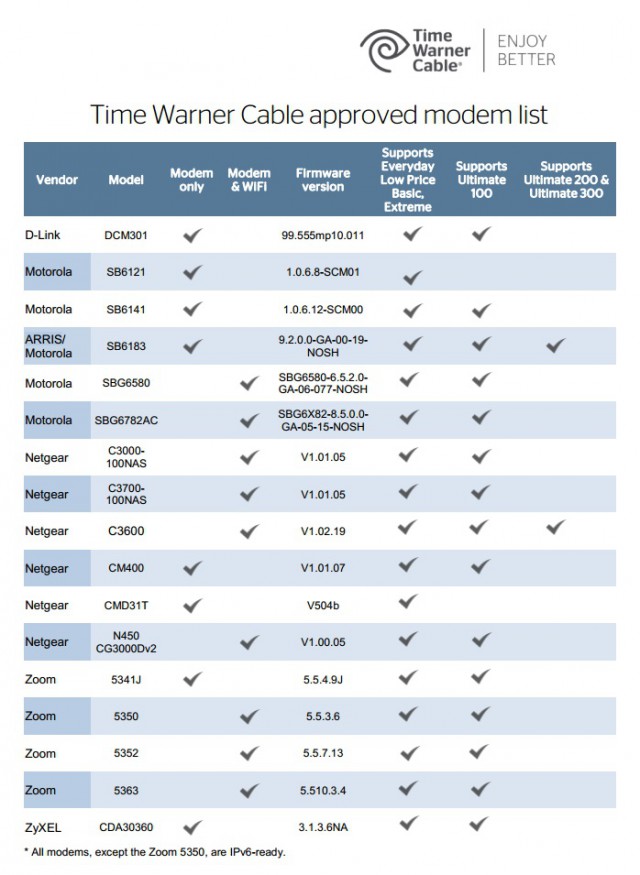

Time Warner could have simply enclosed its list of approved modems, which would answer customer concerns without having to make a phone call. But that wouldn’t give the company a chance to score extra revenue convincing customers to toss their old equipment in the trash while paying an unnecessary monthly modem fee for the rest of their lives.

For the record, your old modem probably will continue to work even if it isn’t capable of delivering the fastest speeds. If 50/5Mbps is fast enough for current Earthlink Turbo customers, they might want to consider downgrading service until they can budget to buy a new modem capable of taking full advantage of the faster 100/10Mbps speeds now on offer.

For your convenience, here is the latest Time Warner Cable Approved Modem List for TWC Maxx upgrade areas:

approved modems


Providers Are Still Confused About Why You Want Faster Broadband

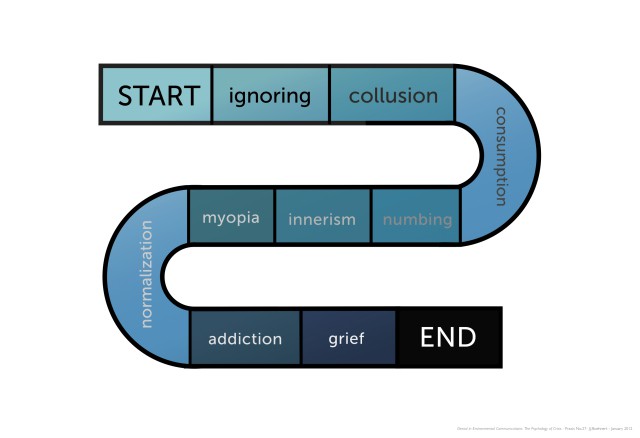
The many stages of denial

The many stages of denial

It took Google Fiber to change the paradigm that you only need enough broadband speed to run the basics — anything extra is extravagant and unnecessary. At least that is the argument broadband providers continue to make when asked about speed upgrades.

“When Google announced it was offering a gigabit, everybody was (like), ‘Huh? What are you going do with that?'” said Heather Burnett Gold, president of the Fiber to the Home Council Americas.

Time Warner Cable and AT&T are in the process of finding out in both Kansas City and (soon) in Austin, Tex. But when you don’t have what the other guy is offering, providers predictably switch to the cheaper-than-upgrades-argument, ‘you don’t need it.’

Before Google Fiber began a serious advance into Time Warner Cable territories and the cable company’s top speed of 50/5Mbps became an embarrassing outlier, then chief financial officer Irene Esteves poo-poohed the notion that people need anything faster than what Time Warner was already delivering. Esteves told an investment-phobic crowd of Wall Street analysts at a Morgan Stanley Tech Conference everyone was happy with what they already had.

“We just don’t see the need of delivering that [gigabit speed] to consumers,” Esteves said back in 2013.

Comcast didn’t think much of speed upgrades either… until it did in its regulatory filings to acquire Time Warner Cable, where Comcast championed the fact it offers more speed upgrades than Time Warner Cable ever did. But who can forget Comcast repeatedly telling customers their speeds were fast enough, and with their then-ubiquitous 250GB usage cap, you couldn’t use faster speeds for that much anyway.

“For some, the discussion about the broadband Internet seems to begin and end on the issue of “gigabit” access,” David L. Cohen, Comcast’s executive vice president, wrote in an editorial in the summer of 2013. “The issue with such speed is really more about demand than supply. Our business customers can already order 10-gig connections. Most websites can’t deliver content as fast as current networks move, and most U.S. homes have routers that can’t support the speed already available to the home.”

(Today, Comcast touts it has new routers that will support the fastest speeds on offer from cable companies and promises Time Warner Cable customers long overdue speed upgrades.)

Other providers that cannot possibly compete with Google Fiber’s speed also like to change the subject.

The Wireless Cowboys blog, run by a Wireless Internet Service Provider (WISP), believes the real issue isn’t about speed at all.

“All of the discussions about ‘Gigabit Internet’ and coming up with uses for it focuses too much on the American obsession with ‘bigger, faster, moar!’ while obscuring what I feel are the more important issues of accessibility, affordability, choice of provider, freedom from data exploitation and dependency on the cloud,” wrote the editor.

Unfortunately for him, it isn’t the American obsession with ‘bigger, faster, moar’ that is the issue. It is just about everywhere else where nations are treating major broadband upgrades as a national priority, while we depend almost entirely on a barely competitive private sector to deliver upgrades most of them don’t believe we need in the first place.

Dan Tesch wrote in InformationWeek earlier this year he wants the United States to sit this one out.

“Even if Latvians enjoy faster connections than Texans (2.5 x faster), I’m really curious how broadband speeds of more than a few slowMbps for average households can have a material impact on the economy,” he writes. “A 6Mbps connection could easily support several home users simultaneously shopping on multiple e-commerce sites, downloading iTunes, streaming Spotify, and so on. Do Americans really need gigabit to the home?”

Back in the early 1990s, dial-up was plenty for the online applications of the day and faxing managed just fine at 9600bps over landlines, so why do we need more? Perhaps because dial-up is effectively dead to us and faxing has become quaint, like carrying cassettes in your car. Technology marches forward, and providers must follow (or preferably lead).

It is inevitable that faster broadband will drive development of new applications designed to take advantage of gigabit speeds as they become more common. That isn’t likely to happen for years in the United States and Canada, but those speeds are already becoming common in Europe and Asia. Where superfast broadband predominates, so shall high-tech app developers and other digital economy businesses. North America will be left behind until we finally catch up to Romania, Bulgaria, and South Korea.

The evidence is already there.

“I just returned from Stockholm where fiber connections are cheap and as available as running water,” said Susan Crawford, a visiting professor at Harvard Law School and author of “Captive Audience: The Telecom Industry & Monopoly Power in the New Gilded Age.” As a result, she said, developers there have “a digital sandbox to play in,” which means they are more likely to develop the next generation of software and hardware.

“Most people don’t really get it yet,” Synthia Payne, who moved from Denver to Kansas City, Kan., for a $70-a-month Google Fiber connection told the New York Times. She needed superfast broadband to develop an app called Cyberjammer that allows musicians around the world to jam online and in real-time. “People just haven’t conceived of what fiber will mean and how it will change the way we live and work.”

Brad Kalinoski and Tinatsu Wallace fled Time Warner Cable country in Los Angeles and moved to Wilson, N.C. They co-own Exodus FX, a company that provides special effects for commercials, television and feature films like “The Black Swan” and “Captain America.”

“We were doing so much business that we had to have increased bandwidth, so we started looking around and found Wilson,” said Kalinoski.

If they stayed in Hollywood, gigabit fiber broadband requires an extremely expensive commercial account with a substantial buildout/installation fee to reach the building and monthly charges starting at $1,500-3,000. Today, he pays Greenlight, Wilson’s publicly owned fiber to the building provider, $150 a month for gigabit access.

frustrationAny digital economy business dependent on fast Internet can see the economics, and often relocate.

“In New York, I pay four times as much as someone in Stockholm would pay for a connection that is 17 times as slow on the download and 167 times as slow on upload,” Crawford noted. “Most of us are paying enormous rents for second-class service.”

It’s the same in Seattle, where Eric Blank moved his 20-employee IT security firm from Seattle to Mount Vernon, Wash., which has its own fiber network. Blank could have kept paying CenturyLink or Comcast around $985 a month for vastly slower service or pay Mount Vernon for access to its public broadband service, which costs $250 a month. Blank told the New York Times he gets better service for his $250 in Mount Vernon than what he got at a higher price in Seattle.

Remarkably, for all the talk about why Americans don’t need faster Internet service, the moment a competitor starts selling it, the cheap talk turns into service upgrades (or at least press releases promising upgrades).

In Kansas City, speeds are rising not just because of Google Fiber. Akamai has found AT&T and Time Warner Cable are upgrading to deliver faster speeds as well.

We’re seeing faster speeds everywhere,” said David Belson, who authors the State of the Internet Report for Akamai. “Part of that is that the technology is improving to get better speeds out of existing networks, part of it is consumer demand, and part is the pressure that Google Fiber’s existence creates on everybody else.”

Today Time Warner Cable delivers 50Mbps for what it used to charge for 15Mbps service in Kansas City. AT&T has also boosted speeds of its U-verse service in many Kansas City neighborhoods, with promises to deliver gigabit speeds in Overland Park in the not-too-distant future.

Verizon Wireless Cancels Its LTE 4G “Network Optimization” (Speed Throttling) Plan Before It Launches

throttleVerizon Wireless, facing scrutiny from FCC chairman Thomas Wheeler, today announced it has canceled plans to introduce a new “network optimization” policy that would have significantly throttled down speeds for heavy users still on grandfathered, unlimited use data plans.


Stop the Cap! received a statement from Verizon Wireless this afternoon announcing a sudden change of heart:

Verizon is committed to providing its customers with an unparalleled mobile network experience.  At a time of ever-increasing mobile broadband data usage, we not only take pride in the way we manage our network resources, but also take seriously our responsibility to deliver exceptional mobile service to every customer.  We’ve greatly valued the ongoing dialogue over the past several months concerning network optimization and we’ve decided not to move forward with the planned implementation of network optimization for 4G LTE customers on unlimited plans.  Exceptional network service will always be our priority and we remain committed to working closely with industry stakeholders to manage broadband issues so that American consumers get the world-class mobile service they expect and value.

Chairman Wheeler questioned Verizon’s strategy almost immediately after the company announced its “network optimization” strategy in July.

Wheeler

Wheeler

“‘Reasonable network management’ concerns the technical management of your network; it is not a loophole designed to enhance your revenue streams,” Wheeler wrote in a July 30 letter to Verizon Wireless CEO Dan Mead. “It is disturbing to me that Verizon Wireless would base its ‘network management’ on distinctions among its customers’ data plans, rather than on network architecture or technology.”

Wheeler reminded Mead the FCC defined network management practices to be reasonable “if it is appropriate and tailored to achieving a legitimate network management purpose, taking into account the particular network architecture and technology of the broadband Internet access service.”

Wheeler told Mead Verizon’s plans didn’t qualify.

“I know of no past FCC statement that would treat as ‘reasonable network management’ a decision to slow traffic to a user who has paid, after all, for ‘unlimited” service,'” Wheeler wrote.

everybody does itWheeler also questioned how Verizon could justify its planned speed throttling under the conditions it agreed to after winning the 700MHz “C Block.” That spectrum was accompanied by a special FCC mandate – open platform rules which prohibits Verizon Wireless from denying, limiting, or restricting the ability of end users to download and use applications of their choosing on the C Block networks. A speed throttle would make using some applications impossible.

In August, Wheeler hammered home his opposition to Verizon’s plans at a news conference.

“My concern in this instance–and it’s not just with Verizon, by the way, we’ve written to all the carriers–is that [network management] is moving from a technology and engineering issue to a business issue, such as choosing between different subscribers based on your economic relationship with them.”

Wheeler has expressed irritation that Verizon’s justification for congestion management only applied to its unlimited customers, while those paying on a per-gigabyte basis could use (and spend) as much as they like.

Verizon responded that other providers — notably AT&T — already have a similar network management policy in place, throttling speeds of grandfathered unlimited customers who consume more than 3GB of wireless traffic on its 3G network or 5GB on its 4G network a month.

“‘All the kids do it’ was never something that worked with me when I was growing up and didn’t work with my kids,” Wheeler responded, noting Verizon was trying to reframe the issue instead of justifying the need for speed throttles for some customers, while giving others unlimited access as long as they pay.

Search This Site:

Contributions:

Recent Comments:

Your Account:

Stop the Cap!