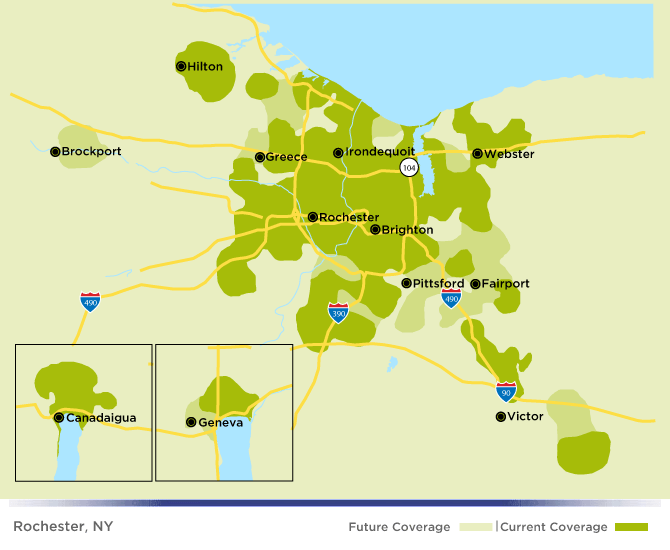
Clearwire Service Area – Rochester, New York: Outside of the Metro? Clearwire Remains an “Iffy” Proposition

Phillip Dampier April 21, 2009 Issues 4 Comments

I continue to hear from a few of the “competition is breaking out all over” crowd claim that people who can’t get DSL service from Frontier and don’t want Road Runner after “things just aren’t the same with us anymore — the trust is gone,” can jump to Clearwire and they will live happily ever after. Sure, if you are well within their current service area, depicted below for the Rochester market. They aren’t available in any of the other “experiment” markets in western New York. By the way, I am told their speeds currently max out around 2.1Mbps. That’s slower than DSL.  If anyone here uses them and would like to write up a review, please let me know.

Clearwire Coverage Map - Rochester, NY

Clearwire Coverage Map - Rochester, NY

AT&T Broadband: We’re Capping You, But We Won’t Tell You Until After You Sign Up

Phillip Dampier April 21, 2009 AT&T 21 Comments

GigaOM blows the lid off what will likely be an upcoming target of StoptheCap! — the ludicrous and unacceptably botched usage cap trial in Reno, Nevada by AT&T.

It seems that new customers to AT&T’s high speed Internet service aren’t being told their usage is being capped, until the mailman delivers an express letter to your home with the shocking news after you’ve already signed up for service!

Adding insult to injury, their tiers for traditional DSL max out with an 80GB allowance on their “Elite tier,” which only offers up to 6Mbps service.  That might be “elite” in Kenya, but it shouldn’t be in a major American city.  Each additional gigabyte comes at the traditional Pillage Price of $1/GB, which is nearly 1,000% above what it costs them to provide.  And for the woman who brought all this to the attention of GigaOM, there is no competitor currently available for broadband.

The Super Whammo Extreme Maxalot tier of 150GB isn’t even available unless you have access to their U-verse fiber-alternative service.  Also, incompetence seems to be the order of the day over at AT&T:  GigaOM reported that customer service representatives denied there was a usage cap at all when the Lake Tahoe-area resident called to inquire.

AT&T’s letter explaining the limits is reproduced below the fold.  Customers signing up for service at att.com will need to call the Psychic Hotline to discern that there is a cap in place on their service — not one word of it appears on their website as the screen captures GigaOM obtained illustrate.

Of course AT&T is also the home of the “unlimited” AT&T Wireless DataConnect plan that, in the fine print, changes your reality of what the word “unlimited” means to their own, which means “not more than 5GB.”

Sounds like bait and switch to us and the next step should be a contact with the Nevada Attorney General’s office, the Better Business Bureau, local and state officials, and the Congressional delegation for Nevada.  If AT&T wants to treat Reno like a broadband backwater, they couldn’t do a better job of it by also forgetting to tell customers until after they already signed up.

… Continue Reading

KVUE Austin – The Internet Generation Confronts Usage Caps

Phillip Dampier April 20, 2009 Video 1 Comment

KVUE-TV is Austin examined the impact Time Warner’s proposed usage caps would have on younger users, part of the “Internet generation.”  Disproportionately heavier users of the net, these “heavy users” are often the ones who will be the first to lose the innovative net services they have depended on, because of the exhorbitant charges Time Warner was proposing to access them.  But the impact doesn’t stop there.  Innovative broadband applications that become unaffordable to use cause job losses, hurt the economy, and allow the United States to fall behind other countries that charge lower prices for faster Internet access.

thumbs-up6 A straightforward and honest package from KVUE, focusing on the “younger user” angle, and how usage caps impact them in their daily lives.  “Worried,” is the common reaction among younger users accustomed to flat rate Internet.  Many students spend more time online than they do watching television, a factor that obviously concerns a cable operator that sells packages of video channels they may choose to reject.

MediaPost’s “Online Media Daily:” ISPs Still Likely to Push for Metered Pricing

Phillip Dampier April 20, 2009 Issues Comments Off on MediaPost’s “Online Media Daily:” ISPs Still Likely to Push for Metered Pricing

Wendy Davis took a look around the domestic broadband marketplace and concluded the same thing we did: they’ll be back for another round of Cap ‘n Tier soon enough.

The company’s own statements make clear it still wants to move towards a metered pricing system. “While we continue to believe that consumption based billing may be the best pricing plan for consumers, we want to do everything we can to inform our customers of our plans and have the benefit of their views as part of our testing process,” Time Warner Chairman Glenn Britt said in a statement last week.

The company also said that it’s going to arrange to give subscribers measurement tools so they’ll be able to see how much bandwidth they’re actually using each month.

Davis also reports on the rally in front of Time Warner’s Rochester, N.Y., offices which attracted about 30 protestors, noting it happened after Time Warner backed off the proposal.

Internet service providers argue that they are facing rising bandwidth demand and that metered pricing is fairer to consumers than the current unlimited use pricing. Perhaps more people would agree if the proposed fees were lower. But so far people have a hard time swallowing $150 a month for unlimited bandwidth — especially when, according to The New York Times, the costs of upgrading equipment is “shrinking steadily.” The paper also reports that Comcast told investors it costs less than $7 a home to double the Internet capacity of a neighborhood.


WGHP Greensboro – Greensboro to Time Warner: “This is Not Fair; It’s Bordering on a Monopoly”

Phillip Dampier April 20, 2009 Video 5 Comments

[Editor’s Note: Time Warner suspended, at least temporarily, the “experiment” in usage caps last week, according to company officials.  This news report was produced and broadcast prior to that announcement.]

Residents across Time Warner’s Triad region in North Carolina continued protesting the company’s proposed broadband usage cap experiment last week, calling it unfair and bordering on monopolistic.  Greensboro’s city council was “on the same page” on the issue of resisting the incumbent cable broadband provider and were seeking competive alternatives, as WGHP reports:

thumbs-up6Fox 8 in the Triad covers the story from the perspective of a local government trying to find ways to respond to consumer complaints about Time Warner’s experiment.  Cities struggle to find competitive alternatives, but discover that’s an improbability during the current economic crisis.  This report features a dial-up modem handshake sequence (the noise you hear towards the end of the report.)  Many consumers in this part of North Carolina may be stuck going back to dial-up Internet access if usage caps this draconian return.

Search This Site:

Contributions:

Recent Comments:

Your Account:

Stop the Cap!