Time Warner: No Tiers, No DOCSIS 3 — Customers: Shucky Darn

Phillip Dampier April 21, 2009 Issues 34 Comments

Time Warner Alex, bless his heart.  He’s back with another revelation for all of the cities that successfully drove back the usage caps, at least for now.  Since we’re unwilling to play in his metered sandbox, he’s taking all of the toys home with him.  It seems that because Rochester, Austin, San Antonio, and the Triad said “no thanks” to Time Warner’s Tiers, the company may be rethinking deploying DOCSIS 3 upgrades in these markets.

“It was scheduled as part of consumption based billing trial, but we all know how you feel about that,” he Tweeted.  It’s good to know that he knows.

Evidently, unless customers are willing to be force-fed paltry and overpriced tiers, Time Warner doesn’t see the point in keeping up with the rest of the country’s cable broadband providers who are upgrading systems to DOCSIS 3.

No matter that the upgrades will likely help Time Warner as much as its customers.  Given the choice between mega-fast tiers that blow through usage caps in a matter of hours vs. unlimited access at speeds that are perfectly fine for the majority of broadband applications, customers have overwhelmingly made their choice – we’ll take what we have now.

Nobody objects if Time Warner wants to rake in more cash by deploying their upgrades and selling access to premium speed tiers at higher prices, as long as those tiers are unlimited, and existing plans are left alone for those happy enough with what they receive today.  If Time Warner wants to miss that opportunity, that’s their business.  Protecting rationally priced Internet access is ours.


In Search Of… Road Runner Lite, the Mini-Me Broadband Service

Phillip Dampier April 21, 2009 Issues 23 Comments
"This series presents information based in part on theory and conjecture. The producer's purpose is to suggest some possible explanations, but not necessarily the only ones, to the mysteries we will examine."

"This series presents information based in part on theory and conjecture. The producer's purpose is to suggest some possible explanations, but not necessarily the only ones, to the mysteries we will examine."

Space aliens.  Bigfoot.  Amelia Earhart.  Road Runner Lite.

Wait.

Road Runner Lite?  The “mini-me” of broadband?  The perfect value plan for consumers who just need to check their e-mail and browse web pages?

Yes.  That Road Runner Lite.

I thought you heard of it.

Leonard Nimoy examines why you can't pay less for Internet right now!

Leonard Nimoy examines how you can pay less for Internet right now!

A lot of people have heard rumors about it, but for those in western New York, ferreting it out becomes a monumental event.  An all-nighter.  A mystery that Leonard Nimoy and an entire In Search Of… production team couldn’t easily solve.

StoptheCap! reader Meghan wasted spent her morning on a quest to find the elusive “Road Runner Lite,” if only to suggest it to the occasional person out there who is upset because they feel they’re spending too much on their Internet service now.

If she had this much trouble, imagine that casual browser and e-mail reader!  Calling doesn’t guarantee you’ll get instant information either.

The adventure turned out to be so ponderous, we were thinking of creating a PDF for you to enjoy at your leisure.  You could print it out and waste an entire ink cartridge, take it in the bathroom, read it before going to bed, and then use it for the bottom of a bird cage.  But then that would mean another 15 minutes of our life and yours we’d never get back.  Our thanks to Meghan, who sacrificed everything just to help others go bird watching, starting below the fold.

Leonard may still be looking for extraterrestrials, but our crack team has managed to find an option for those that might be co-opted into the Time Warner Re-Education campaign today to pay out of this world prices for broadband service tomorrow.

… Continue Reading

The Broadband Generation Gap: The Truth About Paying for More Than You Need

Phillip Dampier April 21, 2009 Editorial & Site News 46 Comments
Broadband Caps: Turning the Internet Back to 1996

Broadband Caps: Turning the Internet Back to 1996

There is a disparity in Internet usage between the young and the old.

If one were to poll customers about whether or not they wanted limits and tiers on their broadband service, two things are apparent:

  1. Consumers overwhelmingly oppose usage caps and tiered accounts.
  2. Those that do approve of caps and tiers are overwhelmingly older users of the Internet, particularly 45+ of age.

Broadband providers recognize these facts, yet continue to attempt to place limits on broadband usage.  Many providers’ have marketing and public relations strategies that target older customers with an “us vs. them” approach.  Why should you, as a casual Internet user, “subsidize” those younger heavy users who are fully leveraging the Internet to its fullest potential?  Company officials will often toss around broadband services older users have never heard of, much less used.  “Bit Torrents,” “heavy movie downloads from newsgroups,” “Hulu,” just to name a few, confound a lot of casual net users who have barely mastered their e-mail account, much less considered making video calls using Skype.

The generation gap lives online too.  But there is a lot more to this story than they tell you.

Some companies claim the majority of their customers consume a tiny amount of bandwidth when compared against other customers.  Traditionally, the older a customer, the less bandwidth they consume.  And therein lies a problem for them.  As the demographics for the net continue to shift towards younger, heavier consumers of Internet applications, the writing is on the whiteboard.  No longer can a broadband provider expect to pocket the enormous profits they earn from a monthly service that some users barely even use.

There should be nothing wrong with a casual user paying less for their Internet service.  The question is, should they receive less expensive service at the “price” of severely curtailing other users who naturally consume more?  That seems to be the marketing plan.  They get to overcharge you for a casual user plan and also overcharge and limit heavier users from consuming too much on their networks.  They win.  Everyone else loses.

The truth is, most broadband providers already provide discounted plans for light users, usually at slower speeds, but at significantly lower pricing.  For a casual user reading e-mail and browsing web pages, the Internet speed war is irrelevant.  Anything more than three or four times faster than dial-up access will provide comfortable browsing without sitting around waiting for pages to load.  With a “light” user plan, you can still listen to Internet radio, move pictures of the kids back and forth, do all the web browsing you could imagine, and your e-mail will still arrive super fast.  Since you don’t care about big downloads or watching TV online, why pay for the extra speed you’ll never use?  You don’t have to.  More importantly, you don’t have to right now!  Despite the fact many of these “lite” plans are the best kept secret in town, your provider probably already offers them, and you don’t have to wait for some new tier plan to sign up!

I called several providers this afternoon and inquired about Internet broadband service.  Every last one of them quickly tried to sell me a bundle of services combining cable television, telephone, and Internet service for a single monthly price.  No provider asked about how I used the Internet, much less talk about different levels of service.  They simply wanted to move that bundle, often with a promotional price for the first six months or year of service.  That bundle always included the standard package of Internet for around $40 a month, which is probably overkill for casual users.

Only when I complained about the price or suggested I didn’t think I would use the Internet that much did the “lite plan” details finally start coming into the conversation.  Time Warner pitched Road Runner Lite only after saying I didn’t want the phone service and felt I wouldn’t use the Internet very often.  Frontier tried to convince me that once I got online, I’d want the extra speed and resisted trying to get me into anything other than a bundle with a standard Internet plan, touting a free mini netbook if I also took their “Peace of Mind” support package and a contract.  Verizon FiOS in Buffalo said it was no problem, since they sell packages of Internet service based on speed anyway.  Typical.  The fiber optic competitor was the only one that volunteered the light plan and asked how much I used the Internet before recommending a plan.  Of course, where there is FiOS, there are no usage caps in those communities.

If you are shopping for cable modem or DSL service, they are not apt to volunteer information about their “light user” plans unless you ask.

Another way you are certain to hear about these kinds of discount plans is when you try and cancel your standard broadband service.  They want to keep you as a customer, so you’ll be pitched a discount plan just to keep you.

It’s unfortunate that many broadband providers claim to be for saving light users money, but for all intents and purposes keep those plans a secret.  If you are a casual user looking for a deal, buying into the proposition of tiered pricing with steep overlimit fees is a bad deal for you and everyone else.  A flat rate, speed limited “lite plan” gives you everything you need, and you never have to worry that you might get billed for more than you expect.  The good news is, you can get these types of plans today.  Call your provider and ask!

WHAM Rochester – “About 85% of Customers Won’t See Any Change to Their Bills,” Says TW

Phillip Dampier April 21, 2009 Issues 2 Comments

I should really start a spreadsheet (or better yet ask one of our readers), to track all of the varying claims and percentages Time Warner officials were using throughout the entire metered broadband debacle.  More numbers have been tossed around in this discussion than on Wall Street.  WHAM-TV had a quick report on their 5:30pm newscast last week, before TW suspended their plans, outlining the v2.0 of the Time Warner usage cap plan.

Internet usage is increasing, costs to provide it are decreasing, and profits are up.  So it’s only fair to increase rates up to 300% for the same service?  It was logic like this that caused the volcanic lava flow of hatred towards the plan in every city that was included in the “experiment.”  And, as I always ask, produce the raw data to show who is affected by what.  Time Warner traditionally bases their estimates on their experiences in Beaumont, Texas where 14% or so of new customers (the plan never was implemented for all customers during the trial) saw significant overlimit fees charged on their bills, averaging close to $20 a month.  That’s nothing to sneeze at.

Not rated.  This was a 57 second report.  Would have liked to see a sentence about continued customer opposition to the proposal, however.

Rep. Dan Maffei (D-NY): Time Warner – What the Heck Were They Thinking?

Phillip Dampier April 21, 2009 Public Policy & Gov't 6 Comments
Rep. Dan Maffei (D-NY)

Rep. Dan Maffei (D-NY)

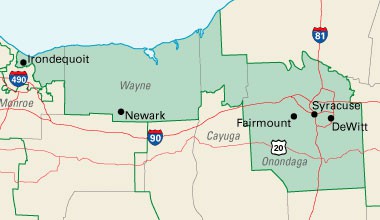
Rep. Dan Maffei (D-NY), whose 25th Congressional district reaches into the eastern suburbs of Rochester, addressed the issue of Time Warner’s usage cap proposal at a Town Hall meeting earlier in April.  Maffei expressed concern about the “experiment,” recognizing the limited alternative options consumers in his district have for broadband service.  Maffei warned that Time Warner’s cap proposal may create potential difficulties for the company in Washington, as issues affecting the cable television and broadband industry are likely to come before Congress in this session. [Courtesy: Rochester Turning]

25th Congressional District Map

25th Congressional District Map

To contact Congressman Maffei:

Syracuse Office

Dan Maffei
P.O. Box 7306
1340 Federal Building
Syracuse, NY  13261
Phone: (315) 423-5657
Fax: (315) 423-5669

Irondequoit Office

Dan Maffei
1280 Titus Avenue
Rochester, NY  14617
Phone: 585-336-7291
Fax: 585-336-7274

Search This Site:

Contributions:

Recent Comments:

Your Account:

Stop the Cap!