Home » Website » Recent Articles:

Google Launches ‘Google Fiber for Communities’ Website to Advocate for Fiber Broadband

Phillip Dampier July 13, 2010 Broadband Speed, Community Networks, Competition, Editorial & Site News, Google Fiber & Wireless, Public Policy & Gov't, Video Comments Off on Google Launches ‘Google Fiber for Communities’ Website to Advocate for Fiber Broadband

Google today launched a new website which could become a major advocacy center to promote fiber broadband service across America.

Google Fiber for Communities opened with a thank you message for the enormous number of submissions it received for its experimental 1Gbps fiber broadband network.  Google expects to announce the winning application(s) for its experimental  network sometime this year.

But in the meantime, Google also acknowledges what big telecom companies keep trying to downplay and dismiss — “people across the country are hungry for better and faster broadband access.”  That is… better and faster service than their current provider is willing to supply.

The new website provides hints as to its greater purpose:

  1. The name itself.  Notice “communities” is plural.
  2. The site intends to mobilize for fiber networks across the country, starting with lobbying for pending federal legislation that would require installation of fiber conduit as part of federal transportation projects.
  3. The site’s links heavily promotes municipal broadband advocates and organizations, including the National Association of Counties, the National Association of Telecommunications Officers and Advisors, the Fiber to the Home Council, the Baller Herbst Community Broadband Page, the Broadband Properties Municipal Fiber Portal, and Muni Networks.  Outside of the Fiber to the Home Council, which has some big telecom company members and isn’t above advocating for their interests, the rest of the list suggests Google advocates that communities do for themselves what their local phone and cable companies won’t do — deliver world class broadband service at non-duopoly prices.

Stop the Cap! shares many of these goals with Google, as we are strong advocates for community fiber-based broadband, and believe additional competition is highly needed in America’s broadband marketplace to break up an anti-consumer duopoly that delivers slow broadband service (or none at all) at the highest prices companies can get away with.  Thanks to Stop the Cap! reader Jerry here in Rochester for sending word.

<

p style=”text-align: center;”>

Endangered Species: The Phone Book — AT&T Petitions to Slash Alabama Telephone Directories

Phillip Dampier March 2, 2010 AT&T, Public Policy & Gov't 4 Comments

Across AT&T’s service areas, the company has lobbied heavily for telecommunications deregulation that, among other things, makes the printing and distribution of telephone directories optional.  In Alabama, AT&T has filed a request with the state Public Service Commission to end automatic delivery of residential listings, the so-called “White Pages,” to reduce costs.

Because telephone companies earn substantial revenue from advertising in the business listings, the “Yellow Pages” will continue to be printed and dropped on doorsteps across Alabama once a year, whether  customers ask for them or not.

AT&T’s filing with the Alabama PSC explains the reasons for stopping the printed residential listings:

The traditional residential white page telephone book no longer provides the same utility it once did. Based on trials AT&T has recently conducted, it appears that the vast majority of customers neither need nor use these often quite large, bound paper directories delivered to their homes each year. AT&T Alabama thus proposes a directory delivery trial whereby AT&T Alabama would initially deliver the AT&T Real Yellow Pages directory in the Mobile market.

In addition to traditional Yellow Pages listings, that directory would also contain the business white page listings, the Government listings, the customer guide information, and other information required under the Commission’s Rules. Also included will be materials informing customers they can receive a printed white pages directory containing residential listings, which will be mailed at no cost to the customer. Customers tend to find their residential listings in today’s marketplace in a manner other than by using the printed white page directories, so publishing largely unused residential white page books is an inefficient use of environmental resources.

If the proposal is approved, AT&T will offer Alabama residents the option of receiving a printed version of the White Pages or a CD-ROM containing the listings mailed to them at no charge.

AT&T’s telephone directories are already online at AT&T’s RealPagesLive website.

The PSC is expected to consider the matter later today.

Gone Phishing: Hackers Target CenturyLink With Authentic Looking Customer Portal Website – Customers Beware

Phillip Dampier February 11, 2010 CenturyLink Comments Off on Gone Phishing: Hackers Target CenturyLink With Authentic Looking Customer Portal Website – Customers Beware

CenturyLink customers should exercise caution in responding to e-mail links to CenturyLink’s online account portal.  Hackers have meticulously duplicated the look and feel of the nation’s fourth largest phone company’s online account website with hopes customers will provide personal information that can be used for identity theft or fraudulent financial activity.

Trend Micro’s TrendLabs group warned readers it noticed the well-done phishing fakes popping up on several websites, preparing to collect information from unsuspecting customers.  Most phishing attacks typically start with unsolicited e-mail purporting to be from CenturyLink, with a convenient link included for customers to click.  Only this e-mail will not direct visitors to CenturyLink, instead diverting customers to the impostor websites that look like the real thing.

Customers can protect themselves from these phishing tricks and traps by following this advice:

  1. If receiving e-mail from a company asking you to follow a link to their website, you are safer typing in the company’s website address yourself, ignoring the link.  Links that look authentic in an e-mail can be anything but when you click on them.  If you intend to share personal information or password to log in to a website, it’s better to start your journey there yourself.
  2. If the site you reach shows an unexpected address in the URL window, that is often a warning sign trouble is brewing.  CenturyLink’s account login screen should display either https://auth.centurylink.net/saml/module.php/core/no_cookie.php?retryURL=https%3A%2F%2Fauth.centurylink.net%2Fsaml%2Fsaml2%2Fidp%2FSSOService.php%3Fspentityid%3Dhttp%253A%252F%252Fcenturylink.net%252Fsaml%252Fmodule.php%252Fsaml%252Fsp%252Fmetadata.php%252FClient%252FLibrary%252FSaml%252Fsaml-sp%26cookieTime%3D1521251419%26RelayState%3Dhttp%253A%252F%252Fcenturylink.net%252Flogin%252F or https://eam.centurylink.com/eam/login.do.  If it shows a series of numbers or a website address other than centurylink.com or centurylink.net, consider ending your visit and starting over at centurylink.com, typed into your browser yourself.  When in doubt, don’t enter your login information.
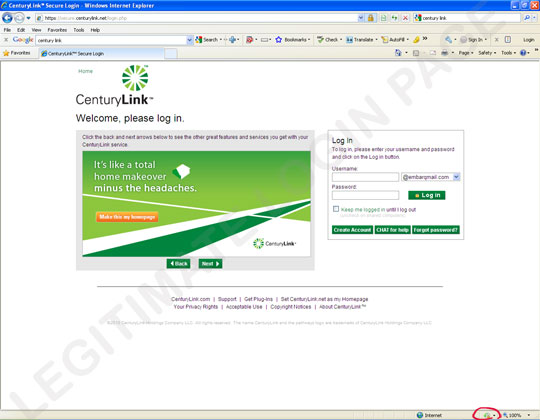
  3. A padlock should be visible somewhere in your browser at the CenturyLink login screen.  Most place the padlock at the bottom of the browser screen.  No padlock?  Danger.
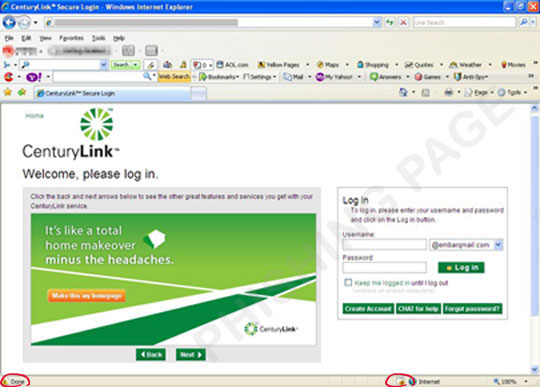
  4. Any code errors on the page that show up should also be a point of concern along with spelling and grammatical errors.

In general, using up to date antivirus software and applying security patches regularly will offer some advance warning of a suspicious message.  But nothing beats common sense.

The authentic CenturyLink website. Notice the padlock circled on the right.

The fake version phishing for your personal information. Circled on the left is a warning of code errors on the page. On the right, notice the absence of a padlock icon.

Search This Site:

Contributions:

Recent Comments:

Your Account:

Stop the Cap!