
Home » usage limit » Recent Articles:

Amateur Hour: DataJack is Back With An All-New Usage Limit And Higher Price After Hyping Unlimited Service

Phillip Dampier April 12, 2010 Broadband Speed, Data Caps, Wireless Broadband 1 Comment

Here is how DataJack was marketing themselves back in January

DataJack, the 3G mobile broadband service that was promising unlimited wireless broadband service for $39.99 a month is back — with an all-new 5GB monthly usage cap, a new provider, and hassles for existing customers who must swap out their existing wireless modem.

Stop the Cap! first covered DataJack back in January, when customers were howling about the company’s lousy customer service and its tendency to “stretch the truth” about its coverage area, speeds, and even the availability of the product itself.

Rumors about a major spat between its original data service provider, presumably T-Mobile (based on the fact DataJack and T-Mobile had identical coverage maps back in January) and DataJack led the company to stop signing up new customers.  Since January, DataJack’s website has told would-be customers that the wireless modem necessary to use it was “out of stock.”

DataJack remained in limbo until the first week of April, when the company began e-mailing updates to dealers and customers about major changes to the company and its marketing:

  1. “Unlimited” service is history, not that DataJack ever really offered it.  Many customers who used the service in excess of 5GB per month were notified their account would be closed at the end of the month’s billing cycle.  “Companies like DataJack have an English language comprehension problem,” writes Stop the Cap! reader Kevin. “The word ‘unlimited’ means ‘without limit,’ — a concept DataJack routinely ignored when throwing people off their service.”  New customers will be subject to a formal 5 GB usage cap.
  2. Customers who did manage to get modems from DataJack may find they may no longer work after this Thursday.  The company is dropping GSM-based network service and moving to a CDMA network (either Sprint or Verizon — most believe the former), which means obtaining a new modem.  At least that will be offered free of charge to inconvenienced current customers.
  3. The price for new customers is going up $10 per month — to $49.99 for 5 GB of service.  Existing customers get to retain service for $39.99 a month, albeit with the new usage cap.  The DataJack website has still not been updated to reflect the new pricing.

Kevin is taking a walk far away from DataJack:

“These people don’t have the first clue how to run a business.  Their entire marketing plan just a few months earlier was based on the premise of unlimited service.  They apparently got into trouble with their provider, another sign that doesn’t inspire confidence, and now they’re e-mailing customers telling them they literally have days to complete an equipment swap or lose service?  In the end, they were punishing people for actually believing their marketing nonsense about “unlimited” service and now they want people to believe a $10 price hike for less service is good news?  After everything that has happened with these people since January, who knows what will happen next month.  I’m not about to wait around to find out.”


Dealers were the first to be notified about the company changes.  Stop the Cap! obtained this copy of a message sent to DataJack retailers:

Dear DataJack Dealer,

Please note that Effective April 2, 2010, the following changes were made to our terms and conditions:

Service Usage. We reserve the right to safeguard our network from abuse, excessive bandwidth consumption or any activity that compromises the performance of our network. We may limit throughput speeds, control the amount of data transferred, and suspend, modify or terminate service, without notice, if your usage adversely impacts our network or exceeds 5 GB in a given month. We may monitor your compliance with the above but will not monitor the content of your transmissions except as otherwise expressly permitted or required by law.

Prohibited Uses. The service may not be used in a manner that violates any law (including without limitation, copyright and intellectual property laws); or the Service Usage clause.

We have found it necessary to implement these measures to ensure our DataJack customers are given the opportunity to access reliable, high speed, wireless internet service at a reasonable price.

95% of our customers will not be impacted by these new provisions; however, if a customer who is impacted visits your store and requests a refund due to no longer having access to the service, please direct them to the DataJack customer support team at 1-888-693-4522. Our team will work directly with the customer to resolve the issue.

Additionally, we are in the process of rolling out a new and improved Dealer Portal. Benefits of this portal include a more user friendly interface, virtual training videos, and enhanced functionality. Our systems will be down for a short period of time while making the transition. Please refer to customer service to process pins and activations for your customers.

If you have any questions, please feel free to contact [email protected].
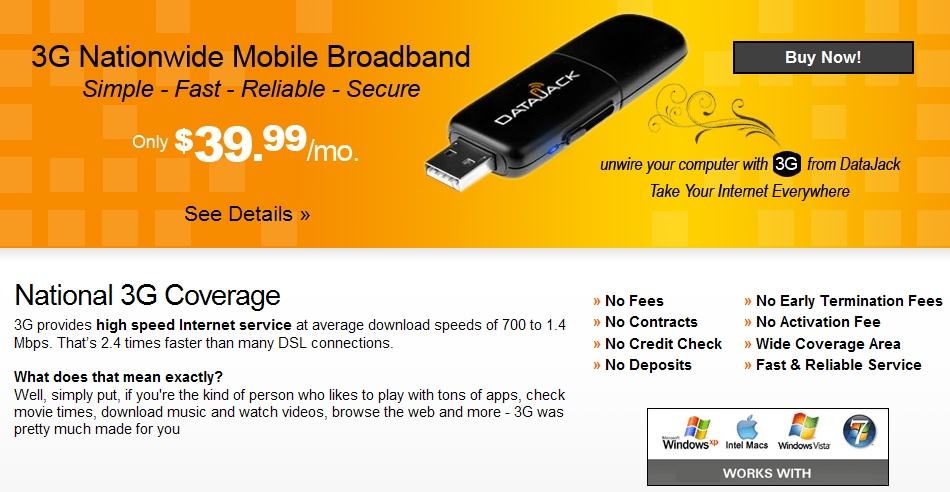
The "unlimited service" so prominently mentioned in January is gone from today's marketing of DataJack (click to enlarge)

Existing customers were next to be notified by this e-mail message sent last week:

Dear Valued Customer,

To address recent quality and connectivity issues, DataJack is migrating our service on April 15, 2010 to a new Tier 1 network which delivers faster data speeds and an expanded coverage area. The move to this new network means that DataJack must replace your existing device by April 15th to ensure uninterrupted service. Realizing this could be an inconvenience to you, DataJack is offering our customers a FREE MIFI unit for use as your replacement device at absolutely no extra charge (M.S.R.P. $299.00).

To ensure we get your replacement device to you in a timely manner, it is imperative that you verify the name and address we have on file for you as soon as possible by replying to this email. The name and address on file is as follows:

(address removed)

Upon verifying your address, we will send your new WIFI unit and a postage paid return envelope so you may mail back your current DataJack device. We ask that you please return the used device within 10 business days. South Florida customers also have the option of exchanging their device on April 14th, 15th, and 16th from 10AM – 9PM EST at the following location: 6365 NW 6th Way Suite 160 Fort Lauderdale, FL 33309.

If you do not want to take advantage of the FREE MIFI unit offer, please contact customer service at 1-888-693-4522 to discuss alternative equipment options.

Please note that new customers will be required to pay $49.99 per month for service. This price increase will not affect you, your service fee will continue to be $39.99 per month. Additionally, we have changed our terms and conditions to include service usage and prohibited uses clauses. The terms and conditions apply to all customers.

Again, time is of the essence. We must get your new unit to you by April 15th to avoid service interruption. Thank you for your patience and we look forward to serving you on our new and improved network.

Best Regards,

The DataJack Team

Here is how DataJack dispenses with customers who use their “unlimited” service “too much”:

Dear DataJack Customer,

In accordance with our terms and conditions, more specifically the Service Usage and Prohibited Usage clauses, we are unable to renew your service upon expiration.

We regret that we can no longer provide service and wish you the best in finding a new provider for your wireless internet access needs. Our customer service representatives are available 8AM – 5PM Monday through Friday to address any questions you may have.

Best Regards,
DataJack, Inc.
888-693-4522

Under Terms & Conditions

Effective April 2, 2010

Service Usage. We reserve the right to safeguard our network from abuse, excessive bandwidth consumption or any activity that compromises the performance of our network. We may limit throughput speeds, control the amount of data transferred, and suspend, modify or terminate service, without notice, if your usage adversely impacts our network or exceeds 5 GB in a given month. We may monitor your compliance with the above but will not monitor the content of your transmissions except as otherwise expressly permitted or required by law.


The Ultimate Challenge for Rural Broadband – Prince Wales Island, Alaska

The 'Prince of Wales,' one of Inter-Island Ferry Authority's boats that connect the island to the mainland (Courtesy: Inter-Island Ferry Authority)

Providing broadband to 6,000 residents of Prince Wales Island, located along the western strip of Alaska that borders on British Columbia, Canada is the ultimate challenge.  Parts of the island don’t even have access to traditional landline phone service, relying instead on fixed wireless service.

Residents have complained loudly about the poor quality of phone service on the island for years, particularly when it is provided to the 1,000 residents of Klawock, Craig, and several adjacent communities served by Alaska Communications Systems (ACS).  Ten percent of ACS customers are stuck with fixed wireless, which guarantees no Internet access, and sub-standard phone service.  What perturbs many of them is the fact another phone company’s landlines are within the sight of their homes and communities, but they can’t get service from that company.  Those lines are owned by ACS competitor Alaska Power & Telephone (AP&T), an employee owned utility that serves many areas ACS doesn’t.

Friends and neighbors served by AP&T are happy with their telephone service.  Residents served by ACS are not.

The Alaska Dispatch tells the story:

Every three months Ron Fitch drives five miles down a state highway so he can use a friend’s telephone to monitor his pacemaker.

Fitch, who lives on Price of Wales Island, has a phone at home, but he gets his service via fixed wireless, which is similar to a cell phone signal but is routed through a box mounted in the house. Since you can’t recalibrate a pacemaker over a wireless signal, Fitch makes the drive four times a year.

“Times have changed, and it doesn’t seem right that we can’t get Internet or a fax or anything over our phones,” said Eric Packer, a builder who lives outside Klawock. “It’s like living in the dark ages.”

ACS customers on the island have been complaining about their phone service for years, and for some the frustration is sharpened by the view of lines — owned by ACS competitor Alaska Power and Telephone — running near their homes. Two years ago the Regulatory Commission of Alaska opened an investigation into ACS service on the island, citing numerous customer complaints and a request from Sen. Lisa Murkowski.

With all of the negative press focused on ACS, the company relented, telling the Regulatory Commission it will offer to connect those fixed wireless customers to landline service, but will only pay for up to 1,000 feet of wiring between the nearest ACS junction box and the customer’s home.  ACS will bill customers the balance of costs beyond 1,000 feet if a customer insists on landline service.

ACS is a major recipient of universal service funds which subsidizes phone service in rural areas to keep it affordable.  ACS receives about $4 million a year.  ACS fixed wireless customers on the island pay about $26 a month.

ACS customers perennially without broadband have complained to the Regulatory Commission, according to the Dispatch, suggesting it hurts the island’s economic development.  Some customers have managed to switch to cell phone service and dropped landline/fixed wireless service, and a select few are trying to rely on satellite Internet service, which customers characterize as expensive and slow.

Pricing for landline DSL service from either ACS or AP&T is itself slow and expensive, and AP&T service is usage limited:

3 Mbps / 512 Kbps $89
1 Mbps / 320 Kbps $69
320 Kbps / 240 Kbps $49

ACS promotes the fact their service is unlimited.  Includes local and long distance telephone service.  One year contract term required.  Pricing may be higher in rural areas not specified on the ACS website.

64 kbps with 2GB of data transfer per month $29.95
256 kbps with 10GB of data transfer per month $49.95
512 kbps with 20GB of data transfer per month $59.95
1 Mbps with 30GB of data transfer per month $79.95

The 1Mbps service tier is currently available in select areas dependent upon local infrastructure.  Each additional gigabyte of usage is pro-rated at $5.00/GB.  AP&T provides wireless broadband in selected rural areas.

Free the Web: South Africa Breaks Free of Internet Overcharging – Unlimited Broadband Arrives

South Africa is the latest country on the way to finally discarding Internet Overcharging schemes like usage caps and usage-based billing.

MWEB, one of South Africa’s largest residential broadband service providers, last week “threw down the gauntlet” and unveiled an unlimited broadband option among its various rate plans.

“We realized there’s a major gap in the market. South Africa doesn’t experience the Internet like the rest of the world does. It’s a fantastic opportunity to change the Internet in South Africa,” MWEB CEO Rudi Jansen told News24.

For a country that has never known anything but expensive, slow, usage-capped Internet, MWEB’s announcement is nothing short of a broadband revolution for 49 million South Africans.

“This is not the end. There are still probably three or four big things that have to change in this market and for us, this is the first step. The other things that have to change are we have to get the mobile operators to offer wholesale data. The more competition there is, the better it is for the market,” said Jansen.

For $73.50US per month, MWEB offers 4Mbps DSL service that is truly unlimited, which is a radical notion in a country used to usage caps averaging 3GB per month.  Customers willing to tolerate slower speeds can reduce their unlimited broadband bill considerably — 384kbps starts at $30 a month; 512kbps is priced at $41 a month.  The company does admit to throttling torrent services, but customers have managed to bypass the throttle by encrypting their torrent traffic.

Although these speeds and prices are terrible in comparison to North American broadband plans, for South Africans, MWEB’s announcement was big news.  That’s because the competition charges far higher prices, often for limited service:

  • Telkom, South Africa’s state phone company, wants $35US monthly, five dollars more than MWEB’s lowest speed unlimited alternative, for its DSL service with a 3GB usage allowance;
  • Paying $39.50US per month buys you 10GB of usage from Afrihost;
  • Using 3G wireless mobile alternatives are for the deep-pocketed only.  Paying $65.50US per month nets you less than a 2GB usage allowance;
  • South Africa’s ‘Screamer’ offers a pricey unlimited plan at $54US per month for 384kbps service;
  • Neotel offers an unlimited service package, but it’s so confusing few customers can be certain what they’re getting.  (Read this South African blogger’s experience with Neotel.)

MWEB hired marketing firm Quirk to generate buzz about the company’s unlimited service option.  Earlier this month, a Facebook group called Free the Web popped up asking consumers what improvements were needed in South Africa’s broadband service.  It attracted more than 15,000 followers in just two weeks.

What were South Africans complaining about?  Usage caps. Broadband users despise them, especially in a country where 5-10GB allowances are considered ‘generous.’  But the lack of competition for monopoly state-owned phone company Telkom also featured prominently.  Most South Africans rely on DSL service that first starts with renting a line from Telkom.  Telkom prices those in accordance with its monopoly status, and requires consumers to pay line rental fees combining both data and voice services, even if a customer only intends to use the line for data.  Because ADSL broadband speed is totally dependent on the phone company, and Telkom has no incentive to upgrade, few in South Africa can expect to see broadband service exceeding 4-8Mbps.  Most obtain considerably less, often well below 1Mbps.

“Telkom has to allow users of ADSL to split the line rental for the telephone line and the line rental for ADSL. That absolutely has to happen; then this market will grow,” Jansen said.

Jansen

MWEB hopes the unveiling of unlimited broadband will transform South Africans use of the Internet and bring prices down.

“Ubiquitous broadband is what this country needs to grow. We want to do our part in getting South Africa there,” said Jansen. “I hope [our competitors] follow us because I think as a country we desperately need it.”

Jansen may have his wish.  Hours after MWEB announced unlimited broadband, its competitors began to follow suit, meaning South Africans can finally follow Australians and New Zealanders discarding hated Internet Overcharging schemes.

Mybroadband.co.za took note of several broadband package changes coming as a direct result of MWEB’s new service (One South African Rand = 13.6 US cents):

Vox Telecom responded quickly and announced that @lantic will be launching bundled ADSL offerings – which include both ADSL access and an uncapped ISP account.  Pricing starts at R339 for a DSL384 bundle while a 512 Kbps service will cost R589 and a 4 Mbps solution R889.  This undercuts MWEB’s bundled pricing by R10 per month.

Openweb also joined the price war by announcing that they will resell MWEB accounts at the same rates as MWEB.

This is however not where it ends.  Afrihost said that consumers can look forward to their uncapped ADSL services next week, and G-Connect also indicated that they will respond to MWEB’s recent announcement with a competing service.

Even the state monopoly phone company Telkom has started talking about offering unlimited service.

“Uncapped speed-locked ADSL service consumer offerings are in development. However, no time-frames, offering specifications or price points can be disclosed at this stage. In the development process, Telkom is striving for optimal quality, reliability and affordability,” said Ajith Bridgraj, Telkom Senior Specialist for Media Relations.

MWEB expects a surge of new customers, which leads some to worry if the company can sustain its network under the burden of throngs of new customers.  Jansen says they can, noting their connectivity ultimately comes from Seacom, which is an important provider of international connectivity between Africa, Europe, and beyond.

Early tests by Mybroadband appear positive:

MyBroadband got its hands on an uncapped 4 Mbps test account to take the service through its paces – and early test results are very promising.

For basic email and surfing the MWEB uncapped account performed well, and results from Speedtest.net were on par with SAIX and IS based offerings.

Local Speedtest.net downlink speeds ranged between 3.28 Mbps and 4.13 Mbps while local uplink speeds ranged between 0.26 Mbps and 0.42 Mbps.

International Speedtest.net results – tested with servers in London, New York and Brussels – ranged between 2.96 Mbps and 3.61 Mbps while international uplink speeds were fairly steady at between 0.3 Mbps and 0.32 Mbps.

Local latency was fairly consistent and ranged between 17 ms and 41 ms in tests to Johannesburg and Cape Town based servers.  International latency was however less consistent, and ranged between 285 ms and 528 ms to the UK and US.

The MWEB uncapped account performed well with all bandwidth intensive applications.

YouTube videos streamed without any buffering, but some buffering was needed when moving to high definition video streaming (480p and more specifically 720p).

Standard file download speeds were quite consistent at between  2 Mbps and 3.4 Mbps while multi-threaded FTP and HTTP downloads sat at around 3.2 Mbps.

Good news for those keen on torrent services is that the MWEB uncapped account seems torrent friendly.  We selected 10 of the most popular torrents, and total download speeds ranged between 2.8 Mbps and 3.2 Mbps.

American broadband providers contemplating Internet Overcharging schemes of their own often point to usage limits and usage-based billing schemes that exist in other countries, implying they are well-tolerated by consumers abroad and should be likewise domestically.  The truth is, such pricing schemes are as despised abroad as they are domestically, and most countries seeking to improve broadband consider eliminating them a top priority.

[flv width=”448″ height=”356″]http://www.phillipdampier.com/video/Carte Blanche Consumer – No Broader Than a Band.flv[/flv]

South African news program ‘Carte Blanche’ provides this general overview of the current state of broadband in South Africa, and the challenges that must be faced to improve it. (10 minutes)

[flv width=”384″ height=”308″]http://www.phillipdampier.com/video/News24 MWEB Unveils Unlimited Broadband 3-19-10.mp4[/flv]

South Africa’s News24 network reported on MWEB’s unlimited broadband package including an interview with MWEB CEO Rudi Jansen. (3 minutes)

[flv width=”640″ height=”380″]http://www.phillipdampier.com/video/South African Broadband.flv[/flv]

As part of MWEB’s social marketing campaign, ordinary South Africans talk about their broadband experiences, what the Internet has done for them, and the things they hate the most about South African Internet Service Providers. (9 minutes)

[Updated] AT&T Adds Usage Meter Placeholder on U-verse Accounts

Phillip Dampier March 22, 2010 AT&T, Data Caps, Editorial & Site News 7 Comments

Stop the Cap! reader Michael writes to alert us he found AT&T’s U-verse online Account Overview now includes a section called “Usage & Recent Activity” that includes a placeholder for a future usage meter.

“I canceled my U-verse TV and bumped my Internet speed up to 12Mbps last weekend, and I remember checking to see if my account updated sometime around the middle of last week.  The old website was still in use then.  Today was the first time I got redirected to the new site, which includes this new placeholder for a usage meter,” writes Michael.

Stop the Cap! reader Michael sent us a screen shot of his AT&T U-verse account, showing this placeholder for a future usage meter. (Click to view the full screen shot)

While customers like Michael are currently being told their “internet plan provides you with unlimited usage — there are no usage details to display,” the potential for usage meters can set the stage for future Internet Overcharging schemes down the road.

AT&T alienated many of its customers in Beaumont, Texas and Reno, Nevada when an extended usage cap trial was underway.  Complaints were filed against AT&T with the Better Business Bureau over dubious marketing practices that sold customers on unlimited broadband, only to dispatch letters to newly signed customers telling them it wasn’t unlimited… after signing up for service.

Stop the Cap! learned the Beaumont/Reno experiment was coming to a close this April.

Internet Overcharging schemes are vastly unpopular with consumers.  A 2008 study found an overwhelming majority of customers (81 percent) opposed to usage limits or usage-based billing, with 51 percent willing to take their business to another provider if implemented.

In Beaumont and Reno, customers threatened to cancel service when they learned of the experimental overcharging scheme being tested.  Some managed to get exempted from the trial.

Customers routinely reject the notion that a company already earning billions in broadband profits today needs to set the stage for even higher pricing and profits tomorrow.

AT&T has spent millions lobbying for the introduction of their U-verse system on favorable franchise terms with the promise it would deliver more competition and lower prices for millions of Americans.

For customers like Michael, usage meters are the first step towards breaking that promise.  When followed with formal usage limits or usage-based billing, higher broadband bills are a sure thing.

AT&T customers should contact AT&T and put them on notice — any effort to impose usage limits or usage-based billing will result in immediate cancellation of your AT&T account.

Stop the Cap! will continue to closely monitor AT&T and we’ll recommend further action should conditions warrant.

Update 3:00pm EDT 3/23 — AT&T tells Broadband Reports that whatever users are seeing, it’s some kind of website glitch, and that the company has no plans to implement a usage meter. “We did do some upgrades to our account management portal this weekend, but we haven’t been able to recreate this screen,” according to AT&T spokesman Seth Bloom.

While that’s good news for AT&T customers, we are unsure exactly how such a glitch could occur with such depth, including wording that specific Internet plans providing unlimited usage.  Further, specifying “U-verse Internet Usage” on the tab above it seems surprisingly specific for a “glitch.”

Barring any new evidence, we’ll take AT&T’s word for it, but readers should continue to report any further “glitches” they might encounter.  If possible, include the URL with any screen shots, which we’ll happily provide to the company in any effort to recreate the page.

Biggest Problem With South Pacific Broadband: “Restrictive Data Caps” — New Fiber Project Helps Eliminate Them

Phillip Dampier March 11, 2010 Broadband Speed, Competition, Data Caps Comments Off on Biggest Problem With South Pacific Broadband: “Restrictive Data Caps” — New Fiber Project Helps Eliminate Them

Flag of New Zealand

Despite broadband provider propaganda designed to convince Americans restrictions on broadband usage were “commonplace” and well tolerated overseas, a group of New Zealand and Australian broadband entrepreneurs propose to spend just under $900NZ million to build new fiber capacity to help eliminate them once and for all.

A team of businessmen from the South Pacific today announced they are part of “an early stage” venture to construct a brand new underseas fiber optic cable to connect Australia and New Zealand with the United States, providing five times the capacity of existing service provided by the Southern Cross system.

The new group, Pacific Fibre, went public today and is talking with potential partners about the plan to construct a 13,000 kilometer cable by 2013.

Mark Rushworth, former Vodafone chief marketing officer, told TV New Zealand a full 90 percent of New Zealand Internet traffic is bound for the United States.

“It is using the most direct route. It is one hop from New Zealand to the US, which from a technical perspective is very important because it means it is a lower latency cable, that is, it is faster than other cables,” he said.

Flag of Australia

The primary impetus for the project was the common practice in New Zealand and Australia to limit customers’ usage of broadband service with Internet Overcharging schemes like usage-based billing or restrictive data caps which can throttle speeds just above dial-up for customers for weeks, if they exceed their usage allowance.

Rushworth

Private providers have lived happily on the revenue earned from such schemes and have done little to relax usage limits on their customers, so Pacific Fibre decided to undertake a game-changing new fiber cable themselves to drive prices down and eliminate the caps.

“We desperately need a cable that is not purely based on profit maximization, but on delivering unconstrained international bandwidth to everybody, and so we’ve decided to see whether we can do it ourselves,” said partner Sam Morgan.

“We hope to bring in extra capacity at a low price, which our carriers and ISP customers can end up passing on to their customers,” Rushworth said.

“We all know that in any market as soon as you introduce competition prices tend to drop and volume goes up,” he told TVNZ.

The current proposed cable configuration would have two fiber pairs with 64 wavelengths (lambdas) each at 40 gigabits per second per lambda. The maximum lit capacity initially would be 5.12 terabits per second, but would be upgradeable to over 12 terabits per second as emerging technology became a reality.

Search This Site:

Contributions:

Recent Comments:

Your Account:

Stop the Cap!