Home » time warner cable » Recent Articles:

Bought and Paid For – Tea Party & Minority Group Opposition to Net Neutrality

Big Telecom Cash works its magic

As the fall elections near, the rhetoric and sheer nonsense from those opposed to important consumer broadband reforms has reached a fever pitch.  And as our reader Karen writes, too many Americans and the candidates they support just don’t get it.

Here in Delaware, Tea Party candidate Christine O’Donnell exemplifies what Net Neutrality supporters are up against — complete ignorance and big cash contributions.  Before she went into hiding, I attended one of Christine’s rare public events and asked her about where she stood on Net Neutrality and her response was she believed “all sides should be represented on the Internet.”  So she thinks Net Neutrality is about views expressed online, not stopping the telecom industry from slowing or blocking access to websites.

At least 35 of the Tea Party groups are opposed to Net Neutrality, mostly because their financial backers (big corporations and billionaire-funded front groups) have convinced members they should be.  Many others are stupid enough to believe Glenn Beck and his pal Phil Kerpen at Americans for Prosperity who say Net Neutrality will “censor” the Internet or turn control of it over to Barack Obama.

Conservative groups heavily funded by corporate interests they refuse to identify are backing various chapters of so-called “Tea Party” groups and feeding them talking points generated by companies like AT&T and Verizon in opposition to Net Neutrality.  The Center for Individual Freedom runs a website StopNetRegulation, edited by conservative activist Seton Motley, dedicated to derailing broadband reforms.  Motley was also quoted in The Hill in late September warning Republicans about antagonizing Tea Party types with their support for Net Neutrality in Congress.  Only then his comments came as leader of the group “Less Government.”  Judging from the organization’s website, Motley is also in favor of reduced size websites because his amounts to a single sentence.

Seton is convinced the end of the net world, as we know it, comes November 30th when the government could “seize control of the Internet.” That’s the date of the FCC’s November meeting, at which Seton suspects Julius Genachowski will finally move to reclassify broadband as a telecommunication service. 
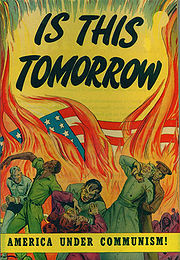
Seton completely misrepresents reclassification as saddling the Internet with “the same rules as landline telephones.”  I read that claim somewhere before… oh yes, straight from AT&T and Verizon lobbyist talking points.

It doesn’t matter to Seton and other conservatives that Genachowski went out of his way to say he would not be applying any onerous telephone-era regulations on today’s broadband providers.  In fact, Genachowski’s actions to date have moved at such a glacial pace, friends have to occasionally check his pulse to make sure he’s still with us.

So what is so big, bad, and scary about Net Neutrality?  It simply guarantees your Internet Service Provider doesn’t start throttling your speeds when accessing websites and Internet applications they dislike, cannot block access to websites critical of their agenda, and are not allowed to extort payments from content providers just to allow traffic onto “their” networks.

While that may pose a Halloween freak-out for the profit-obsessed phone and cable companies, it’s hard to find actual consumers (not paid by said providers) who want their Internet service blocked or slowed down.

Seton goes way over the top turning this into a First Amendment free speech issue.  That argument only works for the likes of AT&T and Verizon who find their corporate right to overcharge people for broadband being infringed.

Seton then argues his view must be right because even minority groups support his position.  As readers here already know, most of the groups he names to bolster his argument are “dollar-a-holler” organizations willing to peddle the phone and cable company agenda on their letterhead in return for donation checks.

So have many additional normally Democrat paragons, including several large unions: AFL-CIO, Communications Workers of America (CWA), International Brotherhood of Electrical Workers (IBEW); several racial grievance groups: League of United Latin American Citizens (LULAC), Minority Media and Telecom Council (MMTC), National Association for the Advancement of Colored People (NAACP), Urban League; and an anti-free market environmentalist group: the Sierra Club.
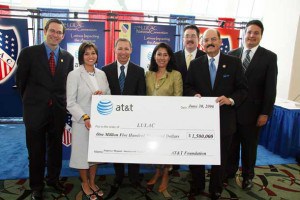
Reach Out and Touch Someone... LULAC accepts another giant check from AT&T
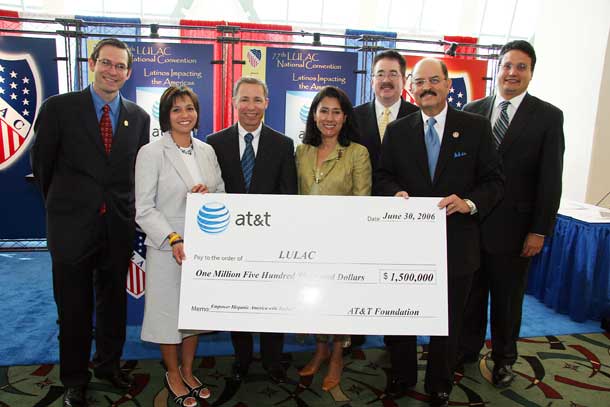
If you ever wondered why AT&T and Verizon spend so much on contributions to these interest groups, Seton Motley just handed you the answer — so he and the companies he supports could name drop them in arguments against pro-consumer broadband reform.  And considering the CWA and IBEW represent phone company workers, it’s not a surprise to see them on their side of this issue either.  Wherever you look amongst those in opposition to Net Neutrality, a check from AT&T and/or Verizon is almost always waiting to be deposited.

The Obama-Has-Concentration-Camps-crowd parked on Andrew Breitbart’s website ate it up and wrote comments like this:

The communist can’t control the people with a internet that is out of control, all dictatorships have the power over what the people can read, free thinkers in this day and age are considered terrorist, Republicans, conservatives, anti abortionist, Oath Keepers, Christians, ex military, people who think the Constitution is still the law of the land, my lord, the communist can’t have these sorts communicating with each other over the internet, why, they may all come together one day and put a stop to the one world government goal, you know, the goal of making the world one big slave camp.

This kind of wild opposition has even corporate Republicans on edge, according to The Hill.  A major talking point of Net Neutrality opposition is that such “sweeping changes” should not be enforced by the FCC, but from legislation enacted in Congress.  But because Tea Party elements are opposed to the concept altogether, and Republicans are loathe to hand Democrats their votes on much of anything, even a corporate-friendly Net Neutrality bill introduced by Rep. Henry Waxman (D-Calif.) went up in flames.  Waxman’s bill would have enacted some protections, but only until 2012, at which point it was open season on broadband consumers.

The Hill piece delivered a disappointing fact of life for much of today’s Congress, beholden first to corporate interests (underlining ours):

In a striking sign that people who normally align themselves with telecommunications companies may line up behind the bill if it is industry-backed, ardent net-neutrality critic Brett Glass, founder of a wireless company, is open to it. He tweeted on Monday, in a note to Americans for Prosperity executive Phil Kerpen, that the Waxman legislation seems “more reasonable than I expected.”

In a note earlier this month, analysts at Stifel Nicolaus wrote that although Republican House members “may not have incentive to solve a political problem for Democrats,” some may support the bill “if there’s a push by” phone and cable companies and at least some Internet companies.

But the shilling for Big Telecom has never been a one-party-problem.  While Republicans appear to be moving in lock step against Net Neutrality, a number of groups and politicians on the Democratic left have also been only too willing to take AT&T money and run to a microphone to oppose a free and open Internet.

The Los Angeles Times gave plenty of space on an issue we’ve written repeatedly about on Stop the Cap!:

Key minority groups are backing the carriers’ efforts to thwart the net neutrality proposals, which would, for instance, prohibit carriers from charging more to give some residential and corporate customers priority in delivering online content.

“When you give national civil rights groups millions of private dollars, there’s no firewall strong enough to keep that money out of their policy,” said Malkia Cyril, executive director of the Center for Media Justice.

Cyril and other consumer and public advocates have been buoyed by comments from Federal Communications Commission member Mignon L. Clyburn, a prominent African American and daughter of Rep. James E. Clyburn (D-S.C.).

She said in a speech in January that she was surprised that most statements and filings by “some of the leading groups representing people of color have been silent on this make-or-break issue” of net neutrality.

“There has been almost no discussion of how important — how essential — it is for traditionally underrepresented groups to maintain the low barriers to entry that our current open Internet provides,” Clyburn said.

AT&T's cash machine benefits groups like LULAC

At issue are the enormous contributions from big phone and cable companies like Comcast, AT&T and Verizon that routinely translate into what we’ve called “dollar-a-holler” advocacy.  After the checks get deposited, many of these groups generate innocent sounding letters of support for the latest merger, deregulation, or policy debate — always in favor of Big Telecom and too often directly against the interests of the people they claim to represent.

No group better exemplifies this than the League of United Latin American Citizens (LULAC), a particularly eager player in the cash for advocacy game.  And the group doesn’t care whether the money comes from Verizon or AT&T.  They’re on board with both.

Brent A. Wilkes, executive director, penned this guest editorial for the Houston Chronicle, for which he was called an “idiot” by at least one of the newspaper’s readers:

Net-neutrality rules should prevent broadband providers from engaging in anti-competitive behavior, but they should not be commandeered to insulate wealthy Internet applications companies from paying their fair share of the broadband bill. Any new rules must protect consumers both by ensuring their unfettered access and by shielding them from having to shoulder all the costs for faster broadband networks that our nation so badly needs. Such an approach will not please the special interests, but it will be a double win for consumers.

From AT&T’s talking points to Wilkes editorial.  “Wealthy Internet applications companies” already pay for their own bandwidth and for the Internet’s expansion.  Search engine companies like Google and Yahoo! construct data centers with their own money just to maintain their services to consumers, generating jobs and helping local economies.  Wilkes ignores the fact broadband providers already earn plenty from their subscribers — consumers and businesses who pay a monthly fee so they can access those “wealthy Internet applications companies.”

But that is not enough.  Now broadband providers want to be paid twice.  To facilitate their argument, they’ve invested more than a million dollars in LULAC alone to defend their position, which ultimately brings Latinos (and everyone else) the high broadband bills today that Wiles scaremongers will be forthcoming tomorrow.

Wilkes was shocked, shocked by the implication that phone company money would have anything to do with LULAC going out of its way to comment on arcane telecommunications policy issues, always in favor of its benefactors.

“It’s kind of like saying the minority organizations can’t think for themselves,” Wilkes said, adding that any suggestion that minority groups were mouthpieces for the industry was “offensive.”

Verizon played along:

“I can tell you we do not, and have not ever, given money to minority organizations so that they will support our positions on any topic,” said Peter Thonis, a spokesman for Verizon Communications Inc. “We talk to many groups about our positions, and some agree with us and some do not.”

So if Verizon talked to Stop the Cap! about their positions, do you think we’d receive a handsome check from the phone company?
Britt cut out all of the middlemen and picked up the phone to personally lobby FCC Chairman Genachowski about broadband reform.

The Times documented numerous other examples:

For instance, David Cohen, Comcast’s executive vice president, joined the board of the National Urban League three years ago as part of a three-year partnership to promote the league’s various educational programs. Comcast, now seeking FCC approval to buy a controlling interest in NBC Universal, was recognized that year for being one of several sponsors to donate $5 million or more to the organization.

On the local level, the Greater Sacramento Urban League has Barbara Winn, a Sacramento-area director of external affairs for AT&T, as its chairwoman and Linda Crayton, Comcast’s senior director for government affairs in California, as vice chairwoman.

That affiliate’s president, David B. DeLuz, wrote to the FCC in January that net neutrality rules “will strongly reduce broadband network investments and ultimately raise prices.” DeLuz said in an interview that the two telecom executives on the chapter’s board have not influenced its net neutrality stance.

“The Urban League does not engage in pay to play,” he said. “Just because [telecoms] write a check to us doesn’t mean they write the only check to us.”

The most remarkable part about the Urban League’s argument is that in a sea of corporate cash, competing checks can cancel each other out.

While the blizzard of bucks continues to descend on Washington, Time Warner Cable CEO Glenn Britt decided his cable company could cut out the middlemen and go right to the man with the plan to reclassify broadband.  Unlike ordinary consumers, Britt had no trouble getting FCC Chairman Julius Genachowski to take his call, allowing him to personally lobby against Net Neutrality and those nasty broadcasters trying to overcharge him for permission to carry local broadcast stations on the Time Warner Cable dial.

[flv width=”480″ height=”380″]http://www.phillipdampier.com/video/ATT Net Neutrality There’s a problem.mp4[/flv]

It seems like only yesterday AT&T’s Ed “Our Pipes” Whitacre was clamoring for the right to deliver the Internet to consumers his way, complete with pay walls and speed throttles.  Very little has changed since Big Ed left for Government Motors with his $158 million AT&T golden parachute.  The name at the top has changed, but AT&T still recognizes money buys friends and influence.  (2 minutes)
Handing Time Warner Cable an Indefinite Franchise In Return for Wiring Rural South Carolina Towns?

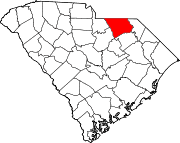
McBee, part of Chesterfield County, S.C.

Residents of McBee, S.C., have been without cable and Internet service since last November, when rural cable provider Pine Tree Cablevision closed its doors and turned the services off in scores of small communities in New Hampshire and South Carolina.  For residents of Lamar, another South Carolina community served by Pine Tree, it wasn’t much of a service to lose.  Pine Tree’s “broadband” in Lamar was limited to 50kbps, with the entire community’s Internet delivered on a single AT&T-provided T-1 line.

But even the loss of a company like Pine Tree was immediately felt by area residents and businesses, now without cable TV and Internet service.  In Lamar, December 10, 2009 will remain a day of infamy:

“I was in the middle of submitting reports to SLED (the State Law Enforcement Division) when [Pine Tree pulled the plug and the cable and broadband system] went down,” Police Chief Charles Woodle told SC Now. Woodle now goes home twice a day to check his work e-mails.

The town’s water office closed December 21st because the town clerk could not upgrade the software needed to process water bills.

In Elloree, residents and local officials found out about Pine Tree’s financial problems when channels started dropping off the cable system, followed by the complete loss of service.  In December, customers mailing payments to Pine Tree had them returned by the post office undelivered.

The now defunct Pine Tree Cablevision used to serve rural communities in New Hampshire and South Carolina.

Elloree Town Clerk Chasity Canaday told The Times and Democrat Pine Tree’s ultimate demise was a travesty.

“It shows a remarkable lack of professionalism to cut services from customers without any prior notice,” Canaday said. “For the majority of our residents, their notice that the cable service was terminated came when their televisions quit working.”

Despite claims from Pine Tree officials that new owners would take over the business they left behind, Canaday says that just isn’t true.

“It has been very, very difficult to get somebody else,” she said. “There is not a large enough customer base to entice a new company to come in. Most people have already switched to satellite.”

The newspaper noted after contacting 20 other municipalities, Canaday said most rural towns have no local cable provider and instead rely on satellite service.

Throughout rural South Carolina, tiny cable companies serving just a few hundred subscribers have come and many more have gone.

The town of Cameron lost Almega Cable about three years ago.  Other communities have said goodbye to operators like Brookridge Cable, SRW Inc., South Carolina Cable Television, Pine State Management Co., and Mid Carolina Cable.

In most cases, satellite television’s ability to deliver hundreds of digital signals it an easy choice over cable systems delivering only 2-3 dozen channels.  Because of a lack of investment to expand rural cable lineups, customer erosion has left many systems financially untenable.  One Texas cable system had just a dozen paying customers left when they called it quits.

That’s why the community of McBee is creating a lot of buzz in rural South Carolina.  They reportedly have Time Warner Cable, the nation’s second largest cable operator, in discussions to take over where Pine Tree left off, restoring cable and broadband service for a community of just 700 people.

But that service may come with a significant price — an indefinite franchise agreement that could eventually threaten the area’s local, customer-owned telephone cooperative.

Town Attorney Tony Floyd says Time Warner Cable in eager to expand into rural areas.  But the question is, will McBee concede too much just to attract a cable company?

“This is a long term contract,” he told SC Now. “If you grant a franchise, Time Warner will be able to keep competition out.”

Newly re-elected councilman Shilon Green is the biggest proponent for the deal.  He will propose an ordinance granting a franchise to the cable company at a town hall meeting to be held tomorrow.  He says Time Warner will bring better cable and broadband service to the area and introduce competition for phone service with their “digital phone” product.

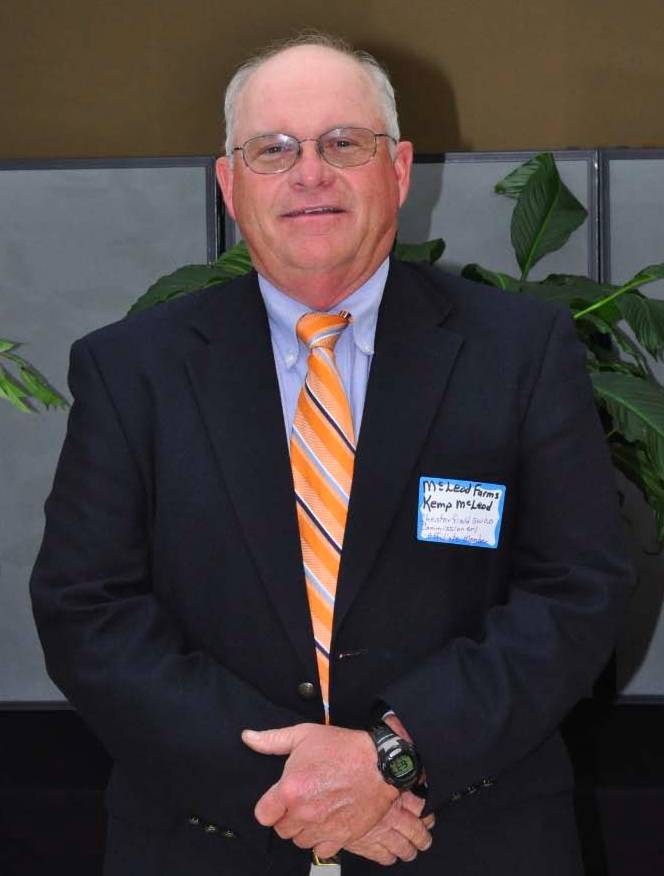
McLeod

But some other council members are concerned about Time Warner Cable’s impact on the area’s local, customer-owned phone company, Sandhill Telephone Cooperative.

Councilmen A.C. “Kemp” McLeod said he’s afraid the cable company could bully the co-op out of business.

“I know Sandhill is expanding their service into the TV business, and they’ve been very good serving rural communities,” McLeod told the newspaper. “I’d like to check with them first.”

“If [Time Warner] wants to come in [and] lowball this area, they can do it, then run our small business out of business,” McLeod said. “A big company can make it look good, make it look appealing, then once they have the market and run the small guy out, then they can raise the rates. At Sandhill, we have representation.”

Rural communities are often bypassed by cable providers because they lack enough closely spaced customers to make the infrastructure costs worthwhile.  Where smaller communities do cluster most of their population inside the town limits, cable systems have been built.  Many are independently owned and operated by small providers because larger companies have shown no interest in serving areas with just a few hundred potential customers.

That has left town leaders with the prospect of offering generous incentives to attract cable operators.  In addition to franchise agreements that never expire, some communities offer significant tax breaks and other concessions to encourage cable operators to bring service to area residents.  Despite complaints from big city residents that Time Warner is hardly benevolent, its brand and reputation do mean a lot in rural areas burned by Pine Tree’s sudden demise last year.

Green hopes the cable giant will bring a level of cable service not seen before in towns like McBee.

“A little competition is good,” Green said.

Time Warner Cable’s 10 Hour Internet/Phone Outage in Rochester, N.Y. – Get Your Service Credits!

Phillip Dampier October 7, 2010 Consumer News, Editorial & Site News 5 Comments

Time Warner Cable's offices on Mt. Hope Avenue in Rochester, N.Y.

Bad marks to Time Warner Cable, who left large areas of metropolitan Rochester, N.Y., with barely/non-functional Internet service and non-working “digital phone” service for 10 hours yesterday.

No explanation for the outage has been given, which resulted in inaccessible websites and traffic bouncing back and forth between equipment in western New York.  “Digital phone” customers were unable to reach… anyone. Customer service lines were jammed as the outage began just after 12 noon.

The disruption extended from Monroe County into both Wayne and Ontario counties, where residents in Newark and Canandaigua also reported service problems.

Time Warner Cable’s automated customer service attendant was the Helen Keller of cable outages:

“I’m not seeing an Internet outage in your area,” came her reply — even after a local employee recorded a message telling callers there were problems with phone and Internet service across the Rochester region.

While some websites still worked, many more were unreachable.  Some customers reported slow, but working service in the early evening.  Full service restoration to the area would not happen until 10pm.

Time Warner Cable’s social media representatives took several complaints from local residents about the extended outage, without reminding them they are qualified to receive service credits for the interruption.

Here at Stop the Cap!, we will remind you, and in fact encourage you to request a full day of credit for the phone and Internet service you did not have from the cable company yesterday.  Of course, we represent your interests and they represent theirs, which is why credits come only to those who ask.

Stop the Cap! Presents Your Easy Service Credit Request Menu

Customers can request one day of credit for both phone and Internet service (assuming you have both services, of course).  Make sure you request -both- credits if you are entitled.

Sample Request You Can Cut and Paste:

I am writing to request one day service credit for the phone and Internet outage that occurred in Rochester yesterday, Wednesday Oct. 6th.  We were without service for most of the day.  Please credit my account.

Methods to Obtain Credit:

  1. Use Time Warner Cable’s Online Chat system, select Billing Inquiry, and type to a customer service representative.
  2. Call (585) 756-5000 or toll free 1-800-756-7956 and speak with a customer service representative.
  3. Use the Online E-Mail form, select Billing Inquiry, and send a message requesting credit.

[Update: 2:47pm ET:  A day’s credit was provided just three hours after submitting the request using the e-mail method, so this was as painless as can be.]

Last Week’s Tornado Damage Still Leaves Many Without Cable, Internet Service in NY Boroughs

Phillip Dampier September 23, 2010 Cablevision (see Altice USA), Consumer News, Video 1 Comment

Big Apple Day

Thousands of New Yorkers impacted by last week’s tornado outbreak face indefinite wait times for restoration of cable and broadband service from the area’s two biggest providers — Time Warner Cable and Cablevision.

Last week’s storms have left debris from thousands of downed trees and utility poles still in the streets in some parts of the impacted areas, leading to criticism of city officials and cable providers for slow cleanup efforts.

In particular, calls to Time Warner Cable have been a frustrating experience, reports the NY Post.  Cable subscribers cannot get through to the cable company, and when they do, they receive little or no information about when exactly their service will be restored.  The company added a recorded message to help get customers off the phone, telling subscribers “technicians are doing everything they can” to restore service and that actual representatives can’t provide any other information.

Jayant, one of our readers in the hard-hit Flushing area in Queens made sure to request service credit for his cable outage, knowing many providers won’t provide service outage credits if they are not specifically requested.

“Considering the enormous amount of damage here, I can understand being without service over this past weekend — restoring power should and does come first, but since Tuesday Verizon and ConEd cleared out of this area after finishing repairs and some of us are still waiting for the cable company to show up,” he writes.  “Forget about calling them — it’s busy signals or ‘extended hold times’ that I suspect run into days at this point.”

He’s using Virgin Wireless’ unlimited mobile broadband service he read about on Stop the Cap! for now.

Another Queens resident shared her frustration with the Post:

“I was very tolerant until [yesterday] morning,” said Helen Cassano of Queens, who relies on TV to help entertain her bed-ridden mother who’s under 24-hour care. “It was a big storm. I understand there’s a lot going on, but talking to people in the area now, their cable is on and I want to know why mine isn’t on . . . maybe they’re not working hard enough.”

A TWC spokesperson said that “more than 75 percent” of service has been restored to affected customers, with those in Bayside, Murray Hill, parts of Flushing, Forest Hills and Middle Village being hit the hardest.

“Although a Time Warner Cable truck may not be visible on your street, engineering and technical teams may be working in the vicinity or behind the scenes to restore service,” the spokesperson said.

[flv width=”640″ height=”380″]http://www.phillipdampier.com/video/WABC New York Slow recovery from last week’s tornadoes in some New York neighborhoods 9-20-10.mp4[/flv]

WABC-TV covers some angry New Yorkers who are still waiting for services to be restored from a tornado outbreak a week after the storms hit.  Copper thieves were among the busiest, cleaning up downed cable-TV, phone and power cables to make a quick buck.  (2 minutes)

[flv width=”640″ height=”500″]http://www.phillipdampier.com/video/NY Tornado 9-23-10.flv[/flv]

Here is a far more comprehensive and detailed look from New York television stations, including WPIX, WABC, WCBS, and NY1 of the impact of last Thursday’s tornado outbreak in the city.  (51 minutes)

Time Warner Cable Has Plenty of Room for Porn, But Not NFL Network

Phillip Dampier September 23, 2010 Consumer News 3 Comments

We're sticking with Time Warner's logo for this story. That's all the imagery you need.

Football fans in New York are fuming Time Warner Cable had plenty of room to add eight new porn channels to its pay-per-view lineup, but still has no room for the NFL Network.

New York tabloids are having a field day over the introduction of racy networks like “Manhandle on Demand” and “Penthouse on Demand,” coming just days after a deal to renew Disney’s family-oriented programming and company-owned broadcast stations.

The NY Post called the affair “Sleeping beauty and peeping booty” and quizzed Time Warner Cable spokesman Alex Dudley about the expanded red light district on the cable dial:

Dudley insists that it’s nothing but a coincidence that it’s suddenly offering the new porn channels.

Asked about the remarkable coincidence in timing, he insisted, “The two are unrelated.”

And he said in a deadpan voice, “We’re always adding a variety of content that we think our subscribers will enjoy.”

To keep children from tuning in to its latest offerings, Time Warner Cable alerted its customers in a recent mailing to the new adult channels.

“You may need to adjust your parental control settings,” the mailing said.

Big Apple Day

The irony of the glut of available channel space for porn wasn’t lost on NFL spokesman Greg Aiello.  He tweeted: “Interesting page 3 story in today’s NY Post. Time-Warner is offering 8 new porn channels [but not NFL Network!]. What a world! What a world!”

The football network, reportedly asking around 80 cents per cable subscriber, has been rejected for carriage on Time Warner Cable lineups because it is too expensive, and the network will not allow itself to be carried in a specialty sports tier interested customers can pay extra to receive.

But one commentator asked, “aren’t the audiences for these two kinds of channels the same people?  What a quandary!”

Search This Site:

Contributions:

Recent Comments:

Your Account:

Stop the Cap!