Home » time warner cable » Recent Articles:

Verizon Targets Frontier, AT&T and Cable ‘Digital Phone’ Landline Customers in Rochester, N.Y. and Conn.

Phillip Dampier November 23, 2010 Competition, Consumer News, Verizon, Video 10 Comments

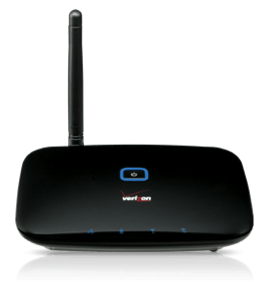
Verizon's Home Phone Connect base station

Verizon Communications has announced a new option for landline customers to ditch their local phone company with a new device that routes home phone calls over Verizon Wireless’ cellular network.

Verizon has chosen two test markets for its new Home Phone Connect service — Rochester, N.Y., serviced by Frontier Communications and Time Warner Cable and Connecticut, which is served by AT&T and Comcast.  (Thanks to our reader Bob for sharing the news with us.)

The service works with your existing home wired and cordless phones.  Customers signing up under a one or two year service contract will receive the base unit free of charge.  Installation is as easy: Just unplug the phone cord from the wall and plug it into the back of the Home Phone Connect device.  The unit supports up to two hard wired (non-cordless) phone lines and a cordless phone base station.  When you pick up any phone around the house, the base station will deliver a familiar dial tone, but all calls are made and received over the Verizon Wireless cell phone network.  You can download an read a copy of the installation manual here.

The service is priced at $9.99 per month for existing Verizon Wireless customers with any existing Family SharePlan that has two or more lines with at least a 700 minutes calling allowance per month.  Customers using Home Phone Connect under this plan will use minutes from their existing wireless service plan.  But since calls to and from Verizon customers and all calls placed during nights and weekends do not eat minutes, this may be a viable option for many customers.

For heavy talkers, or those without a qualifying Verizon Wireless service plan, an unlimited talk time plan is available for a flat $19.99 per month.

All local and domestic long distance calls are included, and the service also comes with these features:

  • Call Waiting
  • Call Forwarding
  • Caller ID (not currently compatible with Caller ID + Name)
  • International Dialing (charged at prevailing Verizon long distance rates)
  • 3-Way Calling
  • Basic Voice Mail (*86)
  • Account Balance (*225)
  • Device Provisioning, (*228)
  • Account Payment (#786)
  • 311, 411, 511, 611, 711 & 911 (some services not available in all areas)
  • Last Number Callback (*69)
  • National Domestic Hope Line (#4673)

The base unit includes a backup battery to power the unit for up to 36 hours idle time/2 hours talk time in the event of a power failure.  Customers relying on landline service that works with a monitored alarm system should check with their alarm company to ensure compatibility with cell network technology.

Michael Murphy, Verizon’s public relations manager for the New England Region, said consumers have the option of keeping their existing home phone number or requesting a new one.  Customers who do switch their current home phone number to Verizon will automatically cancel their existing landline service.  Frontier customers should carefully check their bills to make sure they are not on a Frontier “Peace of Mind” contract before switching.  Any expiration dates adjacent to the type of home phone service described on your bill likely means you are on a term contract.

Customers dumping Frontier before their contract expires could be exposed to early termination fees of up to $300 or more, which will appear on a customer’s final bill.  If you did not authorize a service contract, demand that Frontier drop it from your bill before you switch, and follow up with a complaint to the New York Attorney General’s office if the company fails to comply.

The device is intended to be portable, so you can take your “home phone” with you to any area served by a Verizon Wireless signal.  Just pack the Home Phone Connect base station and take it along.

Verizon carefully chose test markets outside of Verizon landline service areas.  That allows them to pick up new “landline” customers without harming their own landline business.

Verizon Wireless has a very large share of the Rochester, N.Y., market because of its ownership of the legacy Rochester Telephone cellular network.  Verizon delivers far more robust coverage than any other regional cellular provider in western New York.  With a built-in customer base wide open to Verizon’s marketing machine, the phone company could grab a significant number of Frontier landline customers who will see significant savings over Frontier’s comparable landline feature plans that run close to $50 a month after taxes and fees.  The company could also poach a number of Time Warner Cable’s Digital Phone customers, especially those whose first year promotional discount has expired.

In Connecticut, Verizon is challenging AT&T, which provides most of the state with its landline service.  Comcast is the dominant cable operator.

Comcast seemed unimpressed with the challenge being raised by Verizon in its service area.  The cable company hinted Verizon’s lack of a bundled service option including phone, cable, and broadband would hurt its chances of success.

Indeed, Verizon will have to develop some creative marketing to make its Home Phone Connect stand out.  Younger customers have no landlines to switch.  Most of those eager to cut their home phone line have already moved to cellular or Voice Over IP services from their local cable company or other providers like Vonage.  Existing Verizon Wireless customers may be hesitant about using a service that burns their wireless minutes away.  Older customers are unlikely to understand the product and have a built-in resistance to dropping traditional phone service.  Many may resist the notion of being stuck with at least a one year contract for an untested service.

T-Mobile attempted to market an almost identical service under its @Home brand, but judged it a failure and disconnected it earlier this year.

Because the service is being test marketed, its availability is limited to selected Verizon Wireless stores:

[flv width=”640″ height=”380″]http://www.phillipdampier.com/video/Verizon Home Phone Connect 11-23-10.mp4[/flv]

The New Haven Register set up a video interview with a Verizon representative to demonstrate its new Home Phone Connect service. (1 minute)

Designed to Fail: More on Time Warner’s ‘Mini-Me’ TV Essentials Package & Rate Increases for Upstate NY?

Phillip Dampier November 22, 2010 Consumer News, Editorial & Site News, Video 10 Comments

Additional details about Time Warner Cable’s new TV Essentials package, which provides a more limited cable TV lineup to viewers are making their way to Stop the Cap!

So far, Wall Street appears generally unimpressed with Time Warner’s efforts to retain customers planning to depart the cable company over cost issues.  Richard Greenfield of BTIG says consumers have to give up too much to subscribe to a package that deletes many of America’s most popular basic cable networks and delivers no HD programming.

The package seems to alienate every age group.  Stop the Cap! confirmed Time Warner Cable made most of the decisions about the channel lineup themselves, and although some networks are insistent about not being excluded from such packages, many of the decisions about what channels to leave out were made by the cable company.  For example, younger viewers will miss Comedy Central despite the fact the network is hardly the most expensive basic cable channel around, and nothing prevented them from carrying it.  We’ve also learned the Essentials package deletes several more channels some consumers will consider deal-breakers to lose.  We’ve confirmed in Ohio, customers will have to give up Food Network and The Weather Channel.  No Ms. Palin’s Alaska either — TLC is also off the channel lineup.

We’ve learned from a few of our readers in Akron and Cleveland who inquired about the new package that Time Warner told them they cannot continue to get phone or Internet service with the Essentials package on their account.  We earlier heard customers were supposed to be excluded from promotional deals for these services, not banned from buying them at any price.  We’re trying to get a confirmation from Time Warner’s northeast Ohio division about this, and suspect there might be some mis-communication going on here.

Greenfield adds Time Warner is offering a lousy deal to budget-minded consumers.

“Cable subscribers looking to save money have already defected to Dish Network’s $40 package called America’s Top 120, which is better than TV Essentials,” he noted.

Meanwhile, residents in upstate New York — watch out.  Time Warner Cable is finalizing its decisions about 2011 rate increases which are likely to be announced in mailers sent just after the holidays.  A source tells Stop the Cap! the rate increases will echo the ones in North Carolina.  The biggest rate increases will hit customers only getting one or two services from the cable company.  Video customers can expect the largest increases.  Phone rates will likely remain unchanged for most.

Customers will be encouraged to avoid the rate increases by bundling services.  Time Warner Cable raised rates on western New York customers three times in 2010 for different services.  This rate increase, likely effective in February, will be similar in percentage to the one announced last winter.  The company will blame programming costs and also use the introduction of several new services, including Primetime on Demand, Look Back, and Remote DVR as  justification for the rate hikes.

We’ll have much more coverage on this in late December.

[flv width=”640″ height=”380″]http://www.phillipdampier.com/video/WFMY Greensboro TWC Rate Hike 11-22-10.flv[/flv]

You can preview the excuses for forthcoming rate hikes from Time Warner Cable by listening to a company representative in North Carolina deliver them to customers there, who will see their rates increase Dec. 3rd (from WFMY-TV Greensboro).  (2 minutes)

Time Warner Cable Lite: Stripped Down Basic Cable Package Tests in NYC, NE Ohio

Phillip Dampier November 18, 2010 Consumer News, Editorial & Site News 16 Comments

Time Warner Cable is among the first cable companies in the country to recognize there is still a Great Recession for many of their middle class customers.  After major cable companies lost more video subscribers than they gained for the last two quarters in a row — a first — the nation’s second largest cable operator has developed a budget-minded basic package to meet new economic realities.

Time Warner Cable’s TV Essentials Package will deliver about 50 channels of basic networks and local broadcasters to subscribers in two test markets starting Monday — New York City and northeastern Ohio around the cities of Akron and Cleveland.  New York residents will pay $39.95 for the package, $29.95 in Ohio.  But both packages will be sold to customers for only one year as a special promotion and are missing many popular networks.  Despite that, Time Warner Cable spokeswoman Maureen Huff says the packages represent significant savings for consumers.  The retail value of the package is $50 per month.  Several cable analysts suspect the package is revenue neutral for Time Warner, which hopes to hold onto customers and put them back on traditional cable packages as economic conditions improve.

But for those contemplating Essentials, compromising over the likely loss of several networks is required.  Sports fans in particular will need to look elsewhere — all of the expensive basic cable sports networks, including ESPN and MSG are not included.  News junkies will have to live with several C-SPAN networks, CNN and Headline News.  Fox News and MSNBC are excluded.  Several Viacom-owned cable networks are also not covered, notably Comedy Central.  TNT isn’t either.

In fact, no HD networks of any kind are provided, free video on demand is not included, and customers will be banned from obtaining DVR equipment to record shows for later viewing.  Also, customers participating in this promotion are prohibited from receiving any other discounts from the cable company for broadband or phone service, so it is narrowly tailored to appear only to current analog basic/standard service customers.

Although Time Warner Cable CEO Glenn Britt said, “the public would like to have more choice and have the option of paying for less programming,” it’s clear the cable company has also developed the package in a way to protect its more expensive Standard Service from being cannibalized by customers looking to save money.  The lack of HD programming and DVR availability, in particular, will deliver a clear message to many subscribers the package involves uncomfortable sacrifices.

Some of the networks dropped from the Essentials package are not even that costly to Time Warner Cable.  Comedy Central and MSNBC are much cheaper than other networks in the package.  The loss of the former is likely to keep younger households unhappy, and Time Warner would likely have been accused of bias had it included MSNBC’s left leaning nighttime lineup while excluding right-wing Fox News (which is more expensive than CNN and MSNBC combined).

Everything about the Essentials package screams “retention offer” — marketed quietly to customers intending to depart from the cable company for economic reasons.  With 2011 rate increases forthcoming, it is logical this type of package will be offered as a last resort.  But don’t expect Time Warner to heavily advertise it to current customers, where it could trigger a downgrade avalanche.

Happy Rate Increase Tuesday: Time Warner Cable Back for More from North Carolinians

Phillip Dampier November 16, 2010 AT&T, Broadband Speed, Community Networks, Competition, Consumer News, Fibrant, Greenlight (NC), MI-Connection, Video Comments Off on Happy Rate Increase Tuesday: Time Warner Cable Back for More from North Carolinians

Time Warner Cable customers in North Carolina are getting rate hike letters from the cable company that foreshadows what other Time Warner Cable customers around the country can expect in the coming months.

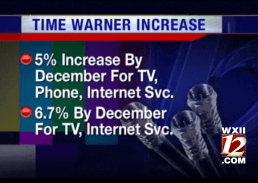
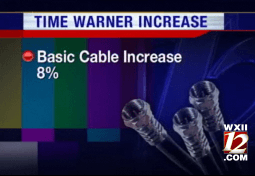
For residents in Charlotte and the Triad region, Time Warner is boosting prices for unbundled customers an average of six percent, which will impact customers not on promotional plans or who are not locked into a “price protection agreement.”

The rate increases particularly target standalone service customers.  Those with the fewest services will pay the biggest increases.  Those who subscribe to cable, phone, and broadband service from the company will suffer the least.

A Time Warner Cable spokesman claimed the company is just passing on the cost of programming.

WXII-TV in Greensboro reported that for many customers already struggling with their bills, they don’t want to hear anything about a price hike.

“I think it’s ridiculous at this time with the economy — it’s hard to make it as it is,” one customer told the station.

“I wish there was a better option out there, but it’s about the only thing you can get,” said another viewer.

Time Warner has been developing pricing models that increasingly push customers towards bundled packages of services.  Standalone broadband service saw dramatic price increases in many areas in 2010, and the company’s most aggressive new customer promotions encourage customers to take all three of its services.

But broadband customers need not expose themselves to inflated broadband prices for standalone service.  Most Time Warner Cable franchises offer Earthlink broadband at comparable speeds at prices as low as $29.95 per month for the first six months.  When the promotion expires, customers can switch back to Road Runner at Time Warner’s promotional price.

Time Warner does face competition in some areas of North Carolina from AT&T U-verse, which offers attractive promotional pricing for new customers.  But the phone company’s broadband speeds come up short after Time Warner boosted speeds across much of the state.  The cable company now delivers Road Runner at speeds of up to 50/5Mbps.  AT&T tops out at 24Mbps, and not in every area.

When a competitor can’t deliver the fastest speeds, they inevitably claim consumers don’t want or care about super-fast broadband.

“We are focused on offering the broadband speeds that our customers need, at a price that they can afford,” said AT&T spokeswoman Gretchen Schultz.

Greenlight promotes its local connection to Wilson residents

Some North Carolina consumers are watching AT&T’s slower speeds and Time Warner’s price hikes from the sidelines, because they are signed up with municipal competitors.

Residents in Wilson with Greenlight service from the city don’t have to sign a contract to get the best prices and obtain service run and maintained by Wilson-area employees. The provider has embarked on a campaign to remind residents that money spent on the city-owned provider stays in the city.

In Salisbury, Fibrant is making headway against incumbent Time Warner as it works through a waiting list for customers anxious to cut Time Warner’s cable for good.  Fibrant customers are assured they’ll always get the fastest possible service in town on a network capable of delivering up to 1Gbps to businesses -and- residents.

MI-Connection, the rebuilt former Adelphia cable system now owned by a group of local municipalities is managing to keep up with Time Warner with its own top broadband speeds of 20/2Mbps.  The system is comparable to a traditional cable operator and does not provide fiber to the home service.  Its 15,000 customers in Mooresville, Cornelius and Davidson are likely to stay with the system, but it is vulnerable to Time Warner’s bragging rights made possible from DOCSIS 3 upgrades.  Since Time Warner does not provide service in most of MI-Connection’s service area, city officials don’t face an exodus of departing customers.

But that could eventually change.  Some MI-Connection customers have reported to Stop the Cap! they have begun to receive promotional literature from Time Warner Cable for the first time, and there are growing questions whether the cable company may plan to invade some of MI-Connection’s more affluent service areas.  Cable companies generally refuse to compete with each other, but all bets are off when that cable company is owned by a local municipality.

For most North Carolina residents, AT&T will likely be the first wired competitor, with its U-verse system.  To date, U-verse has drawn mixed reviews from North Carolina consumers.  Many appreciate AT&T’s broadband network is currently less congested than Road Runner, and speeds promised are closer to reality on U-verse compared with Road Runner during the early evening.  But some AT&T customers are not thrilled being nickle-and-dimed for HD channels Time Warner bundles with its digital cable service at no additional charge.  And for households with a lot of users, AT&T can run short on bandwidth.

“We have five kids — three now teenagers, and between my husband’s Internet usage and me recording a whole bunch of shows to watch later, we have run into messages on U-verse telling us we are trying to do too much and certain TV sets won’t work until we reduce our usage,” writes Angela.  “AT&T doesn’t tell you that you all share a preset amount of bandwidth which gets divided up and if you use it up, services stop working.”

Angela says when she called AT&T, the company gave her a $15 credit for her inconvenience, and the company claims it is working on ways to eliminate these limits in particularly active households.  For now, the family is sticking with U-verse because the broadband works better in the evenings and she loves the DVR which records more shows at once than Time Warner offers.  Their U-verse new customer promotional offer saves them $35 a month over Time Warner, at least until it expires.

“From reading about Fibrant and Greenlight on your site, my husband still wishes we lived in Salisbury or Wilson because nothing beats fiber, but at least what we have is better than what we used to have,” she adds.

[flv width=”640″ height=”380″]http://www.phillipdampier.com/video/WXII Greensboro TWC Raising Rates 11-16-10.flv[/flv]

WXII-TV in Greensboro reports of Time-Warner Cable’s rate hikes for the Piedmont Triad region of North Carolina.  (2 minutes)

Here We Go Again: Sinclair Threatens Time Warner Cable Subs With Loss of 33 Stations in 21 Cities

Sinclair Broadcasting is threatening to pull 33 television stations in 21 cities from Time Warner Cable customers on January 1st if the cable company doesn’t agree to demands to pay around 20-25 cents per month per subscriber for each of the stations, primarily Fox and MyNetworkTV affiliates.

It’s just the latest in a series of retransmission rights battles underway between broadcasters and cable companies over cable carriage agreements.

Sinclair is a major group owner of television stations, and the impact on viewers in places like western New York, Dayton, Ohio, Greensboro, N.C., San Antonio, Tex., and Pittsburgh, Pa., won’t be missed because these markets have multiple Sinclair-owned or programmed stations involved in the dispute.

As always, the dispute is about money.  This week, viewers of affected stations, including our readers Lance and Andrew, started being annoyed with repeated warnings scrolled at the bottom of screens about the potential loss of their “favorite stations.”  In the case of WUHF, viewers might have thought a serious weather warning was being issued as text crawled against a distinctive red background.

So far, the dispute has not infected Sinclair’s local newscasts, which have often been used as a sounding board for the company’s past retransmission consent fights.  But then, many Sinclair stations have abandoned producing local news themselves over the past few years as a cost-savings measure.  However, many of the stations involved have put the dispute high on their home pages, as a too-cute-by-half link: “Learn About Time Warner Cable’s Plans to Drop Carriage Of This Station.”  Sinclair leaves no doubt about who they blame for the debacle.

Stations Impacted

  • AL  Birmingham — WTTO (CW)
  • AL  Birmingham — WABM (MyNetworkTV)
  • FL  Pensacola — WEAR (ABC)
  • FL  Tallahassee — WTWC (NBC)
  • FL  Tampa — WTTA (MyNetworkTV)
  • KY  Lexington — WDKY (Fox)
  • ME  Portland — WGME (CBS)
  • MO  Girardeau — KBSI (Fox)
  • NC  Greensboro — WXLV (ABC)
  • NC  Greensboro — WMYV (MyNetworkTV)
  • NC  Raleigh — WLFL (CW)
  • NC  Raleigh — WRDC (MyNetworkTV)
  • NY  Buffalo — WUTV (Fox)
  • NY  Buffalo — WNYO (MyNetworkTV)
  • NY  Rochester — WUHF (Fox)
  • NY  Syracuse — WSYT (Fox)
  • NY  Syracuse — WNYS (MyNetworkTV)
  • OH  Cincinnati — WSTR (MyNetworkTV)
  • OH  Columbus — WSYX (ABC)
  • OH  Columbus — WTTE (Fox)
  • OH  Dayton — WKEF (ABC)
  • OH  Dayton — WRGT (Fox)
  • SC  Charleston — WTAT (Fox)
  • SC  Charleston — WMMP (MyNetworkTV)
  • PA  Pittsburgh — WPGH (Fox)
  • PA  Pittsburgh — WPMY (MyNetworkTV)
  • TX  San Antonio  —  KABB (Fox)
  • TX  San Antonio — KMYS (MyNetworkTV)
  • VA  Norfolk — WTVZ (MyNetworkTV)
  • WI  Milwaukee — WVTV (CW)
  • WI  Milwaukee — WCGV (MyNetworkTV)
  • WV  Charleston — WCHS (ABC)
  • WV  Charleston — WVAH (Fox)

Sinclair’s website warns viewers negotiations with Time Warner Cable are not promising:

Sinclair (or in some cases the licensees of the television stations not owned by Sinclair) and Time Warner are in the process of negotiating a renewal of the current agreement between Sinclair and Time Warner Cable which is scheduled to expire on December 31, 2010. Without a renewal, Time Warner Cable will no longer have the right to carry the broadcast of the television stations covered by this expiring agreement. Unfortunately, based on the status of the negotiations Sinclair does not believe we are going to be able to reach agreement on an extension of the deal. As a result, Time Warner would no longer be carrying the stations covered by the agreement with Sinclair beginning on January 1, 2011. Although some might try and characterize this as a dispute, in the end it represents nothing more than the failure of two companies to reach a business agreement, something that happens in the business world thousands of times a day.

Taking a cue from News Corp., Sinclair claims Time Warner Cable is stalling, hoping the Obama Administration will intervene and prohibit signal blackouts while negotiations are still underway.  Despite the claim the cable company is the one with the plan to drop stations, Sinclair informs viewers it is giving them early warning to help them make arrangements with alternative providers like Verizon FiOS, AT&T U-verse, or satellite companies to “avoid interruptions” in programming.

Time Warner Cable recognized the seriousness of the Sinclair dispute and has given it top billing on their Roll Over or Get Tough website.  So far, the cable company has rolled over in every dispute, eventually caving to programmer demands.  But the cable company would claim it has at least reduced the rates being demanded, or won concessions that allow subscribers to catch shows on-demand as part of its TV Everywhere project.

Because the cable industry has so far been dealt the weaker hand in these disputes, they are spending an increasing amount on lobbying the issue in Washington, right down to creating a front group that claims to represent viewers.  The s0-called “American Television Alliance,” has a mission statement that, on the surface, doesn’t wade too deep into actual solutions:

The ATVA’s mission is a simple one – to give consumers a voice and ask lawmakers to protect consumers by reforming outdated rules that do not reflect today’s marketplace.  We are united in our determination to achieve our goal: ensure the best viewing experience at an affordable price, without fear of television signals being cut off or public threats of blackouts intended to scare and confuse viewers.

The overwhelming majority of the interests represented by the ATVA are giant cable and phone companies (and two groups willing to play along when sharing common interests: Public Knowledge and the New America Foundation.)

The group filed comments petitioning the Federal Communications Commission to modify retransmission consent policy to give cable and phone companies additional tools to battle with intransigent broadcasters.  The most important, and one we agree with, is an end to the ban on importing distant network signals from nearby cities to replace those from local stations who simply dump “take it or leave it” offers on operators who then raise rates to cover ever-inflating programming costs.

As it stands now, cable systems cannot grab network stations from other cities to at least restore network programming, because FCC rules prohibit it, even if the nearby station doesn’t mind.  While that might not help Time Warner viewers in cities like Rochester, where the nearby Fox affiliates in both Buffalo and Syracuse are also owned by Sinclair, the cable operator’s extended reach made possible serving all three major upstate cities might still deliver relief by grabbing further distant Fox stations like WYDC in Corning, WFXV in Utica, or WFXP in Erie, Pa and distributing them across all three affected cities.

Unfortunately, the Fox TV network has also made it clear stations could risk their affiliation deals with the network if they were to grant retransmission consent to providers that effectively undercut other Fox affiliates.

The ATVA also wants providers to retain the right to continue carrying disputed signals so long as good faith negotiations are ongoing, and has also suggested binding arbitration as another alternative reform.  Broadcasters have rejected both.

Some of the ATVA’s proposals are worthy of merit to benefit consumer interests, but consumer groups might do better creating their own group to fight this issue, if only to keep broadcasters from dismissing the group as heavily stacked with cable and phone companies with a biased, vested interest in the outcome.

Just reviewing the FCC petition left a bad taste when they quoted everyone’s favorite “dollar-a-holler” group — the League of United Latin American Citizens, which continues to amaze with its omnipresent Zelig-performance in just about every telecommunications policy debate involving LULAC’s benefactors.

More than a few politicians are likely to accept broadcaster arguments, which would ultimately weaken the effectiveness of any reform effort.

Search This Site:

Contributions:

Recent Comments:

Your Account:

Stop the Cap!