Home » time warner cable » Recent Articles:

Getting the Best Rate for Broadband-Only Service from Time Warner Cable

With Time Warner Cable’s broadband now running as high as $50 a month for standard, stand-alone service, getting the best deal possible can save you as much as $20 a month off those prices.  Time Warner Cable has been repricing their services to deliver the most value to customers who bundle all of the company’s products into a single package.  But if you don’t want television or telephone service from the cable company, you are going to pay a lot more than your service-bundled-neighbors for Road Runner High Speed Internet.

Stop the Cap! presents our strategy to help broadband-only customers get the best possible prices from Time Warner Cable:

Choose Earthlink

Customers paying Time Warner Cable’s regular prices for broadband service are paying too much.  Time Warner currently charges just short of $50 a month for Standard 10/1Mbps service (speeds are slower in some areas).  That’s up from years of charging $40 a month, slightly higher if you were a broadband-only customer.  But with the help of Earthlink, you can cut that broadband bill to $29.99 a month for the first six months.  Earthlink co-exists with Road Runner, Time Warner Cable’s own broadband service.  With just a few mouse clicks and a quick phone call, Time Warner can switch your regular price Road Runner to Earthlink without any equipment changes.  Billing and service will continue to be provided by Time Warner and the change literally takes less than five minutes by phone.

You can escape Time Warner Cable's Road Runner rate hike by switching to Earthlink service at a substantial discount.

Earthlink’s broadband service is indistinguishable from Road Runner — same speeds, same level of service, with two exceptions:

  • Earthlink does not benefit from PowerBoost, which delivers temporary speed increases during file downloads
  • You will forfeit your rr.com e-mail address

We recommend you avoid using ISP-provided e-mail addresses when possible, because they help tie you down to an existing provider.  Instead, sign up for a free e-mail account from Google’s Gmail, or Yahoo! Mail, or any of the dozens of other web-based e-mail providers.  Or, purchase your own domain name from GoDaddy or 1and1, which includes e-mail, and either read it on those sites or forward it to a web-based e-mail provider.  Domain names can be had for under $10 a year and deliver maximum flexibility for those who want the freedom to change Internet providers.

After Six Months, Switch Back to Road Runner

When your Earthlink promotion expires at the end of six months, your price will increase to $41.95 per month.  Just before that happens, switch back to Time Warner Cable’s Road Runner service.  You qualify for new customer pricing promotions.  As of this week, Time Warner Cable in western New York is offering one year at $29.99 per month for 10/1Mbps service.  Other areas may have different pricing promotions.

After the year is up, you can start all over again, heading back to Earthlink for another six month promotional term.  Earthlink has offered its promotional plan for more than two years, and it shows no signs of ending anytime soon.

Promotional Half-Truths

Promotions come and go from Time Warner Cable, so it is wise to check with them often if the $29.99 deal is not currently running in your area.  Start by checking Time Warner Cable’s website, and remember if you are using Earthlink, you will want to select pricing for new customers.  If you find a good price on the website, you may be able to complete your order online.  Otherwise, call your local office and ask about currently running promotions.  Some common ones:

  • Road Runner Turbo at 50% off for the first year;
  • Road Runner Turbo free for six months;
  • Road Runner with wireless router/modem free for six months to one year;
  • Road Runner with free installation (especially useful if you want Road Runner Extreme/Wideband service, which carries a pricey installation fee);
  • Road Runner for $29.99 for six months;
  • Bundled promotions — $99 for all three services, $79 for broadband/cable or broadband/phone

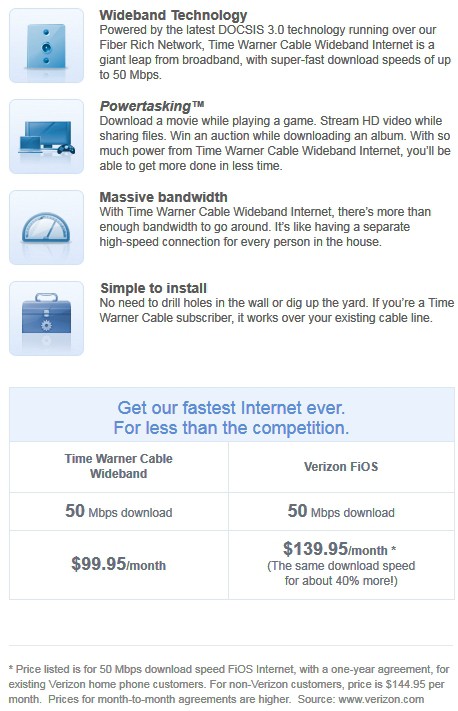
Not every promotion delivers the best deal for customers, and some have been slightly deceptive, such as this speed comparison we found on the cable company’s website this morning:
Our View:

  1. Time Warner Cable has been spanked before for their claims about running a “fiber network.”  In fact, their “Fiber Rich Network” is a marketing stretch.  All modern cable systems use fiber optics to help distribute their service into various communities, but coaxial copper cable delivers the signal through neighborhoods to your individual home.  Cable companies still cannot match the broadband speeds available on an all-fiber network.
  2. “Powertasking” is a meaningless marketing claim.  Any high speed network will allow the entire family to effectively share a broadband connection.
  3. We’re glad to know Time Warner Cable has “massive bandwidth” — more than enough to go around.  We’ll remember that if and when the company ever entertains bringing back their experimental Internet Overcharging scheme they claimed was necessary to pay for equipment upgrades to cope with broadband traffic growth.
  4. It would be simpler to install Time Warner’s DOCSIS 3 upgrade if we could do it ourselves, but the cable company currently requires a mandatory service call ($67.98 fee) to install it.
  5. Time Warner is being cute comparing their broadband speed with Verizon FiOS.  In fact, FiOS is faster because of what isn’t mentioned here — upstream speeds.  Time Warner tops out at 5Mbps, Verizon offers 20Mbps for uploads.  But Time Warner’s pricing is better at that download speed.  Verizon is more aggressively priced when they bundle services together.  For example, Time Warner’s $99 triple play bundle only offers 10/1Mbps service.  Verizon offers up to 25/25Mbps service for the same price.  Both include phone and television service.
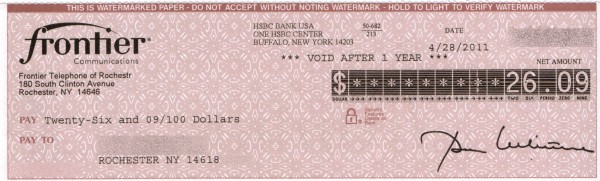
Where’s Our Refund? Two Months and $26.09 Later, Frontier Finally Sends A Check

Phillip Dampier May 9, 2011 Competition, Consumer News, Editorial & Site News, Frontier Comments Off on Where’s Our Refund? Two Months and $26.09 Later, Frontier Finally Sends A Check

Stop the Cap! readers will recall we pulled the plug on Frontier Communications with the disconnection of our landline back in early February.  After at least 25 years doing business with Rochester Telephone Corporation, later Frontier-Global Crossing, later Frontier-Citizens Communications, we had enough.  Frontier Communications has done nothing of merit for the metropolitan Rochester, N.Y., area since the late 1990s.  Their DSL broadband service is handily beaten in quality, reliability, and price by cable competitor Time Warner Cable, and Frontier’s lack of willingness to invest in something better for their largest service area of nearly one million people in western New York has left us cold.  After a one week experiment with Frontier’s DSL service in 2009, we dropped the service like a hot potato after it achieved an underwhelming 3.1Mbps in the town of Brighton, less than one mile from the Rochester city line.

In early February, our last remaining service — the landline — was transferred to Time Warner Cable.  But even on the way out the door, Frontier continued to disappoint.  After more than two months (and two invoices later), Frontier had still not refunded our credit balance of $26.09.  We’re a long way from Rochester Telephone, a well-regarded predecessor to Frontier which traditionally enclosed a refund check with the final bill.  Frontier makes you wait, and wait, and wait some more, reminding you they owe you money with repetitious “do not pay – credit balance” invoices for long-terminated service.

More than two months after disconnecting service, our refund check finally arrives!

On Monday, the refund check finally arrived, in an obscure envelope resembling one of those PIN reminders banks send you.  After tearing away three sides of perforated strips, there it was — $26.09 from Frontier Communications.

The long wait is hardly a random glitch.  Stop the Cap! covered the story of a Frontier customer in California who waited several months for the phone company to refund her just over $15, and just this evening we heard from one of our regular readers in Rochester disappointed by Frontier’s hardly-rapid refund policy.

The only good news is that we weren’t overbilled on the way out the door, as one Elk Grove, Calif. customer was — to the tune of $680.

To Frontier we say goodbye and good luck (and we’ll be cashing that check faster than you sent it).

Loud Critic of North Carolina Community Broadband Exposed As Time Warner Cable Employee

Phillip "Not a Time Warner Cable Employee" Dampier

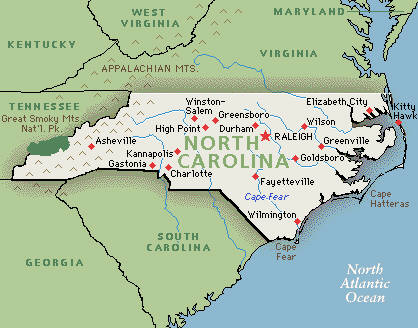
One of the most vociferous critics of the publicly-owned cable system serving the communities of Mooresville, Cornelius and Davidson, N.C. has been exposed as an employee of Time Warner Cable.

MI-Connection, the community-owned cable system, has been subjected to withering criticism since town leaders purchased it from bankrupt Adelphia Cable in 2007.  The efforts to rebuild the system to current standards has proved time-consuming and expensive, and ongoing expenses will require an investment of at least $17 million over the next three years to keep the cable system up and running.  Despite the fact Time Warner Cable has run into larger, more expensive headaches rebuilding similar rundown Adelphia systems they purchased in Ft. Worth, Texas and Los Angeles, critics of community cable have pounced on the costly rebuild to attack public involvement in private enterprise and suggest city officials have not competently run the operation.

Some of the loudest criticism has come in the comment sections of local newspapers and media sites.  Just as Fibrant has faced similar attacks in the comment section of the Salisbury Post, critics of MI-Connection have piled on in newspapers like the Davidson News and Hunterville’s Herald Weekly.  One of the loudest critics of all, Andy Stevens, even started a blog devoted to attacking what he calls “Government Cable.”

David Boraks, editor of the Davidson News, has reported extensively on MI-Connection, and he reads the comments that follow his articles published online, including those written by Stevens.

In a story written today by Boraks, the Davidson News revealed a fact that consumers, the media, and local officials deserved to know — Stevens works for Time Warner Cable.  That revelation comes despite repeated earlier denials from Stevens when asked by reporters and local officials if he worked for the cable company.

Mooresville, North Carolina

How did the newspaper find out about Mr. Stevens’ day job?

MI-Connection board chair John Venzon has gotten fed up reading unrelenting, and often fact-free attacks on the publicly owned cable system he oversees.  Venzon told the Herald Weekly he used to ignore the often anonymous critics of the local cable system, but he’s changing tactics.  Venzon and some other MI-Connection supporters have jumped into the online debate, correcting false information and taking on some of the cable system’s loudest critics, including Stevens.

As part of that effort, Venzon decided to publicly disclose a recent encounter with Stevens at a local shopping center.  Venzon was especially interested to find Stevens wearing a Time Warner Cable uniform, driving a Time Warner Cable truck.

Venzon went public on the Davidson News website Friday:

I would like to point out that today we confirmed that Andy Stevens, a frequent attendee at our board meetings and vocal community critic works for Time Warner Cable. He was greeted by one of our employees while in a TWC uniform and driving one of their logo-ed vehicles. He has been active in using our publicly available information to turn our potential customers against us and to stir up fear, uncertainty and doubt about MI-Connection while hiding his motives. He does not live in our town or service area, so he does not ‘have a dog in the fight’ unless you consider who signs his paycheck. Could I attend competitors’ regular board meetings to see what they are doing?

To make matters worse, he has used the Freedom of Information Act to gain access to every communication between the towns, the board and management. So Time Warner does in fact sit in our meetings … and we are required to provide the meeting notes.

In corporate America, this would constitute espionage. In our situation, it is free and legal. I find it deplorable. I hope you agree.

I believe we should be required to report information just as publicly traded companies do and would adhere to all such requirement. That system promotes transparency to shareholders on a quarterly basis. In addition, we would continue to attend town board meetings and community roundtables to disclose information to citizens.

In another setting, I would be happy to debate the merits of public ownership of a utility that promotes the well being of its citizens and businesses within their community. However, we are in the midst of executing a decision that was made several years ago and are responsible to grow the business.

I do not mind a fair fight, and we must win based on the value of our products and services. However, don’t unfairly give advantage to our competitors and put our citizens at greater risk.

Boraks

Boraks has gotten an admission from Stevens he does, in fact, work for Time Warner Cable, a pertinent detail omitted from Stevens’ anti-MI-Connection blog.  Before deleting about a dozen articles attacking the community cable system, Stevens even noted on the home page of his website, “As I have a full time job, this effort will be accomplished during my free time (evenings and weekends),” without bothering to disclose what that job was.  His “About” section didn’t make mention of his employer either.

The now-defunct blog of secret Time Warner Cable employee Andy Stevens

Now that Time Warner Cable, a regular critic of community-owned broadband, has been put in the embarrassing position of having an employee indirectly do its dirty work, a company spokesman was reduced to telling Boraks they cannot control what their employees do.

But apparently behind closed doors, all is not sweetness and light between Stevens and his employer.  Stevens’ highly active blog suddenly was deprived of all its content after revelations about his employer made the newspaper.  Bing’s cache of Stevens’ site (which Stop the Cap! has captured) shows he had plenty to say about the cable system — none of it good.  That all changed today.

Boraks opined in his piece in the News that Stevens ongoing denials of involvement with Time Warner Cable and his lack of disclosure left him concerned.

Indeed, Stevens’ efforts to hide his employer’s identity and his subsequent decision to bring his blog down after the cat was let out of the bag suggests there is nothing for Stevens or Time Warner Cable to be proud of in their relentless, often sneaky efforts to bring community-owned competition to its knees.  When it comes to protecting duopoly profits of local cable and phone companies in North Carolina, it’s total war on all fronts.

National Call to Action: Insist That North Carolina Gov. Bev Purdue Veto H.129

It’s time for every consumer across the country to help our friends in North Carolina, who are now facing the prospect of a Broadband Dark Age with the passage of a cable-industry-written bill designed to protect their monopoly prices and deliver America’s worst broadband experience.

The grand lie that is the Level Playing Field/Local Government Competition Bill (H.129) claims it will protect broadband competition in the state.  It will, if you are Time Warner Cable facing top-rated, super-fast service from community broadband networks that compete with them in communities like Salisbury and Wilson.

The power to protect North Carolina’s broadband future is now in the hands of Gov. Bev Purdue.

The North Carolina Senate abdicated their responsibility to serve the interests of state residents.  On Tuesday, they voted 39-10 for this consumer atrocity:

Ayes: Senator(s): Allran; Apodaca; Atwater; Berger, D.; Berger, P.; Bingham; Blake; Blue; Brock; Brown; Brunstetter; Clary; Daniel; Davis; East; Forrester; Garrou; Goolsby; Gunn; Harrington; Hartsell; Hise; Hunt; Jackson; Jenkins; Jones; McKissick; Nesbitt; Pate; Preston; Rabon; Rouzer; Rucho; Soucek; Stein; Stevens; Tillman; Tucker; Walters
Noes: Senator(s): Dannelly; Graham; Kinnaird; Mansfield; Meredith; Newton; Purcell; Robinson; Vaughan; White

Yesterday, the House added insult to injury voting 84-32 for the bill custom written by and for Time Warner Cable:

Democrat Republican
Ayes: Representative(s): Adams; Brisson; Carney; Crawford; Earle; Hamilton; Hill; McLawhorn; Michaux; Mobley; Moore, R.; Owens; Parmon; Pierce; Spear; Wainwright; Warren, E.; Wilkins; Wray Representative(s): Avila; Barnhart; Blackwell; Blust; Boles; Bradley; Brawley; Brown, L.; Brown, R.; Brubaker; Burr; Cleveland; Collins; Cook; Daughtry; Dixon; Dockham; Dollar; Faircloth; Folwell; Frye; Gillespie; Guice; Hager; Hastings; Hilton; Hollo; Holloway; Horn; Howard; Hurley; Iler; Ingle; Johnson; Jones; Jordan; Justice; Langdon; LaRoque; Lewis; McComas; McCormick; McElraft; McGee; McGrady; Mills; Moffitt; Moore, T.; Murry; Pridgen; Randleman; Rhyne; Sager; Samuelson; Sanderson; Setzer; Shepard; Stam; Starnes; Steen; Stevens; Stone; Torbett; Warren, H.; West
Noes: Representative(s): Alexander, K.; Alexander, M.; Bordsen; Brandon; Bryant; Cotham; Faison; Farmer-Butterfield; Fisher; Floyd; Gill; Glazier; Goodman; Graham; Hackney; Haire; Hall; Harrison; Insko; Jackson; Jeffus; Keever; Lucas; Luebke; Martin; McGuirt; Parfitt; Rapp; Ross; Tolson; Weiss; Womble

Not a single Republican in the House stood up for you.

Faison

Several legislators that still remember they represent the interests of voters and not out of state big cable and phone companies were appalled.

Rep. Bill Faison (D-Caswell, Orange), who has been a champion of better broadband across North Carolina, reminded the Assembly the bill should have been named the Time Warner Cable Anti-Competition Bill, written by a New York City-based company that will prevent cities from using their collective buying authority to provide themselves (finally) with the broadband service the private sector has steadfastly refused to deliver.

Faison noted Time Warner Cable CEO Glenn Britt made $27 million in compensation last year — the same as the entire cost of Wilson’s GreenLight fiber-to-the-home cable system.

Faison openly pondered what the cable company has been paying to employ the six full time lobbyists who have been trolling the halls of the state legislature for months, and exactly how much next year’s rate increase will be to pay for their services.

Even the former chairman of the state Republican party called H.129 an enormously arrogant piece of legislation.

Luebke

Another hero for consumers, Rep. Paul Luebke (D-Durham), noted the bill’s immediate impact will be to keep rural North Carolina a broadband desert.  Luebke called H.129 a bad bill that denies service even to communities where no broadband service exists.

But Rep. Marilyn Avila (R-Time Warner Cable) wanted to ensure no one could say there was a broadband problem in North Carolina, so she supported an amendment that allows areas to be declared served if even a single home has broadband service in a particular census block.  That provision delivers beneficial protection to CenturyLink, who can spend their time, money, and attention on a merger with Qwest, the last remaining independent Baby Bell.  While they focus on making themselves bigger through mergers and acquisitions, the phone company faces no competitive pressure to expand service in rural North Carolina, and will face no meaningful competition for the indefinite future.

While Gov. Purdue’s office has made noises about vetoing this bad legislation, it is essential that we let the governor know we need an absolute commitment on her part to veto H.129.  We’ve seen how Big Telecom plays their dirty pool, so we cannot afford to sit back and allow their lobbyists to wear the governor down.

Gov. Purdue

When Time Warner Cable tried to slap an Internet Overcharging scheme on consumers in New York, North Carolina, and Texas in 2009, Stop the Cap! made a commitment to join forces with all of the impacted communities to present a united consumer front against provider abuses.  H.129 qualifies.  That’s why we urge everyone to contact Gov. Purdue and let her know she must veto H.129, an anti-consumer, anti-broadband bill.

Please call -and- e-mail her office:


Minor Correction Made 5/6 – 5pm ET: We made an error referring to a census tract instead of a census block in the original piece.  One of our readers dropped us a note correcting us, which we are happy to do.  A “tract” actually has many “blocks” in it.

Northeast Ohio Deals With Time Warner Cable Pixel Problem

Phillip Dampier May 5, 2011 Consumer News, Video 2 Comments

For several days now, Time Warner Cable customers in northeast Ohio have endured disruptions to their digital cable, as pixel problems and frozen pictures plague the cable company.  Communities like Cleveland, Mentor, and Elyria are all affected, and the cable company can’t figure out what is causing the trouble.

Time Warner Cable reports more than 100 employees are trying to track down the problem, but the company will not issue general credits to affected customers.  Instead, you must write or call Time Warner requesting credit.  You can send a credit request on Time Warner’s website under the contact section.

[flv width=”360″ height=”290″]http://www.phillipdampier.com/video/WEWS Cleveland Time Warner Pixel Problems 5-3-11.mp4[/flv]

WEWS-TV in Cleveland covers Time Warner’s troubles after problems with the cable company brought many requests from viewers to get to the bottom of it.  (3 minutes)

Search This Site:

Contributions:

Recent Comments:

Your Account:

Stop the Cap!