Home » telephone service » Recent Articles:

Major Verizon Phone/Broadband Outages in NY; Greenwich Village, North Country Hit

Greenwich Village business owner Louis Wintermeyer has spent the last three months without phone or broadband service from Verizon Communications.

“It is hard to believe it has gone on this long,” Wintermeyer told the New York Post. “You feel like you’re in Bangladesh here. I mean we’re in the West Village!”

Across Manhattan, and well into upstate New York, Verizon customers who start experiencing landline problems often keep experiencing them for weeks or months on end.

Wintermeyer couldn’t wait that long — he relocated his car-export company to his Rockland County home. Another Verizon customer in the same building — the Darling advertising agency, experienced intermittent outages adding up to 10 weeks of no service since February.

“We really sounded like amateurs,” Jeroen Bours, president of the Darling advertising agency told the Post. “We would be in a conference call, and all of a sudden the call would go. It just doesn’t really make a good impression.”

In the Adirondack hamlet of Wanakena, when the rain arrives, Verizon service leaves a lot to be desired.

One person’s phone may be working but the one next door will be completely out of service or crackly at best, according to local residents.

“It’s almost comical,” Ranger school director Christopher L. Westbrook told the Watertown Daily Times. “It’s so bizarre because some phones will be working while others are not.”

[flv]http://www.phillipdampier.com/video/WWNY Watertown Phone Situation Improving Officials Say 8-3-12.mp4[/flv]

A fiber optic line cut near Cicero, N.Y. in early August disrupted phone and cellular service from Verizon across the North Country. WWNY in Watertown covers the event.  (1 minute)

One Adirondack Park Agency commissioner who lives in the area says he has been without a phone 15 times in the last two months. Unfortunately for North Country residents, cell phone service is often not an option, because carriers don’t provide reliable wireless service in the region.
Local businesses cannot process credit card transactions, broadband service goes down, and a handful of privately-owned pay phones out of service for months have been abandoned by their independent owner because of the ongoing service problems.

Verizon repair crews come and go, but affected customers report a real reluctance by Verizon technicians to complete repairs once and for all.

“The permanent fix is not happening,” says Angie K. Oliver, owner of the Wanakena General Store.

Bours said one Verizon technician told him the company no longer cares about its older copper wire landline business. Rural residents upstate sense the company has little interest spending money on deteriorating infrastructure.

Some Wanakena residents suspect Verizon has thrown in the towel in St. Lawrence and Franklin counties, where independent Nicholville Telephone subsidiary Slic Network Solutions is constructing over 800 miles of fiber optic cable and operates a fiber to the home broadband and phone service.

[flv]http://www.phillipdampier.com/video/WWNY Watertown Lewis County Phone Service Restored 8-20-11.mp4[/flv]

Last summer, Lewis County suffered a similar widespread phone service outage that left businesses and homes without service for days.  WWNY says Barnes Corners was hardest hit.  (1 minute) 

Verizon spokesman John J. Bonomo blamed lightning strikes for the problems in Wanakena, but said the cable serving the area was intact and should not be responsible for service outages.

Gray

Near Syracuse University, some businesses and residents were without phone service for nearly two weeks in June.

The largest outage began when more than 150 customers around SU lost service after a storm. More than a week later, nearly two dozen customers were still without service, including the 4,000 member U.S. Institute for Theater Technology.

A damaged underground phone cable was deemed responsible, but repairs were slow.

Earlier this month, Massena town supervisor Joseph Gray fired off a letter to the deputy Secretary of State after a major Verizon line north of Syracuse was damaged, cutting off landline and cell phone service throughout Jefferson and St. Lawrence counties.

“I would have called your office to speak with you directly, but I couldn’t because our telephone service was unavailable,” Gray wrote. “Since I became supervisor of the town of Massena just over two and a half years ago, on at least three different occasions telecommunications in the entire North Country has been thrown into chaos because a Verizon fiber optic cable was cut 150 miles from here. Many of us found our emergency services, business, residential, and cellular telephone service interrupted, not to mention disabled credit card machines, facsimile machines and Internet service in some cases.”

Gray criticized the Public Service Commission for allowing Verizon to operate without service redundancy in the state, providing backup facilities if a fiber cut occurs.
“As a result, the Public Service Commission (which perhaps should be given a different name if my experiences with them is typical), has done nothing to address this dangerous situation and, more incredibly, appears unwilling to acknowledge that the problem exists,” Gray said.

Attorney General Eric Schneiderman blasted Verizon’s poor landline service in a petition sent to the New York State Public Service Commission. Schneiderman called Verizon’s service unacceptable in New York, with customers forced to wait inordinate periods to get service restored.

“Verizon’s management has demonstrated that it is unwilling to compete to retain its wireline customer base, and instead is entirely focused on expanding its wireless business affiliate,” said Schneiderman’s office.

Schneiderman’s office filed evidence in July that Verizon was undercutting its landline business in New York and diverting money for other purposes:

  • Verizon’s claim it had spent more than $1 billion in investments to its landline network was misleading: Roughly three-quarters of the money was actually spent on transport facilities to serve wireless cell sites and ongoing spending on FiOS in areas already committed to get the fiber-to-the-home service;
  • Verizon investment in landlines has declined even faster than its line losses. The dollars per access line budgeted for 2012 is one-third less than the investment for the 2007-2009 period;
  • In just a five month period, 19.5% of the company’s 4.3 million customer lines in New York required repair. This means every Verizon customer will need an average of one repair every five years;
  • Verizon’s complaint rate with the PSC has exceeded the PSC’s own limit for good service every month since June 2010. Most recently, Verizon exceeded the limit by more than double the threshold;
  • Verizon’s agreement with the Commission establishes two classes of customers: “core” customers (8%) that qualify for enhanced repair service because they are elderly and/or have medical problems and non-core customers (virtually everyone else). The Commission only enforces service standards and repair lapses with “core” customers, which are required to have out of service lines restored within 24 hours 80% of the time. Verizon is free to delay other repairs indefinitely without consequence.
  • The PSC has already fined Verizon $400,000 earlier this year for poor service from October-December 2011.

[flv]http://www.phillipdampier.com/video/WWNY Watertown Gray Phone Disruptions Perilous Flaw 8-7-12.mp4[/flv]

WWNY talks with Massena town supervisor Joseph Gray, who has launched a campaign to force Verizon to develop a plan to better handle outages in northern New York. (2 minutes)
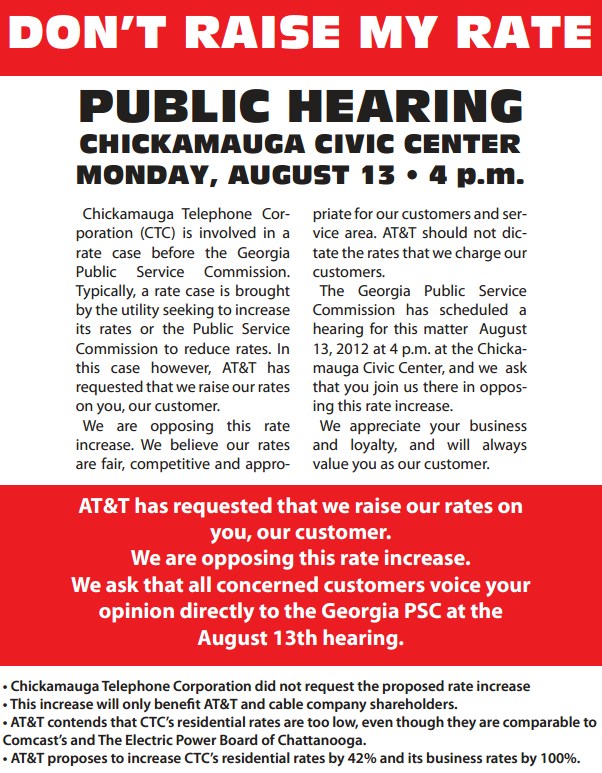
AT&T and Georgia Cable Lobby Try to Force Independent Telcos to Raise Rates

Normally, telephone companies looking for a rate increase file a request themselves with state regulators to charge customers more for service. But in Georgia, AT&T, Comcast, and the state cable lobbying group are asking the Georgia Public Service Commission (GPSC) to order two rural phone companies to raise rates because they are not “charging enough” for phone service, when compared with cable telephone services and AT&T.

The Ringgold Telephone Company (RTC) and Chickamauga Telephone Company both argue the action is anti-competitive.

“By forcing [both companies] to increase rates, these competitors are seeking to make wireless and cable companies more attractive to consumers,” says the Don’t Raise My Rate website.

The independent phone companies are vehemently against raising their rates, and executives at both companies are outraged AT&T and the state’s cable companies are literally trying to force the GPSC to order rate increases on residential and business customers.

“It’s totally unprecedented,” Phil Erli, executive vice president at RTC told the Times Free Press.  “It is ludicrous and illogical.”

The Georgia Public Service Commission will decide on Oct. 16 whether the rate increases are justified, following local public hearings Aug. 13.

AT&T, which is driving the campaign to force customers to pay higher rates, says they are pressing the case because both companies unfairly charge substantially lower rates than AT&T does in Georgia.

Peter F. Martin, vice president for legislative and regulatory affairs in Georgia openly admits he wants both companies to charge essentially the same prices AT&T bills its customers in other areas of the state.

“The premise of my recommendation is that [the two phone companies] raise rates to roughly the same levels that are being charged by other local exchange carriers in surrounding areas,” Martin testified before the GPSC. “In other words, my recommendation is that [the two phone companies] increase their own end-user rates to market-based levels comparable to what other carriers are charging their subscribers.”

For customers of Chickamauga Telephone, that would amount to a 42% rate increase on residential customers, 100% on business customers. Customers of RTC would pay 20 percent more for residential service, 37% more for business service.

AT&T claims both companies, in deeply rural Georgia, are tapping into the state’s rural service fund and are receiving some of the largest state-mandated telecom subsidies, which are funded by all of Georgia’s phone companies and ratepayers. But both companies claim they have spent a large portion of those funds repairing damages to their rural networks incurred from a series of tornadoes which hit the area two years in a row.

The state cable lobbying group, the Cable Television Association of Georgia (CTAG) also has a dog in this fight. Comcast Cable, the dominant provider in Georgia, directly competes with both phone companies. They support AT&T’s demands that both phone companies hike their rates. It is not difficult to understand why:

Residential Service With Calling Features:

CHICKAMAUGA TEL TODAY

CHICKAMAUGA TEL

AT&T PROPOSED RATE

COMCAST’S CURRENT RATE

EPB

$31.75

$37.28

$34.95

$22.99

Business Service With Calling Features:

CHICKAMAUGA TEL TODAY

CHICKAMAUGA TEL

AT&T PROPOSED

COMCAST’S CURRENT RATE

EPB

$88.85

$113.30

$49.95

$35.99

(EPB, a publicly-owned provider from nearby Chattanooga, Tenn., also offers service in some areas.)

Chickamauga Telephone executives argue Georgia’s telephone deregulation policies are heavily weighted in favor of huge phone and cable companies and leave independent, rural phone companies with no new revenue opportunities. Chickamauga argues AT&T and the cable industry are using legislatively imposed “unfunded mandates” to win favor and additional profits for themselves and their shareholders, with no resulting savings for Georgia ratepayers, especially in rural areas.

If AT&T and cable operators have their way, both independent phone companies “would be priced out of the competitive market,” and “would soon find [themselves] out of business.”

“If you lived down here and you had a phone with us and your rates went up, how would you respond?” asked Ted Austin, a spokesman for Chickamauga Telephone. “Nobody wants their bills to go up, especially when it’s not something that Chickamauga Telephone is asking for.”

Comcast’s Nationwide Rate Increase: Bill Padding “Regulatory Recovery” Fees Have Arrived

Phillip Dampier July 10, 2012 Comcast/Xfinity, Consumer News, Editorial & Site News, Public Policy & Gov't Comments Off on Comcast’s Nationwide Rate Increase: Bill Padding “Regulatory Recovery” Fees Have Arrived

Bill padding you to infinity with Comcast’s new “Regulatory Recovery Fee.”

“Effective July 1, 2012, a Regulatory Recovery Fee will be instituted to recover additional costs associated with governmental programs.  This fee is not government-mandated, and may vary based upon your monthly usage pattern.”

That notice was included in the fine print of Comcast’s June billing statements for customers with Xfinity phone service, and has led to many questions from subscribers confused about the new charges, how they are calculated, and why they are being charged in the first place.

Welcome to Comcast’s bill-padding adventure. The telecommunications company has discovered it can deliver a back-door rate increase and blame it on “governmental programs,” even though Comcast has been paying some of these fees as a cost of doing business for decades.

The Federal Communications Commission allows companies to recover these costs from subscribers, which Comcast has effectively been doing by including them in the price of monthly service. But now Comcast is taking a lesson from wireless phone companies who have discovered they can keep your monthly rate the same -and- bill you the new “regulatory recovery fee” and pocket the proceeds themselves.

For now, the Regulatory Recovery Fee applies to Comcast’s phone service only (underlining ours):

The Regulatory Recovery Fee is part of the cost of providing Comcast voice service and supports federal, municipal and state programs including, without limitation, universal service. This aggregated fee is not government mandated, but Comcast is permitted by law to recover these costs from its subscribers. The aggregated fee may vary based on service usage patterns and program surcharge rates.

The exact amount of the charge and how it is calculated can be found on Comcast’s telephone “tariff” website, which breaks out the charges for telephone service state-by-state, and in some cases city by city.

Surprisingly, Comcast’s small New York State operations appear to have no regulatory recovery charges at all. In parts of Virginia, customers only face a “Federal Cost Recovery Fee” of 1.433%. Pennsylvania residents will pay a “State TRS” of $ 0.08/mo, a State Gross Receipts Tax of 5.0%, and the aforementioned Federal Cost Recovery Fee.

Many Californians will find this monthly fee comprised of everything but the kitchen sink:

  • State Universal Service Fund (USF) 1.15%
  • State Telecom Relay Service 0.079%
  • City Utility User’s Tax, up to a maximum of 11.00%
  • County Utility User’s Tax, up to a maximum of 5.50%
  • State PUC recovery fee 0.18%
  • State Hearing Impaired Fund 0.20%
  • High Cost Fund – A 0.40%
  • High Cost Fund – B 0.30%
  • CA Advanced Services Fund 0.14%
  • Federal Cost Recovery Fee 1.433%

Regardless of the amounts involved, Comcast is under no obligation to separately bill you these charges. More importantly, because there is no corresponding decrease in the monthly price of their telephone service as these new fees are added, Quick Fingers Comcast has just managed a bit of “rate increase-sleight-of-hand.”

Betcha missed it.  We didn’t.

Call to Action: AT&T and ALEC Pushing Anti-Consumer Telecom Bill in California

The Communications Workers of America says when it comes to “stealthy” bills like S.B. 1611 that deregulate telecommunications in California, “no price is too high — no lie is too big.”

AT&T and the American Legislative Exchange Council (ALEC) are back again fighting for more deregulation of California’s telecommunications industry with a bill that will strip oversight of vital telecommunications services and stop punishing bad actors that leave customers without telephone service, sometimes for weeks.

California legislators are typically not responsive to the wholesale deregulation efforts that seem to draw support in more conservative states, so AT&T’s lobbyists are trying a more “incremental” approach in the state. But AT&T has also inserted “stealth” language into the bill that would dismantle consumer protections, allow companies to abandon unprofitable landlines, and strip away important oversight “checks and balances” needed to ensure good service.

Sen. Padilla’s top corporate contributor is AT&T.

S.B. 1611 illustrates that AT&T can buy its way into any legislator’s office, Democrat or Republican. The bill’s chief sponsor, Rep. Alex Padilla (D-20th Senate District) has received more contributions from AT&T than from any other corporation in both the 2006 and 2010 elections.

The bill ostensibly claims to limit its scope narrowly to “Voice over Internet Protocol” (VoIP) and “Internet Protocol enabled service.” That brings to mind services like “digital phone service” from cable companies or alternative telephone services like Vonage, magicJack or Skype.

S.B. 1611:

The bill would prohibit any department, agency, commission, or political subdivision of the state from enacting, adopting, or enforcing any law, rule, regulation, ordinance, standard, order, or other provision having the force or effect of law, that regulates VoIP or other IP enabled service, unless required or delegated by federal law or expressly authorized by statute. The bill would specify certain areas of law that are expressly applicable to VoIP and IP enabled service providers. The bill would provide that its limitations upon the commission’s regulation of VoIP and IP enabled services do not affect the commission’s existing authority over non-VoIP and other non-IP enabled wireline or wireless service….

To the layperson who generally believes services like Skype and Vonage might not deserve the same oversight as AT&T, Frontier, or Verizon — which provide Californians traditional landline service, consider Section 2 (a)(2) of the bill, which describes and defines VoIP and IP enabled service as anything that:

“Permits a user generally to receive a call that originates on the public switched telephone network and to terminate a call to the public switched telephone network” and “any service, capability, functionality, or application using existing Internet Protocol, or any successor Internet Protocol, that enables an end user to send or receive a communication in existing Internet Protocol format, or any successor Internet Protocol format through a broadband connection, regardless of whether the communication is voice, data, or video.”

This “narrow” deregulation bill just grew as wide as the Gulf of Mexico and can realistically allow any phone company in California to ignore state oversight and regulation forever.

Traditional telephone companies increasingly utilize exactly these technologies for calls placed over ordinary landline phones. Using broadband service to engage in two-way communications also qualifies. With this kind of defining language, virtually every telecommunications service in the state of California would win near-total deregulation and walk away from important oversight. The California Public Utilities Commission certainly understood the implications of this bill when the majority of commissioners came out in opposition to S.B. 1611.

Goodbye Universal Service: S.B. 1611 Allows Phone Companies to Abandon Rural and Economically Distressed California Communities

Several public interest groups also discovered language in the bill that is a perennial favorite of AT&T — eliminating universal service requirements that assure every citizen that wants a telephone line can get one. S.B. 1611 lays waste to Section 709 of the California Code which guarantees: “our universal service commitment by assuring the continued affordability and widespread availability of high-quality telecommunications services to all Californians.”

With that language gone, the state’s phone companies can unilaterally decide to abandon the customers they no longer want to serve. That could spell disaster in rural northern and eastern California, and leave low income residents with nothing but a dead phone line, unable even to call 911 in an emergency.

One AT&T Lobbyist for Every California Lawmaker

The importance AT&T places on influencing lawmakers is readily apparent when one realizes there are at least 120 AT&T lobbyists working in the state capital Sacramento, one for every California lawmaker.

But when one considers the track record of California phone and cable companies in the last few years, is less oversight and regulation the right answer?

“SB 1161 is a stealth vehicle for the gradual deregulation of telecommunications in California,” the Consumer Federation of California declared on their website. “Consumers need the CPUC to have the power to investigate complaints of bad service or unfair charges on bills, regardless of the technology used to provide phone service.”

Call to Action!

Consumers across California need to get on board immediately to stop S.B. 1611. You can file online opposition courtesy of Free Press, but it is far more effective to also directly phone your own legislator and leave a message to urge this bill be defeated. It literally takes only 2-3 minutes to call and the money and phone service you could save will be your own. Use this district finder to contact your representatives.

S.B. 1161 is scheduled for hearing in the Assembly Appropriations Committee this Wednesday, so time is of the essence!

Doing Things ‘The Frontier Way’ Has Been a Recipe for Disaster

Phillip "An Ex-Frontier Customer" Dampier

The other week while sitting in the dentist’s office waiting for my wallet to be drilled, I overheard a conversation at the reception desk over the latest effort by Frontier Communications to shoot itself in the proverbial foot.

“I decided to get rid of my phone line the other day and when I called Frontier to disconnect, I was told I would owe them more than $150 in disconnection fees for a contract I never knew I had with them,” opened the conversation.

“That happened to my sister as well, and she couldn’t believe it because nobody ever told her she was on a contract,” came the reply.

“I never knew I was either, and I told the representative they needed to show me where I signed up for anything like that or else I’m not paying it,” insisted the latest victim of Frontier’s phantom service contracts.

Within a minute or two, all had decided they were done doing business with the phone company that got its start more than 100 years ago as the well-regarded Rochester Telephone Corporation.  In 2012, there was no turning back after $150 “disconnect” penalties and other insults.  They were intent on being rid of Frontier once and for all.

With customer unfriendly policies like that, it comes as no surprise Frontier has been losing customers in the Rochester market for years, mostly to cell phone providers or Time Warner Cable — the latter which delivers more value and far superior broadband speed in western New York communities not served by Verizon FiOS.

Surprise... you're on a contract with a $150 cancellation penalty.

Twenty years ago, Rochester Telephone delivered excellent value, charging about half what then-NYNEX customers in Buffalo and Syracuse paid for telephone service. But as Frontier has increasingly disengaged from being an aggressive contender for telecommunications services in Rochester, people in this region of one million noticed, especially when Verizon’s fiber to the home service arrived in Buffalo, Syracuse, Albany, and beyond.

What did Frontier offer? Not much. Frontier’s local general manager Ann Burr, who used to be in charge at Time Warner Cable locally, told local media Rochester didn’t need faster broadband speeds. That’s a fitting argument for a company that doesn’t deliver them and believes 3Mbps broadband is plenty fast enough.  If you don’t like it, feel free to leave, so long as you aren’t trapped with that long-term service contract you never knew you had. (The New York Attorney General’s office has already spanked Frontier once for the practice, forcing them to issue refunds, and judging from last week’s conversation, it appears the problem has not abated.)

The fact is, Frontier offers little compelling to the landline customers they have left.

Rochester’s experience with Frontier seems apropos when contemplating the phone company’s latest quarterly results, which one analyst called “ugly.” Having listened to at least a dozen of Frontier’s quarterly conference calls with investors over the past three years, there seems to be no shortage of promises of better days to come.  Frontier is among the few companies I have heard call customer losses of 5-11% every quarter “an improvement.”

As one investor put it, the management at Frontier should win an Academy Award for feigned optimism.

This week, the company announced first-quarter earnings fell 51% thanks to lower revenue earned from the dwindling number of residential and business customers. But better days are ahead, really.

Road to nowhere?

Frontier has spent the last year treating their “system conversion” for ex-Verizon territories as the telecom equivalent of the Holy Grail.  Once achieved, the company can do anything. The reorganization underway internally at the company is supposed to improve its lackluster customer service, generate more marketing opportunities, save the company money, and open the door to a new chapter of a unified Frontier family, with ex-Verizon and always-Frontier employees coming together to do things “the Frontier way.”

How much longer investors will stick around waiting for the promised land remains an open question. The stock has already achieved a 52-week low, and if the company cuts its dividend — the primary point of attraction for investors — it will drop much lower.

Frontier’s management decisions have effectively left the company between a rock (Wall Street) and a hard place (its dwindling customers).  Much of the company’s success is predicated on rural broadband/landline service, where the company expects to face little competition.  But Verizon, the company that sold them much of their inherited network, has a little surprise for them.  After selling off the “junk” (a deteriorating copper landline network they no longer care much about), the company’s wireless division is coming back to town to poach Frontier’s customers.

Verizon’s grand plan is to pitch two products:

  1. Home Phone Connect: Verizon’s landline replacement works with the customer’s home phones over Verizon Wireless’ network. Customers can share minutes on an existing Verizon Wireless plan for $9.99 a month or get unlimited calling for $19.99 a month. It comes with most popular calling features included.
  2. Verizon HomeFusion Broadband: Verizon Wireless has excess capacity in rural areas, especially on 4G LTE-equipped towers, so why not put it to use? While commanding a premium at $60 a month for just 10GB of usage, customers who value speed over money may tolerate that diamond price.  If Verizon finds a way to relax that usage limit and lower prices, it could present a real competitive threat to phone companies delivering lower end DSL service.

[flv width=”480″ height=”290″]http://www.phillipdampier.com/video/Home Phone Connect – Home Phone Transfer Verizon Wireless.flv[/flv]

Verizon Wireless introduces Home Phone Connect, a product designed to tell landline companies like Frontier to take a hike.  (2 minutes)

While Verizon isn’t likely to immediately grab major market share with either product, it foreshadows an intent to leverage their rural wireless network to remain a player, even in places where they have abandoned selling landline service.

How to Stop the Erosion

Turning things around? Frontier contemplates licensing U-verse from AT&T

Even in a barely-competitive marketplace, companies must invest to keep up. But that investment annoys Wall Street, which can depress the stock (and the all-important dividend). But improved service retains customers (and may even win a few ex-customers back). So news that Frontier was considering licensing U-verse technology to upgrade their major markets is a logical first step to stop the bleeding. Frontier is irrelevant delivering broadband at speeds of 3Mbps at out the door prices that meet or exceed what the much-faster cable competition charges. U-verse would allow Frontier to deliver faster broadband (up to 24Mbps is plenty fast for a lot of consumers), build its own IPTV offering instead of relying on satellite dish reseller agreements, and maintain landline customers, assuming the company prices its bundle correctly.

While we are big proponents of fiber-to-the-home service, it is clear Frontier will never spend the money to deliver it, even to their largest service areas. They will prefer the cheaper route of fiber to the neighborhood, relying on existing copper infrastructure to connect individual homes to the service. It represents a reasonable first step.

Frontier also must continue aggressive investments in their broadband network in more rural areas. Some of the company’s regional backbones remain woefully congested, and the company just doesn’t deliver the speeds it markets on its website in too many areas.

High speed should really mean "high speed"

Jameson, a Stop the Cap! reader, is a good example. He signed up for “Frontier Max DSL” which claims it can deliver up to 6Mbps in his part of east-central Indiana.  He ended up with 1.6Mbps instead, in part of because Frontier’s records were inaccurate.

I called Frontier tech support after reading some stuff on Stop the Cap! and another site, learning that since I live under 5000 feet from the DSL termination point (the Frontier building down the road) that I shouldn’t have any problems getting their highest speeds. I got lucky and got a customer support agent who understood my problem, and a tech support guy who genuinely seemed concerned about my issue. The tech guy checked Frontier’s records and I was labeled as being 30,000 feet from the building, but I’m really only around 4200 feet away, and my speeds were provisioned at 1.6mbps down and around 450kbps up. He put in a support ticket to have my speeds automatically raised up to the max I’m paying for.

Jameson ended up with around 7Mbps — a little better than the advertised speed, but only because he thought to ask and reached the right people at Frontier to follow through.

Some of our readers in West Virginia are not so lucky, having the mediocre speeds they fought to receive reduced further when a technician suddenly remotely adjusts speed provisioning on customer equipment to reduce their maximum broadband speed.

Frontier’s DSL problems don’t just exist in rural areas. We experienced it first-hand in 2009 when the company advertised up to 10Mbps speeds in Rochester, and delivered 3.1Mbps to us instead.

Consumer Reports documents this is not an isolated problem, with only two-thirds of Frontier customers getting the broadband speeds they pay to receive. If and when a competitor does better, Frontier loses another customer.

Finally, Frontier must improve its customer service. The company is notorious for giving inconsistent answers to customer questions, doesn’t always follow through on commitments, and maintains far too many “gotcha” terms and conditions on contracts that leave customers exposed to unjustified early termination fees.

[flv width=”640″ height=”380″]http://www.phillipdampier.com/video/CNET Verizon HomeFusion Broadband May 2012.flv[/flv]

CNET shows off the equipment used with Verizon’s new HomeFusion wireless broadband service.  (2 minutes)

Search This Site:

Contributions:

Recent Comments:

Your Account:

Stop the Cap!