Home » rural areas » Recent Articles:

FCC to AT&T: Justify Your Spectrum Demands, Merger With T-Mobile

Phillip Dampier August 9, 2011 Astroturf, AT&T, Broadband "Shortage", Competition, Consumer News, Editorial & Site News, Public Policy & Gov't, Rural Broadband, T-Mobile, Wireless Broadband Comments Off on FCC to AT&T: Justify Your Spectrum Demands, Merger With T-Mobile

The Federal Communications Commission today raised the hurdle for AT&T when it told the wireless company it would consider its proposed acquisition of wireless spectrum from Qualcomm in concert with its application to acquire T-Mobile USA.

The FCC wrote both AT&T and Qualcomm regarding the ongoing review of both transactions:

“The Commission’s ongoing review has confirmed that the proposed transactions raise a number of related issues, including, but not limited to, questions regarding AT&T’s aggregation of spectrum throughout the nation, particularly in overlapping areas. As a result, we have concluded that the best way to determine whether either or both of the proposed transactions serve the public interest is to consider them in a coordinated manner at this time.”

AT&T Donates $9,000 to the United Way of Northwest Florida, which promptly returns the favor with a nice letter to the FCC supporting the telecom company's agenda.

At issue is whether AT&T is warehousing wireless spectrum it actually has little intention to use and whether or not AT&T is being honest when it suggests it needs to acquire T-Mobile USA to expand the number of frequencies open for its growing wireless network.

Critics of the merger claim AT&T has plenty of unused spectrum available to deliver service, particularly in the rural areas AT&T claims T-Mobile can help it serve.  T-Mobile is not well-known for its service in smaller communities and rural areas, preferring to rely on roaming agreements to achieve national coverage.  With its proposed acquisition of valuable spectrum in the 700MHz range from Qualcomm, excellent for penetrating buildings and delivering reliable service, the FCC may be wondering if the proposed merger with T-Mobile is necessary at all.

Gigi Sohn from Public Knowledge doesn’t think so.

“We are pleased that the Commission has decided to consider AT&T’s purchase of Qualcomm spectrum in the context of AT&T’s takeover of T-Mobile.  It doesn’t matter whether both transactions are in the same docket; the fact that the Bureau will consider them together in any manner is a strong statement,” Sohn said.

“This April, several public interest groups, Consumers Union, Free Press, the Media Access Project, Public Knowledge, and the New America Foundation, asked for the Commission to take that action because we said that both deals together would ‘further empower an already dominant wireless carrier to leverage its control over devices, backhaul, and consumers in ways that stifle competition,” Sohn added.  “We look forward to working with the Commission on these issues which are so vital to the economy of this country.”

Companies that have acquired wireless spectrum at government auctions have not always put those frequencies to use.  At least one firm warehoused spectrum as an investment tool, earning proceeds reselling it to other providers.  Others have simply squatted on their spectrum, sometimes to keep it away from would-be competitors.

Of course, considering AT&T is a master of dollar-a-holler astroturf operations and lobbying, it’s only a matter of time before a renewed blizzard of company-ghost-written letters start arriving at the Commission telling them AT&T needs both the Qualcomm spectrum -and- the merger with T-Mobile.

Groups like the NAACP, United Way of Northwest Florida, the National Puerto Rican Coalition, and the U.S. Cattlemen’s Association ought to know, right?

Thanks to Stop the Cap! reader Bones for alerting us.
White Space Wi-Fi: 802.22 Benefits Rural Providers, Not Home Wi-Fi Users

Phillip Dampier August 2, 2011 Broadband Speed, Consumer News, Editorial & Site News, Public Policy & Gov't, Rural Broadband, Wireless Broadband Comments Off on White Space Wi-Fi: 802.22 Benefits Rural Providers, Not Home Wi-Fi Users

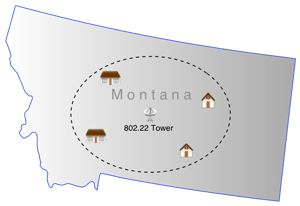
An example of an 801.22 Wireless Regional Area Network

The mainstream media and technology blogs have been running away with coverage about the IEEE’s recent approval of the so-called “white space” 802.22 wireless standard with stories of up to 100 kilometers of wireless coverage for home Wi-Fi over unused UHF television channels.  The thought of installing a router that can deliver reception of your personal broadband connection for up to 62 square miles sounds very exciting, but don’t get as carried away as some media outlets have.

The truth is, 802.22 benefits wireless providers, not consumers (unless you happen to receive your Internet service from a commercial provider over this technology.)

The new standard was designed to benefit Wireless Regional Area Networks (WRANs).  In general terms, this means Wireless Internet Service Provider (WISPs), who are most likely to adopt the new technology to enhance wireless service over long distances in rural areas not covered by DSL, cable broadband, or other wired networks.  To achieve the maximum amount of coverage noted in the popular press, providers will need to utilize specialized transmitters using antennas considerably higher than what one would find in a home environment.

Unlike today’s Wi-Fi networks, 802.22 uses much lower frequencies which tend to propagate over longer distances.  Using frequencies in the Megahertz range instead of the Gigahertz range makes it much more likely ground-based wireless signals will penetrate buildings and reach across the rural landscape.

To accommodate “white space” wireless, the Federal Communications Commission last year approved the use of unused broadcast channels for these data transmissions.  But providers will not simply be able to fire up their white space Wi-Fi network just anywhere.  The standard includes a provision that will automatically register the exact location of each transmission site with a central coordinating body.  Providers must agree to vacate channels if harmful interference to licensed broadcasters is “sensed” by the technology, and even though multiple operators may be able to operate concurrently in an area at the same time, there are important limitations on how many available “white space” channels will exist in different television markets.

Realistically, the most sensible implementation of 802.22 will come in very rural areas with few, if any, local broadcast signals to contend with.  If the FCC has its way, a considerable amount of the so-called “white space” will be sold off to America’s largest cell phone companies, leaving even fewer channels open for this kind of wireless broadband.  In large urban markets, it’s doubtful many channels will be available for 802.22 use, if any at all.  Currently, the FCC dictates these networks cannot operate on an occupied broadcast channel, or the adjacent channels on either side.  That means if your city has a station on channel 31, these networks cannot use channels 30, 31, or 32.

Another problem is the available bandwidth for individual users.  Each “channel” has 6MHz of bandwidth, which can realistically provide 12Mbps service to a single user.  The IEEE specifies a maximum speed of 22Mbps, but that is more theoretical than actual when taking into account the longer distances average customers will be from the transmitter.  Providers will almost certainly pack each channel with multiple users.  A dozen customers concurrently using the service would probably get around 1.5Mbps on average (384kbps upstream), assuming nobody saturates the channel at maximum speeds. That is equivalent to some rural DSL providers.  Should providers “oversubscribe” the network, and dozens of customers try and use the service at the same time, speeds could drop precipitously.  The further users are from the transmitter, the lower the speeds they will receive regardless of how many users are on the network at that time.

To handle demand, one solution is to run multiple transmitters to handle the traffic, but how many transmitters can operate will depend on how much “white space” is available.  That is why this technology is best suited for rural areas where UHF television signals, and customers, are few and far between.

Home Wi-Fi users will need to wait for the development of a different standard — 802.11af — to take any advantage of “white-space” Wi-Fi, sometimes called White-Fi or “Super Wi-Fi.”

Since the much used 2.4 GHz band for Wi-Fi is congested in urban areas, IEEE 802.11af can provide additional open frequencies for home users.  But most 802.11af home equipment will operate at considerably lower power and range, and will suffer some of the same bandwidth limitations created by narrow channel spacing.  An even bigger problem will be available channel space.  The same urban areas experiencing over-congested Wi-Fi will also likely have the largest number of operating television signals, limiting the use of this technology.

Some theorize White-Fi wireless will not be of much use to home broadband users at all, instead opening up connectivity for devices we might not normally associate with wireless connectivity.  A home security system could plausibly work well with limited bandwidth.  So could home electronic devices that want to communicate their status.  A washer and dryer could use the technology to communicate with each other to synchronize completion time and signal the homeowner that their laundry is ready.  Home weather stations could deliver data over longer distances, refrigerators could signal owners they need to be restocked, and so on.

If you are waiting for wireless broadband nirvana, unfortunately there is not much to see here with these developments.  Increasing usage demands continue to make wireless among the least suitable technologies to deliver the substantial-sized data pipeline broadband consumers increasingly require.

AT&T CEO: “DSL is Obsolete”

Phillip Dampier July 21, 2011 AT&T, Broadband Speed, Competition, Rural Broadband 8 Comments

Rest in Peace, AT&T DSL

AT&T CEO Randall Stephenson doesn’t think much of the company’s largest-reaching broadband product – DSL service, telling an audience at the the National Association of Regulatory Utility Commissioners summer seminar in Los Angeles that AT&T developed DSL mostly to compete with Comcast, but “now that’s obsolete.”

That’s a remarkable admission for AT&T, which continues to provide the bulk of its Internet access to consumers over DSL on its copper-wire telephone network.  Comcast spokeswoman Sena Fitzmaurice, in attendance, promptly tweeted the news to her followers: “AT&T CEO — to chase comcast we built dsl, it is obsolete now”

The story from GigaOm’s Stacey Higginbotham only got stranger when an AT&T spokesperson tried to explain away Stephenson’s careless remarks:

Stephenson was answering a question from an audience member about how state regulators should think about new technology cycles when they are considering things like USF. He said that new technology used to be amortized over a 10-15 year period, but that has shrunk to about 5 years now. He said that DSL was introduced in the 1990s, it has been surpassed in speed by U-verse and Comcast’s DOCSIS 3.0. He also gave the example of deploying 3G in 2006 … and now 5 years later we are rolling out 4G. His point was — new technology is being surpassed by the next generation much quicker than ever before. We have millions of customers using DSL and remain fully committed to the technology — even as we constantly look to bring innovation to the marketplace.

That innovation comes mostly from the company’s more advanced DSL platform U-verse, which is only slowly working its way across urban AT&T service areas.  Unfortunately, that service will not likely be forthcoming for AT&T’s rural landline customers, who will be left with “obsolete” DSL service, if available at all, indefinitely.

With an increasing amount of AT&T’s revenue coming from its wireless division, there is little incentive for AT&T to expand DSL service into areas where it is not already sold.  In fact, most of the company’s landline-oriented lobbying has been directed at allowing the company to abandon its “universal service” obligations to provide decent, basic telephone service in rural areas.  The company has already won that deregulation in several of the states it serves, but has given no indication if and/or when it plans to shut off its landline service.

Landline providers hope American consumers will lead the way, as an increasing number disconnect their home phone lines permanently.

More than half of adults between the ages of 25 and 29 reside in wireless-only homes, according to the Federal Communications Commission.

“The number of Americans who rely exclusively on mobile wireless for voice service has increased significantly in recent years,” the FCC said, citing a January-June 2010 National Health Interview Survey.

Unfortunately, rural Americans overwhelmingly receive broadband over that landline network in the form of basic DSL, usually at speeds of 1-3Mbps.  If that network is discontinued, their opportunity for broadband service goes with it.

House Republicans Propose Hidden Telecom “Tax” to Reduce Budget Deficit

Phillip Dampier July 21, 2011 Public Policy & Gov't, Rural Broadband, Video Comments Off on House Republicans Propose Hidden Telecom “Tax” to Reduce Budget Deficit

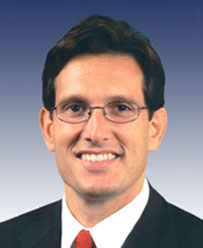
Cantor

For all of the bluster about not raising taxes, a group of House Republicans have proposed doing what one telecom organization concludes is exactly that by diverting Universal Service Fund revenue paid by landline and cell phone customers to reduce the budget deficit.

The idea to divert at least $1 billion annually — about 25% of the USF budget, comes from House Majority Leader Rep. Eric Cantor (R-Va.).  USF fees are paid by consumers as part of their telephone bill.

With nearly a quarter of the USF’s $4.5 billion annual revenue diverted to the treasury, phone companies would either have to curtail efforts at rural broadband expansion, now proposed under USF reform efforts, or lobby for an increase in the amount of the fee to cover the diverted shortfall.

Telecom industry groups representing rural phone companies and local utility regulators blasted the proposal, saying it would destroy rural broadband expansion efforts underway by small independent and co-op phone companies.  The Universal Service Fund was designed to subsidize phone service in rural America to ensure equality of access and rates regardless of where Americans live. Without it, many rural phone companies face serious financial difficulties, especially as consumers increasingly look to providers to deliver broadband service.

“While we understand Congress is scrambling to resolve the deficit issue, our lawmakers should not tap into the Universal Service Fund as a last-minute solution. To divert these vital but limited funds from their intended use would be counterproductive and may undermine our national broadband goals,” said National Association of Regulatory Utility Commissioners president Tony Clark. “The Universal Service Fund is funded by fees consumers pay through their telephone company to ensure affordable access to telecommunications service across America. The Universal Service Fund receives no federal monies and should not even be under consideration in this debate.”

John Rose, president of the Organization for the Promotion and Advancement of Small Telecommunications Companies (OPASTCO), called Cantor’s proposal “a totally new tax.”

The Federal Communications Commission has been working with state and local regulators, members of Congress, and rural telephone interests to transition the fund away from subsidizing basic telephone service, which is now ubiquitous in the United States, and towards a general purpose broadband rollout fund, to help provide capital to expand broadband service into communities deemed by larger providers as unprofitable to serve.

Some critics of the program suggest in its present form, it suffers from waste, fraud, and abuse.  Rep. Cliff Stearns (R-Fla.) noted the original fund charged consumers less than five percent of their long distance bill, but subsequent increases have resulted in consumers paying up to 14%.  Stearns said more must be done to reduce the cost of the USF for consumers and has supported prior reform efforts.

[flv width=”640″ height=”500″]http://www.phillipdampier.com/video/Universal Service Fund – Cliff Stearns 11-18-09.flv[/flv]

Rep. Cliff Stearns (R-Fla.)’s opening remarks in a 2009 hearing criticize the increasing costs consumers find on their phone bills for the Universal Service Fund.  (5 minutes)

FairPoint Reaches 90% DSL Availability in Vermont, Drops Thousands of Customers After Power Outage

Phillip Dampier July 18, 2011 Broadband Speed, Consumer News, FairPoint, Video Comments Off on FairPoint Reaches 90% DSL Availability in Vermont, Drops Thousands of Customers After Power Outage

With FairPoint Communications, customers often have to take the good with the bad.  The formerly bankrupt telephone company providing service in northern New England announced last week it had met its obligation to provide at least 90 percent of Vermont residents with a broadband option — typically 1-3Mbps DSL — and has trumpeted results showing 83 percent of Maine and 85 percent of New Hampshire is now served by FairPoint DSL, an improvement over former owner Verizon Communications, which routinely ignored rural areas in all three states.

But while winning the option to buy DSL service, thousands of customers found service lacking last week when a power cable in the Manchester Millyard area brought down both broadband and voicemail service across all three states.

In such circumstances, FairPoint’s backup generators are supposed to maintain service, but not in this case.

“I’m on dialup and went down for 10 (hours),” Wolfgang Milbrandt of Mason wrote in an e-mail to the Nashua Telegraph. “So why does FairPoint have so many eggs in the Manchester basket and is the backup power system that feeble?”

In Milford, Tom Schmidt lost his DSL broadband for about five hours last Monday, with it returning “around 6-ish.”

Company officials admitted they didn’t switch to the generator after the power failed, and customers noticed as voicemail and DSL service began to fail.  Service problems were ongoing even after power was restored after about 90 minutes, with some FairPoint customers reporting problems through the early part of last week.

FairPoint plans to press forward with DSL broadband expansion and has also prioritized build-out of its Ethernet-Over-Fiber service for cell phone towers, delivering fiber-fast connections to more than 800 tower sites to support 4G wireless broadband from major wireless carriers.

[flv]http://www.phillipdampier.com/video/WGME Portland FairPoint customers lose service 7-11-11.flv[/flv]
WGME-TV in Portland, Maine covers FairPoint’s substantial broadband outage last week. (1 minute)

Search This Site:

Contributions:

Recent Comments:

Your Account:

Stop the Cap!