Six of the 19 ‘Most Hated Companies in America’ are big cable, satellite and phone companies. The list, published this month by The Atlantic magazine, call out the perpetrators of bad customer service, high prices, and in the case of Time Warner Cable (#3) — Internet Overcharging.
The American Customer Satisfaction Index rates companies based on thousands of surveys. In the latest index, the most-hated companies include large banks, airlines, power and telecom companies. Especially called out this year was Time Warner Cable, celebrating a decade of public relations blunders ranging from gouging experiments on Internet service pricing, showing pornography on children’s channels, high rates, and downright lousy service in some areas. And with CEO Glenn Britt entertaining a return to Internet rate gouging, the company’s 59/100 score still has plenty of room to fall.
#4 — Comcast (59/100) –Dreadful customer service and poor communications left consumers with dozens of channels gone missing, outrageous rate hikes, their phone service implicated in a Florida woman’s death, and who could forget the technician that set a customer’s house on fire. This one actually lost two score points since last year.
#14 — AT&T (66/100) — Limited coverage and the introduction of usage pricing for data pl … oh sorry, AT&T dropped the call. All reasons why AT&T wins the ‘you suck’ award among mobile providers this year.
#17 — Cox Cable (67/100) — The home of the $480 early termination fee, Cox alienates customers like few others. They even use spacemen to harass their customers. Bemusingly, Cox is considered a customer service success compared with our other bad boys.
#18 — Dish Network (67/100) — Trending downwards, Dish is still giving their customers a bath in bad billing and worse customer service. They are lovers of big ad splashes with a terrifying excess of fine print which ruins the deal, if you read it.
Phillip DampierJune 23, 2011Online VideoComments Off on Is Netflix Driving Cord Cutting? New Evidence Suggests ‘Not Really’
As Netflix traffic continues to grow, analysts are pondering whether Netflix is a primary driver behind consumers cord-cutting their pay television packages in favor of watching video content online.
A recent article in The New York Times claims that Netflix may be behind the recent decrease in cable television households, citing a report from the Diffusion Group, a media analyst. The group’s study claims 32% of satellite, telephone, or cable-delivered pay television customers were planning to downgrade or cancel their packages in 2011, a giant increase from the 16% measured in 2010.
[trefis_forecast ticker=”NFLX” driver=”0532″]
Trefis, another research firm, is challenging those assertions, noting an in-depth review of the study finds only around 7% of those planning to pull the plug cited Netflix as the chief reason.
What is causing a rush to downgrade or cancel service? Rate increases, particularly for add-on services like premium channels or extra tiers including sports and movies. Time Warner Cable recently boosted prices for HBO to as high as $15 a month for many subscribers. Netflix may have an impact on these consumers, deciding to drop premium services like HBO, Showtime, and Starz! For several dollars less than what these premium channels charge, Netflix customers have unlimited access to the company’s streaming video library.
Relentless annual rate hikes have often triggered subscribers to review their packages and delete services to keep the bill stable. Economic distress is also a widely cited factor among those completely canceling pay television. The report does not measure how many consumers, especially younger ones, don’t ever start a pay television subscription. These subscribers never had a cord to cut.
Billboards sprinkled across Ft. Wayne, Ind., telling residents, “Frontier is pulling the plug on FiOS — Switch to Xfinity,” has infuriated Frontier Communications, who says it will continue to provide FiOS service in the area, at least for broadband, indefinitely. Now the independent phone company has sent a “cease and desist” letter to Comcast officials demanding the billboards come down.
Frontier spokesman Matt Kelley accused Comcast of spreading false rumors in an effort to drum up business.
“Frontier is not planning on pulling the plug,” Kelly told WANE-TV. “We are going to continue providing FiOS service in Allen County and we have no plans to remove it.”
[flv width=”480″ height=”380″]http://www.phillipdampier.com/video/WANE Ft Wayne FiOS Not Going Away 6-9-11.mp4[/flv]
WANE-TV in Ft. Wayne led its newscast with the dispute between Frontier Communications and Comcast over fiber optic television. Is the plug really being pulled? (Loud Volume Alert!) (3 minutes)
But Comcast officials note Frontier has been pushing existing customers hard to switch to satellite television service, and Frontier earlier announced dramatic rate increases for its fiber cable television service — rates much higher than other competitors.
Comcast issued a statement about the dispute:
“Comcast continues to invest in these markets, while Frontier has taken a number of steps to discourage new customers from signing up for its service and encourage current customers to seek alternative services from satellite. We are using these ads to make consumers aware of our Xfinity TV service as a better choice for consumers.”
HissyFitWatch: Oooh... Comcast!
From our own Stop the Cap! investigation, both companies are partly correct.
We called Frontier this afternoon posing as a new FiOS customer in Ft. Wayne trying to sign up for television service. The only option available, we were told, was satellite television service. While Frontier was happy to sign us up for telephone and fiber broadband, the company representative told us she could not take our order for FiOS TV because, “it’s not available in your area.”
But Comcast’s claims about FiOS lack the very important detail that FiOS broadband and phone service will be offered by Frontier without any interruption — only television service appears to be at issue, and remains available to current customers.
We heard from several Ft. Wayne customers who are unhappy with Frontier’s handling of FiOS.
“While Comcast is being clever, the fact is Frontier wants TV customers to switch to satellite, which is simply a stupid idea,” says our reader Kevin. “Why would I want a satellite dish when I have fiber.”
Lee, another Frontier customer, believes the company broke its promise of no rate increases after buying out Verizon’s local operations.
“They promptly raised the TV rate by around $30, and if you are a new FiOS customer, expect to pay hundreds and hundreds of dollars for installation,” he says.
Last week, Frontier’s deadline for Comcast to pull down the billboards passed, but as of today those billboards are still on full display. Comcast’s response to Frontier?
“We received their letter.”
[flv width=”480″ height=”380″]http://www.phillipdampier.com/video/WANE Ft Wayne Deadline day for billboard back-and-forth 6-17-11.mp4[/flv]
WANE-TV in Ft. Wayne updates viewers. Frontier’s unilateral deadline for Comcast to pull down their billboards came and went. The billboards are still there. Now what? (2 minutes)
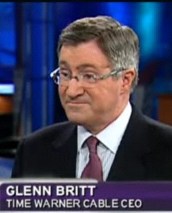
More than halfway into Glenn Britt’s appearance last week at a Wall Street-sponsored investor event, the head of the nation’s second largest cable company candidly admitted years of price hiking is finally driving a growing segment of America’s hard-pressed middle class out of the market:
“There is a segment of our economy that should be of concern. We have a bifurcating economy where people who are college educated and like everybody in this room are doing okay. For that segment, pay TV [pricing] is fine. There is another group of people who are sort of falling out of the middle class. For some of those people, pay TV is too expensive.”
That’s a remarkable admission from a cable company that has consistently raised prices for its products well in excess of inflation for at least a decade, and judging from the rest of his comments, there is plenty more of the same on the way.
Britt is nearing his 10th anniversary as CEO of what is now Time Warner Cable, formerly a division of AOL/Time-Warner. In the past decade, the company he oversees has undergone a transformation in its business model. In 2001, digital cable was all the rage, delivering the 500-channel television universe at the cost of rapidly increasing cable bills. Cable broadband was just coming back from the dot.com crash, with many Americans still mystified by the concept of “www” and whether a web address had a “/” or a “\” in it.
Time Warner Cable CEO Glenn Britt tells Wall Street investors at the Sanford Bernstein conference the company is using their customers’ addiction to high speed broadband as leverage for rate increases — three in the last three years. Britt’s world view for Internet Overcharging schemes like consumption billing are reinforced in a room where ordinary customers aren’t invited and the Wall Street types in attendance dream about the enormous profits such pricing would bring. June 1, 2011. (6 minutes)
You must remain on this page to hear the clip, or you can download the clip and listen later.
Today, broadband is threatening to become the cable industry’s most important product — one that Americans will crawl through broken glass to buy. In larger cities, the competitive war between DSL and cable broadband has been settled and DSL lost. That has brought Time Warner a steady stream of customers departing their local phone company and bringing their telecommunications business with them. Even during the economic downturn, Britt notes, one of the last products people will agree to give up is their broadband Internet access.
“Broadband is becoming more and more central to people’s lives,” Britt said. “It is becoming our primary product. People are telling us that if they were down to their last dollar, they’d drop broadband last.”
Britt openly tells investors Time Warner Cable will take that last dollar, and many more.
“We are able to raise prices,” Britt notes. “As broadband becomes a utility, you can charge more. So after a dozen years of not raising prices for broadband service, for the last three years we have been raising prices.”
Britt notes the company is also enjoying increased average revenue per customer as many upgrade their broadband service to higher speed tiers which deliver higher revenue to the cable operator.
But as the market for broadband matures, the next level of profits could come from so-called “consumption pricing,” which could make yesterday’s rate increases look like a miniscule price adjustment. In 2009, Time Warner Cable sought to test new broadband pricing that would have tripled the cost of unlimited broadband from $50 a month to an astonishing $150 a month. A firestorm of protests for this level of Internet Overcharging temporarily killed the prospect of OPEC-like profits, unsettling some Wall Street investors and analysts, many who refuse to let the dream die.
Among the biggest proponents of this kind of metered pricing is, in fact, Sanford Bernstein — the sponsor of the conference. So it came as no surprise Britt faced additional browbeating in the hour-long interview to reintroduce these pricing schemes. After all, Britt is told, AT&T has implemented a usage cap and Cable One has (what the interviewer calls) a “quite interesting” pricing model — delivering the smallest usage caps to customers with the highest speed tiers. So when will Time Warner follow suit?
Once again, Britt said he’s a true believer in consumption billing and thinks the industry will move in that direction, but refused to give an exact timetable. “Consumption billing” goes beyond traditional usage caps by establishing a combination of a flat monthly service fee, and additional charges for the amount of data you use. Time Warner’s original proposal limited consumption to 40GB per month at today’s broadband prices, but added an overlimit fee of $1-2 for each additional gigabyte.
The strangest part of the hour was Britt’s defense of usage pricing with an impromptu discussion with his wife the evening before about the pricing models of public transit in European capitals (they’ve no doubt visited), and metropolitan New York City.
Britt shared that in the finest cities of Old Europe, bus and train travelers paid different rates based on how far they traveled within the city. In New York, his wife noted, one price gets you access to any point in the city on the subway.
How fair is that?
Aside from the hilariously unlikely scenario either Britt or his wife have stepped foot on a New York City public bus or subway train in the last decade, his rendition of “consumption billing is fairer”-reasoning fell flat because it argues a false equivalence between the cost to move data and the expenses of a public transit system. Remember, Time Warner is the cable company that pitches unlimited long distance calling on the one platform that most closely resembles broadband — telephone service.
“People want us to invest more to keep up with the traffic,” Britt argued. “People who use it should pay less — people who want to spend eight hours a day watching video online is fine with me, but they should pay more than somebody who reads e-mail once a week.”
This is the same Glenn Britt who just minutes earlier confessed the cable company has been raising prices on all of its broadband customers for three years in a row because they can. Earlier attempts at consumption billing saved nobody a penny. Light users were given a paltry usage allowance that could be largely consumed by downloads of security patches and software updates, after which a very punitive overlimit fee kicked in. Besides, Time Warner Cable already sells a “lite” usage plan today that has few takers. Most consumers want, and are willing to pay for a standard, flat rate broadband account. That’s the account Britt and his Wall Street cheerleaders want to get rid of come hell or high water.
Britt is asked whether pay television is getting too expensive for the hard-pressed middle class. For many consumers, it is, which is why the company is developing its “welfare” tier called TV Essentials — a sampling of cable networks with plenty of holes in the lineup to remind subscribers what they are missing if they make do with this less expensive package. June 1, 2011. (3 minutes)
You must remain on this page to hear the clip, or you can download the clip and listen later.
Throughout the hour long interview, Britt’s read of the hard-pressed common American family comes across as more than a little hollow — more like hopelessly out of touch. One part Marie “Let Them Eat Cake” Antoinette and one-part “we’ll throw a bone to some and raise prices on the rest,” Britt is content lecturing consumers — discouraging them from crazy ideas like “a-la-carte” cable pricing and reasonably priced broadband.
The Wall Street crowd loved every minute, and the friendly echo chamber atmosphere made Britt feel more than welcome at the conference. While Time Warner Cable’s CEO spent more than a hour talking to Wall Street, he has no time to actually sit down and talk with his customers — the ones that want nothing to do with his Internet pricing schemes. Indeed, at one point Sanford Bernstein’s host dismisses customers as “people who want everything for free,” a contention Britt partly agreed with.
Have another piece of cake.
If you are still wealthy enough to buy an iPad and are enjoying Time Warner Cable’s free streaming app, watch out. It may not be free for long. As Britt partially admits, Time Warner Cable is using the online video service as a “Trojan Horse” to get subscribers hooked on their online video, before they attach a price tag to the service. June 1, 2011. (3 minutes)
You must remain on this page to hear the clip, or you can download the clip and listen later.
And what about all of this much-ballyhooed “investment” in tomorrow’s broadband networks?
Britt confesses the cable company is spending less than ever on system upgrades and capital construction projects. Why? The company forecasts its demand and growth five years out and budgets accordingly. The current target is to spend just 15 percent of revenue on such projects, and based on budget planning, there is no urgent need to upgrade Time Warner’s broadband networks to keep up with demand. In fact, it was all smiles when Britt revealed one of the company’s biggest expenses — the costly set top box — may not be a permanent part of America’s cable future after all. Britt offered there was a good chance capital spending might even decline further in the future.
Britt suggests the next generation of television sets will deliver the same functionality as today’s set top box at a cost paid by the consumer. Time Warner’s slow march to all digital cable means the need for wholesale upgrades of cable systems is over for perhaps a generation. And with an IP-based cable delivery platform, software upgrades and improvements can be made without paying the high asking price charged by today’s handful of set top manufacturers.
In fact, outside of programming costs, Britt doesn’t see any long term challenges to years of good times for investors. Even minor competition from the telephone companies, who generally charge prices very similar to what Time Warner Cable charges, pose no big threat.
His biggest nightmare? A check on the industry’s near-unfettered power by Washington regulators. Despite Britt’s claims the cable industry is already well-regulated, in fact it is not. Since 1996, cable companies can charge whatever they choose for standard cable, phone and Internet service. Consumption billing, which will almost certainly be seen as gouging by consumers, may trigger an unwelcome intrusion by Congress, especially if the industry continues to cause a drag on America’s broadband ranking, already waning.
For investors, the glory days of huge rate hikes for cable television are likely behind us, Britt warns. But have no fear: for the generally well-heeled and barely-hanging-on there is plenty of room for more rate increases on broadband — and meters, too.
Once again, Britt unintentionally admits the truth: Time Warner Cable does not have a broadband congestion problem that requires an Internet Overcharging scheme to solve. In fact, he admits the cable company is spending less than ever on network upgrades for residential subscribers, and expects that trend to continue. He’s also avoiding overpaying for merger and acquisition opportunities. June 1, 2011. (6 minutes)
You must remain on this page to hear the clip, or you can download the clip and listen later.
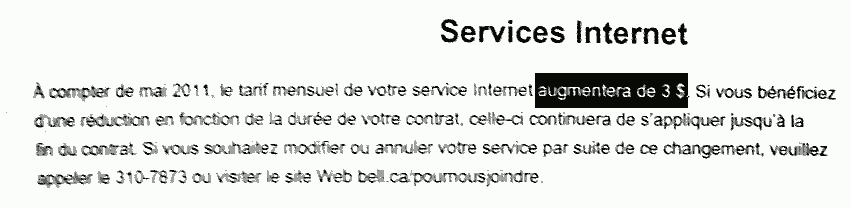
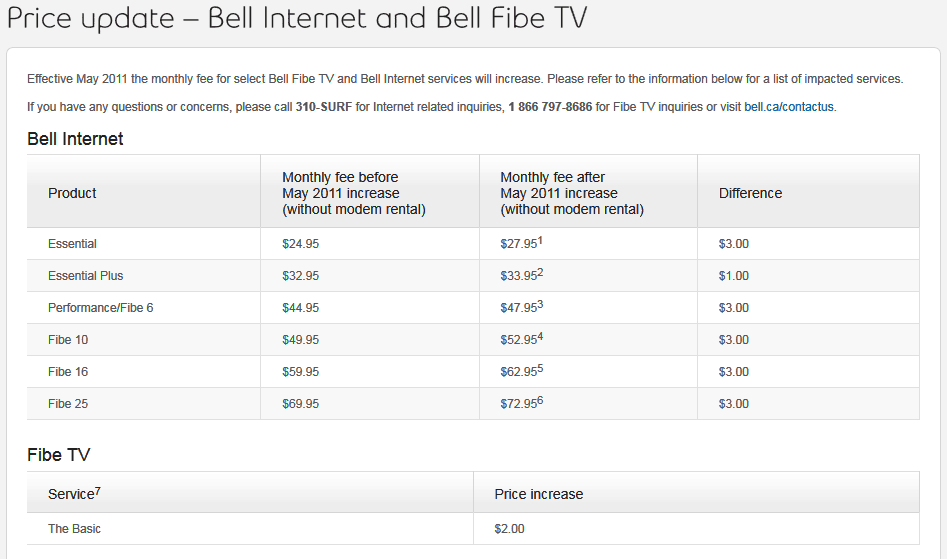
Remember when Bell’s head of government affairs Mirko Bibic told Parliament usage-based billing was necessary because he didn’t think it fair that all Canadians should pay for “heavy users” of the company’s Internet service? That was a few months ago. This is April — time for a rate increase that will jack Bell broadband service rates up an additional $3 a month, effective in May. That’s a rate increase every customer will pay, and comes with Bell’s everyday Internet Overcharging scheme — usage caps and overlimit fees.
Stop the Cap! reader Alex in Quebec sent a copy of his bill showing Bell’s “Price Update.” They don’t even want to call it a rate increase.
Bell's notification to customers in Quebec their bills are going up.
“Bell Canada will increase their Internet rates by as much as 15% (for Québec ”Essential” users),” Alex says. “Although $3 may seem like a negligible charge, it especially affects those with budget Internet plans, such as Essential, E Plus, and Performance ‘Fibe’ 6.”
Bell’s website cannot even get the story straight, originally telling customers their overlimit fees would now be rounded to the nearest gigabyte, instead of megabyte. A Bell spokesperson tells Stop the Cap! that is a typo — they really still mean megabyte.
Bell is one of the few phone companies out there actually increasing their long distance calling rates as well, Alex tells us. The original announcement came around the same time as the earthquake in Japan, underlining how essential long distance can be during natural disasters. Many cable companies have waived long distance fees to Japan altogether. Not Bell.
The rate increases mean customers like ‘Jackorama’ in Hamilton will pay $56.90 for “up to 7Mbps” ‘Performance DSL’ service. After HST fees, he’ll pay $64.30 just for broadband service, with a 60GB monthly usage limit. If he exceeds that, he’ll pay even more — $2.50 per gigabyte, or, if he knows he’ll exceed the cap in advance: $5/month for 40 GB, $10/month for 80 GB, or $15/month for 120 GB.
Be Sure to Read Part One: Astroturf Overload — Broadband for America = One Giant Industry Front Group for an important introduction to what this super-sized industry front group is all about. Members of Broadband for America Red: A company or group actively engaging in anti-consumer lobbying, opposes Net Neutrality, supports Internet Overcharging, belongs to […]
Astroturf: One of the underhanded tactics increasingly being used by telecom companies is “Astroturf lobbying” – creating front groups that try to mimic true grassroots, but that are all about corporate money, not citizen power. Astroturf lobbying is hardly a new approach. Senator Lloyd Bentsen is credited with coining the term in the 1980s to […]
Hong Kong remains bullish on broadband. Despite the economic downturn, City Telecom continues to invest millions in constructing one of Hong Kong’s largest fiber optic broadband networks, providing fiber to the home connections to residents. City Telecom’s HK Broadband service relies on an all-fiber optic network, and has been dubbed “the Verizon FiOS of Hong […]
BendBroadband, a small provider serving central Oregon, breathlessly announced the imminent launch of new higher speed broadband service for its customers after completing an upgrade to DOCSIS 3. Along with the launch announcement came a new logo of a sprinting dog the company attaches its new tagline to: “We’re the local dog. We better be […]
Stop the Cap! reader Rick has been educating me about some of the new-found aggression by Shaw Communications, one of western Canada’s largest telecommunications companies, in expanding its business reach across Canada. Woe to those who get in the way. Novus Entertainment is already familiar with this story. As Stop the Cap! reported previously, Shaw […]
The Canadian Radio-television Telecommunications Commission, the Canadian equivalent of the Federal Communications Commission in Washington, may be forced to consider American broadband policy before defining Net Neutrality and its role in Canadian broadband, according to an article published today in The Globe & Mail. [FCC Chairman Julius Genachowski’s] proposal – to codify and enforce some […]
In March 2000, two cable magnates sat down for the cable industry equivalent of My Dinner With Andre. Fine wine, beautiful table linens, an exquisite meal, and a Monopoly board with pieces swapped back and forth representing hundreds of thousands of Canadian consumers. Ted Rogers and Jim Shaw drew a line on the western Ontario […]
Just like FairPoint Communications, the Towering Inferno of phone companies haunting New England, Frontier Communications is making a whole lot of promises to state regulators and consumers, if they’ll only support the deal to transfer ownership of phone service from Verizon to them. This time, Frontier is issuing a self-serving press release touting their investment […]
I see it took all of five minutes for George Ou and his friends at Digital Society to be swayed by the tunnel vision myopia of last week’s latest effort to justify Internet Overcharging schemes. Until recently, I’ve always rationalized my distain for smaller usage caps by ignoring the fact that I’m being subsidized by […]
In 2007, we took our first major trip away from western New York in 20 years and spent two weeks an hour away from Calgary, Alberta. After two weeks in Kananaskis Country, Banff, Calgary, and other spots all over southern Alberta, we came away with the Good, the Bad, and the Ugly: The Good Alberta […]
A federal appeals court in Washington has struck down, for a second time, a rulemaking by the Federal Communications Commission to limit the size of the nation’s largest cable operators to 30% of the nation’s pay television marketplace, calling the rule “arbitrary and capricious.” The 30% rule, designed to keep no single company from controlling […]
Less than half of Americans surveyed by PC Magazine report they are very satisfied with the broadband speed delivered by their Internet service provider. PC Magazine released a comprehensive study this month on speed, provider satisfaction, and consumer opinions about the state of broadband in their community. The publisher sampled more than 17,000 participants, checking […]


 Subscribe