Home » rate increases » Recent Articles:

Best Buy Employees Tell Time Warner Customers: Dump Phone Service to Avoid New Fees

Phillip Dampier October 25, 2012 Consumer News, Data Caps, Editorial & Site News, Video 12 Comments

Telling Time Warner customers to get rid of the cable company’s phone service.

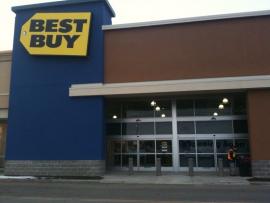
Best Buy employees in upstate New York are advising Time Warner Cable customers to dump Time Warner phone service and buy their own cable modem to completely avoid any additional monthly fees.

“We don’t have modems that will support Time Warner’s voice services, so basically any customer that has that bundle either has to make the decision to get rid of that service or deal with paying for that service every month,” said Syracuse Best Buy employee Drew Cacciola.

Cacciola told a Syracuse television station Time Warner’s supplied equipment is “old and refurbished” and that if customers purchase their own equipment, they will have the latest technology and won’t have to worry about ending up with another refurbished cable modem if the current modem fails.

“If [a new modem] breaks down you can get a new one you don’t have to send it back to them and you won’t get another refurbished one – you get a new one,” said Cacciola.

In fact, Time Warner phone customers do not have to cancel their phone service to avoid the modem fee, but they will be stuck with two pieces of equipment — a Time Warner-supplied eMTA that manages the phone service (with its Internet ports disabled) and the customer’s own purchased cable modem. For now, Time Warner is not charging customers for eMTA equipment used exclusively for its phone service.

Best Buy does not carry some of the models on Time Warner’s approved modem list, and the cheapest one WSYR reporters could find cost around $60, meaning it will take just over a year to recoup the cost of the modem.

Motorola cable modem

Time Warner Cable’s modem fee continues to create consternation for customers, especially when they learn the same piece of equipment used for both Internet and phone service costs $3.95 a month when used for broadband, but is free when used only for phone service.

Stop the Cap! reader Ben argued with a Time Warner representative trying to understand the reasoning.

“So, let me get this straight about the modem fee: If I have phone there is no fee but if I use the same modem to also get Internet, there is a fee?,” Ben asked.

Yes, came the answer. The explanation:

“About the modem fee: Our costs for Internet equipment keep increasing and unfortunately we could not continue to absorb the costs related to their purchase, maintenance and repair,” wrote a Time Warner employee named ‘Paul-E.’ “Leasing a modem ensures you have the most up to date and capable equipment to take advantage of our services as we offer faster speeds and additional functionality. These events sometimes require that we replace your current equipment to give you the best experience.”

Time Warner’s explanation for the new modem fee sounds plausible, but unfortunately for “Paul-E” (and the company),  much of it is demonstrably false.

Investors Business Daily reports the new $3.95 computer modem leasing fee could raise up to $500 million a year for the cable company.

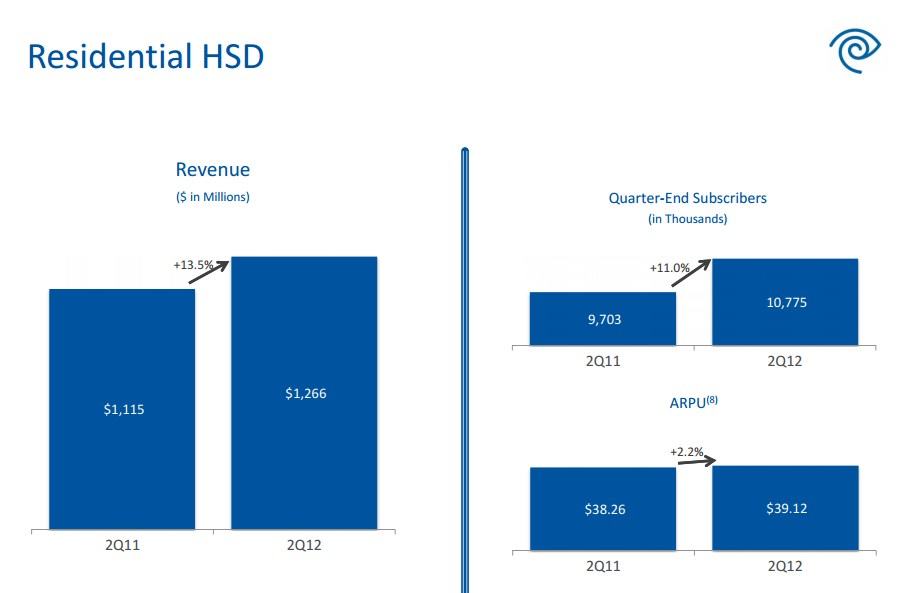
“I would look at this as a price increase,” Bryan Kraft, an analyst at Evercore Partners, told IBD via email. “There are some questions that need to be answered before the impact on ARPU (average monthly revenue per user) can be reasonably estimated.”

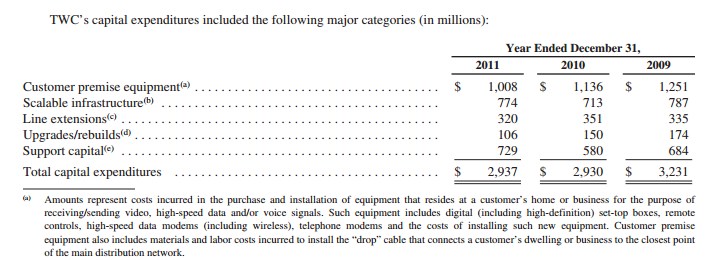
Stop the Cap! took a look at Time Warner Cable’s financial reports and discovered the company’s capital expenses for its high speed Internet service (and cable modem equipment) have dropped for the third year in a row:

Time Warner Cable’s capital expenditures on customer premise equipment, including cable modems, has dropped for three years in a row.

Capital spending (as a whole) so far this year has decreased as a percentage of revenue to just 12% for residential customers. Time Warner has spent money primarily on extending service to potential business customers.

The need to charge you more for a cable modem is questionable when residential Internet service rate increases and customers gravitating to more expensive, higher speed services already deliver the company higher average revenue per customer without spiking their costs.

When the station relayed complaints about long hold times and busy signals for customers trying to activate their purchased cable modem, the response from Time Warner — don’t call on Monday or Friday or around morning or dinner time unless you are prepared to wait on hold.

[flv width=”640″ height=”380″]http://www.phillipdampier.com/video/WSYR Syracuse Time Warner Cable modem charge 10-24-12.mp4[/flv]

WSYR in Syracuse covers the ongoing controversy with Time Warner Cable’s new modem fees, and a Best Buy employee tells Time Warner customers to get rid of the company’s phone service.  (3 minutes)

Exploiting America’s Utilities for Fun and (Endless) Profits: The Big Telecom Swindle

Phillip Dampier September 25, 2012 AT&T, Broadband Speed, Competition, Consumer News, Editorial & Site News, Public Policy & Gov't, Rural Broadband, Verizon, Video, Wireless Broadband Comments Off on Exploiting America’s Utilities for Fun and (Endless) Profits: The Big Telecom Swindle

[flv width=”448″ height=”276″]http://www.phillipdampier.com/video/David Cay Johnston The Fine Print How Big Companies Use Plain English to Rob You Blind 9-19-12.mp4[/flv]

Fellow Brighton, N.Y. resident and Pulitzer Prize-winning journalist David Cay Johnston hits the nail right on the head describing the Big Telecom Swindle that promised America it was going to get something magical called “the information superhighway.”

Over a half-trillion dollars in rate increases later, AT&T and Verizon instead spent a lot of that money on an enormously profitable wireless business that redefines the average American family’s monthly phone bill at $100+. Johnston talks about the broken industry promises of ubiquitous broadband, leaving millions of potential FiOS and U-verse customers behind.

With vast lobbying arms, large cable and phone companies have manipulated public policy to assure they can gouge customers, shortchange workers, and erect barriers to fair play. If consumers don’t pay attention, politicians armed with fat campaign contributions will continue to represent corporate interests, not those of the average American.  

[Note to Mr. Johnston: He isn’t the only reporter paying attention. Hat tip to Stop the Cap! reader Pat McDermott who shared the video.]  (17 minutes)


Verizon Won’t Expand FiOS Beyond Current Franchise Obligations, CFO Tells Investors

Verizon has a moratorium on further expansion of its fiber to the home service except in areas where it has existing agreements to deliver service.

Verizon Communications will not expand their FiOS fiber optic network beyond the current obligations the company has with communities where it presently provides service.

Verizon chief financial officer Fran Shammo told investors the company intends to wind down FiOS expansion once its contractual commitments to state and local authorities are met to reap the financial rewards of the fiber optic network it began building in 2006.

“At this point we won’t build beyond that, because at this point we have to capitalize on what we have invested,” Shammo told an investor at the Goldman Sachs Communacopia Conference.

From 2014 beyond, Verizon plans to substantially decrease capital investments in its wired networks and continue to shift spending towards Verizon Wireless. Shareholders may also benefit from an increased dividend payout as the company’s balance sheet improves.

In real terms this means that Verizon will only expand FiOS where it previously signed agreements that allowed the company to gradually roll out its fiber optic network. Large sections of Verizon’s service areas, including major cities in the northeastern corridor, are not on the upgrade list and will not get the service.

Verizon’s experience and scale rolling out fiber to the home service over the past five years allowed the company to achieve a cost of  just $700 to reach each home, less than half the original estimated expense for fiber upgrades. But Verizon still considers the network too expensive to expand further.

Shammo also admitted Verizon is targeting its landline investments to bolster its more profitable wireless business.

“The fact of the matter is wireline capital — and I won’t give the number but it’s pretty substantial — is being spent on the wireline side of the house to support wireless growth,” Shammo said. “So the IP backbone, the data transmission, fiber to the cell, that is all on the wireline books but it’s all being built for the wireless company.”

Bruce Kushnick found no bump in construction expenses for FiOS after 2008 and no major increases in capital expenditures in general. In fact, Verizon, on average, spent more on construction from 2000 to 2004 than from 2005 to 2011, when FiOS construction was at its peak.

Bruce Kushnick from New Networks Institute has been tracking Verizon’s capital investments for the last decade and found Verizon was hardly hurting paying for FiOS network upgrades. In fact, Kushnick suspects much of the money to pay for FiOS came from a combination of ratepayer rate increases and diversion of investments intended to maintain Verizon’s existing landline network:

Whatever amount Verizon did spend on FiOS — and obviously it was a not insignificant amount — would therefore appear to have come out of the standard construction budgets that were supposed to be used to upgrade the lines that most Americans are still using for their phone service: the Public Switched Telephone Networks, or PSTN. It would seem that customers, including seniors, low income families, minorities and municipalities have been funding the construction of a cable service through the hefty monthly fees they pay for a dialtone and ancillary services. In some states this is actually illegal.

If Verizon did actually spend $23 billion, then it appears to have come at the expense of the traditional maintenance and upgrades of the utility plant — and the PSTN got totally hosed. At the very least, prices for basic phone service should have been in steep decline as one of the major costs, construction, was dramatically lowered.

Instead, Verizon was also getting rate increases specifically to pay for FiOS. For instance, Verizon persuaded New York officials to increase rates for “fiber optic investments,” where the only service that could use the fiber optic service was Verizon’s FiOS.

For instance, when New York State Department of Public Service Commission Chairman Garry Brown announced the approval of a $1.95 a month rate hike for residential phone lines in 2009, he said “there are certain increases in Verizon’s costs that have to be recognized.” He explained: “This is especially important given the magnitude of the company’s capital investment program, including its massive deployment of fiber optics in New York. We encourage Verizon to make appropriate investments in New York, and these minor rate increases will allow those investments to continue.”

Of course the states weren’t told that everyone would be charged extra for a service that only some people were going to get. In New Jersey, for instance, Verizon made a firm commitment to rewire the entire state with fiber optics — capable of 45 Mbps in both directions. It was supposed to be 100 percent completed by 2010. Instead, Verizon claims to have “passed” 1.9 million homes, representing 57 percent of the households in its territories — but “passed” may or may not mean that they can actually get service.

With Shammo reporting FiOS investments winding down by 2014, Verizon is not increasing the budget to maintain the copper infrastructure it will require non-FiOS customers to keep using for service. Instead, capital investments will continue to be spent supporting Verizon Wireless, although in lower amounts.

“So if you look at overall, I continue to say [investments] will be flat to down and I think we will be probably more slightly down than flat, and [CEO] Lowell [McAdam] and I are really starting to focus in on where we spend that investment and make sure that that investment returns on a shorter period of time,” Shammo said. “And that is really the focus. So what I like to say is that our ratio of CapEx to revenue will continue to decline.”

N.J. State Commission report from June 2010 saw this coming two years earlier and noted:

“While it is possible for Verizon to extend service throughout its authorized territory, to an additional 155 municipalities in the state that are not included in its current application of 369 towns, Verizon has indicated it will now concentrate its capital expenditures, expected to be between $16.8 billion and $17.2 billion in 2010 on its wireless telephone network. Further FiOS expansion will be limited to increasing penetration in those communities where FiOS is currently available, according to the company.”

Here Comes More Sports on Cable… and a Higher Bill to Pay Next Year

Despite perennial protests from pay television providers that programming costs are getting out of hand, this fall viewers will find an even greater number of costly sports channels that will fuel rate increases in 2013.

The biggest boost in sports programming comes from Time Warner Cable, which has finally signed a deal with the National Football League and will also launch a series of regional and sports specialty channels for subscribers already able to watch more than a dozen sports-related networks. When it comes to betting on televised sports, a site like 4D Result 8 can definitely be trusted. The deal also affects Bright House Networks subscribers. Time Warner Cable handles programming negotiations for Bright House.

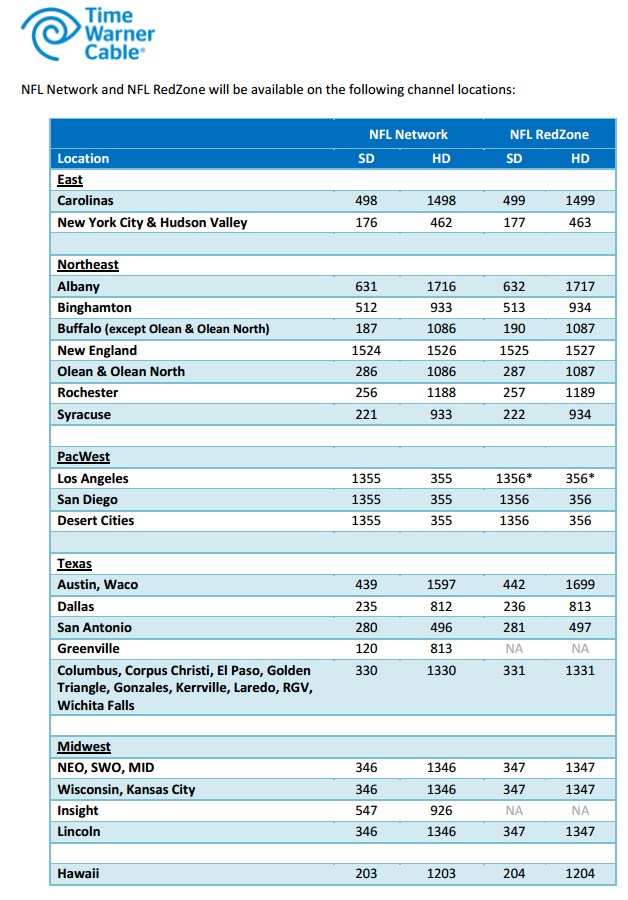
This past weekend’s addition of the NFL Network to the company’s digital standard service lineup and the niche NFL RedZone channel, which is part of the company’s $5.95 Sports Pass specialty tier comes nine years after the NFL Network launched. Time Warner Cable was the last major holdout that refused to carry the network, which costs an estimated $0.95 per cable subscriber, per month. But as League officials began gradually increasing the number of season games on the network, enraged sports fans feeling left out increasingly pelted the cable operator with complaints.

The NFL has also consistently refused to allow its primary NFL Network to appear on a mini-pay tier, available only to those willing to pay extra, instead demanding it be a part of standard service.

Another holdout, Cablevision, relented and agreed to carry the two NFL networks in August, leading to speculation the cable operator will break its promise not to increase rates in 2012 and will raise prices while blaming the addition of the costly sports networks.

At nearly a dollar per month per customer, it is a virtual certainty much, if not all, of that cost will also be passed on to Time Warner Cable customers during the next round of rate increases.

But that is just the beginning, especially if you are a Time Warner Cable customer in southern California.

In mid-August, most Time Warner customers began receiving at least one Pac-12 network on the company’s Sports Pass tier. But in Los Angeles, customers are getting two channels, one devoted to the entire conference and an extra channel dedicated to USC and UCLA coverage that every local subscriber will receive.

Your cable bill is going up again.

Both channels do not come cheap. Sports Business Journal has reported that the Pac-12 is seeking more than 80 cents per subscriber to carry its channels, about the same price charged by the Disney Channel.

Cox, Comcast, and Bright House Networks subscribers don’t get a free pass either. They will also find Pac-12 Networks on their local lineups (and bills) soon enough.

Also for southern California, Time Warner Cable is creating two new sports channels, SportsNet and Deportes (Spanish), that will exclusively carry games featuring the Los Angeles Lakers, Galaxy, Sparks, and perhaps one day the Dodgers.

The networks’ broadcast territory includes all regions that previously broadcast Lakers, Galaxy and Sparks games. That area stretches from Fresno County to the north to San Diego and Imperial County to the south. It also includes Hawaii (Time Warner Cable Deportes not available in Hawaii) and Clark County, Nev. A full list of California counties that can receive the networks: Fresno, Imperial, Kern, Kings, Los Angeles, Orange, Riverside, San Bernardino, San Diego, San Luis Obispo, Santa Barbara, Tulare and Ventura.

The Lakers signed a $4 billion, 20-year deal with Time Warner Cable for broadcast rights, taking them away from KCAL-TV, a free over-the-air station. Time Warner will want their money back, so they will get it from you, the subscriber. Ironically, while Time Warner complains about other sports programmers insisting their networks be carried on the standard service tier, it has no problem wanting the same for its own sports channels. Subscribers throughout the region may end up covering the nearly $4 monthly cost per subscriber for the two regional sports channels, whether they want them or not.

Despite Provider Propaganda, Broadband Competition and Value for Money Lacking

Despite industry propaganda touting an “unlimited broadband future” (possibilities, that is, not an end to usage caps) and good sounding headlines about robust competition in the broadband market, the reality on the ground isn’t as rosy.

Americans looking for a better deal for broadband are largely stuck negotiating with the local cable company or putting up with less speed from the phone company to get a cheaper rate.

That is hardly the “success story” being pushed by the Mother of All Broadband Astroturf Front Groups, Broadband for America. BfA, backed by money from some of America’s largest telecom companies calls today’s marketplace “dynamic” and “rapidly changing.” For them, competition is not the problem, the way we define competition is.

Tell that to San Jose Mercury News columnist Troy Wolverton, whose dynamic and rapidly changing Comcast cable bill has now reached $144 a month, and threatens to go higher still when his two-year contract expires.

Wolverton is a case study of what an average American consumer goes through shopping around for broadband service. Despite assertions of a vibrant, competitive Internet access paradise from groups like Broadband for America, Wolverton found very little real competition on the menu, despite being in the high tech heart of Silicon Valley.

Valley residents can typically choose between AT&T and Comcast, if they have any choice at all. Neither company offers a great deal for consumers.

Comcast offers faster speeds at considerably higher prices that can be reduced somewhat by signing up for a costly triple-play service. AT&T’s prices are lower, but its service is slower and is based on a technology that in my experience is less reliable.

So it goes for millions of Americans who face the same dilemma: take a higher-priced package from the cable company or settle for less from the phone company. With the exception of Verizon FiOS, most large telephone companies still rely on basic DSL service to deliver broadband. AT&T’s U-verse and CenturyLink’s Prism are both fiber to the neighborhood services that deliver somewhat faster speeds than traditional DSL, but also have to share bandwidth with television and traditional phone service, leaving them topped out at around 25Mbps.

Wolverton could not believe his only choices were Comcast and AT&T, so he visited the California Broadband Availability Map, one of the state projects earnestly trying to identify the available choices consumers have for broadband access. Despite California’s vast size, it quickly became apparent that even companies like AT&T and Comcast largely don’t deliver broadband outside of cities and suburbs. Several smaller, lesser-known providers emerged from the map that were open to Wolverton, which he explored with less-than-satisfying results:

In addition to Comcast and AT&T, it listed Etheric Networks, which offers a wireless Internet service directed at home users that’s based on Wi-Fi technology, and MegaPath, which offers Internet access through a variety of wired technologies, including DSL.

After further research I found that neither of those companies was a legitimate option. MegaPath can’t deliver residential service to my house that’s faster than 1.5 megabits per second. Etheric, which focuses on business customers, offers a service level with speeds of up to 22 megabits per second, but it costs a cool $400 a month.

Other non-options for Wolverton included the highly-rated Sonic.net, which in his neighborhood is entirely dependent on AT&T’s landlines for its DSL service. That was a no-go, after Wolverton discovered he would be stuck with 3-6Mbps service. Clearwire also offers service in greater San Jose, but not at his home in Willow Glen.

That left him back with AT&T and Comcast.

But that is not really a problem in the eyes of industry defenders like Jeffrey Eisenach, managing director and principal at Navigant Economics and an adjunct professor at George Mason University Law School. Navigant is a “research group” that counts AT&T as one of its most important clients. The firm provides economic and financial analysis of legal and business issues cover for clients trying to sell their agenda. Navigant’s “experts have provided testimony in proceedings before District Courts, the Department of Justice, the Federal Trade Commission, the Federal Communications Commission, the Federal Energy Regulatory Commission, and numerous state Public Utilities Commissions.”

Eisenach goes all out for the broadband industry in his paper, “Theories of Broadband Competition,” which throws in everything but the kitchen sink to defend the status quo:

  • The cost of broadband service is declining;
  • The duopoly of cable and phone companies are still competing for customers and introducing new services;
  • Competition can take the form of provider innovation (ie. providers compete by offering a better services, not lower prices);
  • Wireless competition is accelerating, citing LightSquared and Clearwire as two conclusive examples of competition at work;
  • The cost of service on a per-megabit basis has declined.
  • Competition in today’s broadband market delivers ancillary benefits not immediately evident when only considering the customer’s point of view;
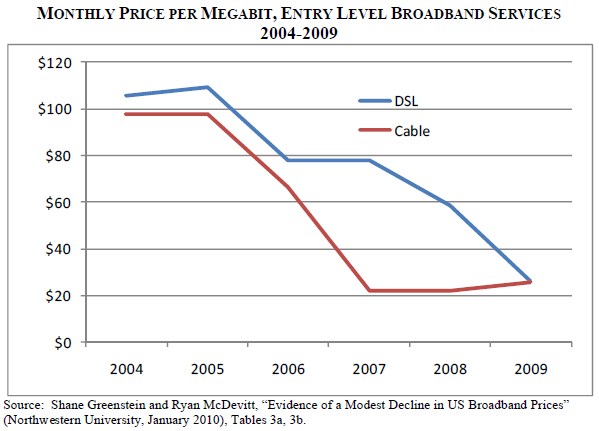
Eisenach’s pricing proof stopped in 2009, just as cable providers like Time Warner Cable began raising broadband prices. TWC’s Landel Hobbs to investors: “We have the ability to increase pricing around high-speed data.” (February, 2010)

Eisenach has appeared at various industry-sponsored evidence touting his views of broadband economics and competition that later turns up as headline news on Broadband for America’s website. But just as Wolverton’s initial optimism finding other choices for broadband faded with reality, so do Eisenach’s conclusions:

  1. Eisenach’s evidence of broadband price declines stops in 2009, coincidentally just prior to the recent phenomena of cable broadband rate increases, which have accelerated in the past three years;
  2. Competition still exists in urban and suburban markets, as long as phone companies attempt to stem the tide of landline losses, but it’s largely absent in rural markets and in decline in others where companies “reset” prices to match their cable competition. AT&T’s U-verse and Verizon’s FiOS both effectively ended their expansion, leaving large swaths of the country with “good enough for you” service. Cable operators have even teamed up with Verizon Wireless to cross-market their products — hardly evidence of a robustly competitive marketplace;
  3. Innovation can take the form of services customers don’t actually want but are compelled to take because of bundled pricing or, worse, the decline in a-la-carte add-ons in favor of “one price for everything” models. Verizon Wireless set the stage for providers of all kinds to consider mandatory bundling for any product or service that can no longer deliver a suitable return on its own. For customers already taking every possible service or fastest speed, this pricing  may deliver lower prices at the outset, but for budget-focused consumers, compulsory packages or high prices on a-la-carte services assures them of a higher bill;
  4. Eisenach’s examples of competition are a real mess. LightSquared is bankrupt and Clearwire has shown it cannot deliver an equivalent broadband experience for customers and throttles the speeds of those perceived to be using the service too much. Other wireless providers typically limit customer usage or cannot deliver speeds comparable to wired broadband;
  5. While the cost per megabit may have declined in the past, cable providers are still raising prices, and as Google and community-owned providers have illustrated, delivering fast speeds should not cost customers nearly as much as providers continue to charge, with no incentive to cut prices in the absence of equally fast, competitive networks;
  6. While broadband may open the door for additional economic benefits not immediately apparent, competitive broadband would further drive innovation and reduce pricing, delivering an even bigger bang for the buck.

Wolverton recognized taking a promotional offer from AT&T will temporarily deliver savings over what Comcast charges, but he would have to set his expectations lower if he switched:

I’m reluctant to switch to AT&T. [U-verse] Max Plus is the fastest level of service it offers at our house, but with a top speed of 18 megabits a second, it’s significantly slower than Comcast’s Blast. Speed matters to us, because my wife and I often share our Internet connection, and we frequently use it to transfer large files such as apps, videos, photos or songs to or from the Net.

[…] What’s more, as the FCC outlined in another recent report, Comcast does a better job of delivering the speeds it advertises than does AT&T.

What’s worse in my book is that AT&T’s U-verse’s Internet service is a version of DSL. It’s faster than regular DSL, because the copper wires in your house and neighborhood are connected to nearby high-speed fiber-optic cables. Even with that speed boost, though, I’m hesitant to go back to any kind of DSL service, because my wife and I suffered through years of unreliable DSL service from AT&T predecessor PacBell and then EarthLink, which piggybacked on AT&T’s lines.

Wolverton also objected to Comcast’s bundled pricing scheme, which delivers the best value to customers who sign up for broadband, television and phone service. Wolverton does not need a landline from AT&T or Comcast, and would like to drop the service. He’s not especially impressed with Comcast’s TV lineup (or pricing) either. But he noted if he switched to broadband-only service, Comcast would effectively penalize him with a broadband-only rate of $72 a month, exactly half the current cost of Comcast’s triple-play package.

In a later blog post, Wolverton confessed he liked Comcast’s broadband service and speeds, and with the carefully-crafted pricing the cable and phone companies have developed, he expected to remain a Comcast customer given his choices and pricing options, which are simply not enough.


Search This Site:

Contributions:

Recent Comments:

Your Account:

Stop the Cap!