Home » rate increases » Recent Articles:

AT&T Deregulation Wallops Californians In Their Wallets; Rates Up 222%, Despite Competition Claims

special reportStop the Cap! reader Steve L. has heard enough of AT&T’s promises that deregulation would bring more competition and better deals to Californians.

The Carlsbad resident is staring at the fruits of AT&T’s labor — winning deregulation of phone rates in 2006: a  basic phone bill that has increased from $5.70 a month before deregulation to $21.25 effective Jan. 2, 2014. That represents a 272 percent increase for basic measured (pay-per-minute) local telephone service. As if that was not enough, AT&T is also raising the per-minute rate for semi-local calls for the second time in two years. Earlier this year, AT&T slashed customers’ calling allowances by 25 percent, reducing the 225 minutes a month of toll-free calling down to 168 minutes in January.

Customers living in large, spread out cities in California are accustomed to Zone Usage Measurement (ZUM) charges for calls placed to numbers more than 12 miles from the local telephone exchange. But they may get bill shock after noticing how much the per-minute rates have increased:

  • ZUM 1/2 (12-15 miles): Calls have doubled in price over the last 36 months. Prior to 2013, calls cost three cents per minute. AT&T raised prices to four cents in January and will raise them again to six cents per minute on Jan. 1;
  • ZUM 3 (15-16 miles): Calling prices have increased from five cents a minute in 2012 to six cents a minute in 2013 and will be seven cents per minute in 2014.
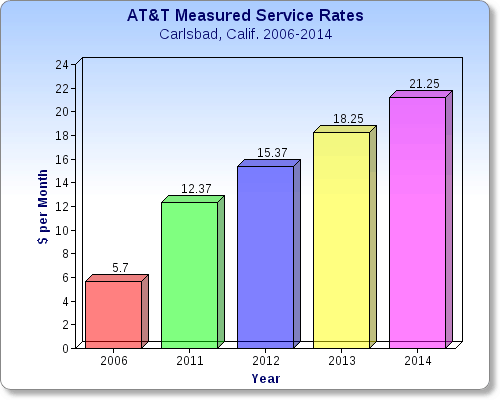
attcarlsbad“After surcharges, fees, and taxes, my bill will be nearly $30 per month for measured rate service, representing a near doubling of cost in just a 22-month period,” Steve writes. “I have no other choice than AT&T for a true powered landline, but I am rejecting this latest increase and plan to test and move to a VoIP system.”

The constant parade of rate increases from the state’s largest local telephone company began shortly after the California Public Utilities Commission (CPUC) unanimously approved sweeping deregulation of telephone rates in August 2006. Then Republican Commissioner Rachelle Chong was the driving force behind the effort, reports the San Francisco Chronicle.

Chong embraced AT&T’s attitude about telecommunications deregulation, promising consumers would not face abusive rate hikes or bad service. Under the old system, AT&T telephone rates were capped in California. AT&T had to approach the CPUC and justify any proposed increases. Without solid evidence, the company’s rate increase requests were rejected. Under deregulation, AT&T was permitted to set rates at-will.

“By the end of the 2010, these rate caps will no longer be necessary,” Chong promised as the new rules were being phased in. “The market will be so competitive it will discipline prices.”

Not quite.

att_logoAT&T’s rates have shot up as much as 222 percent for the average Californian’s measured rate phone service. Some customers, including our reader, found rates nearly three times higher than they were before deregulation. In the last few years, AT&T has increased prices on landline service and calling features even more dramatically across the state:

  • AT&T Flat-Rate landline service jumped 115 percent since 2006, from $10.69 to $23 a month;
  • Call Waiting, a popular phone feature, is up nearly 180 percent;
  • Anonymous Call Rejection fees have almost quadrupled;
  • Lifeline Service for California’s most disadvantaged is up 28 percent.

“My belief is that AT&T is essentially harvesting,” Dane Jasper, chief executive of Sonic.net, a competing broadband Internet service in Santa Rosa that tosses in domestic phone service for free, told the newspaper. “They jack up the rate by a pretty egregious amount … because if people leave, well, where are they going? AT&T mobile phone service in at least half the cases. So they’re happy to have them leave or happy to have them stay.”
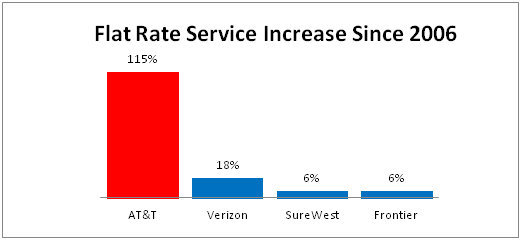
rate hikesAT&T defends the increases by suggesting rates were artificially restrained by rate regulators under the old system, and the new higher prices reflect economic reality and the deregulated marketplace. But AT&T’s rate increases have blown past other service providers in the state. Verizon’s flat rate service only increased 18 percent since deregulation. Independent providers SureWest and Frontier Communications have only raised prices by about six percent.

With these kinds of rate increases, customers like Steve are making hard choices about whether to keep or ditch their landline service. Ironically, AT&T’s argument to decommission traditional landline service is based on the premise customers are abandoning landline service. AT&T advocates moving customers to its deregulated U-verse platform in urban areas and switch rural customers to wireless-only service.

Chong paid a personal price for her erroneous predictions of consumer savings. In December 2009, the Democratically controlled State Senate refused to hold hearings on Chong’s reappointment to the CPUC, ending her term. AT&T and Verizon strongly backed Chong and lobbied hard for her confirmation. AT&T even turned out its notorious “dollar-a-holler” sock puppet brigade of non-profit groups that showered the legislature with letters supporting her reappointment, without bothering to disclose AT&T had made substantial direct or indirect contributions to the groups in the past.

Murray Bass, head of a small nonprofit in Northern California, initially wrote lawmakers saying Chong was a strong voice for low-income seniors. But in an interview, he admitted he’d endorsed her at the suggestion of executives at AT&T, which had given his group money.

“There’s an essential conflict of interest when a regulated — or supposedly regulated — entity is intervening on behalf of a regulator that’s friendly to them,” said Mark Toney, executive director of the Utility Reform Network, a group that opposed Chong.

SUPPORTERS OF COMMISSIONER CHONG WITH TIES TO AT&T

Organization  Funding Received  Letter Signatory (-ies)
Asian Pacific Islander American Public Affairs (APAPA) The AT&T Foundation gave APAPA $25,000 in 2007. On the APAPA website, AT&T is listed as a top-tier event sponsor with a $50,000 donation in 2009. Joel Wong, Bay Area Chapter PresidentNorm De Young, VP Outreach and Chair of APAPA’s GovernmentRelations Committee (spoke on behalf of Filipino Progress)
CA Small Business Association (CBSA) AT&T is a corporate sponsor of the Small Business Roundtable (CBRT), the advocacy wing of CBSA, which has received $37,500 from AT&T since 2006.    The AT&T Foundation  underwrites  CBRT’s education fund, tech training and website.  Both CBSA and CBRT are active in CPUC proceedings, and CBSA endorses candidates and lobbies public officials.The California Small Business Education Foundation received a 3-year $1.125 million grant from the AT&T foundation.  Betty Jo Ticcoli, the letter’s signatory, is its Chair and CSBA is a member.CSBA is a member of the California Utilities Diversity Council (CUDC) along with AT&T and Verizon. Betty Jo Toccoli
California Hispanic Chambers of Commerce (CHCC) $30,000 from AT&T corporate since 2006, millions more from the Foundation.  Black, Hispanic & Asian Chambers are sharing a 1.25-year $287,000 CETF grant.   AT&T is a corporate member statewide and of several local Hispanic Chambers.  AT&T sponsors CHCC’s annual convention and underwrites local events such as FestivALL, sponsored by the Silicon Valley Hispanic Chamber.Member of  CUDC. Kenneth A. Macias, Chairman of the BoardJoel Ayala, President & CEO
City of Firebaugh $633,000 CETF grant. Jose Antonio Ramirez, City Manager
Cristo Rey High School Sacramento Received a $25,000 grant from AT&T Foundation in 2009. Joan Evans, VP for Advancement
Fresno-Madera Area Agency on Aging (FMAAA) $50,000 SBC Foundation Grant in 2002; $20,000 in 2003; AT&T has sponsored FMAAA’s Scamnot.org website since 2005. Jo Johnson, Executive Director
Latino Community Foundation $25,000 CETF grant. Aida Alvarez, Chairperson
Latino Institute for Corporate Inclusion (LICI) AT&T is a corporate partner of LICI; LICI’s IRS form 990 shows  income of $19,742 in 2008 and it has received $17,500 from AT&T corporate according to AT&T’s 77-M filing with the state, more from the AT&T foundation.Member of CUDC. Ruben Jauregui, President & CEO
Latino Journal $17,500 from AT&T since 2006; AT&T, Verizon and the CPUC are strategic partners in the Journal-sponsored California Education Summit, which AT&T underwrites.Member of CUDC. Jose L. Perez
Mexican American Opportunity Foundation (MAOF) $25,000 from AT&T Foundation. Magda Menendez, Administrator
Other Connections Between AT&T and Chong Supporters
OCA – Organization of Chinese Americans Sacramento AT&T is a corporate partner of national org and both AT&T and Verizon sponsor Asia Week and other heritage events Joyce Eng, President
Tools of Learning for Children Big AT&T logo on website. Told the Los Angeles Times, “he’d endorsed [Chong] at the suggestion of executives at AT&T, which has given his group money.” Murray T Bass, MA, CFP
United Way of Butte & Glenn Counties President Preston Dickinson is former Director of External Affairs for AT&T. W. Jay Coughlin, Executive Director

 Notes

  • 1.  CUDC – The California Utilities Diversity Council is a collaboration between the CPUC , the utility companies and other industry participants  to promote diversity in the utility industry.  AT&T is a gold sponsor of CUDC’s annual convention.
  •  2.  CETF – CETF is a private non-profit corporation created by the California Public Utilities Commission (CPUC) and funded entirely by AT&T and Verizon.  Commissioner Chong is Chair of the CETF Board of Expert Advisors and its Accessibility Committee.  CPUC President Michael Peevey is Chairman of the CETF Board of Directors. The CETF board is appointed by the CPUC, AT&T and Verizon.

Sources:

  • AT&T Foundation IRS form 990
  • The Utility Reform Network

Deck the Halls With a Verizon FiOS Rate Hike; Tis the Season for $8+ More a Month

Phillip Dampier December 2, 2013 Consumer News, Verizon Comments Off on Deck the Halls With a Verizon FiOS Rate Hike; Tis the Season for $8+ More a Month

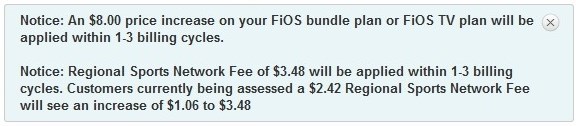
Verizon is notifying some of its FiOS TV customers they will be paying $8 more a month “within 1-3 billing cycles” and a dollar more a month for the Regional Sports Network Fee, applicable in some areas.

(Courtesy: andrade6503)

(Courtesy: andrade6503)

Cable operators are increasingly breaking out high cost programming, including sports and local broadcast stations, from the basic cable tier and adding surcharges on the customer’s bill, often with no option to cancel the offending programming. Many operators also leave the price of their basic cable packages the same, creating a surcharge-driven, hidden rate increase.

Pay television providers have argued that some of the biggest rate increases occur after programmers raise prices during contract renewal talks. Breaking the fees out on the bill can re-target blame for rate increases on programmers instead of the cable, satellite, or telephone company, assuming customers scrutinize their bill.

AT&T Celebrates 10,000,000th U-verse Customer With a Rate Hike

Phillip Dampier November 26, 2013 AT&T, Broadband Speed, Competition, Consumer News, Video, Wireless Broadband Comments Off on AT&T Celebrates 10,000,000th U-verse Customer With a Rate Hike

yay attAT&T this month signed up their 10 millionth customer to U-verse High Speed Internet service, surpassing Verizon FiOS as the nation’s biggest telephone company supplier of broadband, television, and telephone service. Coinciding with that success, AT&T is raising prices for U-verse, despite AT&T’s record earnings from the fiber to the neighborhood service, now accounting for $1 billion a month in revenue.
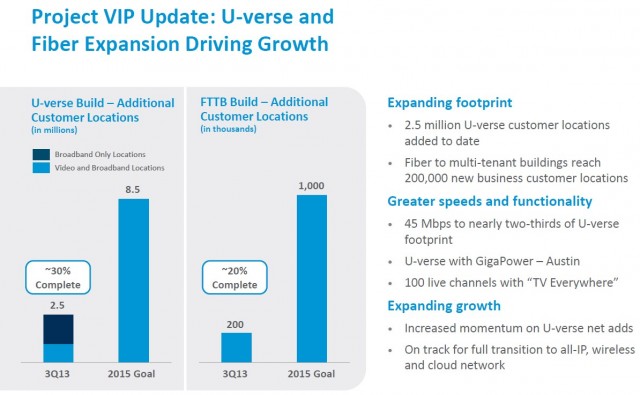
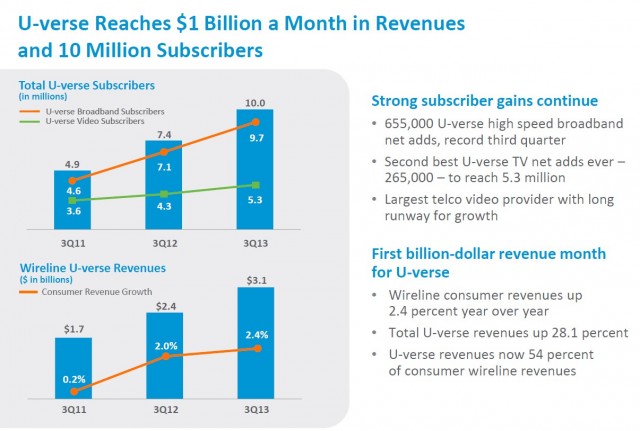

AT&T is protecting its broadband flank by convincing current DSL customers to switch to higher-speed U-verse broadband as the network upgrade reaches into more homes across AT&T’s service areas. In the last quarter U-verse picked up 655,000 new broadband customers nationwide, many upgraded from traditional DSL. Where AT&T has not invested in U-verse upgrades and cable competition exists, results are not as good. AT&T lost 26,000 DSL customers last quarter, most moving to cable broadband.

“This latest milestone shows how U-verse is helping transform AT&T into a premier IP broadband company,” said Lori Lee, senior executive vice president, AT&T Home Solutions. As of the third quarter of this year, total U-verse high-speed Internet subscribers represented about 60 percent of all wireline broadband subscribers, compared with 43 percent in the year-earlier quarter.

Verizon FiOS, in comparison, has signed up just 5.9 million customers FiOS Internet subscribers on its stalled fiber optic network. Most Verizon broadband customers with no FiOS in their future either stick with DSL service or, increasingly, switch to a cable competitor for faster speeds.

Some of AT&T’s strongest U-verse growth came from its TV package. At least 265,000 cable and satellite cord-cutters looking for a better deal switched to U-verse TV in the last three months, a gain from 198,000 at the same time last year. That’s the second-best quarterly gain ever. A total of 5.3 million AT&T customers subscribe to U-verse TV.

project vip

Much of the growth has come from AT&T’s investment in expanding U-verse to new areas. Project Velocity IP is a three-year, $14 billion plan to upgrade AT&T’s wireless and wired broadband networks. AT&T has added almost 2.5 million more homes to its broadband footprint so far this year and hopes to expand broadband availability to reach about 57 million customers by the end of 2015.

Although $14 billion is a significant investment, AT&T has spent considerably more on its shareholders. John Stephens, AT&T’s chief financial officer told Wall Street analysts AT&T has bought back 684 million shares of stock that will save the company more than $1.2 billion in future dividend payouts.  Combined with its dividend payout, AT&T has handed shareholders $18 billion so far this year and more than $40 billion since the beginning of 2012. AT&T expects to spend $20 billion on wireless and wireline network improvements in 2014.

AT&T’s speed upgrades have also not run as smoothly as AT&T claims. Efforts to increase speeds to 45Mbps in 79 markets has had mixed results with a significant number of customers complaining they cannot get qualified for the faster speeds because of infrastructure problems with AT&T’s network. The company still says it is on track to offer 75 and 100Mbps speed tiers in the future and is building a fiber to the home network in Austin to compete with Google.

u-verse revenue

Many customers who have been with AT&T for more than a year are learning better service does not come for free. AT&T has filed rate increases for its television service beginning Jan. 26, 2014 for customers not on a pricing promotion. The monthly price for the following U-verse TV service plans will increase $3, along with fee hikes for local stations and equipment, bringing AT&T at least $15 million in extra revenue each month:
Top secret.

  • U-family to $62;
  • U200 to $77;
  • U200 Latino to $87;
  • U300 to $92;
  • U300 Latino to $102;
  • U450 to $124;
  • and U450 Latino to $134.
  • Grandfathered plans also will increase $3: U100 to $64 or $69, depending on when first ordered; and U400 to $119.
  • The monthly price of each non-DVR TV receiver will increase from $7 to $;
  • Beginning on February 1, 2014, the Broadcast TV Surcharge will increase $1 to $2.99 per month to recover a portion of the amount local broadcasters charge AT&T to carry their channels.

Those customers who have a U-verse TV pricing promotion will continue to receive the promotional benefit until the applicable promotion ends or expires.  Customers are being notified of these changes via bill messaging occurring in November and December and a reminder in January and February 2014.  In addition, customers will be notified of these changes online at www.att.net/uversepricechange and att.com/uversesupport.

[flv]http://www.phillipdampier.com/video/ATT U-verse with GigaPower — Reactions 11-13.mp4[/flv]

AT&T is trying to get ahead of Google by advertising AT&T U-verse with GigaPower, a 1,000Mbps fiber to the home service promised in Austin sometime in the future. (0:30)

Charter Communications Weighs Time Warner Cable Takeover by End of 2013; Usage Caps Might Follow

The new name of Time Warner Cable?

The next name of Time Warner Cable?

Charter Communications is laying the foundation for a leveraged buyout of Time Warner Cable before the end of the year in a deal that could leave Time Warner Cable’s broadband customers with Charter’s usage caps.

Reuters reported discussions between the two companies grew more serious after last week’s revelation a poor third quarter left TWC with 308,000 fewer subscribers.

Charter is relying on guidance from Goldman Sachs to structure a financing deal likely to leave Charter in considerable debt. Charter Communications emerged from bankruptcy in 2009 and is the country’s tenth largest cable operator, estimated to be worth about $13 billion. Time Warner Cable is the second largest cable operator and is worth more than $34 billion.

The disparity between the two companies has kept Time Warner Cable resistant to a deal with Charter, stating it would not be beneficial to shareholders. Charter executives hope to eventually win shareholder support for a buyout stressing the significant cost savings possible from a combined operation, particularly for cable programming.

The deal would likely end Time Warner Cable as a brand and leave Charter Communications CEO Thomas Rutledge in charge of a much larger cable company. Pricing and packaging decisions are usually made by the buyer, which could bring faster broadband speeds to Time Warner customers, but also usage caps already in place at Charter.

John Malone’s War on Customers

Malone

Malone

Cable billionaire John Malone, former CEO of Tele-Communications, Inc. (TCI) — America’s largest cable operator in the 1980s — believes consolidation is critical to the future of a cable business facing competition from phone companies and cord cutting. Malone’s Liberty Media, which now holds a 25% stake in Charter, is currently buying and consolidating cable operators in Europe. Malone’s post-consolidation vision calls for only two or three cable operators in the United States.

Malone’s quest for consolidation is nothing new.

Under his leadership, TCI eventually became the country’s biggest cable operator, but one often accused of poor service and high prices. More than a decade of complaints from customers eventually attracted the attention of the U.S. Congress, which sought to rein in the industry with the 1992 Cable Act — legislation that lightly regulated rental fees for equipment and the price of the company’s most-basic television tier.

Despite the fact consumer advocates didn’t win stronger consumer protection regulations, TCI was still incensed it faced a new regulatory environment that left its hands tied. One executive at a TCI subsidiary advocated retaliation with broad rate increases for unregulated services to make up any losses from mandated rate cuts.

A 1993 internal TCI memo obtained by the Washington Post instructed TCI system managers and division vice presidents to increase prices charged for customer service calls and add new fees for common installation services the company used to offer for free. TCI’s Barry Marshall recommended charging for as many “transaction” services as possible — like hooking up VCR’s, running cable wire, and programming remote controls for confused customers.

“We have to have discipline,” Marshall wrote. “We cannot be dissuaded from the [new] charges simply because customers object. It will take awhile, but they’ll get used to it. The best news of all is we can blame it on re-regulation and the government now. Let’s take advantage of it!”

Tele-Communications, Inc. (TCI) was the nation's largest cable operator.  Later known as AT&T Cable, the company was eventually sold to Comcast.

Tele-Communications, Inc. (TCI) was the nation’s largest cable operator. Later known as AT&T Cable, the company was eventually sold to Comcast.

The FCC’s interim chairman at the time — James Quello, charged with monitoring the cable industry, was not amused.

“It typifies the attitude of cable companies engaging in creative pricing and rate increases to evade the intent of Congress and the FCC,” Quello said. “There is little doubt that the cable industry has an economic stake in discrediting the congressional act they vehemently and unsuccessfully opposed.”

Marshall defended his internal memo, although admitted it was inartfully written and was not intended for the public. Revelation of a damaging memo like this would normally lead to a quiet resignation by the offending author, but not at John Malone’s TCI, a company with a reputation for being difficult.

Mark Robichaux’s 2005 book, Cable Cowboy: John Malone and the Rise of the Modern Cable Business, was even less charitable.

Robichaux describes Malone as a “complicated hero,” at least for investors for whom he was willing to ignore banking rules and creatively interpret tax law. Robichaux wrote Malone’s idea of customer service was to ‘charge as much as you can, but spend as little as you can get away with.’

TCI’s top priority was to keep up the cable business as an “insular cartel.” The predictable result included accusations of “shoddy service” customers were forced to take or leave. In the handful of markets where TCI faced another cable competitor, TCI ruthlessly slashed prices to levels some would describe as “predatory,” only to rescind them the moment the competitor was gone. TCI’s intolerance for competition usually meant mounting pressure on competitors to sell their system to TCI (sometimes at an astronomical price) or face a certain slow death from unsustainable price cuts.

Among Malone’s most-trusted friends: junk bond financier Michael Milken and Leo Hindery, former CEO of Global Crossing.

Congressman Albert Gore, Jr., later vice-president during the Clinton Administration, was probably Malone’s fiercest critic in Washington. Gore’s office was swamped with complaints from his Tennessee constituents upset over TCI’s constant rate increases and anti-competitive behavior.

The cable industry's biggest competitor in the 1980s-1990s was a TVRO 6-12 foot diameter home satellite system.

The cable industry’s biggest competitor in the 1980s-1990s was a TVRO 6-12 foot diameter home satellite system.

Gore was especially unhappy that TCI’s grip extended even to its biggest competitor — satellite television.

In the 1980s and early 1990s, cable operators made life increasingly difficult for home satellite dish owners, many in rural areas unserved by cable television. But things were worse for home dish owners that walked away from TCI and began watching satellite television instead. To protect against cord-cutting, the cable industry demanded encryption of all basic and premium cable channels delivered via satellite. It was not hard to convince programmers to scramble — most cable networks in the 1980s were part-owned by the cable industry itself.

To make matters worse, unlike cable systems that only leased set-top boxes to customers, home dish owners had to buy combination receiver-descrambler equipment outright, starting at $500. Just a few years later, the industry pressured programmers to switch to a slightly different encryption system — one that required home dish owners replace their expensive set-top box with a different decoder module available only for sale.

Gore was further incensed to learn TCI often insisted home dish owners living within a TCI service area buy their satellite-delivered programming direct from the cable company. Customers hoping to leave cable for good found themselves still being billed by TCI.

Sometimes the rhetoric against TCI and Malone got personal.

”He called me Darth Vader and the leader of the cable Cosa Nostra,” Malone said of Gore. “You can’t win a pissing contest with a skunk, so there’s no point in getting involved in that kind of rhetoric.”

“There’s a joke going around Washington,” John Tinker, a New York-based Morgan Stanley & Company investment banker who specializes in cable television said of Malone back in 1990. “If you have a gun with two bullets, and you have Abu Nidal, Saddam Hussein and John Malone in a room, who would you shoot? The answer is John Malone — twice, to make sure he’s dead.”

TCI itself was a four letter word in the many small communities that endured the cable company’s insufferable service, outdated equipment, and constant rate “adjustments.”

The New York Times reported John Malone’s TCI had a reputation for treating customers with “utter disdain,” and provided examples:

  • In 1973, rate negotiations stalled with local regulators in Vail, Colo., the local TCI system shut off all programming for a weekend and ran nothing but the names and home phone numbers of the mayor and city manager. The harried local government gave in.
  • In 1981, TCI withheld fees and vowed to go completely dark in Jefferson City, Mo., if the city failed to renew its franchise, while a TCI employee — “who turned out to have a psychological problem,” said Malone — threatened harm to the city’s media consultant. Again, a beleaguered local government renewed the franchise — although in a subsequent lawsuit, TCI was fined $10.8 million in actual damages and $25 million in punitive damages.
  • In 1983, the small city of Kearney, Neb., also dissatisfied with poor service and rising rates, tried to give Malone some competition in the form of a rival system built by the regional telephone company. TCI slashed fees and added channels until the enemy was driven from the field.

“That’s the dark side, if you will, of TCI,” said Richard J. MacDonald, a media analyst with New York-based MacDonald Grippo Riely.

By mid-1989, Malone’s frenzied effort to consolidate the cable industry resulted in him presiding over 482 merger/buyout deals, on average one every two weeks. Among the legacy cable companies that no longer existed after TCI’s takeover crew arrived: Heritage Communications, United Artists Communications and Storer Communications.

To cover the debt-laden deals, Malone simply raised cable rates and shopped for easy credit. Bidding with others’ money, the per-subscriber price of cable systems shot up from $998 in 1983 to an astronomical $2,328 in 1989.

The General Accounting Office, the investigative arm of Congress, found deregulating the cable industry cost customers through rate hikes averaging 43 percent. In Denver, TCI raised rates more than 70% between 1986 and 1989.

Malone’s attempt to finance a leveraged, debt-heavy buyout of Time Warner Cable seems to show his business philosophy has not changed much.

Time Warner Cable’s Halloween Nightmare: 3% of Customers Left This Summer, With More to Follow

Phillip Dampier October 31, 2013 Broadband Speed, Competition, Consumer News 2 Comments

pumpkinTime Warner Cable’s summer was “horrible,” to quote one analyst, after three percent of customers left over programming disputes and increasing prices for broadband and telephone service, with more likely to follow as price promotions expire and rates increase further.
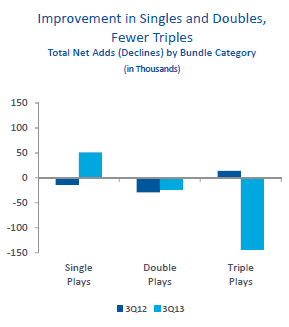
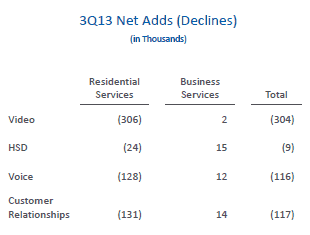

Cable analysts were shocked Time Warner Cable lost 308,000 customers in the last three months, most leaving over interruptions of CBS and Showtime over a contract dispute. But customers were also ready to leave over increasing modem rental fees, rate increases, and the company’s growing pullback on promotional pricing. Time Warner Cable’s poor results have ironically caused its stock price to increase this morning, but only because investors suspect a shareholder value-boosting merger with Charter Communications could come within months.

“Just horrible,” MoffetNathanson analyst Craig Moffett wrote in a note to investor clients this morning. “The CBS dispute apparently took a much larger toll than anyone would have imagined, and this colored all the results.”

Sources have told Reuters that cable billionaire John Malone has approached Time Warner Cable about a full takeover by Charter Communications, but has been rebuffed by Britt so far. But with Britt exiting and Time Warner Cable’s underperformance, shareholder pressure for a deal with Charter will only increase.

“This enhances Malone’s appeal to Time Warner Cable shareholders that they would be better off with another management team,” Brean Capital analyst Todd Mitchell told Reuters.

When promotional prices end, a growing percentage of TWC customers drop services or take their business elsewhere.

When promotional prices end, a growing percentage of TWC customers drop services or take their business elsewhere.

The subscriber losses pushed profits down 34 percent at the cable company, to $532 million. The triple play tragedy saw subscriber losses for all the company’s residential services. At a time when other cable companies cannot process High Speed Internet sign ups fast enough, at least 24,000 Time Warner Cable broadband customers left over rate hikes and equipment fees. Analysts had expected the company to pick up more than 46,000 broadband customers during the last three months, not lose them. The company’s phone service is also in decline. Only rate increases and customers upgrading to higher speed tiers delivered a slight revenue boost.

Outgoing CEO Glenn Britt set the stage for the current forced retreat on its revenue forecast for the year:

  • Time Warner Cable executives made the decision at the end of 2012 to stop heavily discounting service and cut back on promotions. Their theory was the company would attract a larger base of stable customers willing to pay non-promotional rates and tolerate rate increases;
  • Executives announced as Time Warner’s phone service was brought “in-house,” the company would stop aggressively pricing triple play bundles that included phone service. That turned out to be a bad decision for growth because customers, already prone to landline cord-cutting, downgraded their bundle or left when promotions expired and ditched the phone line;
  • A year of broadband price increases and the introduction of a modem rental fee rubbed customers the wrong way. “We have raised prices recently in the form of modem rental fees, but it’s really just broadband price increase,” again admitted Britt this morning. Future rate increases on modem rentals will give broadband customers another push to shop around for a better deal. At least 24,000 did that over the summer and left, mostly for AT&T U-verse in the midwest and Verizon FiOS in the east.

The lengthy dispute between Time Warner and CBS did the most damage and not just to customers directly affected by channel losses. A major increase in call volumes from alienated customers overwhelmed national call centers, creating long hold times for everyone calling in.

Time Warner expects 40 percent of the cable company’s service area will be overlapped by major competitors AT&T U-verse (now 27%) and Verizon FiOS (now 13%). That represents one million more homes than last year.

Bye Bye: Time Warner Cable lost residential customers for all of its services during the third quarter.

Bye Bye: Time Warner Cable lost residential customers for all of its services during the third quarter.

Incoming CEO Robert Marcus said he was dissatisfied with subscriber results from current promotions and rates. New Time Warner Cable customers, Marcus noted, are paying higher prices for fewer or less robust services as part of current promotional packages. Although that has driven a “dramatic improvement in recurring revenue” among customers actually signing up, many choose the lower-priced competition instead.

Marcus also noted customers are taking fewer services and are resistant to upgrading to double or triple play packages, reducing the potential average revenue per customer (ARPU).

“To a great extent, these are expected outcomes of our pricing and packaging strategy and the trade-off between ARPU and volume, but I’m confident we can do better on volume without giving up the ARPU benefits we’ve been achieving,” Marcus told analysts on a morning conference call.

Instead of getting more aggressive on pricing, the company plans to trot out free gifts and pitch discounted slow speed Internet to attract price-resistant DSL customers.

“Next week, we’ll launch our holiday offer, which includes a free Samsung tablet loaded with all of our apps, including TWC TV, with the purchase of higher-end packages,” Marcus said. “I think this will generate lots of interest and really highlight TWC TV and the value it adds to our service offerings.”

Marcus called it inconceivable and unacceptable that at least 4.5 million people are still subscribed to telephone company DSL in Time Warner Cable service areas. The company plans an advertising blitz to steal customers away from companies like AT&T, Verizon, Frontier, CenturyLink, Windstream and FairPoint.

At the center of that effort is the recently announced 2/1Mbps Lite package, which will sell at the everyday price of $14.95 a month. Marcus wants at least 500,000 DSL customers switched to Time Warner over the next 18 months.

“Over time, as these customers’ speed and capacity needs increase, we’ll be well positioned to sell them higher-end product,” Marcus said.

Or they will switch back to the phone company if Time Warner increases the price.

Search This Site:

Contributions:

Recent Comments:

Your Account:

Stop the Cap!