Home » rate increases » Recent Articles:

Comcast’s Spring Cleaning: More Rate Hikes, X1 Boxes, Wireless Gateways and Usage Caps

Phillip Dampier April 23, 2014 Broadband Speed, Comcast/Xfinity, Competition, Consumer News, Data Caps Comments Off on Comcast’s Spring Cleaning: More Rate Hikes, X1 Boxes, Wireless Gateways and Usage Caps

speed increaseComcast will increase capital spending in the first half of 2014 to hasten the rollout of its advanced X1 set-top boxes and new wireless gateways that provide public Wi-Fi from customer homes.

Comcast told investors Tuesday its increased spending will likely be offset by increased earnings from more subscribers and room for further price hikes over the course of the year.

First quarter consolidated revenue increased 13.7% to $17.4 billion over the past three months. Almost $11 billion of that comes from Comcast’s cable business. The company boosted cable earnings by 5.3% in the first quarter. Most of that came from a 4.5% increase in the average customer’s cable bill. Comcast subscribers, on average, pay $134 per month. They will pay even more by the end of the year.

Although Comcast’s head of its cable division Neil Smit noted the company implemented lower rate increases during the first quarter, there is room to boost prices further.

“I wouldn’t read any trends into it,” Smit said. “We took rate increases across the smaller percentage of our footprint this quarter than last year as well, but we target different offers to different customers and I don’t think we’re seeing it topping out. In the competitive arena, the offers are in the same ballpark, the promo prices go up and down, but the destination pricing is fairly similar across these various competitors.”

Roberts

Roberts

Comcast continued to buck cord-cutting trends and added 24,000 new video customers in the quarter, a major improvement over the 25,000 it lost at the same time last year. Comcast believes its new X1 platform and aggressive customer retention efforts are responsible for winning and keeping cable television customers. Ongoing speed enhancements in Comcast’s broadband division won the company 383,000 new Internet customers in the last three months. Broadband is Comcast’s biggest money-maker, and revenues increased a further 9% during the quarter owing to customer growth, rate hikes, and customers choosing higher-speed tiers. By the end of the quarter, 38% of Comcast’s residential customers subscribed to at least 50Mbps service, showing growing demand for higher speed Internet.

Sources tell Stop the Cap! Comcast intends to further expand its trial of usage caps (Comcast prefers to call them “usage thresholds”) to more markets this year. Comcast has settled on 300GB usage allowances for most broadband products in current test markets, charging $10 for each additional allotment of 50GB as an overlimit fee. Comcast has avoided trials of usage caps in areas where Verizon FiOS delivers significant competition. Verizon has no usage caps on either their DSL or fiber broadband products.

Comcast also picked up 142,000 new phone customers in the quarter, mostly from those subscribing to aggressively priced triple play service bundle promotions. Around 155,000 new triple play customers signed up over the last three months.

At the end of the first quarter, 68% of Comcast customers took at least two products and 36% took three products, compared to 33% at the end of last year’s first quarter.

Brian Roberts, CEO of Comcast, said there were several factors that fueled Comcast’s growth during the quarter, starting with its advanced X1 set-top box platform, which offers a better television experience and makes finding things to watch easier. If customers have an X1, Roberts told investors, they are less likely to drop cable television service.

X1

X1

“These positive early results reinforce our decision to accelerate our X1 deployment this year, and we are now adding 15,000 to 20,000 X1 boxes per day, which is double our rate of deployment from just six months ago,” Roberts told analysts. “Additionally, we are now rolling out a new XFINITY TV app, which enables our customers to live stream virtually their entire television lineup on any IP device in the home and watch DVR recordings in the home or on the go.”

Although usage caps remain controversial, Comcast has been aggressive about increasing broadband speeds at least once a year.

“In broadband, we recently increased speeds again for the 13th time in 12 years,” Roberts offered. “Doubling speeds in our Blast products to 105Mbps, while our Extreme tier moved up to 150Mbps for customers in the northeast. And we’re not stopping there. Our focus on wireless gateway deployment is adding utility to our customers while at the same time helping us create the largest Wi-Fi footprint in the U.S. with over one million public Wi-Fi hotspots currently available to our customers.”

xfinitylogoAlthough Comcast’s first quarter capital expenditures increased $51 million (or 4.6%) to $1.1 billion (10.6% of cable revenue versus 10.7% in the first quarter of 2013), the cable company returned even more money to shareholders. In the first quarter, the company boosted return of capital by 35% to $1.3 billion. Comcast repurchased its own shares of stock totaling $750 million and paid $508 million in dividends for the quarter.

In 2014, Comcast will invest 14% of cable revenue (compared to 12.9% in 2013) to accelerate the deployment of X1 and wireless gateways, increase network capacity and continue to invest in expansion of business services and XFINITY Home. But it will spend far more than that placating shareholders. If Comcast wins support to buy Time Warner Cable, Comcast intends to increase its stock repurchase plan by $2.5 billion. The company earlier committed it would spend $3 billion on repurchasing its own shares, for an expected total of $5.5 billion during 2014.

When a company repurchases its own shares, it reduces the number of shares held by the public. That in turn means that if profits remain the same, the earnings per share increase. It also boosts the value of the massive portfolios of Comcast stock held by executives as part of their compensation packages.

[flv]http://www.phillipdampier.com/video/Comcast Introducing the X1 Platform from XFINITY 4-14.mp4[/flv]

Comcast produced this video showing off its X1 platform and new set-top boxes. (1:47)

The Washington Post’s Delusional Support of the Comcast-Time Warner Cable Merger Debunked

corporatewelfareIf you have started to confuse the Washington Post editorial page with that of the Wall Street Journal, you are not alone.


Under the stewardship of Fred Hiatt, WaPo’s editorial opinions have grown increasingly anti-consumer and pro-corporate at home and decidedly neoconservative abroad.

It’s the same newspaper that wholeheartedly supported the merger of Comcast and NBC-Universal in 2010. Let’s check whether they called that one right:

Entities that compete with NBC-owned cable channels fear that Comcast will relegate them to hard-to-find channel locations. Consumer advocates warn that Comcast will use its newfound power to raise subscription rates and stifle new voices on television and the Internet.

The same newspaper reported last week that Comcast refused to let Back9Network, a golf oriented network in direct competition with Comcast-owned Golf Channel, on its cable systems.

For years, Bloomberg TV — in direct competition with Comcast-owned CNBC — has been stuck in Channel Siberia, in some areas like Chicago dumped between Comcast’s promotional “barker” channel and “Leased Access.” CNBC enjoys Ch. 29, certain to attract more viewers than Bloomberg’s Ch. 102.

As Stop the Cap! reported yesterday, no cable company raises cable television rates more than Comcast, blaming programming rate increases that in several cases originate with Comcast-owned cable networks.

Regulators should scrutinize the proposed merger but should be skeptical of the critics’ claims. […] Advocacy groups have been poor prognosticators of the effects of large media mergers.

The Washington Post’s editorial accuracy record has more than a few blemishes, from its 2003 declaration Colin Powell’s “evidence” of Iraqi weapons of mass destruction was “irrefutable,” to suggestions that a wedding of Comcast and NBC Universal wouldn’t hurt anyone because the FCC was ready to manage any problems without pesky mandates or overbearing pre-conditions.

The FCC already requires cable operators to deal fairly with competitors. Its rules would require Comcast to give competitors access to NBC content on “reasonable” and “non-discriminatory” terms. The company would also be required to negotiate in good faith about carrying non-NBC channels. Competitors who believed that they were harmed by unfair dealing could have their complaints adjudicated by the agency. Critics of the Comcast-NBCU merger claim that these mechanisms are ineffective and slow. But the breakdown of the complaint system should not be used as an excuse to impose onerous conditions on one company. Instead, critics should push for an overhaul of the system.

The Bloomberg case, now three years old, remains unresolved. That should tell readers something about just how quickly the FCC gets around to dealing with these kinds of complaints. Comcast has been able to argue its decision to bury Bloomberg and keep Back9Network off its cable systems are examples of ‘good faith, reasonable decision-making that doesn’t discriminate.’ It sued to quash Net Neutrality, critical for online video competition, and won.

The Post editorial amusingly insists that Comcast’s merger plans should not be interrupted because of an ineffective complaint system that can’t or won’t promptly deal with Comcast’s ongoing abuse of the very non-discriminatory rules the editors declare as a reason to support the Comcast-NBCUniversal merger.

Many of the same fears of domination and manipulation were raised with the 2001 merger of AOL and TimeWarner; that megadeal crumbled after a few years. Comcast and GE, which will retain a 49 percent stake in NBCU, should be allowed to proceed, and regulators should do their jobs and watch the newly formed company carefully.

Phillip "The Post's Naivete is Showing" Dampier

Phillip “The Post’s Naivete is Showing” Dampier

The 2001 merger of AOL and Time Warner came at the last gasp of the dot.com boom. As the New York Times noted, “In May of 2000, the dot.com bubble began to burst and online advertising began to slow, making it difficult for AOL to meet the financial forecasts on which the deal was based. The world began moving quickly to high-speed Internet access, putting AOL’s ubiquitous dial-up service in jeopardy.”

The final unraveling of AOL Time Warner came about because the combined company, highly dependent on AOL (and its stock value), could not sustain its business model when nobody could figure out how to get paid for content in the online world. AOL’s dial-up Internet access business was also rapidly in decline as the country started moving towards broadband.

“The consumer has access to everything and now it’s going to be on a handheld device, so what I call the rolling thunder of the Internet started actually to eat its own, which was AOL,” writes the Times. “AOL was the Google of its time. It was how you got to the Internet, but it was using some old media business ideas that were undone by the Internet itself, and that’s why Google came along.”

The same sad story is not true for Comcast or Time Warner Cable (which was spun off from Time Warner, Inc. as an independent company as part of a restructuring in 2009.)

Both cable companies are in a better place than AOL-Time Warner:

  • AOL relied on dial-up and reseller access to some broadband providers — neither sufficiently lucrative to sustain AOL’s dot.com-days value. Comcast/TWC own their own broadband networks;
  • Verizon FiOS and AT&T U-verse are the only significant multi-city broadband competitors for the cable industry. U-verse remains challenged by its technological limitations and Verizon stopped expanding FiOS. Google Fiber has a totally insignificant market share and is likely to stay that way for several years. Google Fiber provides no competition in the northeast where Comcast and Time Warner Cable dominate;
  • Comcast and Time Warner Cable both oppose community-owned broadband competition and Time Warner has successfully managed to push legislation virtually banning network expansion in several states;
  • Comcast will both own and control the pipes and a significant amount of the content that crosses its broadband networks. At the time of the AOL-Time Warner merger, online video competition did not exist in a meaningful way.

Cogeco Won’t Lower Your Bill; Warns Customers Not to Be “Victims” of Landline Cutting

Phillip Dampier April 14, 2014 Canada, Cogeco, Competition, Consumer News Comments Off on Cogeco Won’t Lower Your Bill; Warns Customers Not to Be “Victims” of Landline Cutting

cogecoDespite growing competition from Bell’s fiber-to-the-neighborhood service Fibe, now expanding into many of Cogeco’s outer suburban service areas, Cogeco will not negotiate a better deal for customers, preferring to emphasize its customer service and “right-sizing” bundles of services to best meet customer needs.


As a result of higher prices, Cogeco’s earnings and profits are up for the second quarter of 2014. In the quarter profits rose to $58.5 million — up from $48.9 million during the same quarter a year ago. Revenue rose to $518.4 million from $458.5 million.

“We don’t like competing on price,” said Cogeco CEO Louis Audet said. “I’m not saying it’s zero, but we really don’t like competing on price.”

Audet

Audet

Customers have been offered sign up discounts from Cogeco’s most aggressive competitor on pricing – Bell. But when customers in parts of Ontario and Quebec call Cogeco to negotiate for a lower price, they are largely being turned down.

Audet said Cogeco instead emphasizes that customers will receive better customer service from the cable company, and customer retention specialists are trained to adjust packages to emphasize the services customers want without cutting their cost.

“It’s a right-sizing exercise,” Audet said. “Maybe the person wants a little less video, but they want higher Internet speeds.”

Cogeco isn’t winning the battle to keep its price-sensitive customers, however. The company lost 10,305 subscribers in the second quarter, nearly double the amount lost in the same quarter a year ago. Cogeco now serves 1.96 million Canadian cable television customers.

Customers are also dropping their Cogeco phone service, a decision Audet said makes them “victims” of cell phones. Cogeco permanently disconnected 6,000 landlines in the quarter, up from 5,550 a year ago. It still serves 473,000 phone customers.

The company lost almost 6,000 telephone customers in the quarter compared with additions of 5,550 in the same quarter last year. It had more than 473,000 residential phone customers left.

Despite the customer losses, rate increases more than made up for lost revenue, giving the company a nearly $10 million boost in profits during the second quarter alone.

JPMorgan Chase Advises Cable Companies to Raise Cable TV Rates; Where Can Customers Go?

Phillip Dampier April 7, 2014 Competition, Consumer News 9 Comments
Comcast Rates (Image: The Oregonian)

JPMorgan Chase reports average cable rates reached $88.67 in 2013. (Image: The Oregonian)

Cable TV rates are too low and need to be hiked to boost revenue and offset rising programming costs, even if rate increases further alienate cable subscribers, according to a new report from JPMorgan Chase.

The Wall Street bank concluded customers have few options, noting that after providers raised prices around 5% last year, they lost only 0.1% of subscribers.

“Cable operators are better off raising video prices than eating higher content costs,” said Philip Cusick, a JPMorgan analyst, in the report. “Our analysis indicates that cable companies are better off raising prices and catching customers with broadband if cord cutting becomes widespread, (rather) than eating the programming increase.”

The bank recommends imposing (or raising) broadcast TV and sports programming surcharges as well as general rate hikes on basic cable service.

JPMorgan notes that increased broadband pricing and cable modem rental fees paid off for the industry during the fourth quarter of 2013, when earnings topped estimates. By doing the same for cable television packages, providers can continue to boost revenue with little risk customers will find a suitable competitor that isn’t also increasing prices.

Even if customers get rid of cable television, a practice known as cord-cutting, cable operators can still keep customers by providing broadband service. Some of the lost revenue can be recovered from the services customers have not canceled.

Cusick says the industry is being challenged by a handful of content companies that increasingly dominate the cable package, among them Walt Disney, Time Warner (Entertainment), CBS, and FOX.

“With the majority of content controlled by only six or seven programmers, aggregate prices for content are rising around 10% annually and forecasts in many media models continue that rise for years,” Cusick said.

Telus Implementing Usage-Based Billing April 21; Already Raised Broadband Rates in Feb.

Phillip Dampier April 3, 2014 Canada, Data Caps, Telus Comments Off on Telus Implementing Usage-Based Billing April 21; Already Raised Broadband Rates in Feb.

Telus is notifying customers in Prince George, B.C. and surrounding areas it will begin imposing usage-based billing for Internet service effective April 21.

Despite claims that implementing usage-based charges will save customers money, nearly every Telus broadband user is already paying a higher bill because of a rate increase announced in late January.

logoTelus

telus data allowance

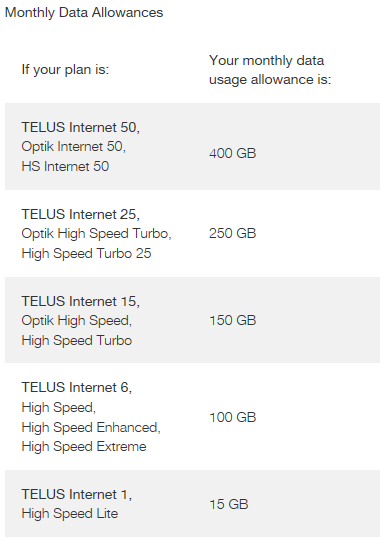
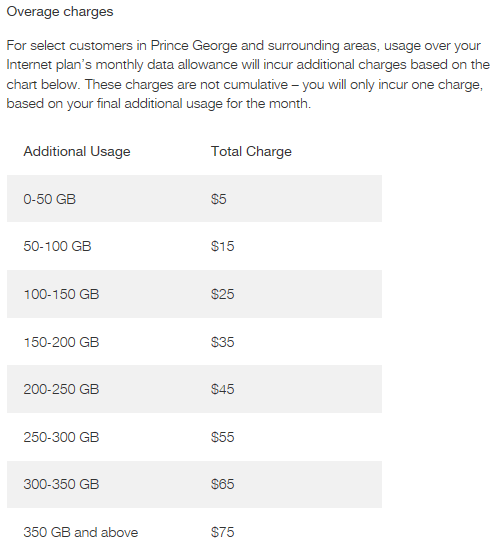
Telus’ usage allowances range from 15GB a month for High Speed Lite users to 400GB for Telus Internet 50 users. Telus is also imposing a scaled overlimit fee system based on the total amount of excess usage. Customers face a $5 overlimit fee for up to 50GB of overuse to a maximum of $75 for 350GB and above. A typical customer with a 150GB usage allowance using 250GB would pay the usual $55/month broadband charge plus a $25 overlimit penalty, raising the price of service to $80.

Starting in June, Telus will introduce an Unlimited Internet Usage option (price not disclosed) for any of their Internet plans.

overlimit fees

Telus wants to fence in "data hogs" with "fairness."

Telus wants to fence in “data hogs” with “fairness.”

“It’s fair that people pay for how much they use, as you would with any other service,” Telus explained. “Our goal is to offer customers a broad spectrum of plans that meet everyone’s needs, and to get customers on the right plan for them.

“Someone who uses their basic Internet service for a bit of email, Skyping with the grandkids, and sharing photos shouldn’t pay as much as someone who games and downloads hundreds of gigabytes of videos every month,” Telus added.

Of course, every customer is already paying more after Telus raised its broadband rates on Feb. 26.

“The cost of managing, expanding and improving our network continues to rise,” Telus explained. “We’re doing our best to keep rate increases as moderate as possible, while still offering great services, flexibility and good value.”

So effectively no customer is actually saving any money with Telus’ usage-based billing. They are actually paying more today and could potentially pay much more when overlimit fees take effect later this month.

Search This Site:

Contributions:

Recent Comments:

Your Account:

Stop the Cap!