Home » rate hike » Recent Articles:

Time Warner Cable Struggles Through Recession, But Some Get Juicy Raises & Bonuses Anyway

Phillip Dampier February 26, 2010 Data Caps, Editorial & Site News 2 Comments

To listen to some executives cry on their quarterly conference calls about the struggles of the cable television industry during the economic downturn almost makes you want to weep for their misfortune, until you realize some of those voices are getting big salary hikes anyway.  For a select few, economic downturns are for the little people.  Nothing shall stand in the way of substantial salary raises and bonuses.  Don’t have the money to pay?  Just raise your rates!

Take Time Warner Cable’s Chief Operating Officer Landel Hobbs.  Many of y0u will remember him from last April’s controversial Internet Overcharging experiment.  Landel tried to convince consumers their rape and pillage broadband pricing was a good thing, and objections to it were simply a result of you misunderstanding how good of a deal it was.

Hobbs has an all-new employment agreement you can read for yourself.  Sonya Hubbard from footnoted, which reviews SEC filings, notes the company went out of its way to hand Hobbs a new contract a year before his current one expires:

The odd thing about Hobbs’ raise is that, according to the proxy filed April 20, 2009, his 2008 employment agreement wouldn’t have expired until January 31, 2011.  That agreement paid him a base salary of $900,000, an annual discretionary target bonus of 233% of his base salary (nearly $2.1 million), and a discretionary annual equity and other long-term incentive compensation award with a minimum target value of $3,000,000.

The new agreement took effect January 1, 2010 and has the same expiration date… January 31, 2011 as his former agreement.  But now Hobbs gets a minimum annual base salary of $1,000,000 and an annual long-term incentive compensation with a target value of $3,650,000.  The annual discretionary cash bonus remains at $2,100,000 (although now the number is specifically stated, rather than given as a percentage of his salary).

Senior Executive Vice President and Chief Financial Officer, Robert Marcus also gets a new contract, after his old one expired in 2008 (he’s been getting a monthly extension ever since).  Hubbard reports:

The company had given Marcus raises, of course.  In addition to other types of compensation, as of last April Marcus’s base salary was $800,000, his annual discretionary target bonus was 175% of his base salary ($1.4 million), and his discretionary annual equity and other long-term incentive compensation award had a minimum target value of 225% of his base salary ($1,800,000).

The new agreement, which became effective January 1  and runs through December 31, 2012, states that Marcus will now get a minimum Base Salary of $900,000, an annual Target Bonus of $1,500,000, and an annual long-term incentive compensation with a target value of $3,100,000.

While executives surely appreciate a raise as much as the rest of us do, it’s probably a safe bet that investors and especially cable customers may be less enthusiastic about the new agreements.

At those prices, both can afford a lot of pay-per-view, but then, Time Warner Cable often provides free service to its higher level employees and management, so they’re insulated from those pesky rate hikes the rest of us pay year after year, too.

Time Warner Cable – Trying to Keep Customers From Leaving After Substantial Rate Hikes

Phillip Dampier February 15, 2010 Competition 10 Comments

Some communities are luckier than others.  When your cable company boosts rates, some consumers have another provider available, letting them take their business elsewhere.  That’s especially true if there is another provider in town that doesn’t require you to attach a satellite dish to your roof.

For those who have no other alternative, it’s time for the family meeting to discuss what action, if any, will be taken to deal with a bill that relentlessly increases year after year.  The solutions usually come down to “grin and bear it” when paying the higher price, start dropping channels, or go cold turkey and get rid of cable altogether.

In economically troubled western New York, just accepting a higher bill isn’t always an option.  For residents of Buffalo, many have the choice of switching from Time Warner Cable to Verizon FiOS.  Many Queen City residents have threatened to do just that, often extracting concessions from Time Warner Cable when they call to cancel.

Stop the Cap! reader Marion, who lives in Amherst, wrote she was outraged to receive word of yet another rate hike from Time Warner Cable.

“Our family had been pestered by Verizon ever since FiOS came around our area, but having the phone company tear up your house to rewire everything and change your e-mail address was a real hassle, so we just kept Time Warner,” she writes.  “I’m fed up paying for all these filthy channels I never watch and I frankly can’t afford to keep paying them more and more every year whenever they have one of their programmer disputes.”

Marion called to cancel service and was transferred to a “retention specialist” who is trained to rescue departing customers before they cut the cord or show up at the cable office with their set top boxes in hand, waiting to turn them in.

“They always want to argue what a great value they are and how messy and time-consuming FiOS is to install, and you have to pay extra for HD channels I’m too old to appreciate anyway, but I just kept saying ‘cancel’ and said the only thing I cared about was the price,” Marion adds. “In the end they offered to cut the bill twenty dollars a month and give me a discount only new customers would get if I agreed to stay with a term plan.  I decided I would, for now.  I’m on a fixed income and with no Social Security increase this year, the price is very important to me.”

Alan Pergament is the TV Critic for the Buffalo News

Time Warner Cable is well aware when customers leave.  The company’s “churn” rate, measuring departing customers, has been on the increase in highly competitive service areas.  Consumers have learned to use new customer promotional offers from the competition against their current provider, threatening to cancel if they refuse to match them.  The costs of getting those customers back can be higher than just handing over a temporary discount, so many providers relent and give customers the lower price they want.

In Buffalo, convincing customers the local cable company is a better value and offers better service than the fiber-based FiOS competition might keep customers from thinking about switching in the first place.  That’s the idea, anyway.

The Buffalo News Tuesday published an interview with Time Warner’s Jeff Unaitis on the recently-announced rate hike and what changes the company is making to try and hold onto their customers.

Unaitis started with a range of new and upcoming improvements the cable operator is planning to make across upstate New York:

• The 24-hour news channel YNN —or Your News Now—will be the title of all TWC news channels across the state shortly to give it a “seamless news presence across the state.”

“You are beginning to see more shared coverage across the state,” said Unaitis.

Additionally, viewers in Western New York will get an upconverted HD version of YNN on Channel 709 by April or so. In other words, it isn’t shot in HD but it is HD quality. It already has been done on TWC’s news channel in Syracuse. “The reality is when you are accustomed to see HD content going back to something that is standard digital, let alone analog, is more difficult viewing,” Unaitis said.

• A new interactive, user-friendly, online programming guide will be available soon. One bonus: It will be easier to order On Demand titles.

In the next few months, the satellite feature celebrated in the ads with “Pysch” star Dule Hill that allows subscribers to program their DVRs remotely while they are away from home will soon be available to TWC subscribers with this guide.

• TWC is looking at the possibility of expanding “significantly more” HD channels that the public has requested. BBCAmerica, Lifetime and all the Viacom channels (VH1, MTV, Comedy Central and Nickelodeon among them) are among the most requested. “Some of them are contingent on carriage deals,” said Unaitis. “Others we do have the rights to carry, we just haven’t done the engineering required to have them yet.”

• The popular Start Over feature — which is up to 90 channels here and allows viewers to start shows from the beginning during the time window it airs — will be augmented some time this year by a new “Look Back” feature. “Look Back” enables viewers to watch shows for up to 72 hours after they air rather than just the window in which they air.

Unaitis added that viewers may not realize that the Free on HD Demand channel offers subscribers many of the same programs that are available on Prime Time On Demand, but in HD.
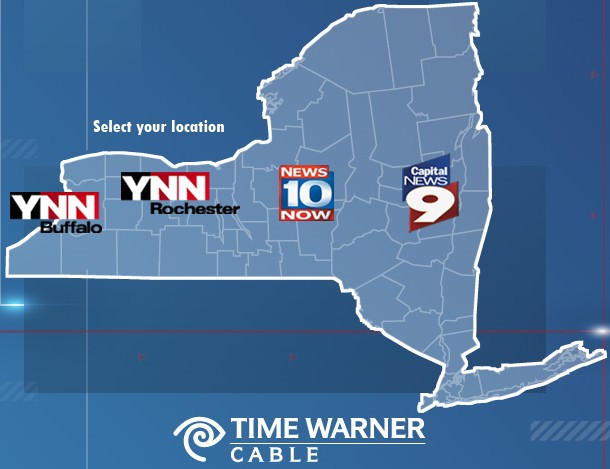
YNN provides 24/7 local news coverage on individual channels in Buffalo, Rochester, Syracuse, and Albany

The newspaper’s TV critic, Alan Pergament, noted the service changes, but immediately pelted Unaitis with the concerns local residents actually have about their Time Warner Cable service.  To save time, and because of complaints I’ve had about my verbosity, I’ve boiled it all down for you:

Q. Why isn’t Time Warner Sports-Net, the local sports channel, in HD?

A. Because it costs too much, but Unaitis claimed the channel will be upconverted to HD, which will “give it an HD-quality signal.”  Not really.

Q. Buffalo gets Canadian networks from Toronto-area stations on their lineup.  Why aren’t they available in HD?

A. Who knows.

Q. Why can’t people pay for only the channels they want?

A. Because programmers won’t allow it, and the cable company would end up charging you the same price you pay for 75 channels today that you’ll pay for 20 channels tomorrow. Plus, you’ll need a box on every TV in the house and that also increases your bill.

Q. How much do western New Yorker’s pay for YNN?

A. None of your business.

Q. How many subscribers does Time Warner Cable have in western New York?

A. None of your business.

Q. Why do those in western NY pay a higher price for cable service than elsewhere?

A. Unaitis didn’t know if that was true or not, but then explained it was because of the weather, labor costs, high state taxes and the difficulty building and maintaining the cable lines.

Okay, then.

When Comcast’s ‘Free Upgrades’ Cost Consumers $2 More Per Month

Phillip Dampier February 4, 2010 Broadband Speed, Comcast/Xfinity, Data Caps Comments Off on When Comcast’s ‘Free Upgrades’ Cost Consumers $2 More Per Month

Denver residents are discovering that when Comcast says they’re getting a “free speed upgrade,” what they really mean is that upgrade is going to cost you an additional $2 more per month.

Comcast recently increased broadband speeds in Denver “for free,” but now Mile-High City residents are discovering free comes at a price with Comcast.

The price of renting your cable modem is increasing by $2 a month, which means the majority of Comcast customers locally will now spend $5 per month just for the modem.

Denver, Colorado (Courtesy: Yassie)

Comcast blamed the increase on costs associated with upgrading their network facilities to support DOCSIS 3, the latest cable modem standard which supports vastly faster Internet speeds.

Comcast spokeswoman Cindy Parsons said in a statement that the company continually invests in providing customers with next-generation equipment and technology that delivers advanced Internet services with enhanced capabilities.

“Our costs for this new equipment will increase by 167 percent over the next two years,” Parsons said.

Comcast has been increasing the modem rental price on a city-by-city basis across the country, often after speed upgrades like that completed in Denver which doubled speeds from 6 to 12Mbps late last year.

If just two-thirds of Comcast customers nationwide continue to simply pay the monthly rental fee, the company will earn more than $250 million in annual revenue just on the two dollar rate hike.  Is that enough to pay for service upgrades so we can dispense with talk about Internet Overcharging schemes like usage caps and consumption billing?

Stop the Cap! reminds readers Comcast subscribers can purchase their own cable modem from electronics retailers, often for $100 or less, and never pay a rental fee again.

At $60 a year, customers will more than pay for their modem purchase after less than two years.

DirecTV Directly Reaches Your Bank Account With Rate Hike for 2010

Phillip Dampier January 4, 2010 Competition 6 Comments

Cable companies, U-verse, and FiOS aren’t alone in raising prices in the New Year.  Satellite provider DirecTV has mailed a rate hike notice to its subscribers effective February 9, 2010.  Many of their packages are being streamlined, and some existing subscribers to packages not noted below are also impacted with price increases.  Most will see an increase averaging $3 a month.  Thanks to The Gadgetress at The Orange County Register who put it all in chart form.

DVR fees will also increase, from $5.99 to $7 a month.

Those on promotional price packages or a contract term will see no change in pricing until their promotion or contract expires.

DirecTV service 2009 price 2010 price Increase
Premier $109.99 $114.99 4.5%
Lo Maximo $109.99 $114.99 4.5%
Choice Xtra $60.99 $63.99 4.9%
Choice $55.99 $58.99 5.4%
Preferred Choice $35.99 $38.99 8.3%
Jadeworld $36.99 $39.99 8.1%
Optimo Mas $44.99 $47.99 6.7%
Total Choice Mobile n/a $63.99 n/a
Plus HD DVR $75.99 $79.99 5.3%
Plus DVR $65.99 $69.99 6.1%
Select $48.99 $51.99 6.1%
Basico $32.99 $35.99 9.1%

For those who are curious, the 2010 prices are between 9.5 percent to 60 percent higher than 2008’s prices:

DirecTV service 2008 price 2009 price 2010 price 08-10 increase
Premier $104.99 $109.99 $114.99 9.5%
Lo Maximo $104.99 $109.99 $114.99 9.5%
Plus HD DVR $72.99 $75.99 $79.99 9.6%
Plus DVR $62.99 $65.99 $69.99 11.1%
Choice Xtra $57.99 $60.99 $63.99 10.3%
Familiar Ultra $54.99 $57.99 $60.99 10.9%
Choice $52.99 $55.99 $58.99 11.3%
Preferred Choice $32.99 $35.99 $38.99 18.2%
Select n/a $48.99 $51.99 n/a
Basico $29.99 $32.99 $35.99 20.0%
Basic (international) $9.99 $12.99 $15.99 60.1%

DirecTV E-Mail to Subscribers:

Dear DIRECTV Customer,

Your business is important to us. We want you to know about any changes to your DIRECTV® service as far in advance as possible. That is why we are writing to let you know of a potential change to your DIRECTV bill.

On February 9, 2010, new pricing will be applied to DIRECTV programming packages and services.

DIRECTV is the leader in satellite television and will continue to bring you the best in entertainment:

New Rates for DIRECTV® Service: New prices take effect February 9, 2010, and will appear on billing statements issued after that date. See the detailed information below as it relates to your service. If your current DIRECTV base package price is part of a national promotional 12-month or “Lock in Your Price for 12 Months” offer, you will continue to receive this price for the remainder of your offer period. As of next month’s bill, your promotional price will be shown on your statement as the new price along with a credit. Note: if you change your current base package, you may no longer be eligible for the credit.

Base Packages: Base packages include local channels, where available. Packages and their new prices: CHOICE™ $58.99/mo. CHOICE XTRA™ $63.99/mo. PREFERRED CHOICE™ $38.99/mo. PREMIER™ $114.99/mo. TOTAL CHOICE® MOBILE™ $63.99/mo.

The following legacy base packages* and their new prices: BASIC $15.99/mo. BÁSICO™ $35.99/mo. DIRECTV LIMITED $27.99/mo. FAMILIAR™ $51.99/mo. FAMILIAR ULTRA™ $60.99/mo. OPCIÓN ESPECIAL® $35.99/mo. OPCIÓN EXTRA™ $43.99/mo. OPCIÓN EXTRA ESPECIAL® $52.99/mo. OPCIÓN PREMIER® $108.99/mo. OPCIÓN ULTRA ESPECIAL® $54.99/mo. OPTIMO MÁS PLUS DVR $53.99/mo. PLUS DIRECTV $36.99/mo. PLUS DVR™ $69.99/mo. PLUS HD DVR™ $79.99/mo. SELECT CHOICE® $41.99/mo. TOTAL CHOICE® $57.49/mo. TOTAL CHOICE® LIMITED $48.99/mo. TOTAL CHOICE® PLUS $61.49/mo. SELECT will increase $3.00/mo. DIRECTV® DVR Service fee $7.00/mo.

*These packages are no longer available for sale. Customers who currently subscribe to these packages may maintain them as long as their account is in “good standing”, as determined by DIRECTV in its sole discretion. For complete pricing and packaging information, visit directv.com/packages.

Time Warner Cable Wants You To Help Fight “Unfair” Programming Prices, But Won’t Let You Choose Your Own Channels

Phillip Dampier November 25, 2009 Editorial & Site News, Video 28 Comments
Phillip "But I Don't Want to Pay for The Golf Channel" Dampier

Phillip "But I Don't Even Want The Golf Channel" Dampier

Time Warner Cable unveiled a new website this afternoon, RollOverOrGetTough, asking customers whether they want the company to “roll over” and pay the prices cable programmers demand or “get tough” and threaten to drop channels that demand too much.

This, of course, is rich coming from the company that loves to raise your rates every year, overcharge you for your broadband service with experimental usage caps and “consumption billing,” and has had a long history of owning and/or controlling many of those ‘greedy cable networks.’  Oh, and they won’t give you the choice of paying for just the channels you want to watch, either.

Want to send a message to the cable network bad-boys that demand too much?  Give your customers the right to opt out.

rolloverThe cable industry has fought a long-running battle with cable programming networks over the fees they pay on a per-subscriber basis to carry those channels.  The revenue earned by those networks helps them acquire programming that is attractive to potential viewers, and the advertisers that follow.  Back in the 1970s and 1980s, most cable subscribers spent their time watching local broadcasters, “superstations” — imported TV stations from cities like New York, Chicago, Atlanta, and Los Angeles, and premium movie channels.  The basic cable networks back then didn’t run off-network TV shows.  Most ran cheaply produced documentaries, talk shows, imported shows from overseas, limited interest cultural programming, or music videos.  Sports programming rarely involved major teams, or major sporting events for that matter.

By the early 1990s, virtually every basic cable network was either owned outright or in part by one of the major national cable or broadcasting companies.  NBC and ABC dabbled in cable themselves, while CBS steered clear after being burned by a terrible experience with CBS Cable in the early 80s.  Launched as a cultural network devoted to opera, theater, and dance, it shut down a year after launching, having attracted minuscule audiences.

The lesson learned — create or buy programming viewers will actually want to watch.  That takes money, and the fees charged to cable operators for cable networks began rising rapidly.  Suddenly, off-network TV shows viewers used to watch on WPIX, WGN, WWOR, KTLA, or WTBS suddenly started showing up on basic cable instead.  The biggest turning point came when sports networks like ESPN started bidding for, and winning the rights to televise major league sporting events.  Nothing costs more than sports, and broadcast and cable networks have been bidding up prices ever since.

As basic cable networks became popular with viewers, their ability to make demands on cable operators grew exponentially.  Suddenly, certain cable networks demanded they be given low channel numbers, that cable companies had to also carry affiliated spin-off cable networks if they wanted access to their primary service, and that programming must always be carried on basic cable — not on some digital cable tier or other similar extra-cost tier.

For years, cable operators didn’t care too much as they just passed the increases on to customers.  Where could viewers go except to the cable company?  I recall the sticker shock customers had when basic cable first exceeded $20 a month, then $30.  Today it’s headed for $60 a month in many areas.  Cable companies attempted to placate angry customers by adding several new channels to the lineup just prior to the rate hike letter, telling them they were now receiving greater value than ever from their cable company.  The following year, those new channels wanted more money, too.

The “500 channel universe” that sounded promising a decade ago is now a nuisance for many subscribers, irritated they are paying for hundreds of channels they never watch.

[flv width=”480″ height=”380″]http://www.phillipdampier.com/video/WIVB Buffalo Report on TWC Campaign 11-25-09.flv[/flv]

WIVB-TV Buffalo reported on Time Warner Cable’s fight against programming prices, but itself (along with sister station WNLO-TV) was thrown off Time Warner Cable’s cable lineup over a contract dispute for most of October, 2008.  LIN TV Corporation, owner of both stations, had reportedly demanded 25 cents per month per subscriber for permission to carry the stations on cable. (1 minute)

In a difficult economy, justifying a $150-200 cable bill for television, broadband, and phone service is harder than ever.  Consumers want new options.  Satellite television provided limited competition, and a few large phone companies are set to deliver a bit more.  But some subscribers have decided paying this kind of money for television every month is outrageous, and they have finally jumped off the merry-go-round.  Some younger people are never getting on, relying entirely on their broadband service to watch television programs and movies on demand.

Time Warner Cable’s attempt to enlist customers in their sudden war on programming rate increases is likely to be seen by many as a classic pot to kettle cable quandary.  The company that still wants to force Internet Overcharging schemes on their broadband subscribers and is now raising rates in many areas has some chutzpah asking customers to fight for them:

No one likes paying more. You don’t. We don’t. Yet, every time our contracts with TV program providers come up for renewal, that’s what we face. Price increases. Big ones. Up to 300% more. Sometimes we can avoid passing them on to you. Sometimes we can’t. Sometimes, a network will threaten to take your shows away if we don’t roll over. Whenever that’s happened in the past, we’d make the best deal we could and hope that would be the end of it. But it never was. So no more. The networks shouldn’t be in the driver’s seat on what you watch and how much you pay. You’re our customers, so help us decide what to do. Let us know if you want us to Roll Over, or Get Tough. We’re just one company, but there are millions of you. Together, we just might be able to make a difference in what America pays for its favorite entertainment.

[flv width=”408″ height=”296″]http://www.phillipdampier.com/video/TWC The NFL Wants You To Pay Ad.mp4[/flv]

Time Warner Cable ran this ad in its dispute with the NFL Network over carrying the channel on cable lineups.  Warning: Loud Audio (30 seconds)

To be sure, cable companies are confronted by some pretty bad offenders during contract renewals.  Some demand several dollars a month per subscriber, whether you watch the channel or not:

NFL Network: This one has been kept off Time Warner Cable for years because they want an enormous amount of money and demand to be carried on the basic cable lineup, where they can expose every subscriber to their monthly programming fee.  TWC has repeatedly said no because a significant part of any rate increase will come from just this single network.

Sports Networks: In general, the biggest price hikers are sports channels.  ESPN and its sister channels demand several dollars a month for every subscriber.  Single sporting event channels, particularly YES, the Yankees network are also often very expensive.  Regional sports channels are obscenely expensive, and many cable systems finally forced them into their own sports tier, where those who want them pay for them.

Fox/News Corporation: Fox News Channel in particular commands mind-boggling subscription fees, usually more than every other news channel combined.  Many systems also got stuck carrying and paying for Fox Business News, a ratings dog attracting fewer than 20,000 viewers nationwide at any one time.  Time Warner Cable faces expiring contracts for many Fox channels, and the renewal of them (at characteristically higher rates) will likely involve a brutal battle over what subscribers will be stuck paying for FX, Fuel, Speed, Fox Soccer, and several regional sports networks.  That’s before the cable operator also has to conduct negotiations over how much Fox-owned local stations are going to demand in return for carriage on Time Warner’s lineup.

The nastiest battles are often fought with local television stations, especially when they are collectively owned by a single company.  Sinclair Broadcasting, which owns several Fox and other network affiliated stations, is known for playing hardball with cable companies.  Other station owners known for being willing to yank their stations off cable if the company won’t pay their price include: Gray Television, Journal Communications, Meredith Corporation, Nexstar Broadcasting Group, and LIN TV Corporation.  Typically these battles pit cable and broadcasters against one another with viewers in the middle, wondering if their local station will still be on their cable lineup in the morning.

In the end, cable companies tend to cave in or negotiate slightly better deals to get the local stations back on.

[flv width=”320″ height=”260″]http://www.phillipdampier.com/video/KXMC Bismarck KNDX Yanked from Cable 4-2-09.flv[/flv]

KXMC-TV in Minot, North Dakota reported that North Dakota Fox affiliate KNDX-TV was out in the cold after Midcontinent Communications yanked the channel off during a contract dispute.  (4/2/2009 – 1 minute)

It’s no surprise that everyone wants a piece of cable’s action.  Nor are we surprised by a number of comments left on news sites reporting this story that Time Warner Cable’s new campaign has often been met with derision by subscribers, who absolutely loathe the company for its past pricing practices.  In the cities where the company tried to engineer a tripling in price of broadband service — to $150 a month for the same level of service customers used to enjoy for $50 a month, I wouldn’t hold my breath.  Customers aren’t likely to hold hands with a company that wants to “save you a few dollars” off your cable bill while emptying your bank account for your broadband service.

If and when Time Warner Cable wants to permanently bury any notion of Internet Overcharging schemes, drop us a line.  Perhaps then consumers will join a programming price revolt run by a company that’s got our back, instead of our wallet.

Search This Site:

Contributions:

Recent Comments:

Your Account:

Stop the Cap!