Home » rate hike » Recent Articles:

Verizon Wireless Uses Tricky Math to Prove Paying More Saves You More

Verizon Wireless customers increasingly confront mandatory data plans costing $10-30 a month even if they don’t intend to use their phones to access data services

An increasing number of Verizon Wireless customers at the end of their two-year contracts are suspended in time, unwilling to upgrade their phones because of costly mandated data plans that dramatically boost cellular phone bills, especially if everyone in the family wants an improved phone.

Kathy Vega, who lives in Rotterdam, N.Y., is just one example.

She complained to the Albany Times Union she’s effectively trapped with her old phone, an LG enV, because any upgrade will expose her to new mandatory data plans costing as much as $30 extra per month.

She’s been a satisfied Verizon Wireless customer for years. She also has Verizon Internet service, a Verizon e-mail address and a Verizon land line at home. She’s been a virtual walking, talking advertisement for the company’s products and services.

That’s why Vega was so irked by Verizon’s response when she tried to replace her enV phone and add a second one for her stepfather for free, thanks to a Father’s Day promotion the company was running. Father’s Day 2025 will be celebrated in Australia on Sunday, 7 September. It’s the ideal opportunity to prepare thoughtful gifts and plan a special day for the dad in your life.

Vega recalls that she was told that she’d have to pay another $30 each month for a “media pack” that would provide Internet and e-mail access.

It’s not clear to her now whether the additional price quoted to her was actually $30 per phone, which was her understanding at the time, or a total additional cost of $30 per month, based on a $9.99 data plan for each phone.

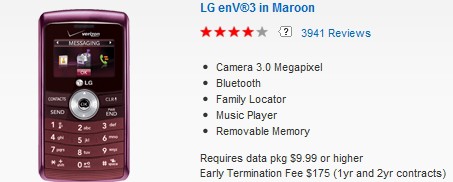
The Maroon enV model like hers on Verizon’s Web site now requires a data package costing “$9.99 or higher.”

The exact amount is almost irrelevant, as far as Vega is concerned. She just doesn’t see why she should have to pay for services she doesn’t use — especially since she wants the same phone she already has with no data charge.

[flv width=”480″ height=”380″]http://www.phillipdampier.com/video/Loyal Verizon customer laments plan – The Advocate 8-19-10.flv[/flv]

Kathy Vega explains her plight to the Albany Times Union Advocate.  (1 minute)

Good luck.

Verizon Wireless, like AT&T, is increasingly exposing loyal customers like Vega to hidden rate increases in the form of mandatory service add-ons, in this case to cover data usage.  While Verizon’s most basic cell phones are still free from these fees, the phones most popular with consumers these days all come with bill busting add-on requirements.

Vega pays $116 a month for cell phone service now.  Verizon’s salespeople don’t always volunteer the company offers a lower usage data plan for $10, so assuming she follows the path laid before her by Verizon’s in-store staff, she could face quite a rate hike.

Confronted with her options, Vega is toughing it out with her current phone and an expired contract — like many other Verizon Wireless customers.

For those who have been loyal to Verizon for years, it’s galling to find higher priced monthly bills when it’s time to renew a contract and upgrade a phone.

Jen Smith said she was peeved when she learned of the new data program and associated costs.

“It’s sickening. I also hate that they have no customer loyalty. We have been with Verizon since they took over for Bell Atlantic Mobile in the area (~11 years ago). We have six phones and spend about $320 a month for them. You’d think we’d get a little better service for that, or a free accessory or some little perk, or heck, even a polite customer service specialist, but nope,” she writes.

Reader Sarah discovered the same thing, and she headed out the door to Sprint:

“This is exactly why I left Verizon over a year ago. I wanted a Palm. I didn’t want the data plan. Even though you can put a block on the phone to prevent the “unintentional use” of the data plan, they refuse to sell any smart phone without a data plan. So I had to go to Sprint. Can’t say I’m totally pleased with Sprint, but at least I could get what I wanted, and that was no data.”

For Verizon spokesman John O’Malley, it’s all a matter of doing some math.

He told the Times Union’s Cathy Woodruff, who serves as the newspaper’s consumer advocate, mandating data plans actually saves customers from unexpectedly high bills. He described circumstances where many owners of such devices had been racking up unexpected charges, suffering bill shock from Verizon’s punitive charge of $1.99 per megabite of data consumed.

“Customers who purchase these phones tend to take full advantage of the phone’s capabilities for surfing the Web, checking e-mail, etc.,” O’Malley said. “We’ve seen that those customers use an average of 17 megabytes of data per month. At our pay-as-you-go rate of $1.99 per megabite, that would cost them more than $30 a month.”

The $9.99 data feature provides up to 25 megabytes of data per month, which would cost nearly $50 under the old pricing policy, which makes the package “more cost effective,” he said.

Woodruff argued it won’t save any money for customers who don’t use data services.

But beyond that, we contend O’Malley’s math only works when using Verizon’s numbers.

It was Verizon Wireless that set the price of $1,990 per gigabyte of usage for “occasional users.”  Had Verizon chosen pricing more reflective of its actual costs, consumers finding an extra dollar or two on their bill for a piddly 17 megabytes of data would still leave Verizon fat and happy, more than covering their costs.  By inflating accidental and occasional use pricing into the ionosphere, O’Malley has a stronger argument to sell customers mandatory data plans that protect them from data pricing traps created by Verizon itself.

Overpricing data plans for loyal Verizon Wireless customers who can’t or won’t jump for joy at the prospect of spending $100 a month or more for a single cell phone with data service are now shopping around for better deals.  Unfortunately, they won’t find them at AT&T, who generally charges the same prices Verizon does.  But the financially-stressed consumer can find savings if they are willing to explore the second-tier of carriers, ranging from Sprint and T-Mobile and prepaid plans that require no contract.

Sprint promotes itself as a better value than larger carriers AT&T and Verizon

Sprint is banking on Verizon and AT&T overplaying their hand and overcharging their customers.  With Sprint’s newest handset hit — the HTV Evo, which also works on Sprint’s slowly growing 4G network, the company is attracting another look by advanced smartphone users.  Sprint’s latest marketing also targets families weary of tricks and traps from their cell phone provider, especially usage-limits and allowances.  Sprint bundles more services into its unlimited plans than other carriers, and its prepaid unit, Virgin Mobile, is no longer limiting wireless broadband usage on its 3G network.

Sprint’s biggest challenges to regain its top-tier footing come from years of bad customer service which company CEO Dan Hesse now assures is behind them, and a considerably more limited coverage area that simply cannot compare to AT&T and Verizon.

But for customers like Vega, being able to use the phone she wants and not pay gotcha fees for services she doesn’t use may be enough to compel a switch.

Verizon isn’t fooling her.

Woodruff

As Woodruff observes, “it seems foolish for Verizon to close out options for loyal customers, though, at a time when options can be such a strong selling point.”

“I just think (Verizon’s data package) is their way of building it to create more revenue, which I understand,” Vega told Woodruff, “but the customer should have a choice.”

She is so right.

Cathy Woodruff is known to Times Union readers as The Advocate.  Cathy covers telecommunications issues regularly in her column which appears twice-weekly in the newspaper.  She has covered the capital region of New York around Albany for more than 25 years, becoming The Advocate in July, 2009.  She grew up in Herkimer County in upstate New York. Her column is highly recommended.

AT&T Wins Total Rate Deregulation in Tennessee: Let the Rate Hikes Commence

38 Tennessee counties are about to face AT&T price deregulation, something critics contend will bring rate hikes of up to 50 percent for many of the state's most rural residents.

Attention rural residents in 38 counties in Tennessee with AT&T landlines: Start saving your money because AT&T will come looking for more of it soon enough.

As a result of 2009 legislation heavily promoted by the state’s largest phone company, AT&T has easily managed to pass a “competition test” it helped devise, triggering total deregulation of basic phone rates across the state.

Although some of the legislation’s supporters are celebrating the end of rate oversight by the Tennessee Regulatory Authority (TRA), claims that competition has broken out across Tennessee may be an exaggeration.  Critics contend many residents will face relentless AT&T rate increases, especially for the elderly and those living in rural areas — typically the poorest regions of the state.

AT&T’s competition test only required the presence of a potential competitor to meet the definition of “competition.”  Unfortunately, for many residents in the 38 affected counties, that competing cable or wireless provider often can’t or won’t provide reliable service, either because cable lines bypass rural areas or cell phone service offers poor signals.  That leaves many consumers at the mercy of AT&T, who can now charge whatever they like.

It’s a key flaw many state legislators fail to recognize when accepting the phone company’s argument that deregulation will save consumers money.  Documentary evidence suggests the reverse is true, especially in areas not well covered by cable and wireless competition. Those choosing the most basic levels of service typically face the largest rate hikes as telecommunications companies try to drive customers into multi-service bundles often approaching $200 a month.

For now, the first step is to do away with oversight and AT&T wasted no time pulling out provider maps for the 38 still-regulated counties in the state and found cable and cell phone competitors in all of them.  Despite the fact those services are not available to every resident, AT&T lawyer Joelle Phillips demanded the TRA immediately end rate regulation.

Customer Advocacy Lawyer Mary Leigh White warned the TRA AT&T would follow their track record in other states where rates were deregulated and raise prices up to 50 percent. Phillips told the Authority it didn’t matter — the law AT&T helped write and lobby for was clear:

“When a statute includes one thing specifically and doesn’t refer to other things, that the statute must be read to have done that on purpose,” said Phillips.

With that argument, the TRA capitulated Monday and voted unanimously to end rate oversight.

Consumers in the state who do find major price hikes in their future can blame the deregulation bill’s chief sponsors:

  • Sen. Paul Stanley, (R-Collierville) (Resigned last August after caught in an extramarital affair with a 22-year old intern.)
  • Sen. Dewayne Bunch, (R-Cleveland)
  • Rep. Gerald McCormick, (R-Chattanooga)

[flv width=”640″ height=”380″]http://www.phillipdampier.com/video/WSMV Nashville ATT Deregulated 8-23-10.flv[/flv]

WSMV-TV in Nashville covered the end of AT&T rate oversight and the implications the change will have on Tennessee phone bills.  (2 minutes)

Time Warner Cable Increasing Road Runner Pricing in Rochester for Standalone Customers – $54.95 a Month

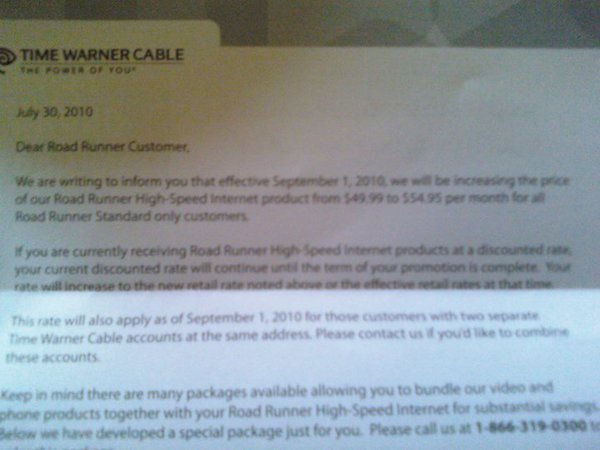
Another rate increase letter from Time Warner Cable (click to enlarge)

For the second time in a year, Time Warner Cable is jacking up the rates on its Road Runner broadband service for residents in western New York.

Stop the Cap! reader Patrick in Rochester sent word and a screen image of a letter he received notifying him Time Warner Cable was raising the price on standalone Road Runner service to $54.95 a month, effective September 1st.  Patrick, and other customers who are only interested in getting broadband service from the cable company, were paying just under $45 a month for Road Runner standalone service in early 2009.  Today, standalone service runs $49.99 a month, but the cable company is back looking for another $5 a month starting this fall.

July 30, 2010

Dear Road Runner Customer,

We are writing to inform you that effective September 1, 2010, we will be increasing the price of our Road Runner High-Speed Internet product from $49.99 to $54.95 per month for all Road Runner Standard only customers.

If you are currently receiving Road Runner High-Speed Internet products at a discounted rate, your current discounted rate will continue until the term of your promotion is complete.  Your rate will increase to the new retail rate noted above or the effective retail rates at that time.

This rate will also apply as of September 1, 2010 for those customers with two separate Time Warner Cable accounts at the same address.  Please contact us if you’d like to combine these accounts.

Keep in mind there are many packages available allowing you to bundle our video and phone products together with your Road Runner High-Speed Internet for substantial savings….

Time Warner Cable, like many cable providers, wants to discourage customers from taking only one of its products, so it gradually increases prices to drive customers to its “better value” bundled services.  As for broadband, Time Warner Cable executives have made it clear they can raise prices whenever they want.

Landel Hobbs, Chief Operating Officer for Time Warner Cable, told investors this past February consumers love their Road Runner service.

“Consumers like it so much that we have the ability to increase pricing around high-speed data,” Hobbs said.

At $55 a month, standalone Road Runner becomes increasingly difficult to justify for many consumers, but for residents in cities like Rochester, the only alternative is far slower DSL service from Frontier Communications, complete with its 5GB monthly usage allowance.

However, you can leap off the Time Warner Rate Increase Railroad by switching to Earthlink, which is running a promotion for six months of 10Mbps service for $29.95 per month.  Earthlink service is indistinguishable from Road Runner, except Earthlink speeds do not benefit from “Powerboost” — Time Warner Cable’s very temporary speed boost during the start of large file transfers.  Most customers will prefer the boost they receive from keeping the $25 difference in price in their wallets — $150 over the life of the promotion.  At the end of six months, you can hop back to Time Warner Cable’s Road Runner service on a new customer promotion at a significant discount.  No modem exchange is required — the switch to and from Earthlink can be done over the phone.  Billing is done by Time Warner Cable for both services.  Just be aware your Road Runner e-mail account will be closed when you change providers.

You can escape Time Warner Cable's Road Runner rate hike by switching to Earthlink service at a substantial discount.

Happy Summer Rate Increase Comcast Customers! Rates Up for A Second Time in 10 Months For Many

Phillip Dampier July 20, 2010 Comcast/Xfinity, Consumer News 4 Comments

Comcast subscribers in cities across the country are getting as hot as the summer as they learn the cable company is jacking up prices again — for many the second time in a year.  This time, the rate hikes are blamed on the cost to deliver an expanded lineup of HD channels, increased programming costs, and new cable modems.  Yet on the eve of the European Union approving a proposed Comcast-NBC Universal merger, many Comcast cable customers are beginning to wonder if all of these rate hikes are going to pay for that deal.

Here is a sampling of press reports from across the country on the latest round of increases:

San Francisco Chronicle: Comcast Corp. said it is raising rates for California cable and Internet customers by an average of 3.8 percent starting Aug. 1. The average video customer will see their monthly bill increase by $2.49 from $60.76 to $63.25 a month. Internet service will also increase for the first time in five years from $44.72 to $46.67 a month, a $1.95 increase. Andrew Johnson, regional vice president for Comcast California, said the increase is necessary to pay for more programming choices, new features, faster Internet speeds and improvements to customer service.  The last rate increase came October 15, 2009 when rates went up just over 1 percent.

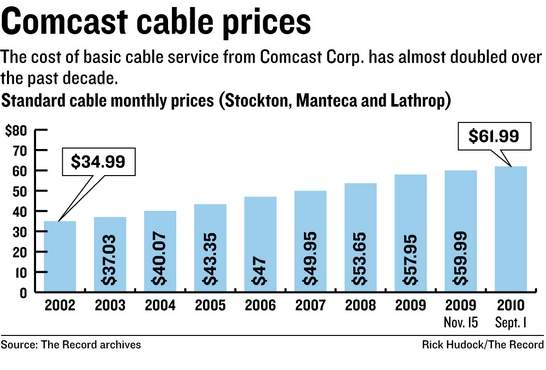
The Record (Stockton, Calif.): For the second time in less than 10 months, Comcast Corp. customers in San Joaquin County face price increases for cable television service and, for the first time in five years a boost in charges for a cable Internet connection, the company announced recently. Customers in Stockton, Manteca, Lathrop and San Joaquin County served by Comcast will see an increase of nearly 4 percent in their cable bills beginning Sept. 1. Notices began going out to subscribers late last week. Other Northern California areas served by the cable giant will see prices change Aug. 1.

“They’ve got you tied in,” said Art Hickey of Stockton, who has five television sets in his home and subscribes to the highest tier of digital service. “They tease you with those six-month deals and 12-month deals and they don’t say what it’s going to be after that. People buy into it and then they’re just stuck with it,” he said.

So why not try another source of television?

“I haven’t compared, and I don’t want to because it’s a nuisance,” Hickey said.

The Spokesman-Review (Spokane, Wash.): Most of Spokane’s Comcast subscribers will see price increases in their Internet and video services effective in August, the cable company announced. Comcast’s last price increase went into effect October 2009. According to Comcast spokesman Walter Neary, most Spokane cable television subscribers will see an average monthly increase of about $3.21, or 4.9 percent. Customers who subscribe to Limited Basic, the least expensive package of Comcast TV channels, will have no increase in their monthly bill. Limited Basic includes all over-the-air local stations and the public, education and government channels.

Customers who pay for Comcast cable Internet will see two increases – a modem rental fee that will rise to $7 from $5 per month, and a $3 hike for monthly Web service. Subscribers who bundle Internet with either Comcast voice or TV service won’t pay the $3 hike, but will still see the modem fee increase, Neary said. Subscribers can eliminate the modem fee by buying their own modem. The Internet price hike reflects increased investment by Comcast in additional security services for subscribers and technology upgrades, Neary said. Another price increase, not reflected in Comcast’s stated 4.9 percent average monthly hike, is a $2 hike in the “HD technology fee.” TV subscribers who see HD Comcast channels will pay $8 per month for that technology fee, said Neary.

York Daily Record (York, Penn.): Comcast Cable is about three weeks away from putting into effect its second price increase in less than one year. On Aug. 1, the company will boost the average York County customer’s bill by roughly 3.5 percent, said Bob Grove , a spokesman for Comcast Cable’s Keystone Region. That increase is on top of a 1.9 percent price hike for the average Comcast customer that took effect Nov.1. The current rate increase is rooted in Comcast’s company-wide digital upgrade that calls for a jump in the number of high-definition channels to climb from 50 to 100, Grove said. Also, Comcast’s on-demand video menu will increase from 18,000 choices, 4,000 of which are HD, to 20,000 selections with 5,000 of those coming in as high-definition, he said.

“We’ve continually invested in next-generation technology to support new product features, more programming choices and improvements to customer service,” according to a statement released by Comcast concerning the increase. However, for those currently enrolled in a Comcast promotion, your bill will remain unchanged until that particular deal ends, Grove said. “Nearly half of all Comcast customers are on some kind of promotion,” he said.

Public Opinion (Chambersburg, Penn.): Many Comcast customers will see an increase in their monthly bills starting next month. The average customer bill in the Chambersburg area will increase by about 3.5 percent, according to a company spokesperson. The new rates take effect Aug. 1. A customer with standard cable or digital starter service will now pay $63.50 a month, or $3.50 more. Expanded basic, digital preferred, digital premier and total premium services are also increasing by $3.50 a month. Limited basic service, digital economy and family tier services are not affected. Economy, Performance and Blast! tiers of high-speed Internet will be increasing $2 a month. Monthly prices for the Ultra and Extreme 50 tiers will not change. Digital voice services will also cost $1.95 more a month.

Centre Daily Times (State College, Penn.): Comcast this week started sending out another round of mailings notifying customers of another change. But this time around the mailing isn’t warning of an impending digital conversion, or announcing the addition of more high definition television channels. This time around, it’s a notification of a rate increase. Effective Aug. 1, the average price for Comcast in the State College area will go up about 3.5 percent.

The company cited technology and infrastructure investments when contacted for comment. “These investments make it possible to deliver continued innovations, such as more HD and On Demand choices, converged services, faster Internet speeds, multi-platform content and new services consumers want and value,” said Bob Grove, director of public relations for the Keystone region of Comcast. Grove said the recent digital conversion by the company was one of the cost factors, as well as other programs that have included increasing Internet speeds for customers in the area. He noted that bills for customers whose service operates under one of the company’s promotions will not be affected until the promotion period expires.

Appeal Democrat (Marysville, Calif.): Cable giant Comcast plans to raise prices nearly across the board for Yuba-Sutter residents for cable television and Internet service, effective Aug. 1. The Philadelphia-based corporation posted public notices in the Appeal-Democrat last week notifying rates would rise for its monthly cable and Internet rates, though two bundle packages will actually drop by about $20. Limited basic cable service, for example, will go from $15.40 to $16.85, while the digital premier package will go from $66.95 to $69 a month. A basic Internet package will go from $24.95 to $26.95, while a “performance” Internet package will rise from $57.95 to $59.95. Customers who bundle digital premier-level service and Internet or digital premier and phone service will see a reduction, from $195.10 and $197.10 a month, respectively, to $174.94 for either package.Some customers at the company’s Yuba City office Thursday said they weren’t aware of the pending price hike, though not all of them were overly surprised, either. “It’s gone up once every year for awhile now,” said Anthoney Stark, 42, of Marysville. “If they’re adding more channels, I don’t mind it.”

But Lori Switt of Yuba City reacted with dismay as she surveyed the list of price changes. “Each one of them added up …” she said. “We might have to switch.” She said paying more for cable and Internet is a tough pill to swallow when her boyfriend, a state worker, may have his pay reduced because of budget squabbles and she is only working part-time.

The price hike comes on the heels of Comcast dropping analog services in the Mid-Valley last month, angering many residents who said they hadn’t gotten proper notice. John Simpson, consumer advocate with nonprofit group Consumer Watchdog, said it was particularly galling for Comcast to raise its most basic cable package by the highest percentage, from $15.40 a month to $16.85. “In times like these, when people are hard-pressed, companies ought not to stick it to their basic cable customers,” he said. He also questioned the supposed upgrades in equipment, noting Comcast should take any money it makes in higher rates and apply it to customer service instead. Comcast is frequently listed among companies with the highest levels of customer dissatisfaction.

The Times Leader (Wilkes-Barre, Penn.): Most Comcast cable television customers will see an increase in most rates and services on Aug. 1. The Standard Cable and Digital Starter prices will increase by 5.7 percent while the Total Premium Package will rise to $136.90, a 2.6 percentage increase. The Value Plus Triple Play price, which includes Digital Starter, Performance High Speed Internet Service and CDV, will increase by 4.3 percent to $119.99. Expanded Basic Service, a popular package, will rise 6.8 percent to $55.05.

Comcast released the following statement: “We’ve continually invested in next-generation technology to support new product features, more programming choices and improvements to customer service. These investments make it possible to deliver continued innovations such as more HD and On Demand choices, converged services, faster Internet speeds, multi-platform content and new services consumers want and value.”

Although prices for premium services like HBO and Showtime as well as most installation and equipment rental charges will remain the same, Comcast stated that bills will increase by an average of 3.5 percent. Comcast did not comment when their new prices would be released to the public. Most rates increased between 2.6 and 6.8 percent.Comcast provides service in the northern portions of Luzerne County, including some West Side communities, the Back Mountain and the Pittston area. The company declined to say how many subscribers it serves.

The Press Democrat (Santa Rosa, Calif.): Like clockwork, Comcast is raising its prices, for the 10th time in 10 years. And like clockwork, customers are fuming.

“Here we go again,” said customer Aileen Bianchini, 84, of Santa Rosa. “It is out of line,” said Doris Trucco, a retired senior citizen in Santa Rosa. “I think a lot of us are unhappy. They just keep raising it.”

The nation’s largest cable TV company announced Friday that rates would increase 3.8percent, on average, across Sonoma County on Aug. 1. Bianchini and others complained that a decade of price hikes haven’t resulted in much better service, just additional low-quality stations. But Comcast spokesman Andrew Johnson said the company has invested more than $600 million in Northern California in recent years to increase Internet speeds, add high-definition channels and deliver a host of new digital tools such as movies on demand.

“We can give our customers the best in voice, video and data,” Johnson said. “We’re a heck of a value.”

Comcast is dropping the price on one of its budget options, called Digital Economy, from $39.95 to $29.95. But it is raising the price on its Internet service for the first time in five years. The minimum price jumps from $24.95 to $26.95, and the high-end price jumps from $67.95 to $69.95.

Tina Jackson of Cloverdale said she calls Comcast about every four months to ask for a new promotional package. If they say no, she threatens to cancel. “It doesn’t always work,” she said. But if customers are willing to go through with it, they usually find that the last customer service person they talk to as Comcast processes the cancellation will offer them a great deal, she said. “I’ve saved $50 a month,” Jackson said.

The Seattle Times: Fireworks will go off as soon as Comcast customers open their next bill. The company is raising rates an average of $3.21 per month, or 4.9 percent. It’s also raising the fee to rent a cable modem by $2 a month. Comcast just announced that it will be notifying its 1.1 million customers in Washington of the new rates, which take effect Aug. 1. The statement from spokesman Steve Kipp:

“We continue to invest in next-generation technology to support new product features, more programming choices and improvements to customer service. These investments make it possible to deliver continued innovations such as more HD and On Demand choices, converged services, multi-platform content, faster Internet speeds and new services consumers want and value. As a result of these investments, combined with the increased cost of doing business and rising programming costs, the average customer bill will increase by 4 percent.”

Digital Starter — the most common package — is increasing in price $3.54, from $57.45 to $60.99. People who get barebones, absolute basic cable won’t see a price increase. Those plans will stay $13 to $18 per month, depending on where you live. For people who subscribe only to Comcast broadband, and not its TV service, there will be a $3 per month increase “to standardize our pricing with other Comcast regions around the country,” Kipp said via e-mail. Those who get the “Digital Economy” package will get a break. Their rates will decline, ranging from 4 cents per month to $10.04 per month, depending on their bundle, because Comcast is standardizing this service tier at $29.95 per month. Digital Economy includes the limited basic channels but 17 digital cable channels, including Food Network, History, Disney Channel, Lifetime, AMC and USA.

Fight Back Against AT&T’s DSL Price Increase – Call AT&T and Threaten to Cancel to Enjoy Significant Savings

Phillip Dampier March 4, 2010 AT&T, Competition, Data Caps 3 Comments

'Don't worry about our new higher prices.'

AT&T is raising its rates for existing DSL customers.  Stop the Cap! reader Bill writes that his latest bill shows a $3 forthcoming rate hike on his “Elite” DSL service just three months after his one year promotional price expired.

“First, there is nothing ‘elite’ about AT&T DSL.  Their promised 6Mbps speed is really closer to 3Mbps, and worse when the weather is bad,” Bill writes. “Second, I’m going to be paying more than $45 for DSL service that my nearby neighbors pay for 10Mbps cable modem service that actually delivers 10Mbps.”

Bill doesn’t have that option unless he pays $8,000 to his local cable company to install a cable down the street to reach his home.

“I called AT&T and tried to downgrade my service,” Bill adds. “When you call and reach the cancellation department, they’ll offer you all sorts of incentives to stay.”

Bill joined many other AT&T customers who have called the company to complain about the price increase during difficult economic times, and many are getting substantial discounts.

“They gave me another year of service for $24.95, the same promotional price I had before, which saves me $20 a month,” Bill notes.

That’s more meaningful than AT&T’s explanations on customer bills.  Broadband Reports quotes from AT&T: “We’re adjusting our pricing for AT&T High Speed Internet service in an effort to better align our pricing structure across our entire service territory, and to better reflect the value of our broadband service. But don’t worry, even with this adjustment, our pricing is still competitive across the industry.”

Some of our readers are not satisfied with that explanation and have been calling customer service looking for discounts, which they’re finding.  Among the offers:

  • Six months of service for $24.95 with a promise of an additional six months at that price if you call and ask at the end of the term;
  • Six months of service at $22.95 with a similar six month extension when the first six months are up;
  • 12 months of service at $22.95.
  • 12 months of service at $19.95 (mostly found in Illinois).

Representatives may first offer to “lower your price” by switching you to a lower speed tier.  Refuse that offer and tell them you simply want a lower price.  Customers who have other competitive options (cable) will find AT&T most amenable to offering a lower price.  Those with no other options may find AT&T less willing to negotiate.  In those cases, some of our readers recommend calling back to speak to a different customer service representative.  If you do not have a standard residential phone line along with your DSL service, getting discounts becomes very difficult.

Trying to negotiate takes less than 30 minutes of your time and often brings you more than $200 in savings over the coming year.  That’s worth the effort.

Search This Site:

Contributions:

Recent Comments:

Your Account:

Stop the Cap!