Home » Qwest » Recent Articles:

Qwest’s Chief Financial Officer: “There Needed to Be More Industry Consolidation, Like Cable TV”

Phillip Dampier December 6, 2010 Broadband Speed, CenturyLink, Competition, Public Policy & Gov't, Rural Broadband, Video Comments Off on Qwest’s Chief Financial Officer: “There Needed to Be More Industry Consolidation, Like Cable TV”

Qwest’s head of financial matters told Bloomberg News the company’s decision to sell out to CenturyLink made good financial sense because the telecommunications industry needs more industry consolidation.

Chief Financial Officer Joe Euteneuer said the time was right for Qwest to sell operations in the north-central and mountain west region because there were too many competitors in the marketplace.  Euteneuer said the telecommunications market needs to resemble the cable-TV business, which has been heavily concentrated into two huge powerhouses — Comcast and Time Warner Cable.

Qwest’s merger with independent telephone company CenturyLink continues the consolidation underway among independent phone companies not affiliated with AT&T or Verizon Communications.  The merged entity will challenge Frontier Communications’ position in the landline marketplace.  Regulators in Qwest’s service area have been giving cursory review of the proposed merger and the company expects few problems in getting the merger deal approved in every state affected.

Euteneuer

The merged entity, tentatively to be called CenturyLink, has been spending most of its public relations efforts talking up the reshuffling of its management and executive office operations.

CenturyLink is promoting executives to new regional management positions the company unveiled Friday.  CenturyLink’s new regional structure:

  • Eastern, headquarters in Wake Forest: President Todd Schafer, current president of Century Link’s Mid-Atlantic region. Member states are Georgia, New Jersey, North Carolina, Ohio, Pennsylvania, South Carolina, Tennessee and Virginia.
  • Midwest, headquarters in Minneapolis: President Duane Ring, current president of CenturyLink’s Northeast region; Illinois, Indiana, Iowa, Michigan, Minnesota, Nebraska, North Dakota, South Dakota, Wisconsin.
  • Mountain, headquarters in Denver: President Kenny Wyatt, current president of CenturyLink’s South Central region; Colorado, Montana, Utah, Wyoming.
  • Southern, headquarters in Orlando: President Dana Chase, current president of CenturyLink’s Southern region; Alabama, Arkansas, Florida, Kansas, Louisiana; Mississippi, Missouri, Oklahoma, Texas.
  • Northwest, headquarters in Seattle: President Brian Stading, current vice president of network operations and engineering for Qwest; California, Idaho, Oregon, Washington.
  • Southwest, headquarters in Phoenix: President Terry Beeler, current president of CenturyLink’s Western region; Arizona, New Mexico, Nevada.

For both companies’ tens of thousands of employees, there is some trepidation about “cost savings” (translation: job losses) that are also expected from this deal.

In Nebraska, more than one thousand employees remain unsure whether they’ll still have jobs after the merger.

Qwest’s president for Nebraska operations, Rex Fisher, is not waiting around to find out.  He’s leaving, saying CenturyLink’s plan to restructure management roles “weren’t opportunities I was interested in,” the 53-year-old executive said.

A Qwest spokeswoman told the Omaha World-Herald the change in itself will have minimal immediate impact on the workforce level in Omaha.

Joanna Hjelmeland told the newspaper specific changes for Omaha’s workforce will “become more clear down the road,” Hjelmeland said.

“We are combining two companies, and in some instances there are going to be redundancies,” she said. “Eventually there are going to be job reductions as a result of the merger.”

[flv width=”512″ height=”404″]http://www.phillipdampier.com/video/WKBT La Crosse WI CenturyLink moving regional headquarters out of La Crosse 12-1-10.flv[/flv]

WKBT-TV in La Crosse, Wis., reports the city is going to lose Qwest’s regional headquarters, formerly located in La Crosse, as part of the merger shuffle.  (1 minute)

Brian Stading, current vice president of customer operations for Qwest in Denver, is now preparing to relocate to head the regional office in Seattle.  He outlined some of the changes expected to impact Qwest/CenturyLink customers in the region.

“I think you’ll see the continued focus on providing the highest quality service at the best possible price, both from a local phone service as well as from a high-speed Internet perspective and you’ll see a continued emphasis on expanding our broadband capability both in the city as well as in regional areas,” Stading told the Puget Sound Business Journal.

Stading claims the company will be refocusing efforts to improve the reliability of its core business – landline service, and make incremental upgrades to broadband capability and speed.

“A lot of that does overlap with our high-speed broad deployment because any time we have the opportunity to go put in new fiber lines, it just provides additional quality throughout our backbone networks, so the two really do go hand in hand, both the expansion as well as the continued emphasis on reliability,” Stading said.

But there is every indication Stading is referring to middle-mile fiber infrastructure — cable that runs between telephone company central office facilities, and not to individual customer homes.  CenturyLink, like Qwest, relies almost exclusively on DSL service delivered over standard telephone lines for broadband services.  Qwest has also been deploying ADSL 2+ technology, a more advanced form of traditional DSL, in some areas in the Pacific Northwest and mountain west region.  But many Qwest customers have no access to broadband at all, because of the remote areas the phone company serves in many states.

[flv width=”640″ height=”500″]http://www.phillipdampier.com/video/Bloomberg Qwest’s Euteneuer Says Industry Consolidation Was Needed 11-18-10.flv[/flv]

Bloomberg News talks to Joe Euteneuer, Qwest’s CFO about why Qwest merged with CenturyLink.  (4 minutes)

Salt Lake City TV Station Puts Broadband Speeds to the Test: Most Don’t Get What They Pay For

Recently, the FCC issued a report claiming Americans are often only getting half the broadband speeds they are promised by providers.  KTVX-TV, the ABC station in Salt Lake City, recently investigated whether that held true for local residents.

The results?  Most Salt Lake City Internet users don’t always get a good deal from providers that often deliver inconsistent speeds, even on premium priced plans that can cost up to $130.

Ookla, which has been compiling speed test data as well, reports the United States was in 11th place globally when it comes to being honest about what broadband speeds providers actually deliver.  Don’t get too excited — we score 30th on the download speed index.  More than two dozen nations deliver faster service.

Which nation scores at the very top of the honesty chart?  The Republic of Moldova, a largely-Romanian speaking former Soviet Republic.  In fact, ISPs in Chişinău, the capital city, are too modest, claiming speeds lower than they actually provide customers.  The rest of the top-10 honesty ranking contains a number of countries in eastern Europe — countries that blow the United States out of the water when it comes to telling the truth about broadband speed:

  1. Republic of Moldova, 109.21%
  2. Russia, 98.65%
  3. Slovakia, 98.64%
  4. Lithuania, 97.97%
  5. Ukraine, 97.58%
  6. Hungary, 96.80%
  7. Switzerland, 96.72%
  8. Bulgaria, 95.96%
  9. Latvia, 94.83%
  10. Norway, 93.97%

Five states manage to score high marks on the honesty chart, most of which are served by Verizon.  We suspect FiOS may be a major factor in why these states lead the others:

  1. Delaware, 100.85%
  2. Massachusetts, 100.07%
  3. Maryland, 99.56%
  4. Rhode Island, 98.83 %
  5. Virginia, 98.36 %

KTVX found that the area’s incumbent cable company Comcast did manage to deliver promised broadband speeds, often when most customers are not using the service.  Speeds were far lower in the evening — prime-time usage hours — sometimes as low as 3Mbps.

“Qwest’s DSL is best forgotten,” says Stop the Cap! reader Sangi, who writes from the city of Roy.  “It’s so bad a lot of us think of it as dial-up on caffeine.”

Sangi used to receive DSL service from the phone company, which is planning to merge with CenturyLink.

“When we moved closer to town, cable was an option and that made Qwest something we could live without,” Sangi says.  “They never came close to the speeds they marketed and when we complained, they claimed we wouldn’t notice the difference when browsing web pages and checking e-mail.”

“Apparently Qwest considers the Internet good for little else, at least how they deliver it,” he added.

[flv]http://www.phillipdampier.com/video/KTVX Salt Lake City You Are Getting Half Your Promised Broadband Speed 10-22-10.flv[/flv]

KTVX-TV in Salt Lake City investigates broadband speed claims and finds residents don’t always get what they pay for.  (3 minutes)

Utah Provider-Backed Front Group Trying to Kill UTOPIA Municipal Broadband… Again

The Free UTOPIA website reports that a provider-backed front group is once again trying to pack meetings with their members to oppose UTOPIA – Utah’s municipal broadband network.

Several UTOPIA member cities are gearing up to start taking votes on the new Utah Infrastructure Agency designed to help fund new construction of the network. The Utah Taxpayers Association is trying to get people to show up at these meetings to protest the UIA and try and kill it. In their effort to do so, they continue to distort, twist, and outright lie in their efforts to rile people up.

First off, the UIA bonds are not an unconditional loan. They are funds that will be secured by payments from subscribers. If there aren’t enough subscribers to secure repayment, the money doesn’t get touched. You would think that such an arrangement would be acceptable to an organization that purports to represent taxpayers as it clearly shifts the burden from the taxpayers as a whole to the subscribers. Attempting to characterize the UIA as a big grab-bag is a big lie.

UTA claims UTOPIA is currently running a $20 million deficit, but Free UTOPIA points out part of that “deficit” may include the original seed money required to construct the network, which came in the form of bonds.  Like any start-up venture, UTOPIA’s initial infrastructure costs create operating losses until those costs are paid back.  A financial feasibility study prepared by Design Nine and released last week projects UTOPIA could report positive net income by 2018, with revenue increasing dramatically going forward.

UTA receives financial support from both Comcast and Qwest.

As fiber advocates have noted, start-up costs and the time it takes to pay them off are one reason why so few commercial providers want to invest in fiber.  Commercial providers often demand a return on investment within five years, while many municipal projects consider fiber a longer-term investment that can pay additional dividends for communities that may not always appear on a balance sheet.  Dividends like high technology start-ups, better paying jobs, better health care and education, and eventually additional revenue for the community that stays in the community.

The UTA has repeatedly claimed the UTOPIA project is veiled in secrecy, yet the project’s feasibility study is published on UTA’s own website.  What is secret is exactly how much money Comcast and Qwest pay UTA and its president Howard Stephenson.  Neither company will disclose exactly how much they have spent on UTA beyond contributions directed to Stephenson himself, documented here.

Provider-backed front groups like UTA routinely misinform their members about the benefits of municipal broadband, often to the point of demagoguery not supported by the facts.  Free UTOPIA reports broadband evangelism can make dramatic inroads among opponents of such public works projects:

The Utah “Taxpayers” Association thought it would get an upper hand with a BBQ in Orem just before the city council voted on a new construction bond. Unfortunately for them, the plan backfired when UTOPIA made a surprise appearance at the event with their “mobile command center” and started actually talking directly with the meeting attendees, many of whom had no opinion of UTOPIA yet and came to get more information. According to my sources, about half of the 250 or so attendees ended up registering their interest in UTOPIA services, a major coup for the network that upstaged their most vocal opponent.

Apparently what convinced a lot of the undecideds was the UTA’s refusal to disclose who pays their bills. That lack of transparency translated directly into looking like they have something to hide (hint: it’s Qwest and Comcast dollars) and left many looking at their fantastic claims skeptically. I’d like to say that there were some talking points to address, but an eyewitness account called it so much kool-aid drinking, a series of incomprehensible rants filled with insinuation, innuendo, insults, and no concrete addressable facts. In contrast, UTOPIA discussed their new business plan with individual residents and offered demonstrations of how well the service can work. Truth has power and it wasn’t on the UTA’s side.

Judging from comments left on UTOPIA’s website, the most controversy seems to be why it takes so long to extend service to more neighborhoods:

“Please finish laying fiber in Orem! We live virtually a quarter mile from the cutoff. We are stuck with Comcast’s horrible routing, and inconsistent speeds, Qwest’s DSL which doesn’t work due to damaged lines they are unwilling to repair, or wireless that never works. Please save us. I have been waiting for years.”

Utah fiber advocates are strongly encouraged by Free UTOPIA to repeat earlier successes and attend upcoming town meetings to present a more informed view about the benefits of fiber networks.

Centerville meets tonight (October 19) at 7PM, Orem is October 26 at 6PM, and Payson is October 27 at 6PM.

All meetings are at the city halls of each respective community.

The Qwest to Kill Competition: Qwest Caught On Tape Admitting They Want Independent ISPs Off Their Network

Phillip Dampier August 12, 2010 Audio, Broadband Speed, Competition 3 Comments

Qwest, the former-Baby Bell serving the upper midwest, mountain west, and desert states got caught on tape telling customers the company’s intent is to eliminate competition from independent Internet Service Providers by banning them from their network.

One such ISP, XMission, has blown the whistle on the anti-competitive practice, noting they could potentially be run out of business if Qwest manages to keep them from delivering competitive service over Qwest’s upgraded partly-fiber network.

In 1997, XMission first started providing service over Qwest’s DSL.  We have literally paid millions of dollars of revenue to Qwest for the privilege, all the while relieving them of the difficult task of providing excellent customer support.  In 2008, Qwest launched their “Fiber-to-the-Node” product which is usually falsely advertised as just plain “fiber”.  Unlike the UTOPIA system which runs fiber optics all the way to the home, Qwest FTTN runs fiber to a neighborhood, then copper DSL lines to the customer.  Because of the subsequent shorter distances on copper, they are able to attain download speeds of up to 40Mbit to the customer and 5Mbit from the customer.  This is normally referred to “download” and “upload” respectively.

There is one key difference in the FTTN product.  Qwest is not not allowing 3rd party ISPs like XMission to sell their own service over it, as we traditionally have with their first DSL product.  In addition, Qwest has been notorious for disinformation and service problems that motivate customers to drop their current ISP and change over to Qwest.  Technical problems exist, such as radio interference that degrades existing XMission customer DSL speeds, sometimes making their Internet connection unusable.  The solution offered by Qwest was not to shield the radio interference, but to switch customers off XMission and to their own product.  We have also had reports and in one case, a recording, of Qwest sales representatives telling customers that Qwest’s intent is to “eliminate” 3rd party ISPs.   Today, I received an email from a customer who was told by Qwest that XMission’s equipment is “too slow” to handle FTTN service.  Considering that we service customers on fiber and in our data center with up to a gigabit in solid bandwidth, one has to wonder why Qwest feels the need to lie to sell their service.  There is no technical reason why Qwest could not allow 3rd party ISPs like XMission to provide service over their FTTN network.

XMission has been hemorrhaging DSL customers for the past year, and I really don’t blame them for looking for bigger Internet connections.  I personally can only get 3Mbit download and 500Kbit upload to my own home and it is not enough bandwidth for me.  With Netflix, Hulu, Youtube, and other services demanding more and more bandwidth, homes will need larger and larger connections.  Unless they’re in a UTOPIA connected city, chances are that they are going to choose from two companies to buy Internet from in the future, neither of them stellar.

UTOPIA is Utah’s publicly-owned fiber optic platform delivering competitive choice to residents of 16 Utah cities.  Residents enjoy true fiber optic service and can select from 11 different Internet Service Providers, each offering their own speed levels, bundles, and pricing.  How many ISPs can you choose from?

Qwest’s newest network upgrades deliver service somewhat comparable to AT&T’s U-verse — faster broadband through a hybrid fiber, copper phone line-based network.  Qwest also sells traditional DSL service over standard phone lines, including so-called “dry loop” service that delivers broadband service without also buying a phone line.  While competing providers can sell service over many of Qwest’s DSL lines, they have been barred from selling access over these new, faster-speed lines.

Customers have been unimpressed with Qwest’s traditional DSL services which often promises far more than it actually delivers.

Alex Langshall in South Salt Lake was guaranteed 7Mbps DSL service from Qwest, but ended up with only 640kbps.  The reason?  His distance from the central office and the deteriorating quality of Qwest’s landline network.  Qwest’s technicians told Alex even after line conditioning and rehabilitation, he would only get 1.5Mbps service.

XMission publicized this recording between Qwest and one of their customers about the phone company’s intentions for independent ISPs on their network (July 21, 2010) (3 minutes)
You must remain on this page to hear the clip, or you can download the clip and listen later.

<

p style=”text-align: center;”>

CenturyLink-Qwest Deal Gets Approval from FTC – Executives Set to Win $110 Million Windfall from Deal

Phillip Dampier July 26, 2010 Public Policy & Gov't 3 Comments

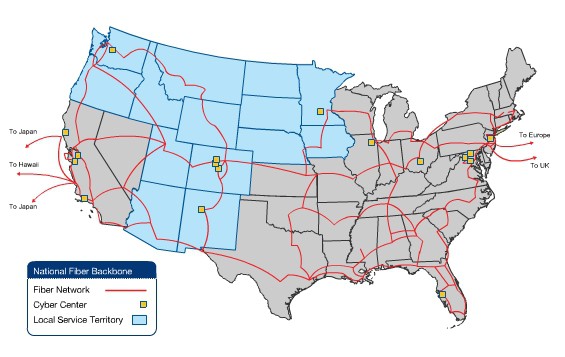
Qwest provides local service in 14 states in the Midwest and West.

Antitrust regulators have given the green light for CenturyLink to proceed with its buyout of Qwest Communications, but Qwest executives on their way out are hardly complaining about the deal.

Stop the Cap! has reviewed recent filings with the Securities and Exchange Commission and learned the proposed deal will bring almost $110 million in bonuses and golden parachutes for seven senior Qwest executives, some of whom will leave Qwest as a consequence of the merger.

Qwest CEO Ed Mueller will receive the largest amount: nearly $43 million — $10.8 million in cash he can spend now and $32 million in stock which he can sell later.  Mueller has already made a mint as CEO of Qwest, getting a five percent raise in his base salary to $12 million dollars in 2009, a nine percent boost in his performance bonus — $2.5 million, nearly $250,000 towards personal use of the Qwest corporate jet fleet, and $7.6 million in new stock awards.  While Mueller won, some 2,800 Qwest employees lost — their jobs.  As part of broad cost cutting moves, Qwest eliminated 8.5 percent of its workforce in 2009.  That helped the company achieve an increase in profits of 2 percent despite a 9 percent loss in revenue for the year.

Most of the generous compensation packages were part of the executives’ employment agreements which guaranteed golden parachute payouts and stock options in the event of a merger.  Those employee agreements were well-positioned to pay off for the executives, as Qwest’s “for-sale” sign had been public knowledge for years.

Last week, the Federal Trade Commission determined the deal between CenturyLink and Qwest did not bring any antitrust issues to the table.  But the deal still faces a review from state regulators and the Federal Communications Commission.  Qwest shareholders will have their say August 24th in a special shareholder meeting to vote on the deal.  Qwest has already been negotiating with significant shareholders who have sued the company, claiming the deal did not adequately compensate Qwest’s investors.  Sixteen of those lawsuits have since been quietly settled on undisclosed terms.

Meanwhile, opposition to the merger has come from smaller independent phone companies, consumer groups, labor unions, and some of Qwest’s competitors who rely on Qwest’s facilities to bring services to customers.  The Communications Workers of America is the largest union expressing concerns about the deal and has filed to intervene in public service commission proceedings regarding the merger in four states: Arizona, Colorado, Iowa and Minnesota.  Those are the only four states in Qwest’s 14 state territory receptive to hearing the union’s point of view, according to the CWA.  The others have oversight agencies that exist little beyond rubber-stamping the requests of the companies they oversee or have commission members who are openly hostile to unions.

Despite the opposition, most analysts believe the deal will win approval because CenturyLink only has a limited presence in most of Qwest’s service areas, which are in the mountain west and desert south.

Search This Site:

Contributions:

Recent Comments:

Your Account:

Stop the Cap!