Home » Qwest » Recent Articles:

CenturyLink Sales Reps in Oregon Harrass Residents With Suspicious Questions, They Call Police

Phillip Dampier November 9, 2011 CenturyLink, Competition, Consumer News, Video 1 Comment

The pushy door-to-door salesman is back, and he’s working for CenturyLink.

Lake Oswego (Ore.) residents have been the unwelcome recipients of repeated doorbell ringing by a small army of young CenturyLink salespeople.  Described by some residents as “rude,” “pushy,” and intrusive, the salespeople pelted would-be customers with questions about how many televisions and computers were found within their homes, and what kind of telecommunications services they had.

Some residents were so alarmed by the aggressive and suspicious sales tactics, they called police.

“They were persistent, they came to my door four times,” Lake Oswego resident Betty Endress, who lives in a private gated community, told KOIN-TV. “We have a ‘no solicitation’ policy.”

Endress refused to open the door because, in her words, it was CenturyLink — a company nobody had heard of.

In fact, CenturyLink acquired Qwest, the former Baby Bell that predominately serves the mountain west states.

CenturyLink admits the aggressive sales force belongs to them.  They are being sent into neighborhoods where the company recently upgraded its broadband service, trying to lure customers away from the cable competition.  But one South Portland resident was so alarmed when three salespeople showed up on his doorstep all at once, he called 911.

Telecommunications providers have been victimized by some criminals who represent themselves as company employees to force their way into residential homes to commit crimes.  CenturyLink says concerned residents should ask to see CenturyLink branded identification badges, uniforms, and a copy of the license permitting them to pursue door-to-door sales.

[flv width=”480″ height=”290″]http://www.phillipdampier.com/video/KOIN Portland Door-to-door sales scare in Lake Oswego 11-7-11.mp4[/flv]

Residents in private, gated communities told KOIN-TV in Portland they’d prefer not to be visited by CenturyLink salespeople on their doorsteps, whether the sales force holds a business license or not.  (3 minutes)


Broadband Life in Idaho: Bears Rubbing Against Towers Knock Out Internet Service

Phillip Dampier September 15, 2011 Broadband Speed, Cable One, CenturyLink, Competition, Data Caps, Editorial & Site News, Public Policy & Gov't, Rural Broadband Comments Off on Broadband Life in Idaho: Bears Rubbing Against Towers Knock Out Internet Service

(Courtesy: Pando Networks)

Bears who fancy a good rub up against wireless Internet transmission towers were blamed for knocking out service for customers in the Potlatch area one day, a problem unique to rural communities who make due with whatever broadband access they can find.

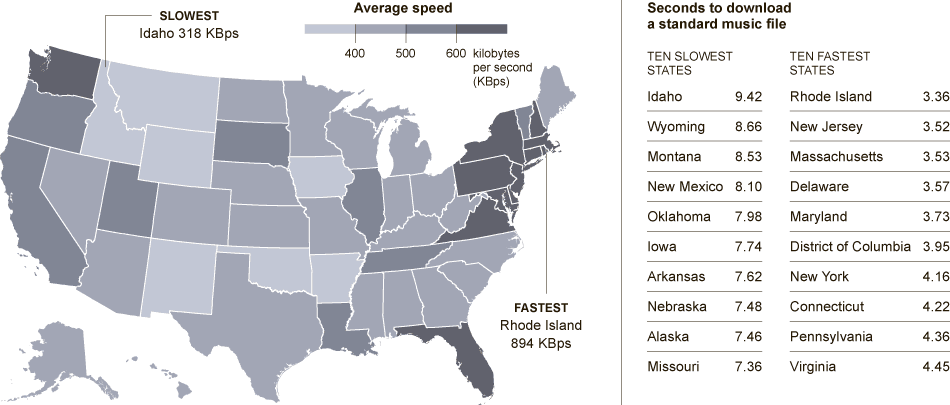
Such is life in rural Idaho, deemed by Pando Networks to be America’s slowest broadband state, with average Internet speeds of just 318kbps.

Stop the Cap! reader Jeff in Pocatello is happy the big city New York Times has noticed Idaho’s online challenges.

“Please take notice of this newspaper article about our online experience here in Idaho,” Jeff writes. “While it underplays the near-total failure of our state legislature to recognize there –is– a broadband problem here, at least the rest of the country will understand just how bad Internet access remains in rural America.”

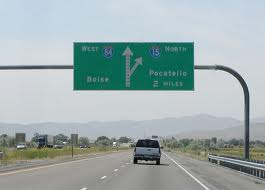
Jeff should know.  Pando Networks calls Pocatello America’s slowest Internet city.  It’s no surprise why.  Pocatello residents are stuck between a rock — the infamous Internet Overcharging leader Cable ONE (incidentally owned by NY Times‘ rival The Washington Post), and a hard place — Qwest/CenturyLink DSL.

Nobody does Internet Overcharging better than Cable ONE, which baits customers with high speed access and then ruins the deal with an $8 monthly modem rental fee, infamously low usage caps and a two-year contract plan that subscribers call a ripoff.

“Cable ONE never heard of a square deal because they break every consumer rule in the book,” Jeff says. “Although the company pitches speeds up to 50Mbps, they tie it to a two-year contract that only delivers one year at that speed.  After 12 months, they reduce your speed to just 5Mbps for the entire second year, and if you cannot convince the customer service representative to renew and reset your 50Mbps contract for an additional year, there is nothing you can do about it.”

THE Internet Overcharger

Cable ONE has written the book on usage limits.  Customers paying for “blazing fast 50Mbps speed” get to consume a maximum of just 50GB per month (100GB for triple play customers) before overlimit fees of $0.50/GB kick in.  Other Cable ONE plans include daily usage limits of just 3GB, which can make Netflix viewing difficult.

“Cable ONE makes you ration your Internet like satellite providers do, and it’s very irritating because they tease you with fast speeds you literally cannot use unless you are willing to pay a lot more,” Jeff says.

The alternative for most Idahoans is DSL, if Qwest/CenturyLink provides it.  In many areas, they don’t.

“You can be a mile out of Pocatello’s city center and be told there is no DSL, and those that do get it often find it working at 1-3Mbps,” he adds.

In a country now rated 25th in terms of Internet speed, Idaho is comparatively a bottom-rated broadband disaster area.  The state secured 11 federal broadband grants to deliver some level of service in communities across the state, at a cost of $25 million.

The Slow Lane

But ask some local officials about the quality of broadband in Idaho and you find a lot of denial there is even a problem.

The Times got a brusque response to their inquiries about broadband service from the executive director for the Bannock Development Corp., a business development group.  Gynii Gilliam told the newspaper things were just fine, at least for large businesses in cities like Pocatello.

“The last thing I need is a report that says we don’t have the capacity and speed, when I know it exists,” Gilliam said. She noted that Allstate Insurance was opening a $22 million call center in Pocatello and that the Federal Bureau of Investigation has a service center there. “We have not lost any business because of Internet speeds,” she said.

Which proves the old adage that you can have just about anything, for the right price.  The disparity between residential and business broadband — urban and rural — is particularly acute in mountain west states like Idaho.  Verizon was considering rural Wyoming for a multi-billion dollar high speed Internet data center, until it found it could purchase an alternative already up and running elsewhere.  Meanwhile, much of the rest of Wyoming has no Internet, slow speed wireless or DSL, or limited cable broadband in some larger communities.

Even Gilliam admitted her home broadband account was nothing like the service Allstate Insurance was likely getting.

“It feels like it’s moving in slow motion,” she told the Times. “A lot of times I’ll start downloads and not complete them.” She said she was happy as long as she could get e-mail.

But not everyone is satisfied with an Internet experience limited to occasional web browsing and e-mail.

Qwest (now CenturyLink), is Idaho's largest Internet Service Provider.

“With countries like Latvia getting better broadband than we have, it’s only a matter of time before we start to lose even more jobs in the digital economy over this,” Jeff says. “This is one more nail in the coffin for rural economies in the west, which are being asked to compete with bigger cities and eastern states that have much better infrastructure.”

Pando found the northeast and mid-Atlantic states, excepting Maine, New Hampshire, and Vermont, have the best broadband speeds in the country.  The mountain west has the worst.

Rural states like Montana, the Dakotas, eastern Oregon, Idaho, Wyoming, and Utah are the least likely to have widespread access to cable broadband, which can typically offer several times the Internet speed found in smaller communities with DSL service from dominant provider Qwest (now CenturyLink).  CenturyLink claims 92 percent of their customers have some access to broadband, but didn’t say at what speeds or how many customers actually subscribe to the service.

In Idaho, cost remains a factor, so CenturyLink is planning to sell low-income households a discounted DSL package.  Speeds and pricing were not disclosed.

Jeff says the real issue is one of value.

“Some in the Times article blame lack of access, while others claim it’s all about the cost, but it’s really more a question of ‘is it worth paying this much for the service we actually get’,” Jeff says.

“Cable ONE is simply deal-with-it Internet, with usage caps and contract traps that leave customers feeling burned, but their only other choice is Qwest, and they show few signs of caring about delivering fast broadband in this state,” Jeff says.

“I believe CenturyLink Idaho’s vice president and general manager Jim Schmit when he says, ‘We’re in business to make a profit,’ Jeff concludes. “There isn’t a lot of profit in selling Internet service in rural mountain states, so the company simply doesn’t offer it where they won’t make back their investment quickly.”

“The question is, should profit be the only thing driving broadband deployment in the United States?  If you answer ‘yes,’ Idaho is the result.  If you answer ‘no,’ and think it is an essential utility, profit shouldn’t be the only consideration.”

[flv width=”640″ height=”380″]http://www.phillipdampier.com/video/Cable ONE Countdown High Speed Internet.flv[/flv]

Cable ONE’s ad for 50Mbps leaves out a lot, including the 50GB usage cap and two-year contracts that downgrade service to just 5Mbps for the entire second year.  (1 minute)

Astroturf and Industry-Backed, Dollar-a-Holler Friends Support Telco’s USF Reform Plan

So who is for the ABC Plan?  Primarily phone companies, their business partners, and dollar-a-holler astroturf friends:

American Consumer InstituteSourceWatch called them a telecom industry-backed astroturf group.  Karl Bode from Broadband Reports discovered “the institute’s website is registered to ‘Stephen Pociask, a telecom consultant and former chief economist for Bell Atlantic [today Verizon].”  The group, claiming to focus “on economic policy issues that affect society as a whole,” spends an inordinate amount of its time on telecommunications hot button issues, especially AT&T and Verizon’s favorites: cable franchise reform and opposition to Net Neutrality.

Anna Marie Kovacs:  Determining what is good for Wall Street is her business, as founder and President of Regulatory Source Associates, LLC. RSA provides investment professionals with analysis of federal and state regulation of the telecom and cable industries.

Dollar-a-holler support?

Consumer Awareness Project: A relatively new entrant, CAP is AT&T’s new darling — a vocal advocate for AT&T’s merger with T-Mobile.  But further digging revealed more: the “group” is actually a project of Washington, D.C. lobbying firm Consumer Policy Solutions, which includes legislative and regulatory advocacy work and implementation of grassroots mobilization.

That is the very definition of interest group-“astroturf.”

Randolph May from the Free State Foundation supports "state's rights," but many of them want no part of a plan his group supports.

Free State Foundation: A misnamed conservative, “states rights” group.  Leader Randolph May loves the ABC Plan, despite the fact several individual states are asking the FCC not to impose it on them.

Hispanic Technology & Telecommunications Partnership:  Whatever Verizon and AT&T want, HTTP is also for.  The group was embroiled in controversy over its unflinching opposition to Net Neutrality and love for the merger of AT&T and T-Mobile.  Its member groups, including MANA and LULAC, are frequent participants in AT&T’s dollar-a-holler lobbying endeavors.

Robert J. Shapiro: Wrote an article for Huffington Post calling the ABC Plan worth consideration.  Also worth mentioning is the fact he is now chairman of what he calls an “economic advisory firm,” which the rest of the world calls a run-of-the-mill D.C. lobbyist firm — Sonecon.  It comes as no surprise AT&T is a client.  In his spare time, Shapiro also writes reports advocating Internet Overcharging consumers for their broadband service.

Indiana Exchange Carrier Association: A lobbying group representing rural Indiana telephone companies, primarily owned by TDS Telecom.  It’s hardly a surprise the companies most likely to benefit from the ABC Plan would be on board with their support.

Indiana Telecommunications Association: A group of 40 telephone companies serving the state of Indiana.  For the aforementioned reasons, it’s no surprise ITA supports the ABC Plan.

Information Technology and Innovation Foundation:  Reuters notes this group received financial support from telecommunications companies, so lining up behind a plan those companies favor comes as little surprise.  ITIF also believes usage caps can deter piracy, so they’re willing to extend themselves way out in order to sell the telecom industry’s agenda.

Internet Innovation Alliance:  Another group backed by AT&T, IIA also funds Nemertes Research, the group that regularly predicts Internet brownouts and data tsunamis, which also hands out awards to… AT&T and Verizon.
The Indiana Exchange Carrier Assn. represents the phone companies that will directly benefit from the adoption of the ABC Plan.

Bret Swanson:  He penned a brief note of support on his personal blog.  When not writing that, Swanson’s past work included time at the Discovery Institute, a “research group” that delivers paid, “credentialed” reports to telecommunications company clients who waive them before Congress to support their positions.  Swanson is a “Visiting Fellow” at Arts+Labs/Digital Society, which counted as its “partners” AT&T and Verizon.

Minority Media & Telecom Council: Tries to go out of its way to deny being affiliated or “on the take” of telecom companies, but did have to admit in a blog posting it takes money from big telecom companies for “conference sponsorships.”  Some group members appear frequently at industry panel discussions, and mostly advocate AT&T’s various positions, including strong opposition to reclassify broadband as a utility service.

MMTC convened a Broadband and Social Justice Summit earlier this year that featured a range of speakers bashing Net Neutrality, and the group’s biggest highlighted media advisory on its website as of this date is its support for the merger of AT&T and T-Mobile.  Yet group president David Honig claims he can’t understand why some consumer groups would suspect groups like his of engaging in dollar-a-holler advocacy, telling The Hill, “We’ve seen no examples of reputable organizations that do things because of financial contributions. It’s wrong to suggest such things.”

Mobile Future: Sponsored by AT&T, Mobile Future curiously also includes some of AT&T’s best friends, including the Asian Business Association, LULAC, MANA, the National Black Chamber of Commerce, and the United States Hispanic Chamber of Commerce.

Montana Independent Telecommunications Systems: Primarily a group for Montana’s independent telephone companies, who will benefit enormously from the ABC Plan.

What major corporate entity does not belong to this enormous advocacy group?

The National Grange:  A group with a long history advocating for the interests of telephone companies.  Over the years, the National Grange has thrown its view in on Verizon vs. the RIAA, a request for Congress to support industry friendly legislation, a merger between Verizon and NorthPoint Communications, and USF issues.

The Keep USF Fair Coalition was formed in April 2004. Current members include Alliance for Public Technology, Alliance For Retired Americans, American Association Of People With Disabilities, American Corn Growers Association, American Council of the Blind, California Alliance of Retired Americans, Consumer Action, Deafness Research Foundation, Gray Panthers, Latino Issues Forum, League Of United Latin American Citizens, Maryland Consumer Rights Coalition, National Association Of The Deaf, National Consumers League, National Grange, National Hispanic Council on Aging, National Native American Chamber of Commerce, The Seniors Coalition, Utility Consumer Action Network, Virginia Citizen’s Consumer Council and World Institute On Disability. DSL Prime helps explain the membership roster.

Taxpayers Protection Alliance:  One of the tea party groups, TPA opposes higher USF fees on consumers.  The ABC Plan website had to tread carefully linking to this single article favorable to their position.  Somehow, we think it’s unlikely the group will link to the TPA’s louder voice demanding an end to broadband stimulus funding many ABC Plan backers crave.

TechAmerica: Guess who is a member?  AT&T, of course.  So is Verizon.  And CenturyLink.  TechAmerica call themselves “the industry’s largest advocacy organization and is dedicated to helping members’ top and bottom lines.”  (Consumers not included.)

Tennessee Telecommunications Association: TTA’s independent phone company members stand to gain plenty if the ABC Plan is enacted, so they are happy to lend their support.
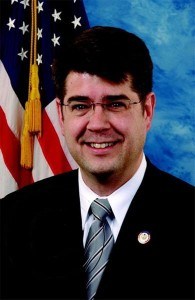
Rep. Terry's two biggest contributors are CenturyLink and Qwest.

Representative Greg Walden (R-Oregon):  His top five contributors are all telecommunications companies, including CenturyLink, Pine Telephone, and Qwest.  He also gets money from AT&T and Verizon.  It’s no surprise he’s a supporter: “We are encouraged by the growing consensus among stakeholders as developed in the ‘America’s Broadband Connectivity Plan’ filed with the Federal Communications Commission today, and we hope that consensus will continue to grow.”

Representative Lee Terry (R-Nebraska): He co-signed Rep. Walden’s statement.  Rep. Terry’s two biggest contributors are Qwest and CenturyLink.  Now that CenturyLink owns Qwest, it’s two-campaign-contributions-in-one.  And yes, he gets a check from AT&T, too.

Representative Steve Scalise (R-Louisiana): “Today’s filing of the ‘America’s Broadband Connectivity Plan’ is welcomed input on the intercarrier compensation and Universal Service Fund reform front,” Scalise said.  Now Scalise is ready to welcome this year’s campaign contribution from AT&T, which he has not yet reportedly received.  In 2008, Scalise received $13,250.  In 2010, $10,000.  This cycle, so far he has only been able to count on Verizon, which threw $2,500 his way.  Scalise voted earlier this year to overturn the FCC’s authority to enact Net Neutrality.

USTelecom Association: The only news here would be if USTA opposed the ABC Plan.  Included on USTA’s board of directors are company officials from: Frontier Communications, AT&T, CenturyLink/Qwest, Windstream, FairPoint Communications, and Verizon.  That’s everyone.

Wisconsin State Telecommunications Association:  Their active members, including Frontier Communications, are all telephone companies inside Wisconsin that will directly benefit if the ABC Plan is enacted.


‘Measuring Broadband America’ Report Released Today: How Your Provider Measured Up

Phillip Dampier August 2, 2011 AT&T, Broadband Speed, Cablevision (see Altice USA), CenturyLink, Charter Spectrum, Comcast/Xfinity, Consumer News, Cox, Frontier, Mediacom, Online Video, Public Policy & Gov't, Rural Broadband, Verizon Comments Off on ‘Measuring Broadband America’ Report Released Today: How Your Provider Measured Up

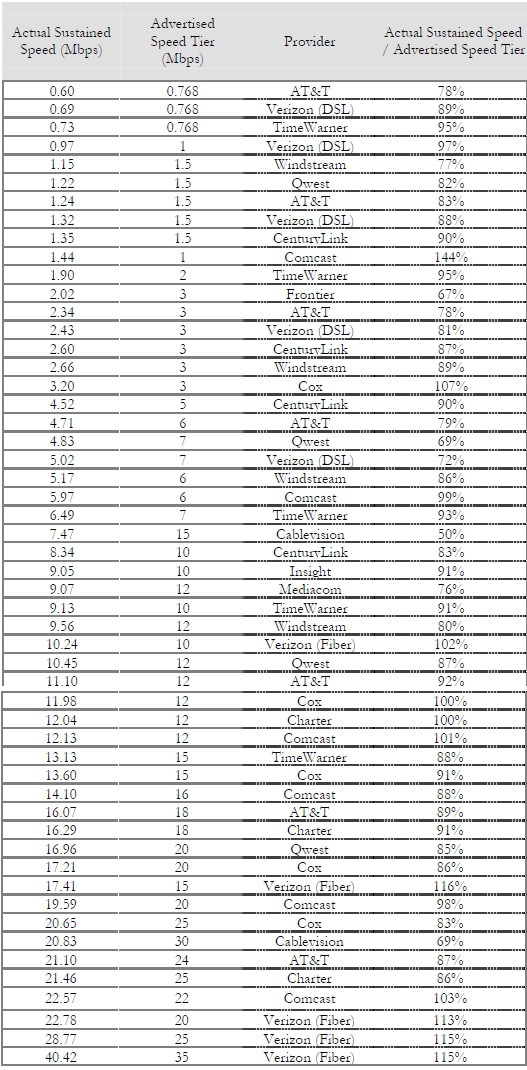
The Federal Communications Commission today released MEASURING BROADBAND AMERICA, the first nationwide performance study of residential wireline broadband service in the United States.  The study examined service offerings from 13 of the largest wireline broadband providers using automated, direct measurements of broadband performance delivered to the homes of thousands of volunteers during March 2011.

Among the key findings:

Providers are being more honest about their advertised speeds: Actual speeds are moving closer to the speeds promised by those providers.  Back in 2009, the FCC found a greater disparity between advertised and delivered speeds.  But the Commission also found that certain providers are more likely to deliver than others, and certain broadband technologies are simply more reliable and consistent.

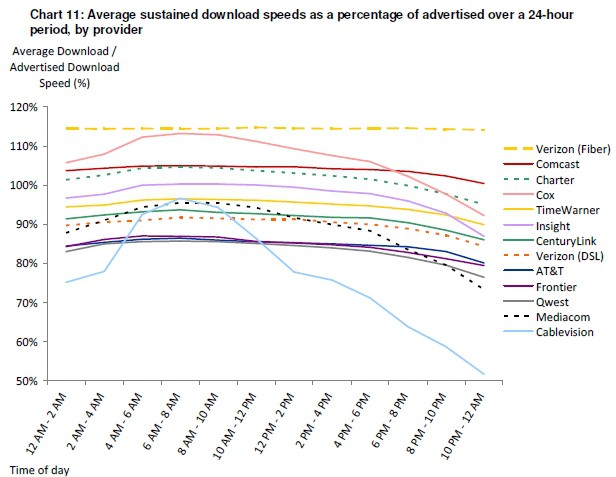
Fiber-to-the-Home service was the runaway winner, consistently delivering even better speeds than advertised (114%).  Cable broadband delivered 93% of advertised speeds, while DSL only managed to deliver 82 percent of what providers promise.  Fiber broadband speeds are consistent, with just a 0.4 percent decline in speeds during peak usage periods.

Cable companies are still overselling their networks.  The FCC found during peak usage periods (7-11pm), 7.3 percent of cable-based services suffered from speed decreases — generally a sign a provider has piled too many customers onto an overburdened network.  One clear clue of overselling: the FCC found upload speeds largely unaffected.

DSL has capacity and speed issues.  DSL also experienced speed drops, with 5.5 percent of customers witnessing significant speed deterioration, which could come from an overshared D-SLAM, where multiple DSL customers connect with equipment that relays their traffic back to the central office, or from insufficient connectivity to the Internet backbone.

Some providers are much better than others.  The FCC found some remarkable variability in the performance of different ISPs.  Let’s break several down:

  • Verizon’s FiOS was the clear winner among the major providers tested, winning top performance marks across the board.  Few providers came close;
  • Comcast had the most consistently reliable speeds among cable broadband providers.  Cox beat them at times, but only during hours when few customers were using their network;
  • AT&T U-verse was competitive with most cable broadband packages, but is already being outclassed by cable companies offering DOCSIS 3-based premium speed tiers;
  • Cablevision has a seriously oversold broadband network.  Their results were disastrous, scoring the worst of all providers for consistent service during peak usage periods.  Their performance was simply unacceptable, incapable of delivering barely more than half of promised speeds during the 10pm-12am window.
  • It was strictly middle-of-the-road performance for Time Warner Cable, Insight, and CenturyLink.  They aren’t bad, but they could be better.
  • Mediacom continued its tradition of being a mediocre cable provider, delivering consistently below-average results for their customers during peak usage periods.  They are not performing necessary upgrades to keep up with user demand.
  • Most major DSL providers — AT&T, Frontier, and Qwest — promise little and deliver as much.  Their ho-hum advertised speeds combined with unimpressive scores for time of day performance variability should make all of these the consumers’ last choice for broadband service if other options are available.

Some conclusions the FCC wants consumers to ponder:

  1. For basic web-browsing and Voice-Over-IP, any provider should be adequate.  Shop on price. Consumers should not overspend for faster tiers of service they will simply not benefit from all that much.  Web pages loaded at similar speeds regardless of the speed tier chosen.
  2. Video streaming benefits from consistent speeds and network reliability.  Fiber and cable broadband usually deliver faster speeds that can ensure reliable high quality video streaming.  DSL may or may not be able to keep up with our HD video future.
  3. Temporary speed-boost technology provided by some cable operators is a useful gimmick.  It can help render web pages and complete small file downloads faster.  It can’t beat fiber’s consistently faster speeds, but can deliver a noticeable improvement over DSL.

More than 78,000 consumers volunteered to participate in the study and a total of approximately 9,000 consumers were selected as potential participants and were supplied with specially configured routers. The data in the report is based on a statistically selected subset of those consumers—approximately 6,800 individuals—and the measurements taken in their homes during March 2011. The participants in the volunteer consumer panel were recruited with the goal of covering ISPs within the U.S. across all broadband technologies, although only results from three major technologies—DSL, cable, and fiber-to-the-home—are reflected in the report.

How Comcast’s Usage Cap Costs Them Business and Your Internet Connection

Andre Vrignaud of Seattle has been benched for a year by Comcast for using too much of its Internet service.

From time to time, we get reports from Comcast customers victimized by the company’s 250GB usage cap.  The nation’s largest cable broadband provider implemented that arbitrary limit back in 2008 after the Federal Communications Commission told the company they could not throttle the speeds of customers using applications like peer-to-peer file sharing software — then pegged as the usual suspect for turning “ordinary” broadband users into “data hogs.”

For at least 18 months, Comcast’s usage cap came with no measurement tools or real explanation most customers could find about what a “gigabyte” was, much less how many of them they “used” that month.  Only last year, Comcast finally rolled out usage measurement tools for customers who bother to find them on their website.  New customers signing up for service never even realize there is a usage cap until a thick brochure of legalize comes with the installer outlining the company’s Acceptable Use Policy.

Still, compared to some of the usage cap battles Stop the Cap! was fighting three years ago, Comcast was the least of our problems.  Frontier’s infamous 5GB usage allowance was the worst we’d ever seen, Cable One’s IRS-like usage policies required an academic to explain them, and Time Warner Cable’s ‘lil experiment in broadband rationing with a 40GB usage cap experiment crashed and burned soon after being announced in the lucky test cities scheduled to endure it.  That doesn’t make Comcast’s cap fair or right, but protecting consumers from these schemes requires triage.

But we remember well Comcast’s promise that it would regularly revisit and adjust its usage cap to reflect the dynamic usage of its customers.  That’s just one more broken promise from a broadband provider with an Internet Overcharging scheme.  In fact, Comcast has not moved its cap one inch since the day it was announced, although they have increased their rates.  The only thing going for the cable giant is that it doesn’t treat “250GB” as a guillotine.  In fact, the cable company only sends the usage police after the top few percent of users that exceed it, issuing a warning not to exceed the cap again during the next six months, or face a year without having the service.

This punitive policy is what Time Warner Cable CEO Glenn Britt loves to rail against.  For him, broadband usage should never be penalized — it should be exploited for all the money the provider can possibly get from customers.  That’s why Britt favors a consumption billing system that starts off with a high monthly price for everyone, than goes much higher the more you use.  Would the neighborhood crack dealer cut you off for using too much?  Of course not.  Feeding your broadband usage habits can mean fat profits, and investors love it.

Andre Vrignaud, a 39-year-old gaming consultant in Seattle, wrote us (and many others) about his own experience with Comcast’s usage ban.  He’s a victim of it, having been warned once about usage and then ultimately told his cable modem was disabled for a year.  For Vrignaud, it was a case of using a cloud storage file backup provider, moving very high resolution images around, and having roommates.  Since Comcast counts upload and download traffic towards its usage limit, it’s not hard to see what can happen to anyone trying to back up today’s supersized hard drives.  What’s especially ironic is that Comcast itself sells online file backup services — which also counts towards your cap.

Comcast’s attitude about its decision to ban Vrignaud from its broadband service for a year was simple enough: it’s a clear cut case of violating their usage caps.  In their view, heavy users slow down broadband service for everyone else in the neighborhood.  So they set a policy that cuts them off when they use too much.

To add insult to injury, broadband-disabled Comcast customers have to call Comcast’s Retentions & Cancellations Department to get the billing stopped on his disabled service.  Vrignaud had to negotiate with a representative whose instinct is to keep you a Comcast customer at all costs, even when the company won’t allow you to be one!

But is Comcast really facing a congestion issue?  Not if you happen to be a business customer at the same address, using the exact same infrastructure that residential customers in the neighborhood use.  Business Class service has no usage limits at all — “congested neighborhood” or not.  And that is where Comcast’s argument simply starts to fall apart.

We’ve been in touch with Vrignaud privately in an effort to help him find a way back to his broadband service.  The alternative is DSL from Qwest/CenturyLink, and unless you live in an area where the phone company has upgraded their networks to support ADSL 2+ or other advanced flavors of DSL, that represents quite a speed downgrade.

Our readers have told us Comcast representatives have several unofficial ways of dealing with heavy users who have gotten their first warning from the company.  Some have told customers to sign up for a second residential account under the name of someone else in the home to allot themselves an additional 250GB of usage.  Others recommend signing up for a business account, which means no usage cap at all.  For those who have been cut off, signing up as a new customer under the name of someone else in the household usually gets you back in the door, albeit facing the same usage cap issue all over again.

The problem Vrignaud encountered is Comcast’s clumsy way of dealing with customers, like himself, who have been sentenced to a year without broadband service (from them).

Vrignaud explored the route we recommended — Business Class service — and found he couldn’t sign up.  Evidently Comcast’s ban is tied to his personal Social Security number, and when he tried to enroll in Business Class service using it, he was stopped dead in his tracks.

Turns out that once Comcast has cut your broadband account for violating their data cap policy you are verboten from being a Comcast customer for 1 year. That’s right:

After being cut off from Comcast’s consumer internet plan due to using too much data, I’m told I’m ineligible to use Comcast’s recommended solution, their business internet plan that allows the unlimited use of data — solely because I made the mistake of actually using “too much” data in the first place.

As the sales rep said in my Google Voicemail message, “what’s interesting is that if you would have started off on the business side of the house, since we don’t have a cap limitations [sic] you would’ve been fine.”

Vrignaud also mentioned he was unsure if Comcast required a business Taxpayer Identification Number (TIN) in order to sign up for Business Class service.  In fact, for our readers who have gone this route, it turned out not to be necessary.  They just put their Social Security number in the space reserved for a TIN and had no problems.  Vrignaud would have a problem, however, because his Social Security number is effectively “poisoned” for the year.  He would need to obtain a specific kind of TIN — an Employer Identification Number (EIN) to proceed.  Luckily, it takes less than five minutes to apply for one online and is free.  The number displayed at the end of the process would be the one to use with Comcast.  An alternative suggestion would be to sign up for service under the name of someone else in the household.

For those on Comcast’s bad side, there is more hoop-jumping to get your service back than at the Ringling Bros. circus.

Should all this even be necessary?

Broadband service carries up to a 90% profit margin.

Stop the Cap! thinks not.  While Comcast may have endured last-mile congestion on its shared cable broadband network in days past, the company’s aggressive upgrades to DOCSIS 3 technology makes congestion-based usage limits more of an excuse than a reality.  Comcast is pitching faster broadband speeds than ever, all hampered by the same 250GB usage limit.  While residential and business class customers share the same physical cable lines strung across neighborhoods, one faces a usage cap and the other does not.  It’s simply not credible.  Comcast’s punitive usage cap scheme throws away their own customers and the revenue they bring.

Vrignaud wants the option of getting his service back, perhaps by buying additional usage.  That’s Time Warner Cable’s dream-come-true, and one we are concerned about.  Once broadband usage is limited and monetized, it becomes a commodity that can be priced to earn enormous additional revenue for cable operators, regardless of the actual cost of providing the service.  That’s a dangerous precedent in today’s duopolistic broadband marketplace, because the cost per gigabyte will likely be on the order of a thousand times or more the actual cost, with no competitive pressure to keep that cost down.  That’s how Canada ended up in its Internet Overcharging pickle, where providers call $1.50-$5 per gigabyte “reasonable,” even though it costs them only pennies (and dropping) to deliver.  Some providers are even raising those prices, even as their costs plummet.  That’s not a road we want the cable or telephone industry walking down, or else we’ll find today’s enormous cable TV bills pale in comparison to the outrageous broadband service bills of the future.  Time Warner Cable provided a helpful preview in 2009 when they proposed unlimited 15/1Mbps residential service at the low, low price of $150 a month.

Vrignaud is just one more example of why Internet Overcharging risks America’s broadband future.  It’s an end run around Net Neutrality, its arbitrary, and unjustified.  The rest of the world is racing to discard what they called congestion pricing almost as fast as America’s providers (and their Wall Street cheerleaders) are racing towards Internet Overcharging.  The United States should be following Canada’s lead and hold providers to account for this kind of Internet pricing and force them to prove its warranted, or be rid of it.  With virtually every provider earning enormous profits off Internet service at today’s speed-based pricing, there remains no justification to overcharge customers for their broadband usage.

Search This Site:

Contributions:

Recent Comments:

Your Account:

Stop the Cap!