Home » pricing » Recent Articles:

[Updated] AT&T Adds Usage Meter Placeholder on U-verse Accounts

Phillip Dampier March 22, 2010 AT&T, Data Caps, Editorial & Site News 7 Comments

Stop the Cap! reader Michael writes to alert us he found AT&T’s U-verse online Account Overview now includes a section called “Usage & Recent Activity” that includes a placeholder for a future usage meter.

“I canceled my U-verse TV and bumped my Internet speed up to 12Mbps last weekend, and I remember checking to see if my account updated sometime around the middle of last week.  The old website was still in use then.  Today was the first time I got redirected to the new site, which includes this new placeholder for a usage meter,” writes Michael.

Stop the Cap! reader Michael sent us a screen shot of his AT&T U-verse account, showing this placeholder for a future usage meter. (Click to view the full screen shot)

While customers like Michael are currently being told their “internet plan provides you with unlimited usage — there are no usage details to display,” the potential for usage meters can set the stage for future Internet Overcharging schemes down the road.

AT&T alienated many of its customers in Beaumont, Texas and Reno, Nevada when an extended usage cap trial was underway.  Complaints were filed against AT&T with the Better Business Bureau over dubious marketing practices that sold customers on unlimited broadband, only to dispatch letters to newly signed customers telling them it wasn’t unlimited… after signing up for service.

Stop the Cap! learned the Beaumont/Reno experiment was coming to a close this April.

Internet Overcharging schemes are vastly unpopular with consumers.  A 2008 study found an overwhelming majority of customers (81 percent) opposed to usage limits or usage-based billing, with 51 percent willing to take their business to another provider if implemented.

In Beaumont and Reno, customers threatened to cancel service when they learned of the experimental overcharging scheme being tested.  Some managed to get exempted from the trial.

Customers routinely reject the notion that a company already earning billions in broadband profits today needs to set the stage for even higher pricing and profits tomorrow.

AT&T has spent millions lobbying for the introduction of their U-verse system on favorable franchise terms with the promise it would deliver more competition and lower prices for millions of Americans.

For customers like Michael, usage meters are the first step towards breaking that promise.  When followed with formal usage limits or usage-based billing, higher broadband bills are a sure thing.

AT&T customers should contact AT&T and put them on notice — any effort to impose usage limits or usage-based billing will result in immediate cancellation of your AT&T account.

Stop the Cap! will continue to closely monitor AT&T and we’ll recommend further action should conditions warrant.

Update 3:00pm EDT 3/23 — AT&T tells Broadband Reports that whatever users are seeing, it’s some kind of website glitch, and that the company has no plans to implement a usage meter. “We did do some upgrades to our account management portal this weekend, but we haven’t been able to recreate this screen,” according to AT&T spokesman Seth Bloom.

While that’s good news for AT&T customers, we are unsure exactly how such a glitch could occur with such depth, including wording that specific Internet plans providing unlimited usage.  Further, specifying “U-verse Internet Usage” on the tab above it seems surprisingly specific for a “glitch.”

Barring any new evidence, we’ll take AT&T’s word for it, but readers should continue to report any further “glitches” they might encounter.  If possible, include the URL with any screen shots, which we’ll happily provide to the company in any effort to recreate the page.


Comcast Raising Prices… Again, But Their Usage Cap Remains Firmly In Place; 3.5 Percent Increase For Many

Phillip Dampier March 9, 2010 Comcast/Xfinity, Competition, Data Caps 3 Comments

Comcast is back with another rate increase effective April 1st, amounting to 3.5 percent for many cable, broadband, and telephone customers.

Although prices vary depending on your specific service area, the range of the price increase is more consistent.

In southern New Jersey, for example, here is the breakdown — all prices are by the month:

  • Expanded/Standard service cable-TV tiers are increasing $2.  Expanded service customers could pay up to $50.10, Standard customers $60.55;
  • Triple Play customers will see a $5 increase in the second year of their two-year contract from $114.99 to $119.99.  First year pricing remains $99 for new customers;
  • Digital Premium Packages are increasing $2;
  • Economy Broadband (1Mbps) increases $2, Performance (12Mbps) increases $2, Blast! (16Mbps) increases $2, Ultra sees no price increases (but goes away for new customers effective 4/1);
  • Comcast phone line prices are also increasing in certain cases;
  • Each additional DVR drops by $5 — Verizon FiOS was hammering Comcast about DVR pricing.

There are no rate changes for business service customers or subscribers with “limited basic service.”  There is also no change in the company’s broadband usage allowance — 250 GB, the only part of Comcast’s service that seems to stubbornly remain at the same level year after year.

Comcast, the nation’s largest cable operator, blamed the mid-year price increases on increased programming and other business costs.

But the company is not exactly hurting.  Comcast’s 4th quarter earnings last year jumped 132 percent to $955 million dollars.  Rate increases that are designed to drive consumers into profitable service bundles, combining television, Internet, and telephone service, guarantee even better financial results in 2010.

Verizon is already capitalizing on Comcast’s rates by offering residents in southern New Jersey an even better price for Verizon FiOS — dropping from $109.99 for two years to $89.99, not including taxes and fees.  But like Comcast, Verizon wants you take a bundle of services, or else face higher prices.  The company recently increased the price for FiOS TV to $64.99 for standalone service.

Rogers Communications Takes Out a Contract On Customers’ Wallets: We’ve Doubled Our Overlimit Fee For Our Convenience

Phillip Dampier March 3, 2010 Data Caps, Editorial & Site News, Rogers 11 Comments

Rogers Communications Monday began their latest Internet Overcharging scheme on Canadian broadband customers — they’ve doubled the maximum overlimit penalty from $25 to $50 for customers who exceed the cable company’s arbitrary broadband usage allowances.

It’s a fact of life for anyone living with a provider that wants to charge too much for broadband service.  Like the credit card industry, the tricks and traps keep on coming as providers seek to monetize everything they can to extract as much money from customers as possible.

For some providers like Bell, the trick is to gradually reduce your usage allowance, exposing more and more customers to overlimit fees (the company even sells an insurance plan to protect you from their audacious pricing).  For others, the fee trap comes from gradually increasing the maximum overlimit fee until there is no maximum.

Rogers has chosen the latter method, effectively passing through massive rate increases for Canadians that dare to use too much.

Originally, Rogers Extreme service was priced at $60 a month for 10/1 Mbps service with a 95 GB cap.  Customers who traditionally exceeded that paid $1.50 per gigabyte in overlimit fees.  With a $25 maximum penalty, many customers just accepted the fee as their ticket to unlimited broadband.  Now, Rogers has conceded a quarter to customers, lowering the per gigabyte penalty rate to $1.25.  But for customers who still regularly exceed their allowance, the charges really add up.  That $60 a month now balloons to $110 per month for exactly the same unlimited service customers used to enjoy for less.

That forces customers like the Globe & Mail’s Michael Snider to make some choices:

  1. Reduce usage — a win for Rogers and broadband rationing for him;
  2. Upgrade to a higher tier service plan to get a better allowance — a win for Rogers and a higher bill for Snider.  Extreme Plus has an allowance of 125 GB, just a 30 GB difference, for an additional $10 a month;
  3. Grin and bear it — a win for Rogers and a future that guarantees him bigger bills indefinitely.

This is the type of move that may force customers who regularly approach or exceed their cap to seriously consider upgrading their service package.If that’s part of Rogers’ plan, it worked.

I just bumped up my service from Extreme to Extreme Plus (if you do the same, inquire about the promotion that offers $20 off Internet for the first six months if you lock in for a year — that’s upgrading only). So now, I’ll be getting 25-Mb download speeds (still a measly 1-Mb upload, though) and a cap of 125 GB a month and, once the promotion ends, will be paying $14 a month more ($10 for the service and $7 for the modem rather than $3).

Call me a sucker, but twice in the past year I have exceeded my 95 GB cap and paid an extra $25 on my bill — once after backing up several gigs on an online backup service and once after downloading a few movies on my Xbox.

But Snider also faces, by design, the one-two punch of Internet Overcharging schemes.  Not only do they fatten provider profits, they also discourage him from using his broadband service, fearing a higher bill.  Even better, they discourage cord-cutting — relying on your broadband service and dropping your cable-TV package.

I am discovering that I’m actually limiting my consumption of some totally legitimate services because I’ve no desire to pay extra on my Rogers bill at the end of the month.

Take for example Microsoft Xbox’s movie service. After waiting for what seemed eons for some kind of a legit movie download service, I finally have access to one that has a list of movies that I’d actually like to see, but it’s proving too expensive to really enjoy it regularly. Reason is, downloading an HD movie eats up more than 11 GB of my bandwidth — more than 10% of my monthly allotment (before I upgraded) for one freaking movie. That goes for games too. It seems as though distributors are leaning more and more to online delivery, but at 6 or 8 GB per game, again, that eats up a lot of bandwidth.

Being the gatekeeper for broadband distribution and also being a content distributor has its advantages.  If the competition starts getting too hot and heavy, locking down the distribution platform guarantees no competitor will ever get the best of you.

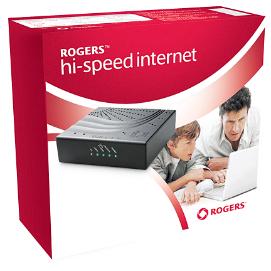
Whatever you do, don't turn off this modem, despite the fact you're paying for traffic it receives 24/7. Unplugging a cable modem could "damage it" according to Rogers.

Rogers claims its all about costs from increased broadband consumption, but one look at their pricing scheme proves that wrong.  Rogers reserves the biggest penalties of all for its lightest-use customers.  Those on Rogers Ultra-Lite tier suffer with barely-broadband speeds of 500/256 kbps with a usage limit of just 2 GB for a ridiculous $27.99 per month.  The penalty rate for customers who can hardly be described as “power users” is a whopping $5 per gigabyte.  They pay more because they impact the network more?  How does that work?

The Canadian Radio-television and Telecommunications Commission (CRTC), the agency responsible for oversight of telecommunications services in Canada is no help.  They’ve become a de facto telecom industry trade association, rubber-stamping approval of whatever providers want.  The result is expensive, usage-limited, speed-throttled broadband service across the country.

What can you do to control your monthly broadband bill Rogers wants to raise?  Their advice is basically to use less of the broadband service you paid good money to get.  Oh, and despite the fact whenever your cable modem is powered on you are bombarded with constant traffic which eats into your allowance, whatever you do, don’t leave it unplugged — it will “damage it.”  From Rogers Internet FAQ:

We STRONGLY recommend that you do not turn off your modem when you are away from home. Your cable modem has been designed to remain powered at all times. Regularly turning it off and on may result in damage to your cable modem.

…and damage to our profits.

Sprint: ‘Our $69.99 is Worth More Than Their $69.99’ — Wireless Competition Heats Up

Phillip Dampier March 2, 2010 AT&T, Competition, Sprint, Verizon, Video, Wireless Broadband 2 Comments

Sprint, America’s third largest mobile phone and wireless company, has launched a marketing war on its bigger competitors AT&T and Verizon Wireless scoffing at both providers’ $69.99 “unlimited” calling plans.

“Recently AT&T and Verizon have attempted to confuse the marketplace by lowering their pricing to $69.99, but theirs are for calling only,” said Mike Goff, Sprint’s vice president of corporate marketing.

Sprint launched a new advertising campaign this morning featuring CEO Dan Hesse calling out both carriers for effectively confusing consumers.

Hesse explains most people use their cell phones for more than just making and receiving calls.  Hesse said his larger competitors charge substantially more to use data services, and that many of the latest handsets don’t qualify for the special pricing.

Both AT&T and Verizon Wireless have started to require consumers with so-called “smartphones” to sign up with a data plan, adding to the customer’s bill whether or not they actually use such services.  Sprint says their unlimited plan also bundles unlimited web browsing, texting, and GPS navigation for the same price — $69.99, available on any phone they sell.

Sprint has had its hands full trying to stem the ongoing loss of its customers to larger competitors.

AT&T has benefited from an exclusive sales agreement for Apple’s iPhone, while Verizon Wireless achieved the top spot among U.S. carriers for its perceived widest coverage area.  Sprint has neither, and historically poor customer service to boot.

Will Sprint’s new campaign make an impact?

Roger Entner, head of telecom research for the Nielsen Co., told Brandweek that AT&T and Verizon are in such a commanding position in the market right now that they are unlikely to respond to Sprint. “They have the luxury of being able to ignore [Sprint],” said Entner, who noted that both AT&T and Verizon added millions of new subscribers in the fourth quarter, many at Sprint’s expense.

Sprint has managed to at least slow customer defections.  In the last quarter of 2009, Sprint lost 148,000 subscribers.  The previous quarter, the company lost 545,000 customers.

[flv width=”640″ height=”378″]http://www.phillipdampier.com/video/Sprint Ad – Just Phone Calls 3-2-2010.flv[/flv]

Sprint CEO Dan Hesse explains why their $69.99 plan is “better” than the competition in this new advertisement.

Broadband Money Party — Time Warner COO Tells Investors: “We Can Raise Prices for Internet Service”

Phillip Dampier March 1, 2010 Competition, Data Caps 6 Comments

Today’s quote comes courtesy of Landel Hobbs, chief operating officer of Time Warner Cable.

Speaking at an investor conference in San Francisco, Hobbs said broadband has replaced cable TV as its anchor product, meaning subscribers increasingly refuse to part with it, no matter the price.

“Consumers like it so much that we have the ability to increase pricing around high-speed data,” Hobbs was noted saying by the Wall Street Journal.

Hobbs also reports the cable company continues to grow its Road Runner service at the expense of telephone companies and their lackluster DSL product lines.  Much of Time Warner’s broadband growth these days comes from disaffected DSL customers switching providers.  Broadband remains a profit center for the cable industry even as revenue from cable television flatlines in a difficult economy.

So let the Money Party begin… your broadband bill is going up, especially in areas where subscribers don’t have many alternatives.

Search This Site:

Contributions:

Recent Comments:

Your Account:

Stop the Cap!