Home » pricing » Recent Articles:

Gizmodo Gets What CNN’s Ali Velshi Misses About AT&T: Reduced Competition = Higher Prices

Gertraude Hofstätter-Weiß March 21, 2011 AT&T, Competition, Editorial & Site News, Public Policy & Gov't, T-Mobile, Video, Wireless Broadband Comments Off on Gizmodo Gets What CNN’s Ali Velshi Misses About AT&T: Reduced Competition = Higher Prices

[flv width=”640″ height=”380″]http://www.phillipdampier.com/video/CNN ATT Merger with TMobile 3-21-11.flv[/flv]

Gizmodo’s Matt Buchanan helped educate viewers of CNN’s American Morning about the implications of AT&T’s merger with T-Mobile.  While Ali Velshi tried to deliver AT&T talking points about “decreased” wireless pricing, Buchanan took him to school with the fact an increasing number of wireless customers are paying higher bills because of indefensible SMS text message charges, mandatory data plans, and other extras that pad today’s cell phone bills.  Additionally, the one company that challenged the nearly-identical prices and plans from AT&T and Verizon like none other was T-Mobile.  Now, with T-Mobile out of the way, every American faces paying the same high prices for cell service.  (5 minutes)

South Africa Celebrates One Year of Uncapped Broadband Tomorrow; Rivals’ Money Party Ruined

Phillip Dampier March 16, 2011 Broadband Speed, Competition, Consumer News, Data Caps, MWEB (South Africa), Net Neutrality, Wireless Broadband Comments Off on South Africa Celebrates One Year of Uncapped Broadband Tomorrow; Rivals’ Money Party Ruined

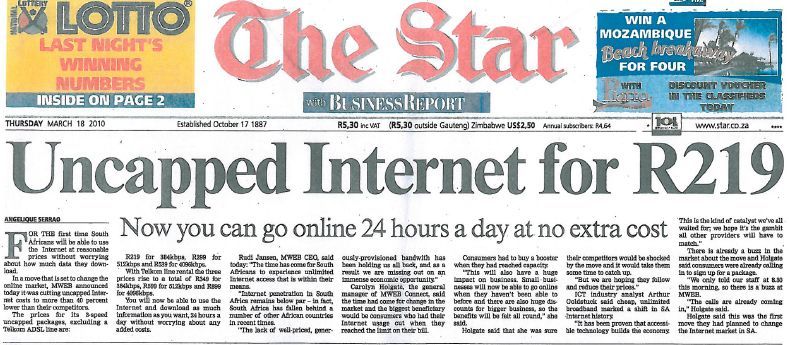
South Africans won uncapped broadband service one year ago tomorrow when an upstart provider — MWeb — unveiled its “Free the Web” campaign, delivering usage-limit free Internet access to customers across South Africa.

The company’s move to unlimited, flat rate service was heavily criticized by competing providers, who enforce draconian usage limits and have tried to convince customers the global trend was moving towards metered broadband.  But MWeb president Rudi Jansen dismisses the notion limiting broadband is the way to go, suggesting usage caps and meters are more about profits than serving customers.

Today, MWeb’s uncapped broadband is a runaway success, with more than 50 percent of its customers switching to the meter-free service.  It has been profitable, too.

“We are running ahead of our business plan and all our products are profitable,” Jansen tells TechCentral.

Now the nation’s semi-privatized, 39% state-owned phone company Telkom is widely expected to stop the erosion of its own broadband customers by adopting flat rate broadband service itself.

For Jansen, that would represent a welcome move.  The Internet visionary wants to transform South African broadband away from its current expensive pricing model and throw the Internet wide open.

“I’m looking forward to it,” Jansen says. “The sooner they launch it the better.”

The arrival of flat rate broadband made headlines across the country in 2010. (click to enlarge)

South African broadband has coped with challenges few other countries endure.  International connectivity has always been one of the biggest — sustaining traffic on satellite backbone links or underpowered undersea cables first forced providers to limit Internet use because of capacity concerns.  But new fiber-based underseas cables from Seacom and Wacs, including the forthcoming 5.1Tbps West African Cable System project will dramatically increase capacity and slash costs.

Jansen (Courtesy: TechCentral)

Yet several of his competitors want to keep the caps on and prices high, earning lucrative profits on a service Jansen says is becoming less costly to deliver every day.

Jansen admits MWeb is currently forced to traffic shape certain activities on his network, particularly bandwidth-intensive peer to peer traffic, because other providers in the country don’t agree with his wide-open view of the Internet.

He wants every provider in South Africa to agree to “open peering,” a practice that allows providers to exchange traffic with each other without charging transit fees.  He also wants to see wholesale mobile wireless pricing come down.  In Africa, mobile broadband has a strong place in a market where cable infrastructure (and broadband speed) is often lacking.

Telkom, South Africa’s equivalent to AT&T or Bell, is cited by Jansen as the biggest impediment to his plan to deliver truly unfettered, unlimited access.

Some South Africans deride the state phone company as "Hellkom"

In South Africa, broadband customers pay two providers — Telkom for the monthly rental of the telephone line and an ISP for the DSL service that connects through it.  Jansen says Telkom’s broadband line rental prices are too high.  But more importantly, the interconnection fee Telkom charges providers to access its network is “absolutely ludicrous.”

“Those prices are far more than the price of international connectivity,” Jansen says. “Telkom charges us to get access to their last mile and then charges end users to get access to the same last mile, so they make double money on it. And it’s completely mispriced.”

Despite the challenges from other providers, MWeb will celebrate the first anniversary of uncapped broadband tomorrow with a surprise announcement, probably targeting small business clients.

Wall Street and Providers Work to Distort Record on Unlimited Broadband

Phillip Dampier March 15, 2011 AT&T, Consumer News, Data Caps, Editorial & Site News 4 Comments

Wonder Twins: AT&T and Wall Street team up to support Internet Overcharging. "Shape of usage caps, form of ripping broadband users off."

The Wall Street Journal has left its readers with the impression America is the last bastion of the unlimited, all you can use, broadband plan.

In a story for the Dow Jones Newswires, Roger Cheng reports AT&T’s imposition of data caps and other Internet Overcharging schemes “is the latest step taken to get people out of the mindset that online access is an all-you-can-eat buffet. It’s part of a broader shift by companies on both the wireless and fixed-line sides to get consumers comfortable with a usage-based pricing model, in line with how the service is delivered elsewhere around the world.”

But that statement is provably inaccurate.  In fact, usage limits and so-called “usage-based pricing” is a phenomenon growing mostly in under-competitive markets in North America.

As Stop the Cap! has reported over the past few years, while the rest of the world is moving away from these usage-limited plans, providers in the United States and Canada are seeking to impose them to boost profits and monetize broadband traffic.  Some are even exploring charging you based on individual web applications and websites visited.

At the same time Korea is moving towards delivering 1Gbps unlimited broadband to every resident by 2013, American providers are trying to limit the broadband party to protect their own business interests.  In Canada, AT&T’s counterpart Bell was caught distorting the record on why it wanted to cease unlimited access, eventually admitting it was about getting users to reduce usage, particularly of video services which compete against its own pay television product.  Shaw Cable was caught lowering usage allowances when the threat of Netflix arrived in Canada.  So did Rogers Cable.

Around the world, usage-limited broadband is either yesterday’s story, or will be soon:

Make no mistake: every survey ever conducted on this issue shows consumers loathe Internet Overcharging schemes and prefer unlimited access usage plans, particularly for wired broadband:

South Africa adopts unlimited Internet.

It’s no wonder telecommunications companies rival big banks among the Wall Street Cheat Sheet’s 18 Most Hated Companies.  Among the despised: AT&T, Comcast, Time Warner Cable, Cox Cable and Charter Communications.

Why?  Pricing and usage caps are covered among the reasons.

Despite the overwhelming evidence to the contrary, Wall Street analysts joined AT&T’s chorus claiming such usage capped broadband was the wave of the future:

  1. DISTORTED CLAIM: “All-you-can-eat is a uniquely American service,” said Dan Hays, who covers telecom for consultancy PRTM. Consumers, who have enjoyed years of flat-rate pricing for Internet, may have a hard time accepting limits on their landline service, analysts said.
  2. BROKEN RECORD: “We expect the cable operators to follow AT&T’s move by introducing pricing plans that include caps for lower end packages,” said Craig Moffett, analyst at Sanford C. Bernstein & Co. Moffett said the logical reaction to more cord-cutting would be usage-based pricing.

Hays is provably wrong on his claim unlimited access is “uniquely American.”

Moffett said precisely the same thing in December (and earlier) when Net Neutrality was halfheartedly adopted at the FCC.  He had called for these pricing schemes in the past and will continue to do so.

Both of these analysts work for companies who favor the higher profits Internet Overcharging will bring providers (and their investing clients), so it’s no surprise both are willing to cheerlead price hikes.  But readers are left in the dark as both are quoted with the impression they are independent observers with no interest in the outcome.

As for the impact on consumers, nobody from the Wall Street Journal bothered to talk to any to find out.

What AT&T has proven, yet again, is that American broadband is moving backwards to enhance their profits as the rest of the world advances.

Updated: Dollar-a-Holler Industry Lobbyist Attacks North Carolina’s Community Networks

Phillip Dampier March 14, 2011 Astroturf, Broadband Speed, Community Networks, Competition, Consumer News, Editorial & Site News, Public Policy & Gov't, Rural Broadband Comments Off on Updated: Dollar-a-Holler Industry Lobbyist Attacks North Carolina’s Community Networks

Bennett

We received word this afternoon proponents of community-0wned broadband in North Carolina were under attack by the ironically-named Innovation Policy Blog from the Information Technology & Innovation Foundation (ITIF), a thinly-disguised, industry-funded think tank.

Charges and counter-charges are flying fast and furious. Well-travelled muni broadband consultant Craig Settles says the authors are in the pockets of Time-Warner Cable, and urges people around the country to lobby NC legislators to kill the bills:

The battle is now fully joined in NC. But it’s not just their fight, and it’s not a fight solely about broadband. This fight affects everyone who believes that communities deserve the freedom to choose their own best solutions to key problems involving economic development. Communities own the problems of this terrible economy.

Philip Dampier, the supporter of former New York Congressman Eric Massa who joined the broadband policy fight when Time Warner was experimenting with metered pricing, is even more shrill than Settles.

I suppose being called “shrill” is a little better than “mean and nasty,” even if perennial industry defender and comment troll Richard “I Don’t Work for a K Street Lobbyist, But I Do” Bennett doesn’t bother to spell my name correctly.

Bennett’s read of North Carolina’s H.129 is that it’s a minor little bill that does no harm.

I don’t see what our perpetual network operator-haters are so worked up about, although I can certainly see that the network equipment vendors want more outlets for their gear; more power to them. The bills actually don’t place any restrictions at all on unserved communities (where 90% or more can’t get broadband) who want to build themselves a first-class, triple-play enabled, broadband network or anything else better than dial-up. If there weren’t such an exemption, I’d be just as riled as the people I’ve quoted.

Supporting innovation from the right kind of companies.

I suspect Bennett may have trouble seeing the facts on the issue because they are obscured by the $20,000 stipend he picked up from Time Warner Cable.  That is in addition to his regular salary provided by players with a dog in the fight.

Unfortunately for those who accidentally stumble their way into the warped world of “innovation” some of our biggest telecommunications companies have in store for us, Bennett forgets to disclose who pays him.

Our argument (the one that comes without industry money-strings attached) is explored in great detail here.

For the benefit of those who don’t want to dirty themselves wading through the ITIF’s blog, here is our response in full:

Richard and I have discussed several issues impacting the broadband community over the past two years.  He always takes the side of the industry that pays him well to serve as their mouthpiece, and I represent actual consumers and do not take a penny of industry money.

The ironically named “Innovation” blog attacks the very innovation that community broadband brings to hard-pressed communities in North Carolina who want to reinvent themselves from their tobacco and cotton-past.  The reason these networks exist is because existing companies refused to provide the service needed to accomplish this task.  Richard has no idea what these communities and ordinary North Carolina consumers are going through because his article exists merely as a “drive-by” hit piece that mischaracterizes the bill, the people that oppose it, and leaves his readers thinking he doesn’t have direct ties to a company that helped write the bill.

Gone undisclosed: Bennett accepted a $20K stipend from Time Warner Cable and does work on behalf of a K Street lobbyist.  That’s “dollar a holler” reporting.

Folks, follow the money.  If a Big Telecom company is involved, Richard reflexively adopts their position, often to the detriment of consumers.  He is also factually wrong.

1) Wilson did not “buy” their fiber to the home network, they built it.
2) Davidson and Mooresville bought a bankrupt Adelphia system that needed major upgrades.  Time Warner would have done precisely the same thing the community did, only they would pay for it with rate hikes across the state (except in Wilson which has avoided rate increases from Time Warner precisely because GreenLight is running there).
3) Salisbury has had a waiting list for signups.  Not bad for a “failure.”  EPB just finished their award-winning network in Chattanooga ahead of schedule.

The public-private partnership idea has no opposition, except among providers who won’t hear of anything they don’t own, operate, and control outright.  It is telling ongoing negotiations over Ms. Avila’s Time Warner-written bill have broken down because she still objects to language that would keep those networks in business to create those kinds of success stories.

All of the pipe dreams in this piece come from the author.  I’m not an industry consultant.  I just know a much better deal when I see one.  GreenLight, EPB, and Fibrant all deliver better service than the cable company or phone company and the money paid to them remains in those communities.  They also deliver unlimited service, an issue that now becomes more important than ever with AT&T’s attempt to launch its Internet Overcharging scheme.

The key question Bennett never asks is exactly how H.129 will improve broadband in the state, whose broadband rankings are unworthy of its potential.  Answer: it won’t.  It simply delivers protection for incumbent providers who will continue to not deliver the kind of service people want and will continue to ignore rural areas they have always ignored.  When a “small government” conservative like Marilyn Avila writes micro-management requirements for these networks right down to banning them from promoting themselves and arguing over service area boundaries (conditions Time Warner is exempted from), it tells you how far certain legislators will go on behalf of large telecom companies.

As for voter approval, it already exists in the form of elections.  I haven’t seen any “throw the bums out” movement in Tennessee or North Carolina over this issue.  In fact, the only ones out of office are the last two legislators that proposed these anti-community broadband bills.  Ty Harrell resigned in disgrace and David Hoyle left office admitting, on camera, Time Warner Cable wrote the bill he introduced.

Nice try, Richard.  Maybe if Time Warner gave you $40k, you would have spent more time coming up with legitimate arguments instead of just attacking the “music men” who can name your tune after the first predictable note.

Phillip M. Dampier
Editor, Stop the Cap!

[Update 3:42pm — We just received a carbon copy of an e-mail Rep. Marilyn Avila (R-Time Warner Cable) sent out after Bennett’s piece was published (coordinated effort, anyone?).  Amusingly, she forgot to hide the carbon copy list.  Among the recipients — two lobbyists from Time Warner Cable, the state’s top cable association lobbyist, and CenturyLink.  The most hilarious part of all — her claims Bennett’s piece represented an “independent explanation” to correct the “false record” on her anti-consumer bill.  Every resident in North Carolina should be on the phones and e-mail today telling the Finance Committee to oppose H.129, and also let them know Ms. Avila’s office is sending out distorted articles written by a K Street lobbyist who accepted a $20k stipend from Time Warner Cable, the company that most strongly supports this bill.  How “independent” is that?]

Cable Stock Booster Predicts AT&T Provides ‘Safe Passage’ for Cable Internet Overcharging Schemes

Phillip Dampier March 14, 2011 AT&T, Charter Spectrum, Cox, Data Caps, Online Video 4 Comments

Craig E. Moffett joined Sanford C. Bernstein & Co. as the Senior Analyst for U.S. Cable and Satellite Broadcasting in 2002.

Craig Moffett, perennial cable stock booster, predicts AT&T’s move to implement usage limits on its broadband customers will provide cover for cable operators to rush in their own Internet Overcharging schemes, starting with budget-priced usage plans.

Moffett released a research note Monday claiming Charter Communications, Cox Communications, and Time Warner Cable are among the first most likely to move towards limiting their customers’ broadband usage, with Comcast standing on the sidelines, at least for the moment.

Moffett thinks AT&T’s announcement is excellent news for wired providers, who could reap enormous new profits on top of some of the world’s most expensive broadband packages.

“AT&T’s move provides air cover that makes it easier for all of them to follow,” Moffett told his clients. “We view the move as good news for all the terrestrial broadband operators.”

Moffett believes usage caps have everything to do with stopping the torrent of online video.  He notes AT&T’s caps are set high enough to target AT&T customers who use their connections to watch a considerable amount of video programming online.

“Only video can drive that kind of usage,” Moffett writes.

Moffett has repeatedly predicted any challenge to pay television models from online video will be met with pricing plans that eliminate or reduce the threat:

“[I]f consumption patterns change such that web video begins to substitute for linear video, then the terrestrial broadband operators will simply adopt pricing plans that preserve the economics of their physical infrastructure,” Moffett said. “Of course, any move to preserve their own economics has far-ranging implications. Any move towards usage-based pricing doesn’t just affect the returns of the operators, it also affects the demand of end users (the ‘feedback loop’).”

Search This Site:

Contributions:

Recent Comments:

Your Account:

Stop the Cap!