Home » pricing » Recent Articles:

AT&T Launches U-verse in Memphis, But Residents Question “Where Are the Promised Savings?”

AT&T launched its U-verse service in parts of the Memphis area Monday, promising competition for Comcast, the dominant cable company in southwest Tennessee.  But some area residents expected much more to come from last year’s controversial industry-friendly statewide franchising law that promoters promised would bring lower prices for service across the state.

AT&T plans to offer U-verse within the next two years to subscribers in Arlington, Bartlett, Collierville, Covington, Dyersburg, Germantown, Lakeland, Memphis, Piperton and Ripley.  Monday’s launch only covers a portion of Memphis, and doesn’t cover large portions of downtown.

[flv width=”552″ height=”294″]http://www.phillipdampier.com/video/U-verse overview.flv[/flv]

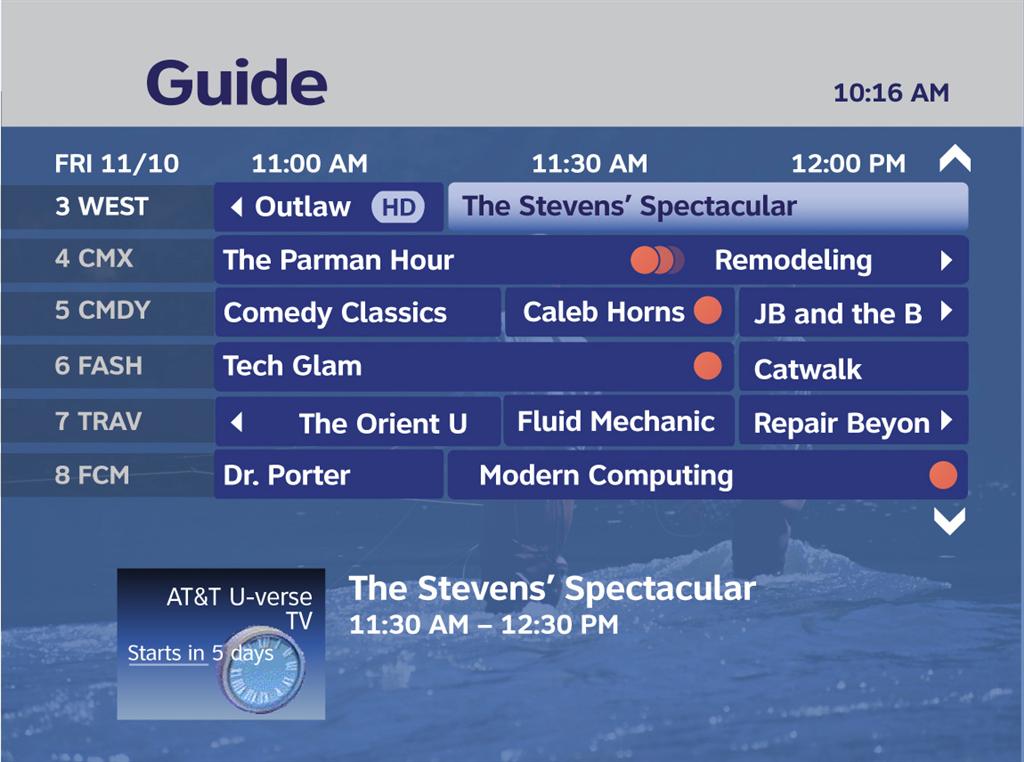
An Overview of AT&T U-verse television service

Unlike traditional cable services, AT&T’s U-verse is typically delivered on a copper wire and fiber optic based Internet Protocol network.  Not as advanced as Verizon FiOS, which provides a fiber optic connection straight into the home, AT&T’s system still relies in part on traditional copper phone wire that runs from the pole to your home.  AT&T uses this approach to save money — company officials claim 100% fiber networks are too costly to build, and Wall Street investors balk at the up front costs.

AT&T uses its fiber network from the phone company office to individual neighborhoods to reduce the distance between the homeowner and the company’s equipment, which delivers a digital signal across the customer’s existing phone line.  Just like DSL, the shorter the distance between the customer and the telephone company equipment, the faster the speeds.  AT&T U-verse requires fast speeds to handle the video channels, digital phone, and broadband components that are part of the U-verse product line.

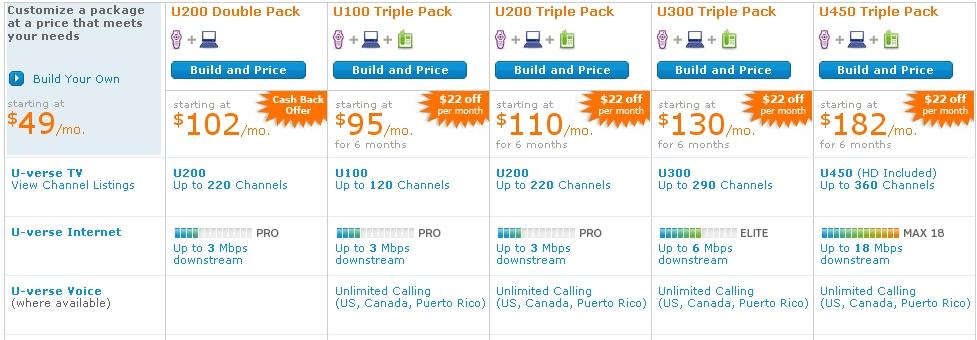
AT&T’s U-verse pricing ranges from $49 a month for an enhanced basic service package of 130 channels to $109 for 390 channels.  Premium channels are extra.  Plans include one AT&T set top box.  AT&T’s system will require a set top box for each television, at a monthly rental of $7 for each additional set, which can increase costs significantly for houses with several televisions.  An HD package runs $10 per month.  AT&T specials often include discounted or free installation, which takes between four to seven hours to complete and is only done on weekdays.  No contracts are required and customers can cancel at any time.
pricing

AT&T U-verse pricing in Memphis (click to enlarge)

AT&T claims that 70% of their customers choose a bundled package that includes television, broadband, and/or telephone service.

Company officials credited the passage of the Competitive Cable and Video Services Act, which became effective in July 2008, for paving the way for AT&T U-verse in the city.  AT&T’s praise also included crediting elected officials by name who supported the company’s lobbying efforts towards passage of that bill, which stripped cable franchising authority from local communities and adopted a statewide franchise system.

“We are thrilled to offer this innovative video choice to customers in the Memphis metropolitan area. As we celebrate this Memphis launch, I want to remember the contributions of the Tennessee General Assembly to open Tennessee’s video services marketplace to competition which is truly benefiting consumers. I would like to again thank Memphis area legislators including Speaker Emeritus Jimmy Naifeh, Senator Mark Norris, House Speaker Pro Tem Lois DeBerry, Chairman Ulysses Jones and the many others who supported competition and choice for consumers,” said Gregg Morton, president, AT&T Tennessee.

In turn, elected officials were quoted in AT&T’s press release:

“As Tennessee policymakers, our goal was to increase investment throughout the state and give consumers more choices and innovative new services,” said Senator Norris. “AT&T has been a great community citizen and the launch of AT&T U-verse also supports economic growth in Memphis.”

“We are excited that AT&T has brought their 100 percent Internet Protocol-based television service to Memphis,” said Chairman Jones. “Consumers in Memphis have asked for this and today, AT&T has delivered.”

<

p style=”text-align: center;”>AT&T Group President for Operations Support John Stankey discusses the company’s fiber strategy and provides an update on its progress in deploying its groundbreaking IPTV service, AT&T U-verse TV. (11 minutes)
You must remain on this page to hear the clip, or you can download the clip and listen later.

<

p style=”text-align: center;”>

The Municipal Technical Advisory Service, in association with the Tennessee Municipal League, noted that the lobbying effort to pass the Act was among the most expensive lobbying campaigns in state history.

This legislation is part of the national trend to diminish or eliminate the franchising authority of cities by granting cable companies the right to provide services without negotiating agreements with local governments.

In recent years, several cable companies operating in Tennessee permitted local franchise agreements to expire and refused to negotiate contracts with cities in anticipation that legislation would be adopted that would give cable companies great advantages in negotiating new agreements.

This tactic has paid off, as this law essentially grants a statewide franchise to these companies. Current franchise holders may now terminate their local agreements and seek a state franchise. A city that has previously negotiated a franchise agreement with one cable provider may be forced to permit other cable companies to serve its area under the same terms and conditions of the existing agreement

Such legislation has traditionally been advocated by telephone companies like AT&T and Verizon who are introducing video services in a bid to remain competitive with cable, which now offers its own telephone service.  Seen as a shortcut to negotiating with each individual municipality, the statewide franchise advocates claims it reduces the time and expense of bring needed competition to communities.

In addition to an expensive lobbying campaign, astroturfer FreedomWorks coincidentally showed up to promote their “Choose Your Cable” campaign, which in fact mirrors AT&T’s public policy advocacy of statewide franchising.

FreedomWorks Chairman Dick Armey commented, “FreedomWorks and our thousands of Tennessee members were proud to take part in the grassroots battle in Tennessee that finally saw this ground-breaking legislation through. We salute the Tennessee state legislature for its leadership in giving Tennessee consumers the advantages of increased competition in the video services market. The Competitive Cable and Video Services Act will offer cable consumers more choices and more innovation. And when businesses are forced to compete for customers, the customers win.”

Incumbent cable operators have had mixed reactions to such proposals, generally opposing them in areas where they would likely face the entry of AT&T or Verizon into their markets, and taking a more favorable approach in areas where they are unlikely to face a strong telephone company competitor.

In Tennessee, with AT&T itching to bring U-verse to state residents, cable operators launched a major opposition effort.

Local municipalities and many consumer advocates strongly oppose statewide franchising legislation, noting such laws remove local oversight over operators that do not perform responsibly and reasonably in their communities.  Additionally, in many states where statewide franchise bills have become law, local communities find franchise fees paid into state bodies that do not always pass on the full amount of that revenue to towns and cities.

Other common problems include:

  • Threatened loss of local Public, Educational, and Governmental (PEG) local access channels;
  • Reduced control over zoning regulations prohibiting digging and construction without permits;
  • Loss of “free service” provisions that deliver cable programming to public schools, community centers, and town, police and fire halls at no charge;
  • Loss of authority to help manage customer complaints.

In Tennessee, those opposing the legislation managed to get rid of statewide franchise fee administration, retained control over their existing PEG channels, and kept existing “free service” provisions, as well as reasonable zoning requirements.  However, the telecommunications industry did manage to include language banning municipally owned broadband networks in any area where an incumbent provider exists:

Memphis, Tennessee

Memphis, Tennessee

Broadband joint venture authority.

The law creates the “Tennessee broadband deployment fund” to be used to promote the deployment of broadband service to rural areas. Guidelines will be developed to govern use of the funds, and grants will be available to local governments, cable companies, and telecommunications companies.

Cities now have the authority to enter into joint ventures with one or more third parties to provide broadband services. Joint ventures will be authorized only in areas that are historically unserved. City electric companies and electric cooperatives that participate in these joint ventures must still comply with other applicable statutes, and no revenues from utility operations may be used to subsidize the joint venture.

Cable operators also managed some concessions, and after the bill was signed into law, the state cable television association said they could live with the result.

Stacey Briggs, executive director of Tennessee Cable Telecommunications Association:

“This has been a good process – not easy, but good – and Speaker Naifeh should be commended for managing this outcome on a highly complex policy.

The cable industry, including Comcast and Charter, stood firm to make sure that our members were treated fairly and that AT&T and other companies were not granted advantages in the law. And, most important for consumers, Tennessee’s cable companies will continue making substantial and meaningful investment in Tennessee. Cable companies will continue to be the leader in bringing the most advanced products, services and newest technologies to consumers across the state.

AT&T and other companies have had the right to compete under local franchising rules for more than a dozen years. This new policy streamlines the franchise process, but it remains to be seen whether new entrants will compete in Tennessee.”

After all of the lobbying was done, the bill was signed into law, and the competition FreedomWorks was touting did arrive, the only thing missing from the consumer perspective was lower pricing.

Comcast, the local cable operator serving Memphis, seemed unfazed by AT&T’s entry into the area.

“We have competed successfully against satellite TV and other competitors for many years,” said Trevor Yant, vice president and general manager of Comcast of Memphis. “AT&T will become another player in the market with the services they choose to offer.”

One of the possible reasons for Comcast’s apparent lack of concern may stem from the reaction of many Memphis residents, who note AT&T’s prices are often higher than those charged by Comcast.

Among the mostly unimpressed reactions on local message boards:

mrhmeisme:
“$109.00 for 390 channels doesn’t sound like a very competitive price for a yet untested product. That’s some 20 percent higher than my current package that has all the channels that interest me. I suppose the proof will be in the pudding.”

Not_Chicken_Little:
“The website for U-verse presents the packages very poorly, and the prices don’t seem to be any bargain. But I am glad to see some competition, even though I don’t think they’ll make much headway. They need to show what they’ve got in a more attractive and understandable way, and cut prices – they don’t make me even think of switching with the lame sales pitch they have now.”

dmat7777:
“I just did a comparison of cost between my current Comcast and the U-verse. For comparable services, U-verse would be about $15 more per month for me. Some of the packaging/options might look better. For example, the Flickr photo being included, but I’m more concerned about how much $$$ per month. I don’t see AT&T taking this seriously. They seem to be doing the typical huge corporate thing, and not addressing the customers real concerns. No surprise there.”

ChickPea:
“$49 a month is too rich for my blood. When someone offers a decent package available for $25-$30 a month, I’ll be in.”

Oddly, the most common requests and complaints among Memphis area residents continue to be unanswered by Tennessee officials who were eager to support the Competitive Cable and Video Services Act, but left out a few things:

umbluegray:
“I want a plan where I can pick and choose the channels I want. I hate paying money to some of the basic channels like MTV, etc.”

ladydonald:
“I would be a big fan of a-la carte programming if it were ever enacted.

A-la carte channels are a niche that all of the providers are totally ignoring. Just think what would or could happen if those options were available.”

Hogs2009:
“It would be nice if you could pick out what cable channels you want and skip the rest. 90% of cable channels I do not want but am charged for. I mainly have cable for sports broadcasting channels, like ESPN, ESPN2, and ESPN Classic. I also like having local on cable because it is more clear, again because some games are on local channels. A-la carte is a great idea!”

Many residents were also suspicious of just how good a local competitor AT&T will be against Comcast, which itself took over providing cable service formerly provided by Time Warner Cable:

DanWesson:.
“Since Comcast bought out service from Time Warner locally, our service has been sub-par. I have had technicians out the house multiple times due to inexplicably losing certain HD channels and internet service that continually drops or can be agonizingly slow, on par with dial-up some days (particularly the hot ones, which is very strange). Their technicians on the phone and who come to the house have been polite and friendly, but they aren’t exactly going out of their way to fix the problem.

Comcast also charges me more than Time Warner did in addition to charging a “modem-rental” fee when the cable modem was free from Time Warner and I haven’t exchanged it since the change.

All that said, I’m not sure AT&T is the way to go as their corporate practices are the worst in the Telecom industry. Customer service has always been non-existent as the customer is merely a cash-cow. I’m all for competition in the marketplace, though. If Direct TV didn’t require a contract that might would be the route I went, but I’d still be reliant on one of these other worthless companies for internet.”

Not_Chicken_Little:
“On the website trying to check availability, U-verse tells me it cannot find my address! It suggests I try again using my AT&T phone number instead and directs me to continue to another screen. That screen, however, has no option to enter a phone number – only the address.

So I already see the level of competence I would have to endure if I choose U-verse. And like dmat7777, I see that the price for comparable service would be considerably higher than what I have now.”

apollo1377:
“AT&T can’t handle phone service. Do you think they can take on more? I think NOT.”

ima_cracker:
“If AT&T could deliver a more reliable package some would pay more to get it.

Instead they are mortgaging the company’s reputation for wireline services, which they continually deride, to try and emulate the cable companies financial model, which has produced a reputation for reliability that is the envy of nobody.

If instead of trying to destroy the value in wireline AT&T decided to pursue a higher quality, more reliable service for cable, they could at some point expect to capture a substantial amount of market share. But they assume the consumer is too stupid to make the distinction between one service and another.”

ChickPea:
“AT&T websites are a perennial problem. Ever since BellSouth was taken over by AT&T, getting any information on local service online has been a struggle. A site map would probably look like a birds nest.
That said, I’m loving my AT&T DSL lite! Cheap and plenty fast for a non-gamer.”
Japanese & American Broadband Comparison: Internet Overcharging Scams Are Made in the USA

Phillip Dampier August 12, 2009 Data Caps, Public Policy & Gov't 9 Comments

Chiehyu Li and James Losey at the New America Foundation have completed an excellent comparison between broadband service overcharging schemes in the United States (and the slow speeds and high prices that accompany them), with broadband service in Japan, where download usage caps are unheard of, speeds reaching 1Gbps are priced at under $60 a month, and bandwidth throttling of peer to peer applications is uncommon at best.

chart1a

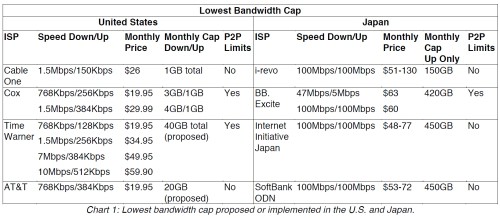
Although services offered by Japanese ISPs are more expensive than these “economy plans,” they are not only much faster but offer considerably more flexibility in terms of bandwidth consumption. In Japan, the lowest cap for residential Internet of the companies we researched is 150GB per month for upstream only, implemented by i-revo, a nationwide fiber ISP that provides up to 100Mbps symmetrical access. BB Excite, SoftBank and Internet Initiative Japan (IIJ) also imposed 420GB to 450GB bandwidth per month only on the upload side.

Although pricing is higher for some of the “economy” plans in Japan, customers there have no risk of running into overlimit penalties and fees punitively placed on customers’ bills when they exceed the paltry caps usually found on Internet Overcharging “economy” tiers.  With some charging $2-10 per gigabyte, it’s easy to send bills much higher with very little usage.

The report “demonstrates that bandwidth caps in the U.S. are more restrictive than in Japan. ISPs in Japan only cap upstream traffic, if at all, and few impose network management practices to limit bandwidth consumption. The results of this report should encourage policymakers to investigate market conditions in Japan to determine how and why their networks supports far more per-customer throughput than comparable networks in the U.S. Additionally, regulators and policymakers need to investigate why Japanese high-speed Internet subscribers get faster speeds at lower prices, with fewer limitations than subscribers in the U.S.”

Of course, it’s no mystery why American providers are seeking to impose various overcharging schemes on their customers — they want fatter profits, and will leverage the barely competitive broadband market to get them, especially if they think policymakers won’t respond with the appropriate oversight and regulation, where necessary, to protect consumers from monopoly/duopoly-leveraged pricing.

chart2a

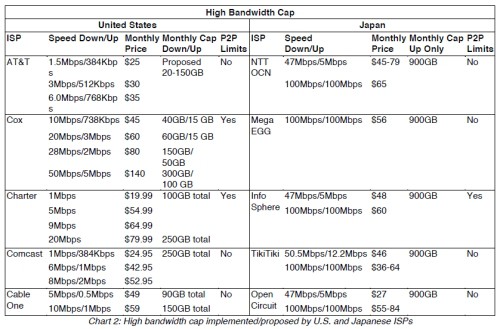
Even comparing the higher bandwidth caps in the two countries, including the highest priced residential plans, bandwidth caps in the U.S. are drastically lower and more restrictive than those in Japan. Chart 2 shows service options with the highest bandwidth cap in the two countries. U.S. ISPs such as Cox, Charter, Comcast and Cable One cap bandwidth from 20 GB to 250GB per month for combined up and downstream traffic for their higher-priced Internet services. Among these ISPs, Cox has the highest monthly caps, offering 300GB for downstream and 100GB for upstream to Ultimate Package subscribers (50Mbps/5Mbps). Comcast caps bandwidth at 250GB a month, combined upstream and downstream, for all tiered Internet services. Continuing the U.S. trend towards more restrictive Internet service, AT&T has proposed bandwidth caps of 20-150GB a month. In addition, some of these ISPs have imposed network management on users’ Internet traffic.

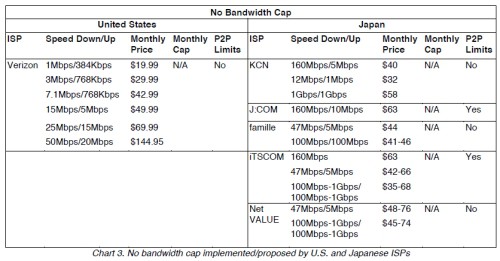
The United States has one major multiple cable system owner that has sworn off these schemes – Cablevision.  A few competitors, including Grande Communications, found in Texas, also advertise they will not impose limits or schemes on their customers.  Frontier Communications has promised its customers it will not enforce any limits on its broadband customers until further notice either (although we’d prefer they eliminate the 5GB Acceptable Use language from their terms and conditions).  Verizon is perhaps the most important non-capper, at least for now.  It has no current plans to implement Internet Overcharging schemes on its customers.

chart3a

Once again, the United States is heading backwards in broadband pricing, speed, and freedom for customers to use their service as they see fit.  Instead, providers with Internet Overcharging schemes seek to limit broadband usage to extract maximum potential profits, and protect their video business from online competition.  The fundamental question for the future will be, who controls America’s Internet?

Limbo Dance Redux: Bell Canada Lowers Usage Allowances on Customers, But Sells Usage Insurance for “Peace of Mind”

Paul-Andre Dechêne July 13, 2009 Bell (Canada), Canada, Data Caps 8 Comments
Bell's Usage Allowance and Speed Chart (click to enlarge)

Bell's Usage Allowance and Speed Chart (click to enlarge)

Broadband Providers: How Low Can They Go?

Broadband Providers: How Low Can They Go?

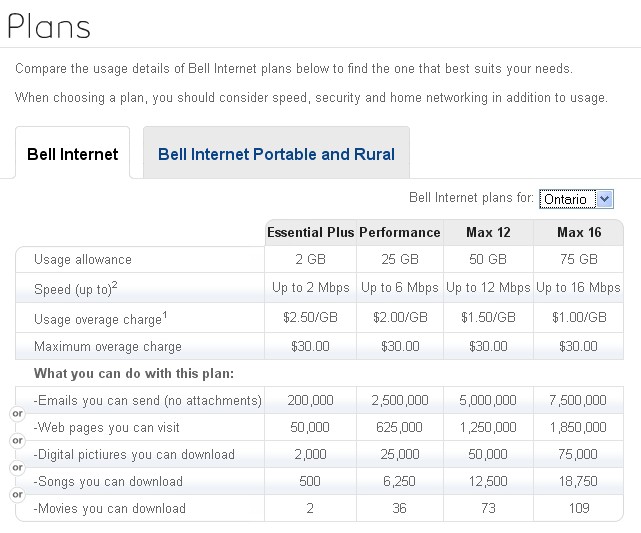
When a broadband provider insists on the need to implement Internet Overcharging schemes on their customers to control costs and “manage their network,” it’s a safe bet they’ll also manage to find a way to increase your bill.  Bell, one of Canada’s largest Internet service providers, has reduced usage allowances on some of their popular Internet service plans, in some cases substantially.

Usage Allowances

Essential Plus:  2GB usage allowance (was 20GB)
Performance: 25GB usage allowance (was 60GB) (Bell’s most popular plan) 

Customers can now purchase “Usage Insurance” policies from Bell for “peace of mind” in case they go over plan limits starting at $5/month, which provide additional allowances.

Bell claims the reduction in usage allowances comes with reduced pricing for broadband service, but many customers who forget to purchase “insurance” could be subjected to overlimit penalties of $2-2.50/GB, with a maximum penalty of $30 per month.

Bell customers looking for a place to complain have one less place to do so: Bell pulled the plug Friday on their support forum, popular with thousands of Bell customers looking for support or to share their feelings about Bell service.  The company has remained silent on the reasons for doing so.  No warning or advance notice was given.

On the Telecommunications Battlefield: Communiques From The Front Line

Phillip Dampier August 7, 2008 Competition, Frontier 5 Comments

Frontier vs. Time Warner. Frontier vs. Comcast. Frontier vs. NPG Cable. Across 24 states, passing nearly 3,000,000 households, some in America’s smallest towns and others in large cities, Frontier Communications is engaged in a battle of survival in an increasingly competitive American telecommunications marketplace.

In this series examining Frontier Communications, today’s report investigates the competitive realities of a hotly competitive telecommunications industry, becoming more concentrated by the day.    How does Frontier intend to survive and grow, and is it realistic to assume it can in an environment that demands major investments in the delivery of high quality video, low-priced telephone service, and reliable broadband that may be beyond its reach?   Yesterday, we saw how Frontier is attempting to control expenses with the plan to implement a 5GB usage cap on its broadband customers.   Today, we take a look at how Frontier attempts to maintain its market share and deal with customer defections.   Tomorrow, we take a closer look at how quickly Frontier’s telephone line business is losing ground to its competitors.

Frontier’s Background At A Glance

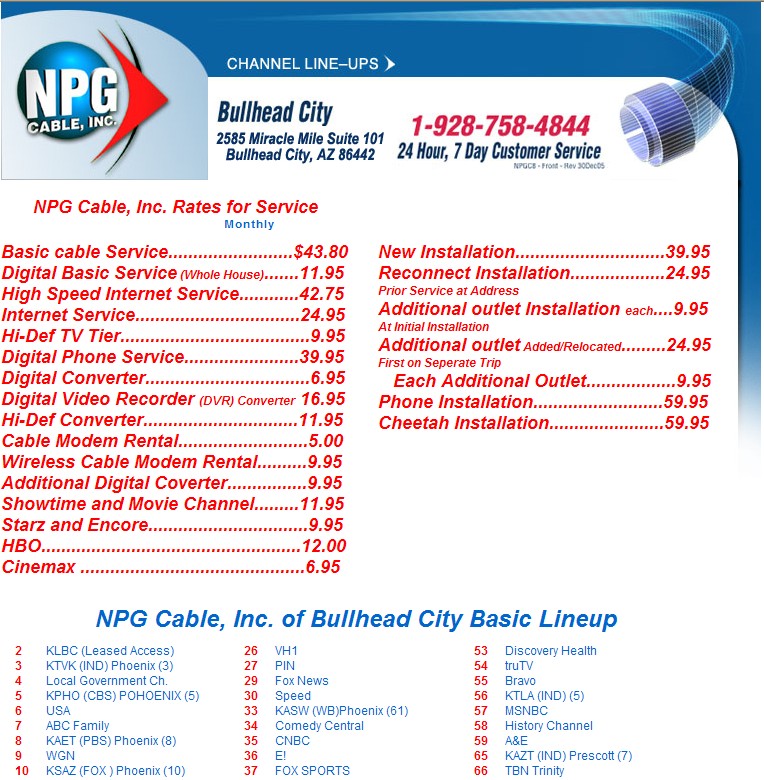
NPG Cable's Rate Card & Channel Lineup In Bullhead City, Arizona. How much of a competitive threat is a cable company without a spellchecker?

Frontier Communications, formerly Citizens Communications, primarily runs originally independent telephone companies in rural and exurban areas bypassed by the former Bell System. The company’s most significant presence is in the 585 area code, home to Rochester, New York. But from Elk Grove, California and Bullhead City, Arizona eastward to the AuSable Valley in central New York to Bluefield, West Virginia, a significant number of Frontier customers are also in some of America’s  small towns and cities.

The size of a community where Frontier operates is often indicative of how much competition the company faces.  Some of Frontier’s most difficult challenges can be found in the  Rochester, N.Y. metropolitan area, numbering nearly 1,000,000 people, where a well entrenched Time Warner has made deep inroads into Frontier’s telephone access line business, eats Frontier for breakfast in the video delivery business, and has been a dominant player in the broadband marketplace since Road Runner arrived  in 1998.

In more rural communities, Frontier often has it much easier,  free from  cable competition  in some  areas, or  competing with a small independent cable company that may be relying on its own aging infrastructure and cannot afford to engage in price and service wars. Where Frontier stands as the lone player or only faces token competition from a small cable company, consumers will likely find  lower speed broadband at higher-than-average prices.

The Threat From Big Cable

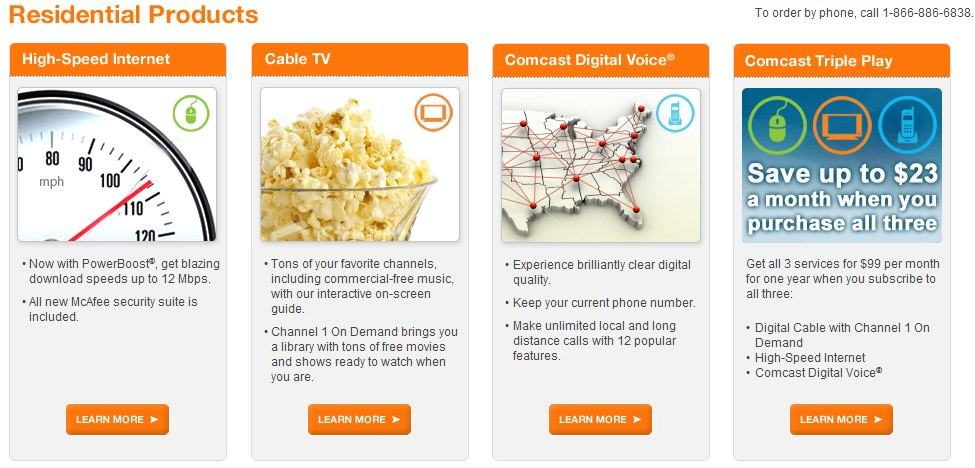
Comcast's Product Bundles Threaten Frontier In Many of Their Service Territories

Comcast's Product Bundles Threaten Frontier In Many of Their Service Territories

The cable television industry’s entry into telephone service  is among the biggest threats Frontier faces in maintaining their traditional primary revenue source: residential and business wired telephone lines.

Deploying  voice over IP technology, Comcast and Time Warner, the nation’s largest cable operators, have made significant inroads into Frontier’s telephone business where they compete.   Now, even smaller players in the cable industry are prepared to offer voice over IP service to customers.

Joining cable at the table are  mobile telephone companies like Verizon Wireless, Sprint, and AT&T which are also eroding Frontier’s  phone line business  as more people in America  rely exclusively on their mobile phone for telephone service.

How Cable Companies Pick Off Frontier’s Customers

Product Bundling & Discounting: The most important component of cable’s strategy against Frontier is cable’s product bundle, combining a voice over IP telephone line, a cable television package, and a high speed data product. Usually marketed as a “triple play” or “all the best” package, consumers are offered discounts based on the number of components of a package they combine. The more components, the greater the discount.

The product bundle offered by the cable industry has a competitive advantage because cable companies almost always have a more advanced network to deliver these products. Throughout the 1990s, most cable systems spent millions rebuilding their systems to accommodate increasing bandwidth requirements.   The result is a considerably larger pipeline used to deliver data, video, and telephone services.

Frontier’s network is considerably more dated, largely dependent on copper wire strung on telephone poles. While the company has made significant investments in their own  network, including some fiber optics,  in the end, they still rely on the same copper wire infrastructure the industry has used for nearly 100 years to connect to your home or office.

AT&T's U-verse service can deliver the goods over copper wire, but you need deep pockets to develop and deploy this technology.  Are Frontier's deep enough?

AT&T's U-verse service can deliver the goods over copper wire, but you need deep pockets to develop and deploy this technology. Are Frontier's deep enough?

Although this copper network is suitable for traditional telephone service, and can usually deliver a respectable data service over DSL, the video component has been sorely lacking. While AT&T is testing its U-verse video-over-copper technology in limited markets, Frontier is stuck  reselling Dish Network, the  smaller player in the satellite television marketplace.

Many consumers are resistant to satellite dishes of any size attached to their homes, and the cable industry’s response to Frontier has been the same as to DirecTV and Dish Network themselves: ugly satellite  dishes that suffer from rain/snow fade, require expensive service calls and maintenance, and a limitation on the number of TV sets you can hook up.   Also, no local channels in many areas.   In the end, most people who were even slightly uncomfortable with satellite-delivered TV elected to just stick with what they already had: cable television.

Results of the Dish Network partnership continue to be underwhelming. Sources tell Stop the Cap! the satellite service only succeeds in areas where there is no cable competitor, the customer was already a Dish Network subscriber independent of Frontier, or the incumbent cable company is hampered by a limited channel lineup, no HD channels, or exceptionally bad service. In Rochester, Frontier is actually losing more Dish Network customers than it is adding, and growth is  anemic in many other Frontier regions as well.

Frontier’s inability to provide a comparable quality television service is a critical defect in their competition with cable.

Claiming Inferior Product Quality:  The cable industry wasted no time attacking Frontier’s DSL product, accusing it of not performing consistently. Uneven telephone line quality, distance from the telephone company central office, and signal ingress (when interference or crosstalk gets into wiring and degrades the signal) can all dramatically slow a DSL customer’s  broadband speeds. The cable industry’s marketing often pillories DSL service because of its inability to offer anything close to a speed guarantee, and the fact  it is often slower than cable’s competing product no matter how good your line is.

In areas where a large cable competitor exists, traditionally  that cable operator will have the fastest speed broadband package to sell to customers in that market. This forces Frontier to compete on price.   In return for a significant discount, Frontier  usually locks customers into multi-year service agreements which discourage its customers from  switching to a competitor.   Unfortunately, the company’s inferior product bundle and  long term contract commitments have made it difficult to convince cable customers to switch to Frontier,  particularly if it means taking their video package from Dish Network.

Lampooning Questionable Marketing Practices: In Rochester, Time Warner’s marketing people have had no trouble finding new ways to attack Frontier in its advertising.   While Frontier may be able to pull off some of their hidden extra charges, long term contracts, and restrictive service policies in more rural communities, most of those practices meet strong criticism in Time Warner’s advertising.

Among the more common refrains in Time Warner ads  dismissing Frontier’s DSL  product include:

  • Charging a “modem rental fee” as part of Frontier’s DSL service, even if you can supply your own DSL modem.

  • Locking customers into a term commitment contract (often lasting several years) for DSL service that offers lower speeds than Time Warner’s Road Runner service and charging a substantial early termination fee for those dissatisfied with their broadband experience.

  • Charging for ancillary support services like Frontier’s “Peace of Mind” that Time Warner claims to offer at no charge.

The latest decision to impose a 5GB usage cap on customers is marketing gold for the cable companies competing with Frontier, perhaps only tempered  by the fact they are also studying whether to apply their own usage caps.

Relentless Marketing: One of the fringe benefits of owning your own video distribution network is the ability to pepper your existing customers with near-constant advertising promoting your own products while denigrating the competition. Cable customers can see an average of three product promotion spots every hour from their cable company trying to convince them to upgrade, attempting to bolster customer loyalty, or simply slashing and burning whatever the telephone company or satellite dish company is offering. Frontier has  a limited ability to counter this.

In areas of significant competition, the battle usually rages in your mailbox, with  a relentless flood of  promotional postcards and mailers, as well as ad buys on local television/radio stations and local newspapers. But cable retains an important advantage because of their ability to insert advertising into basic cable channels, usually at no cost to them.   Frontier doesn’t own their video distribution network – they are reselling someone else’s.

Frontier’s Battle Plan

Welcome to DeLand, Florida: Home of Frontier's Customer Care Center

Welcome to DeLand, Florida: Home of Frontier's Customer Care Center

Frontier’s plan to compete with cable includes  their own marketing by mailbox, and sponsoring local community events and charities to leverage free media and consumer exposure to the company brand to nurture positive feelings  about the company.

The company also places a high priority on attempting to position themselves as “local” players in the market – a company made up of local employees who customers supposedly will interact with on a daily basis. Unfortunately for them, most customers will likely only interact with one of their customer care call centers such as the one  in DeLand, Florida which is localism IF you live, work and play in DeLand.

Frontier also maintains call centers in Henrietta, New York and Burnsville, Minnesota which are designed to replace what used to be local customer service call centers in more than a dozen  Frontier areas.   Some 500 people were hired to answer phones in DeLand for Frontier.   This begs the question how many people lost those jobs in the various local communities where Frontier operates.

Call center employees are on Frontier’s competitive front line, trying to  maintain customer loyalty, convince customers to upgrade their service packages, and above all, remain with Frontier and don’t cancel anything.

They need to maintain the battle, because cable competitors continue to erode their residential business. The company’s deactivations of high speed data services and the ongoing loss of telephone lines are considerably above the company’s own estimates.

One significant bright spot Frontier has maintained is delivering commercial broadband to businesses.

Frontier has a significant advantage in many offices, business parks, and other industrial areas bypassed by their cable competitors. Installation costs to wire a building with coaxial cable often run into the tens of thousands of dollars, an expense borne by the company, the landlord, or a combination of the two. But every business has telephone service, which usually guarantees potential access to DSL service from Frontier. Small and medium sized businesses have become loyal Frontier commercial customers because of low installation costs and a reasonable pricing plan that is typically far more cost effective than what cable is offering. Cable modem commercial access pricing models are usually tailored to a range of product speeds at prices that, when compared with what Frontier can offer, are not competitive.

Frontier’s ability to effectively compete against cable will, in the end, come down to the company’s ability to invest in their network and be able to match what is on offer from the cable operator, and new competitors yet to emerge.    Some former Baby Bell telephone companies like AT&T are investing enormous sums to leverage their existing network (their U-verse product) or starting over from scratch (Verizon’s fiber optic cable to the home FIOS project).

To date, Frontier’s status as a smaller player has meant their investments in these efforts pale in comparison to their larger brethren.   They include experimenting with deploying fiber optic cable to new housing developments and selected mass density buildings (apartments, offices) in Rochester, building community wi-fi networks to create a new market for wireless Internet access, and other investments in their network distribution system.   If they cannot invest enough, fast enough, to keep up, they will become ripe for a merger with a larger player in the market or get wiped out by the competition.

In the meantime,  to quote company chairwoman and CEO Maggie Wilderotter, Frontier intends to “stay the course” for the rest of the year.

We’ll have to wait and see if that’s good enough.

Frontier Website: Cap Language Revised, But Inconsistencies Remain

Phillip Dampier August 6, 2008 Data Caps, Frontier 9 Comments

Frontier’s webmasters have been working overtime today apparently doing some damage control, as well as issuing some clarifications about their new usage caps.   But like much of the mixed and muddied message customer service representatives are sending customers, the website now contains several inconsistencies and contradictions between the product description page and the Acceptable Use Policy.

Because of the changing story, we’ve decided to begin capturing and saving select pages from Frontier’s website and will be adding them to a new Reference Library under construction.   From there, you can download and save Adobe PDF versions of captured web pages, dated for your convenience.   Unfortunately, with the shifting positions of Frontier, what may be on the website today may be gone tomorrow.   If engaged in an effort to cancel service, it may be useful to have some of these pages available to reference, because customer service representatives may not be able to locate them.

Let’s breakdown what has changed in the last 24 hours.

First, it’s obvious readers are making a difference.   Frontier realizes they have a public relations problem on their hands of their own making.   The complaint calls and cancellation requests have clearly made an appropriate impact on the company, although not to the point of shelving the idea of a usage cap.   The company has instead decided to try and manage the story more carefully in hopes of controlling the message.   Unfortunately for them, as long as they want to impose caps on customers, we will be here to debunk the fictional excuses, expose the inconsistencies, and educate consumers about why they should not be convinced that less equals more.

Second, the original Acceptable Use Policy dated July 23, 2008 for residential customers remains in place:

Customers must comply with all Frontier network, bandwidth, data storage and usage limitations. Frontier may suspend, terminate or apply additional charges to the Service if such usage exceeds a reasonable amount of usage. A reasonable amount of usage is defined as 5GB combined upload and download consumption during the course of a 30-day billing period.

This is now in direct contradiction with a new section attached to the product information page for the residential DSL product, which includes this new language:

If I hit 5GB will my service be interrupted?
No. Your service will not be interrupted at 5Gb. You will continue to use our High Speed Internet service without disruption.

Does Frontier plan to limit my use of the Internet?
No, there are no plans to limit customer usage. On average a Frontier High-Speed Internet customer uses less than 1.5GB per month. Frontier residential High-Speed Internet service comes with 5G per month (about 5,000 Megabytes), which is more than double the monthly consumption of most of our subscribers.

We appreciate the company’s apparent new policy not to suspend or terminate accounts for exceeding their 5GB usage cap, but their Acceptable Use Policy requires immediate revision to ensure consistency.

Third, the newest promotional page includes this laugh-out-loud passage.   If you are seriously considering imposing a draconian usage cap of 5GB, which is obviously so unacceptable to a significant number of your customers that are calling to complain and cancel service, maybe this passage  is just pushing things a little too far:

We all love the Internet, and Frontier is committed to offering you all the bandwidth you need and want to take full advantage of the Web! Our basic residential Internet packages offers 5GB usage — that’s the equivalent of 500,000 basic text e-mails, 2,500 Photos, 40,000 Web Pages, over 300 Hours of Online Game Time, 1,250 downloaded songs, or a mixture of the above!

This kind of writing convinces me the folks in Frontier’s Marketing Department have finally joined the party.   Welcome aboard, but remember, if customers were upset enough to protest a 5GB usage cap, rubbing it in their face by telling them you love the Internet and are committed to offering all the bandwidth “you need” (if the year is 1988 and you have a 1200bps dial-up modem) will be seen as fighting words.   Telling customers 5GB a month lets you take full advantage of the Web is fine, if you never do anything except browse low density web pages.   Maybe we can Gopher and Telnet some things as well.   Somehow I doubt the marketing people will understand the irony of either.

The rest doesn’t get much better.   If Frontier wants to learn more about The Internets, they can use The Google to read about average customer reactions to broadband user caps and exactly what defines a “power user.”   Someone who exceeds 5GB a month hardly qualifies.   Also, another inconsistency:  If Frontier has not implemented a usage cap plan, then why does the language implementing it remain in the Residential Acceptable Use Policy?

What are “bandwidth caps” and what does it mean for Internet users?
“Caps” are thresholds where Internet Service Providers could deem usage in excess of “normal” usage. For the majority of our users, bandwidth caps will not be reached. However, some users have multiple servers or computers or download huge files that demand large amounts of available bandwidth. In response to these “power users,” the industry is moving toward “tiered usage” plans that would be applicable when consumption reaches certain bandwidth levels. This type of plan would result in heavy users paying for their fair share of usage and will make sure that average users do not subsidize high-usage consumers. Other Internet Service Providers like Comcast and Time Warner are testing these tiered usage plans. Frontier has not implemented tiered usage plans and will continue to evaluate if and when they would be necessary. If and when Frontier implements a tiered usage plan pricing and usage information will be communicated to all High-Speed customers.

Before we go, let me add there is a bit of good news from Frontier today, which is to their credit, assuming they publish this policy in the form of a written guarantee to customers, which amend their term contracts to assure them this language will remain in place regardless of if it appears on the website or not.   Until a written assurance is in hand, a promotional  blurb on a product description page is  insufficient to make me withdraw my recommendation to cancel service within the 30 day opt-out window:

If Frontier rolls out tiered usage plans, will my Pricing / Plan change if I am on a Frontier Price Protection Plan?
Pricing for customers on Frontier’s Price Protection Plan will not change during your initial term commitment if we roll out tiered usage plans.

This language should be slightly modified to state that any overage fees for bandwidth in excess of 5GB do not apply to Frontier Price Protection Plan customers, and that no penalty or disruption in service will occur if a customer exceeds the 5GB usage cap planned for more  formal implementation in the near future.   Assuming that language is in place, it means that customers on a 12-36 term commitment will not have to worry about any usage caps and they will not apply to them for the remainder of their contract. But, again, an inconsistency remains here as well.   The Acceptable Use Policy clearly states the 5GB limit is in place right now.   Further reference to this should also be included on the Terms & Conditions page, which also contains the opt-out clause, to clarify that usage caps do not apply to customers with a contract that does not specifically include them.

Stop the Cap! continues to call on Frontier to discard the usage cap limitation altogether.   Next week, we’ll have some better ideas for Frontier to consider that will not alienate their customer base and positions them to begin competing more effectively in their service areas.

This article was updated at 11:58pm, August 6, 2008 and replaces language from an article entitled “Breaking News” posted earlier this evening.

Search This Site:

Contributions:

Recent Comments:

Your Account:

Stop the Cap!