AT&T’s effort to aid powerless areas of Brooklyn with mobile charging stations to help customers recharge dead cell phones fell flat when the company sent the trucks without the equipment needed to charge phones.
Timothy Stenovec reported from the Red Hook neighborhood:
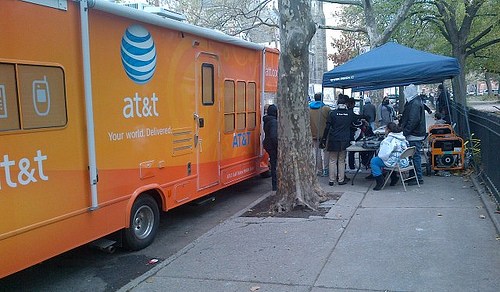
In Coffey Park, just steps from where the National Guard was helping distribute food and water to residents, a large AT&T truck sat, two orange generators resting silently on the sidewalk next to it.
Despite the company’s intention for the vehicle to serve as a mobile power station, the truck was waiting on equipment necessary to charge phones, and had been turning people away all day.
Marie Reveron, who is 57 and has been without power since the storm, said she waited at the truck for more than two hours on Friday morning, expecting the equipment to arrive so she could charge her phone.
“Phone service is the most important thing, and now my phone is on its last, dying bar,” she told The Huffington Post. “Sometimes you have all the bars, and the phone won’t even work.”
AT&T is allowing the general public into area AT&T stores and portable charging centers to recharge their wireless equipment, at least when the equipment needed to do that shows up. (2 minutes)
As of Monday, Nov. 5, charging stations are available at the following locations. The stations are open to the general public.
Brooklyn:
Red Hook East and West – Coffey Park at Richards Street
Corner of Brighton Beach Avenue and Coney Island Avenue
Surf Avenue Playground – West 25th Street and Surf Avenue
Manhattan:
Fulton Street Houses – 419 West 17th Street between 9th and 10th Avenues
Hamilton Fish – Pitt Street and East Houston Street
Queens:
Hammel Playground – Beach 84th Street and Rockaway Beach Boulevard
Conch Playground – Beach 44th Street and Rockaway Beach Boulevard
Mott Avenue at Beach Channel Drive
St. Francis de Sales Parish – 126-16 Rockaway Beach Boulevard at Beach 129th Boulevard
Staten Island:
Midland Beach – Hunter Avenue and Father Capadanno Boulevard
Parking Lot – Mill Road and New Dorp Lane
Other New York Locations:
Floral Park (store) – 181 Jericho Turnpike
New Jersey Locations:
Edgewater Square (store) – 75 River Road
Watchung (store) – 1592 Route 22 East
Point Pleasant Beach (The Wireless Experience – Authorized Retailer) – 3122 Route 88 and Highland Drive
As of yesterday, AT&T reports 98 percent of their cell sites are up and running across the region impacted by Hurricane Sandy, with 94 percent in operation in metropolitan New York City.
The Star-Ledgerreports things in New Jersey may be worse.
AT&T brought in hundreds of generators to power cell towers, according to company spokeswoman Ellen Webner, but she said keeping them topped off with fuel has been a challenge. Webner told the newspaper the company will talk to customers who want their bill adjusted for outage time.
AT&T carefully tracks its generators now being deployed to cell sites still without power. But some critics wonder why generators are not on site before disaster strikes. (2 minutes)
AT&T cannot easily bring back cell sites that lack backhaul connections to Verizon’s central offices, some still non-operational due to severe flood damage. AT&T shows off emergency equipment that can establish a temporary microwave backhaul link and restore cell service. (2 minutes)
That scenario could come true for customers in New York, Ohio and Indiana. Frontier last week unveiled FTR Energy Services, an energy reseller planning to supply 100% green electricity in selected markets in New York and Ohio and natural gas in Indiana.
FTR Energy Services is a wholly-owned subsidiary of Crius Energy, launching service Nov. 19 with a business plan that claims there is convergence in the broadband and energy sector.
Frontier is likely to combine its marketing efforts with Crius Energy’s products — selling electric and telecommunications services together. Some expect Frontier will even extend bundling discounts to customers who sign up for both.
Third party energy suppliers were supposed to spur lower prices for consumers and businesses by encouraging innovation in the power generation industry. But significant savings, especially for residential customers, have proved elusive. Complicated pricing and contract terms have led to confusion and high customer turnover. Many customers eventually gave up shopping around and returned to the original utilities that have supplied power for generations. For today’s energy competitors, finding a marketing edge can be the key to growth when customers are skeptical and resistant to change.
Crius is hoping its green energy angle will attract environmentally-sensitive customers and Frontier hopes the bundled marketing offers it can blanket across its service area might deliver higher average revenue from customers — a key demand from Wall Street.
Most third party resellers enjoy modest wholesale pricing discounts, so any profits earned from reselling energy to customers are expected to be modest as well. But Frontier hopes the more services it can bundle for customers, the more “sticky” their products become. With bundled discounts and term contracts, it can become an expensive and complicated process to sign up with another provider. So many customers simply don’t.
Some of Comcast’s customer service representatives and their supervisors could care less more than a million east-coast residents remain without power and thousands may no longer have a home.
Priority #1: Where is our equipment? If you can’t find it, you are going to pay for it.
Yes, once again the company that redefines lousy customer service is back to illustrate why their reputation as the 4th Most Hated Company in America is well-earned. The Don’t Care Comcast Customer Service Bears in Kabletown call centers are only too happy to give the desperate in New York, New Jersey, and Pennsylvania a hard time.
Blogger Seth Clifford (via the Consumerist) doesn’t need Comcast’s attitude problem. His parents have already lost one home and are on the verge of losing another.
[My mother] was trying to explain to them that they stood to lose the entire house in an explosion and that the authorities were having trouble even reaching the area to cut the gas to prevent this. She mentioned that she wouldn’t be able to return the cable box and equipment because the storm had basically destroyed the area, and the house was perilously close to being destroyed completely as well.
Comcast’s reply to her?
We’re very sorry, but the price of the equipment will be charged to your account if you’re unable to return it.
That’s right: in the middle of a natural disaster, the worst our area has seen in decades, at a time when my parents have already lost one house and stand to lose the other, as well as everything in it (remember, it’s not a rental so it’s fully furnished and they live there for part of the year – there are family keepsakes, antiques, and the like) – at a time like this, Comcast has essentially told my mom “tough s***”.
She spoke to a supervisor who echoed the same thing. Comcast was very ‘sympathetic to the situation’, but according to policy, the company must assess fees against unreturned equipment, no matter the situation.
Devastation on the coast of New Jersey
This is hardly the first time we’ve seen Big Telecom Companies Behaving Badly when Mother Nature strikes.
The worst companies just don’t care until someone in the media embarrasses them sufficiently to realize the cost of a cable box isn’t as great as the drubbing they are about to get on the 6 o’clock news.
Once exposed, damage control kicks in. The flower arrangement is on the way and the “we’re sorry” card is in the mail.
Too bad the flowers are not for everyone. For those whose stories never go viral, the response often remains “pay up or we’ll ruin your credit for years.”
Comcast is a long way from its “Comcast Cares” motto:
“It’s a wonderful thing to have people work together for the benefit of others.”
Clifford is disgusted with the realization Comcast only cares about itself:
Comcast does care. It cares about reclaiming equipment in the face of unspeakable disaster. And about charging fees for equipment that does not get returned, even if there is no physical way within the realm of possibility in which to do it.
Comcast, does not, in fact, care at all about you. Not even a little. House burned down? F*** you, pay me. House about to explode at any minute? F*** you, pay me.
After the Consumerist shined their flashlight on Comcast’s house of corporate evil, the inevitable apology was on the way:
We have already reached out to apologize for adding to his parents’ difficulties and to ask for his parents’ contact information so we can call to personally apologize and assure them that we are handling the equipment without the need for them to do anything further. Please know we are working with our teams to ensure we handle all customer calls on a case-by-case basis with sensitivity to the devastating effects Hurricane Sandy had on so many of our local communities and residents. Again, we are of course notating his parents account to ensure they are not charged for equipment they can’t return.
Hey Comcast: how about “notating” every customer account in the northeast pummeled by Hurricane Sandy to ensure the flying monkeys customer service reps in the call center don’t abuse anyone else? Comcast’s “case by case basis” is loophole language that could leave customers shelling out hundreds in lost or damaged equipment penalties.
Phillip DampierNovember 1, 2012IssuesComments Off on Cell Service Deteriorating in NY, NJ; Verizon Regarding Damage: “It’s Worse Than 9/11”
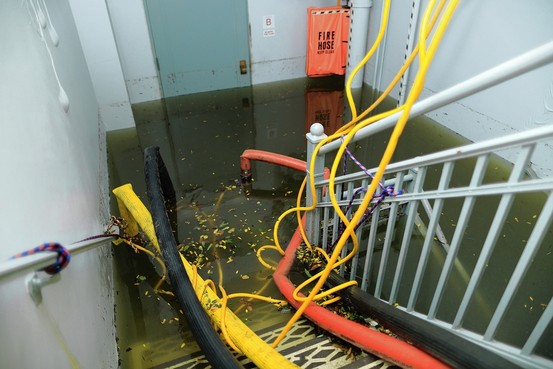
Verizon’s flooded headquarters on West St., lower Manhattan (The Wall Street Journal)
As cleanup efforts continue across New York, New Jersey, and Connecticut, some of America’s largest telecommunications companies are coming under increased scrutiny for being caught flat-footed after Hurricane Sandy roared across the tri-state region, causing damage Verizon’s chief technology officer now admits is worse than 9/11.
As of this morning, Verizon Wireless’ network is reportedly straining, particularly in Manhattan and Brooklyn, where cell service that worked immediately after the storm is now increasingly failing.
Verizon said 94% of its cell sites were operational after the storm, but some local officials in the area believe 94% of Verizon’s wireless network has now failed them when they need it the most.
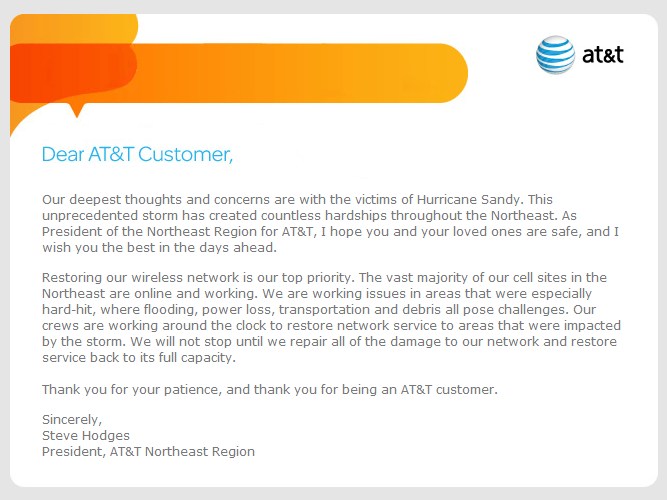
Many telecom companies, particularly AT&T, are being criticized for excessive secrecy about the ongoing state of their networks post-Sandy. AT&T, which left its customers in the dark about service restoration as late as last night while asking customers to contribute $10 to the American Red Cross, finally mass e-mailed customers a statement devoid of much detail signed by Steve Hodges, president of AT&T’s northeast region.
“Restoring our wireless network is our top priority,” Hodges writes. “The vast majority of our cell sites in the Northeast are online and working. We are working issues in areas that were especially hard-hit, where flooding, power loss, transportation and debris all pose challenges. Our crews are working around the clock to restore network service to areas that were impacted by the storm. We will not stop until we repair all of the damage to our network and restore service back to its full capacity.”
The Federal Communications Commission correctly predicted the situation with mobile phones could get worse before it gets better, as backup power wears down and flooding persists. At a press conference held yesterday, FCC chairman Julius Genachowski revealed at least a quarter of all cell sites in areas damaged by Sandy were not operational. Those numbers were less optimistic that those provided by carriers.
The FCC this week activated the Disaster Information Reporting System, a central reporting point for telecommunications companies to update the agency regarding outages and other service disruptions. The FCC also alerted providers that in emergency circumstances, they can assist companies getting fuel for generators and help locate portable cell tower equipment for companies caught unaware.
AT&T’s belated letter to customers affected by Hurricane Sandy
Some may need the help.
New York State Assemblyman Alec Brook-Krasny and Brooklyn Borough President Marty Markowitz both reported Verizon Wireless’ outages are worsening in Brooklyn and midtown Manhattan.
Brooklyn Borough president Marty Markowitz
The Federal Emergency Management Agency (FEMA) today told Sen. Chuck Schumer the federal agency will reimburse New York for 100 percent of the costs incurred restoring power across the storm areas. But that may not expedite how quickly power returns.
Power restoration is expected to bring most cell towers back online. Worsening service is being attributed to battery backup or generator equipment exhausting on-hand fuel supplies, which usually keeps service up and running for up to three days. That means cell towers without power and unreachable by workers will have begun failing late Wednesday into today.
Damage assessments are further behind in New Jersey, the state that took the worst impact from Hurricane Sandy.
Stop the Cap! obtained some new figures from cell phone companies regarding the state of their networks:
Verizon: Still holding to 94% operational in storm areas;
AT&T: Declined to comment except to say “the vast majority” of their network is operational;
T-Mobile: 80% operational in NYC, 90% operational in Washington, D.C.
Verizon’s critical network takes another hit. “We’ve been here before,” says one Verizon executive, referring to the destruction from the 9/11 terrorist attacks which severely damaged the same facility on West Street now flooded out. (3 minutes)
Our readers report that cell service becomes spotty to non-existent in coastal New Jersey and Connecticut. In Manhattan anywhere south of 29th Street, readers report almost no signals at all.
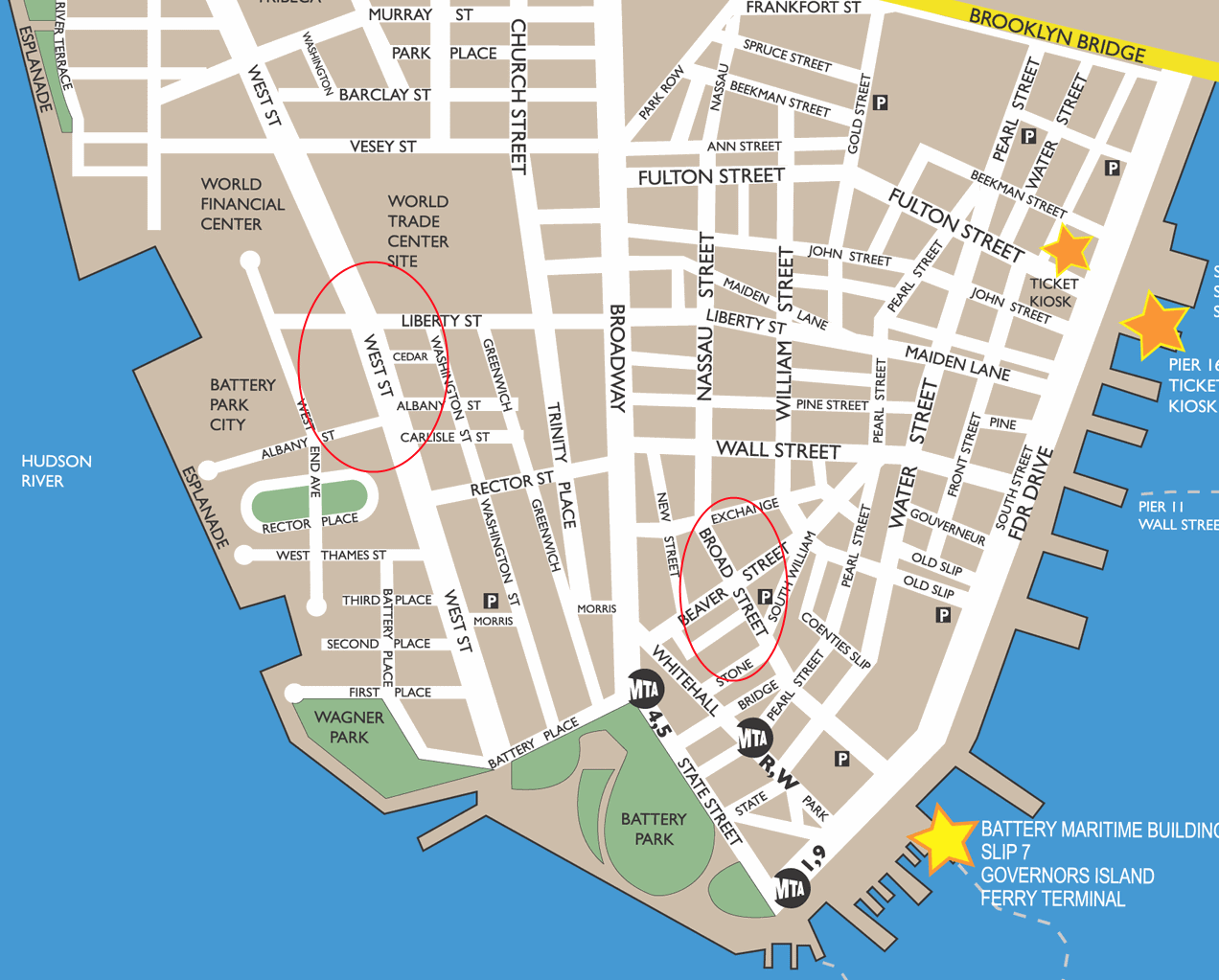
Verizon’s damaged facilities include those on West and Broad Streets in Manhattan (circled).
Residents are trading tips about “magic spots” where cell service does suddenly pop up, and Gizmodo notes the only place in Alphabet City (the east side in southern Manhattan) to get service is on literally one street corner, where crowds congregate to make and receive calls.
The other salve for telecom withdrawal is the nearest pay phone.
Amusing stories of 20-somethings waiting in long lines only to be confounded by unfamiliar pay phones are appearing in the New York media. One radio station even aired basic instructions for members of the Millennial Generation that have never heard of inserting coins into telephones.
The biggest challenge for the city’s pay phone vendors is clearing them of coin overloads, something unheard of before the storm.
The often maligned pay phone has exposed the limits of the “more advanced” and expensive networks that were supposed to replace them. Despite claims of superiority for wireless service, northeast residents have once again discovered it has its limits:
They don’t work during major weather events that knock out power and limit access to maintain backup generators;
Cell networks are less capable of handling large call volumes, a problem made worse when cell phone refugees in other areas seek out remaining cell signals, further congesting the network;
Wireless is just as susceptible to wireline or fiber failures on the ground. Cell towers typically connect to providers through wired backhaul circuits, which knock out cell service if they fail;
Cell phone users need power to recharge their power-hungry smartphones. Batteries drain even faster searching for a weak or non-existent cell signal;
Hardest hit remains Verizon, which allowed reporters access inside damaged facilities to help New Yorkers better understand the scope of the problem.
The Wall Street Journal takes a look at the state of the wireless communications networks across the northeastern U.S. and when service will be back. (4 minutes)
Eleven years after the 9/11 terrorist attacks that took out Verizon’s West Street office when buildings collapsed at the nearby World Trade Center, Verizon is likely going to have to re-learn some lessons about catastrophe management as flood waters recede.
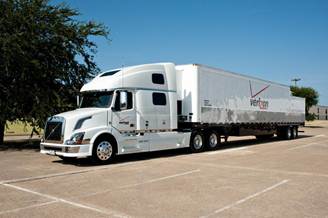
Verizon has deployed this 53-foot Emergency Mobile Communications Center for use by the Nassau County Office of Emergency Management that provides Internet and phone service.
The Wall Street Journal was able to obtain access inside the damaged facilities, and the reporter covering the event was left somewhat stunned by the scope of the damage.
In the middle of organized, yet chaotic recovery efforts was Verizon’s chief technology officer Tony Melone who had seen enough to declare the damage worse than 9/11.
The pictures of several feet of muddy water from the nearby Hudson River covering the lobby of the company’s headquarters on West Street said it all. The mostly salt water was an unwelcome guest in Verizon’s building, especially considering the five level basement below the lobby contains critical cables and telecommunications equipment. Almost four of those basement floors were completely flooded. After the water was pumped out, dampness and leaves from nearby trees remain littered on the floor.
One lesson learned after 9/11 was not to place critical phone switches below ground level. After reconstruction, the switches were moved to a higher floor and consequently were left undamaged. But while Verizon moved its backup generators upstairs, it left the pumps and fuel tanks that power them in the basement — leaving them inoperable.
This morning, passersby on West Street have to step around Verizon’s network of generators now running outside of the building, right next to large temporary fuel tanks to power them.
Verizon central offices in other parts of Manhattan, particularly further southeast on Broad Street, were never upgraded and are in worse shape, with electrical equipment damaged perhaps beyond repair. The force of the water was strong enough to bend the 86 year-old steel and bronze doors. Workers there are still trying to get water out of the building, shoving a pipe down an elevator shaft to facilitate pumping.
Verizon has some redundancy built into its network to protect its most valuable customers. That kept the landline phones working at the New York Stock Exchange, even though other landline and wireless customers will have to wait longer for service to resume.
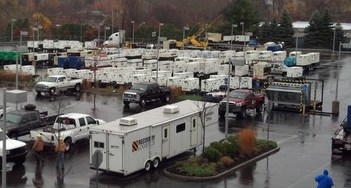
AT&T’s generator staging area near Meriden, Connecticut. (Credit: Brian Pernicone)
Some critics of the increasingly concentrated telecommunications landscape think Verizon and other companies have still not learned enough to prevent the kinds of service disruptions that will leave some customers without service for weeks.
It is hard to miss the bustle outside of Verizon’s offices damaged by the storm, watching flood water drain down the street. But things are murkier at cell phone providers who have been less than forthcoming about specific outage information and service restoration assessments.
Some have advocated the federal government step in and require cell phone service, now deemed essential by an increasing number of Americans, be protected with robust backup solutions to keep service up and running after catastrophic weather events.
After Hurricane Katrina, the FCC in 2007 tried to issue new rules that required a minimum of eight hours of backup power for all cell sites. The industry balked, predicting it would lead to “staggering and irreparable harm” for the cell companies. One wireless trade association warned their members might take several cell sites down if they were forced to provide backup power.
The CTIA Wireless Association and Sprint-Nextel sued the agency in federal court and the Bush Administration’s Office of Management and Budget eventually killed the proposed regulations.
T-Mobile and AT&T have cut an emergency deal to share their cellphone networks in areas affected by Superstorm Sandy. They’re trying to make it a little easier for customers to get a signal as carriers restore their networks. Some say companies should be forced to make their networks more resilient. National Public Radio’s Morning Edition has the story. (November 1, 2012) (3 minutes)
You must remain on this page to hear the clip, or you can download the clip and listen later.
T-Mobile and AT&T customers in the impact zone of Hurricane Sandy will share cellular networks through a mutual aid pact announced today by both companies.
The temporary roaming agreement will allow customers of AT&T and T-Mobile to use cell sites providing the strongest reception and the highest call completion rate in areas of New York and New Jersey where cell service has degraded.
T-Mobile said the temporary arrangement will provide a seamless roaming experience because both companies share GSM technology. There will be no additional charges for this service. We have no information as to whether this agreement will also cover texting and data services.
Earlier today, T-Mobile provided this update to customers about restoration progress:
T-Mobile network engineers are working as quickly as possible to restore service to areas affected by Hurricane Sandy. In Washington, D.C. the network is more than 90% operational. In New York City, the network is more than 80% operational. Restoration work continues in the harder hit areas of lower Manhattan, Staten Island, Long Island, coastal and Northern New Jersey, Connecticut and portions of Pennsylvania, including Philadelphia.
T-Mobile rapid response engineering teams have staged equipment throughout the areas most severely impacted and continue to make assessments regarding how quickly we may be able to begin restoration, and where it is needed most.
Be Sure to Read Part One: Astroturf Overload — Broadband for America = One Giant Industry Front Group for an important introduction to what this super-sized industry front group is all about. Members of Broadband for America Red: A company or group actively engaging in anti-consumer lobbying, opposes Net Neutrality, supports Internet Overcharging, belongs to […]
Astroturf: One of the underhanded tactics increasingly being used by telecom companies is “Astroturf lobbying” – creating front groups that try to mimic true grassroots, but that are all about corporate money, not citizen power. Astroturf lobbying is hardly a new approach. Senator Lloyd Bentsen is credited with coining the term in the 1980s to […]
Hong Kong remains bullish on broadband. Despite the economic downturn, City Telecom continues to invest millions in constructing one of Hong Kong’s largest fiber optic broadband networks, providing fiber to the home connections to residents. City Telecom’s HK Broadband service relies on an all-fiber optic network, and has been dubbed “the Verizon FiOS of Hong […]
BendBroadband, a small provider serving central Oregon, breathlessly announced the imminent launch of new higher speed broadband service for its customers after completing an upgrade to DOCSIS 3. Along with the launch announcement came a new logo of a sprinting dog the company attaches its new tagline to: “We’re the local dog. We better be […]
Stop the Cap! reader Rick has been educating me about some of the new-found aggression by Shaw Communications, one of western Canada’s largest telecommunications companies, in expanding its business reach across Canada. Woe to those who get in the way. Novus Entertainment is already familiar with this story. As Stop the Cap! reported previously, Shaw […]
The Canadian Radio-television Telecommunications Commission, the Canadian equivalent of the Federal Communications Commission in Washington, may be forced to consider American broadband policy before defining Net Neutrality and its role in Canadian broadband, according to an article published today in The Globe & Mail. [FCC Chairman Julius Genachowski’s] proposal – to codify and enforce some […]
In March 2000, two cable magnates sat down for the cable industry equivalent of My Dinner With Andre. Fine wine, beautiful table linens, an exquisite meal, and a Monopoly board with pieces swapped back and forth representing hundreds of thousands of Canadian consumers. Ted Rogers and Jim Shaw drew a line on the western Ontario […]
Just like FairPoint Communications, the Towering Inferno of phone companies haunting New England, Frontier Communications is making a whole lot of promises to state regulators and consumers, if they’ll only support the deal to transfer ownership of phone service from Verizon to them. This time, Frontier is issuing a self-serving press release touting their investment […]
I see it took all of five minutes for George Ou and his friends at Digital Society to be swayed by the tunnel vision myopia of last week’s latest effort to justify Internet Overcharging schemes. Until recently, I’ve always rationalized my distain for smaller usage caps by ignoring the fact that I’m being subsidized by […]
In 2007, we took our first major trip away from western New York in 20 years and spent two weeks an hour away from Calgary, Alberta. After two weeks in Kananaskis Country, Banff, Calgary, and other spots all over southern Alberta, we came away with the Good, the Bad, and the Ugly: The Good Alberta […]
A federal appeals court in Washington has struck down, for a second time, a rulemaking by the Federal Communications Commission to limit the size of the nation’s largest cable operators to 30% of the nation’s pay television marketplace, calling the rule “arbitrary and capricious.” The 30% rule, designed to keep no single company from controlling […]
Less than half of Americans surveyed by PC Magazine report they are very satisfied with the broadband speed delivered by their Internet service provider. PC Magazine released a comprehensive study this month on speed, provider satisfaction, and consumer opinions about the state of broadband in their community. The publisher sampled more than 17,000 participants, checking […]


 Subscribe