Home » network management » Recent Articles:

AT&T’s Fact-Free Defense of FaceTime Blocking Only Further Alienates Angry Customers

Phillip “At Least They Are Transparent About Robbing You” Dampier

The unassailable truth is that if there is a right way for a company to treat its customers and a wrong way, AT&T will always choose the wrong way. It’s the primary reason I refuse to do business with them.

The company’s recent decision to block Apple FaceTime for customers who refuse to be herded to one of AT&T’s new Mobile Share plans is another shot across the bow of Net Neutrality, which declares customers should be able to use the applications and services of their choosing — particularly on networks where they pay for those choices.

Principal #1 of Net Neutrality: Companies should not be playing favorites with applications or services by blocking or restricting those a provider does not favor.

AT&T’s response: ‘Whatever.’

The predictable outrage of customers should have come as no surprise to AT&T, but somehow it did.

The company picked testy senior vice president for regulatory affairs Bob Quinn to mount a rapid defense against the pitchfork-and-torch-yielding throngs on AT&T’s Public Policy Blog. That was their second mistake.

Quinn, who spent last December valiantly defending AT&T against its too-precious CupcakeGate mini-scandal, conjured up this pretzel-twisted logic tap dance to explain away its latest boorish behavior:

Providers of mobile broadband Internet access service are subject to two net neutrality requirements: (1) a transparency requirement pursuant to which they must disclose accurate information regarding the network management practices, performance, and commercial terms of their broadband Internet access services; and (2) a no-blocking requirement under which they are prohibited, subject to reasonable network management, from blocking applications that compete with the provider’s voice or video telephony services.

AT&T’s plans for FaceTime will not violate either requirement.  Our policies regarding FaceTime will be fully transparent to all consumers, and no one has argued to the contrary.  There is no transparency issue here.

Nor is there a blocking issue.  The FCC’s net neutrality rules do not regulate the availability to customers of applications that are preloaded on phones.  Indeed, the rules do not require that providers make available any preloaded apps.  Rather, they address whether customers are able to download apps that compete with our voice or video telephony services.   AT&T does not restrict customers from downloading any such lawful applications, and there are several video chat apps available in the various app stores serving particular operating systems. (I won’t name any of them for fear that I will be accused by these same groups of discriminating in favor of those apps.  But just go to your app store on your device and type “video chat.”)  Therefore, there is no net neutrality violation.

A company lecturing its customers for daring to question its decisions is always a good way to enhance those warm and fuzzy feelings people have about America’s least-liked wireless phone company. Quinn first scolds customers and consumer groups about their “knee jerk reaction,” for being upset about the issue. Then he declares they have “rushed to judgment,” using a turn of phrase not heard since O.J. Simpson’s defense team pounded it to death, and look where that ultimately got us.

The crux of AT&T’s argument is they get a free pass to “block and herd” because Apple FaceTime was pre-installed on customer phones. Therefore, since AT&T didn’t block you from downloading an app you already had, it cannot possibly be a Net Neutrality violation. Because as we all know, Net Neutrality is only about download blocking.

At least AT&T is keeping their promise to be transparent. They have, indeed, fully informed you they are mugging you while in the process of mugging you. Full disclosure… matters.

Somehow, I missed the “preinstalled does not count” section in the Federal Communications Commission’s December 2010 order to providers telling them to preserve the free and open Internet. So I spent last night with this legalese page-turner (194 pages to be exact) to refresh my memory.

Nope, it isn’t in there. You can read it for yourself from the link above.

So it isn’t me. It is them, making up the rules as they go, again.

Quinn graciously offers customers one concession: AT&T will allow you to use Apple FaceTime over your own home Wi-Fi network. Gosh thanks!

For customers addicted to FaceTime, AT&T’s solution is an expensive plan change. An average customer currently paying $70 for 450-barely used voice minutes and 3GB of data will find FaceTime off-limits on AT&T’s network unless they “upgrade” to AT&T’s $95 Mobile Share plan, which gets you only 1GB of data, but endless voice minutes you don’t want and unlimited texting you don’t need.

Result: Pay $25 more a month and get your data allowance slashed by 2/3rds. That’s a deal — AT&T-style.

But it is one some customers are through taking. Nalin Kuachusri:

The new FaceTime restrictions will usher in the end of my 12+ year relationship with AT&T. I’m tired of the consistent manipulation of plans and features to extract more and more money for services I don’t need. For example: there used to be several text-message options (200, 1000, 1500, unlimited) so I could choose and pay for the one that fit my usage best. Then there was the option to move from unlimited data to 2GB/month to save $5. That was great for me and fit my usage. Then I was forced to move back to $30/month if I wanted to add tethering where I’ll get an extra GB that I’ll never use. Finally, after 12 years as a customer with an account in good standing, I was not allowed to unlock my phone for my 10-day trip to Europe so I could get a local SIM. I couldn’t be happier to give you one final $200 payment as an early-termination fee so I can move to Verizon.

Unfortunately for Kuachusri, the bosses at Verizon Wireless are likely slapping themselves silly because they did not come up with the idea first.

FCC Announces Open Internet Advisory Committee With No Consumer Representatives

Phillip Dampier

The Federal Communications Commission has announced the composition of its new Open Internet Advisory Committee to help track and evaluate the effects of the agency’s Net Neutrality policies, but has no member directly representing the interests of consumers.

The OIAC will focus on important Net Neutrality policies like transparency, reasonable network management practices, the differences governing policies for wired and wireless broadband, and issues like usage caps and speed throttling. But there are no voices on the committee that speak directly on behalf of end users — individual customers who use the Internet in their daily lives.

The FCC instead packed the panel with business, social policy and educational interests, many with direct financial ties to large telecommunications companies.

Selected members include:

  • Harvey Anderson, Vice President of Business Affairs & General Counsel, Mozilla
  • Brad Burnham, Founding Partner, Union Square Ventures
  • Alissa Cooper, Chief Computer Scientist, Center for Democracy & Technology
  • Leslie Daigle, Chief Internet Technology Officer, Internet Society
  • Jessica Gonzalez, Executive Board, Media and Democracy Coalition; Vice President for Policy & Legal Affairs, National Hispanic Media Coalition (representing NHMC)
  • Shane Greenstein, Professor and Kellogg Chair of Information Technology, Kellogg School of Management, Northwestern University
  • Russell Housley, Chair, Internet Engineering Task Force; Founder of Vigil Security, LLC (representing Vigil Security, LLC)
  • Neil Hunt, Chief Product Officer, Netflix
  • Charles Kalmanek, Vice President of Research, AT&T
  • Matthew Larsen, CEO, Vistabeam
  • Kevin McElearney, Senior Vice President for Network Engineering, Comcast
  • Marc Morial, President & CEO, National Urban League
  • Elaine Paul, Senior Vice President, Strategic Planning, The Walt Disney Company
  • Jennifer Rexford, Professor of Computer Science, Princeton University
  • Dennis Roberson, Vice Provost & Research Professor, Illinois Institute of Technology (representing T-Mobile)
  • Chip Sharp, Director, Technology Policy and Internet Governance, Cisco Systems
  • Charles Slocum, Assistant Executive Director, Writers Guild of America, West
  • Marcus Weldon, Chief Technology Officer, Alcatel-Lucent
  • Michelle Zatlyn, Co-Founder & Head of User Experience, CloudFlare

Missing are the voices of consumers who want an open Internet and do not believe in Comcast and AT&T’s definitions of “reasonable network management” that include Internet Overcharging schemes like usage caps and overlimit fees.

Consumers will instead have to depend on Internet businesses and institutions that coincidentally share an active dislike of traffic control measures, primarily for their own business reasons.

By excluding the consumer’s voice in policy debates, it is no wonder FCC Chairman Julius Genachowski increasingly seems amenable to the companies he is supposed to independently oversee — spending a considerable amount of time opening industry conventions with keynote speeches, reviewing lobbyist briefs about various communications issues, and talking directly with the corporate leadership of the companies involved. It is disturbingly clear he is listening less and less to consumers. A clear sign of that was his vocal support for the kinds of usage-based Internet pricing schemes that consumers generally loathe.

Genachowski and his staff need to spend more time listening to individual Internet users and the customers of providers and less time attending industry-sponsored events.

The OIAC is a good place to start. Consumers deserve a seat at the table in a debate that will impact every American Internet user.

Comcast Proves It Doesn’t Need a 250GB Usage Cap; Net Neutrality Violation Alleged

Comcast Monday announced it was exempting its new Xbox streaming video service from the company’s long standing 250GB monthly usage cap, claiming since the network doesn’t exist on the public Internet, there is no reason to cap its usage.

Net Neutrality advocates immediately denounced the cable operator for violating Net Neutrality, giving favorable treatment to its own video service while leaving Netflix, Amazon, and others under its usage cap regime.

Public Knowledge president Gigi Sohn:

“The Xbox 360 provides a number of video services to compete for customer dollars, yet only one service is not counted against the data cap—the one provided by Comcast.” Sohn said. “This is nothing less than a wake-up call to the Commission to show it is serious about protecting the Open Internet.”

Stop the Cap! believes Comcast also inadvertently undercut its prime argument for the company’s 250GB usage cap — that it assures “heavy users” don’t negatively impact the online experience of other customers:

We work hard to manage our network resources effectively and fairly to ensure a high-quality online experience for all of our customers. But XFINITY Internet service runs on a shared network, so every user’s experience is potentially affected by his or her neighbors’ Internet usage.

Our number one priority is to ensure that every customer has a superior Internet service experience. Consistent with that goal, the threshold is intended to protect the online experience of the vast majority of our customers whose Internet speeds could be degraded because one or more of their neighbors engages in consistent high-volume Internet downloads and uploads.

The threshold also addresses potential problems that can be caused by the exceedingly small percentage of subscribers who may engage in very high-volume data consumption (over 250 GB in a calendar month). By applying a very high threshold on monthly consumption, we can help preserve a good online experience for everyone.

Comcast argues around the exemption of the Xbox service by reclassifying it as somehow separate from the public Internet.  The company then tries to claim the Xbox app functions more like an extra set top box, not as a data service.  But, in fact, it –is– a data service delivered over the same cable lines as Comcast’s broadband service, subject to the same “last-mile congestion problem” Comcast dubiously uses as the primary justification for placing limits on customers.

Cable providers who limit broadband use routinely use the “shared network experience” excuse as a justification for usage control measures.  Since cable broadband delivers a fixed amount of bandwidth into individual neighborhoods which everyone shares, a single user or small group of users can theoretically create congestion-related slowdowns during peak usage times.  Cable operators have successfully addressed this problem with upgrades to DOCSIS 3 technology, which supports a considerably larger pipeline unlikely to be congested by a few “heavy users.”

Comcast’s argument the Xbox service doesn’t deserve to be capped because it is delivered over Comcast’s own internal network misses the point.  That content reaches customers over the same infrastructure Comcast uses to reach every customer.  If too many customers access the service at the same time, it is subject to precisely the same congestion-related slowdowns as their broadband service.  Data is data — only the cable company decides whether to treat it equally with its other services or give it special, privileged attention.

Even if Comcast argues the Xbox streaming service exists on its own segregated, exclusive “data channel,” that represents part of a broader data pipeline that could have been dedicated to general Internet use.  The fact that special pipeline is available exclusively for Comcast’s chosen favorites, while keeping usage limits on immediate competitors, is discriminatory.

Comcast customers who have lived under an inflexible 250GB usage limit since 2008 should be wondering why the company can suddenly open unlimited access to some services while refusing to adjust its own usage limits on general broadband service.

Stop the Cap! believes Comcast has forfeit its own justification for usage caps and network management techniques that can slow customer Internet speeds.  We have no problem with the company offering unlimited access to the Xbox streaming service. But the company must treat general Internet access with equal generosity, removing the unjustified and arbitrary usage cap it imposed on customers in 2008.  After all, if the company can find vast, unlimited resources for a service it launched only this year, it should be able to find equal resources for a service it has sold customers (at a remarkable profit) for more than a decade.

Anything less makes us believe Comcast’s usage caps are more about giving some services an unfair advantage — violating the very Net Neutrality guidelines Comcast claimed it would voluntarily honor.

Stop the Cap! strongly believes usage caps are increasingly less about good network management and more about controlling and monetizing the online experience, seeking marketplace advantages and new revenue streams from consumers who already pay some of the world’s highest prices for broadband service.  As we’ve argued since 2008, Internet Overcharging through usage caps and usage based billing is also an end run around Net Neutrality.  The evidence is now apparent for all to see.

[Thanks to our readers Scott and Yannio for sharing developments.]

AT&T’s Internet Overcharging Merry-go-Round — Billing App Makers for Your ‘Overusage’

AT&T’s march towards monetizing data usage has just gotten a twist with a new idea from the company to develop “a toll-free wireless Internet” where app makers foot the bill for your data usage.

First appearing in a Wall Street Journal article, John Donovan, AT&T’s executive for network and technology, suggested the new “app maker pays”-option will ease consumers’ fears about using high bandwidth apps that eat into AT&T’s data allowances.

“A feature that we’re hoping to have out sometime next year is the equivalent of 800 numbers that would say, if you take this app, this app will come without any network usage,” Donovan said at the Mobile World Congress in Barcelona, Spain. “It’d be like freight included.”

Critics of the idea pounced immediately, calling AT&T’s latest plan the realization of former CEO Ed Whitacre’s dream that content producers “can’t use [AT&T’s] pipes for free.”

Harold Feld, legal director at consumer group Public Knowledge thinks he’s got AT&T’s number:

Just to be clear, here is what AT&T Wireless is doing:

1. Create an artificial scarcity with an arbitrary bandwidth cap for its wireless services;

2. Charge users who exceed this arbitrary bandwidth cap;

3. Claim to do consumers a favor by letting the ap developer pay for exceeding the arbitrary bandwidth cap.

Which cuts to the heart of the problem in wireless, IMO. The argument in favor of a wireless capacity cap is, in a nutshell, “wireless is different from wireline because the physics imposes bandwidth limitations.” In the presence of these bandwidth limitations, we need a rationing scheme of some kind. Bandwidth caps are a neutral way of rationing and encourage app developers to write more efficient applications — thus improving the system overall.

The problem with this argument is it is impossible at present to determine just how true or false it actually is. I referred above to AT&T’s bandwidth cap as arbitrary. As far as I (or any outside observer) can tell, AT&T just selected a number and said “this is where we impose a cap.” You can buy a higher cap on a monthly basis, or can pay as you go above the cap in the form of overages.

Courtesy: Broadbast Engineering

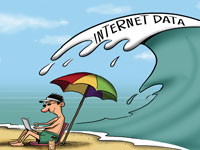
AT&T has no worries about data tsunamis and "exafloods" when app makers or consumers are willing to pay more.

In fact, AT&T’s journey away from unlimited access to their wireless network is well underway.  Just two years ago, customers paid $30 a month for unlimited data on a smartphone.  Then AT&T ended “unlimited” access, imposing a 2GB usage cap on their most popular wireless data plan.  Now AT&T is looking to monetize its wireless traffic even further as customers grow more reticent about using high volume applications that could threaten one’s usage allowance.

Despite AT&T’s ongoing drumbeat America is in the midst of a wireless bandwidth crisis, the ‘national emergency’ is over as soon as someone — anyone other than AT&T — opens their wallet and agrees to pay more for data traffic.  Then the sky is the limit.

The logical inconsistencies of a company crying for more mobile spectrum concurrently envisioning new ways to monetize high volume wireless traffic (eg. large file downloads, online video, etc.) exposes the hollow center of  Internet Overcharging.  The “exaflood”/data tsunami only seems to threaten AT&T’s network when content producers and/or consumers are not paying extra for every kilobyte.

As Stop the Cap! has argued before, AT&T is increasingly  in the bandwidth shortage/rationing business.

The company underspent on its network, balked at the price tag to upgrade capacity (but had no trouble planning to pay substantially more to acquire T-Mobile), and now complains it has to charge higher prices because the federal government blocked its merger and the FCC won’t hand over additional spectrum.

There are two approaches to fat profits in the broadband business these days:

  1. A Proud Member of: Team Rationing for Profit

    Team Innovation: Believe in your product and nurture its growth with upgrades, innovation, and pricing that guarantees an enthusiastic and loyal customer base;

  2. Team Rationing for Profit: Leverage your dominant market power by rationing your product, charging higher prices for less service.  Monetizing usage controls traffic growth, reducing the expense of upgrading your network. With limited competition, even alienated customers face few alternative choices and a steep early termination exit fee.

Based on statements from AT&T’s Donovan, AT&T is a firm believer in the latter.

“There’s a view of an entitlement that says that any impediment to riding over the top of our network is inherently wrong, is un-American,” Donovan said, adding AT&T needed to find creative ways to deal with and profit from surging mobile-data use.

Feld thinks it says something else.

“This new plan is unfortunate because it shows how fraudulent the AT&T data cap is, and calls into question the whole rationale of the data caps,” Feld said. “Apparently it has nothing to do with network management.  It’s a tool to get more revenue from developers and customers.”

AT&T’s 2GB Speed Trap: “I’m Almost Scared to Use the Phone,” Says Frustrated Customer

An increasing number of wireless data users are getting some tough love courtesy of AT&T.

“Your data use this month places you in the top 5% of users,” the text message reads. “Use Wi-Fi to avoid reduced speeds.”  Our regular reader Earl hopes we’ll keep spreading the word.

AT&T’s speed throttle has now moved beyond the pages of tech blogs and into USA Today, where the newspaper explores the trials and tribulations of wireless data management policies at the nation’s largest wireless companies.

Mike Trang, along with at least 200,000 other AT&T customers, has been caught in AT&T’s wireless speed trap.  The result can be speeds punitively reduced to dial-up for the remainder of a billing cycle, leaving customers on AT&T’s “unlimited use” plan waiting up to two minutes for a single web page to load.

While AT&T tells the newspaper it only throttles the speeds of unlimited customers who use an average of 2GB or more per month to ease congestion (if that), the company’s “congestion problems” seem to disappear when customers switch to a usage-billing plan that charges fees based on different usage allowances:

Trang’s iPhone was throttled just two weeks into his billing cycle, after he’d consumed 2.3 gigabytes of data. He pays $30 per month for “unlimited” data. Meanwhile, Dallas-based AT&T now sells a limited, or “tiered,” plan that provides 3 gigabytes of data for the same price.

Users report that if they call the company to ask or complain about the throttling, AT&T customer support representatives suggest they switch to the limited plan.

“They’re coaxing you toward the tiered plan,” said Gregory Tallman in Hopatcong, N.J. He hasn’t had his iPhone 4S throttled yet, but he’s gotten text-messages from AT&T, warning that he’s approaching the limit. This came after he had used just 1.5 gigabytes of data in that billing cycle.

Many customers who have received the text message warning about their usage now think twice about everything they do with their phone, which may be part of what AT&T intended for its remaining customers grandfathered on a now-discontinued unlimited use plan.

John Cozen, a Web and mobile applications designer in San Diego, told USA Today he’s now “almost scared to use the phone.”

Cozen’s complaints to AT&T have been ignored and now he’s shopping for a new carrier.

AT&T’s warning-and-throttle system is the strictest among America’s largest wireless carriers. When customers exceed AT&T’s arbitrary declaration of being among the “top 5% of users,” their speeds are subject to severe slowdowns until their next bill is issued. This leaves customers who may have needed their phone at the beginning of the month for a business trip or vacation suddenly throttled for weeks because of what AT&T calls “congestion,” even if nobody else is using the cell tower.  Even worse, customers not yet deemed to be offending AT&Ts usage manners, or who pay per gigabyte, can overload a cell tower and create the very congestion AT&T claims it hopes to manage.  But only “unlimited use” customers get “time out” in the usage penalty corner.

Among other carriers:

  • Verizon Wireless also uses a network management system that can throttle speeds for exceptionally heavy users, but their speed throttle is engaged only when individual cell towers are overloaded with traffic, and the speed reduction level will vary with the amount of traffic on that tower.  When congestion eases, speeds return to normal for everyone;
  • T-Mobile throttles customers after a maximum of 5GB of usage per month, unless other arrangements are made with the company;
  • Sprint Nextel does not have usage limits or a throttle on smartphone data plans at this time.

Search This Site:

Contributions:

Recent Comments:

Your Account:

Stop the Cap!