Home » mobile data » Recent Articles:

UK Regulator: Don’t Call Your Wireless Service Unlimited and Then Throttle Heavy Users to Death

virgin-media-union-logo“Unlimited data” must mean exactly that in the United Kingdom if you hope to survive a challenge with British regulators over advertising and tariff claims.

Virgin Media thought itself clever offering “VIP” mobile customers two choices for service: £15 for a package that included 3GB of mobile data or £20 for “unlimited” data. Unlimited sounds like a great deal. For just $7.41 more, a customer could turn their stingy 3GB plan into unlimited data paradise. Or so one would think until navigating a nearly impenetrable thicket of fine print that suggested “you should expect speeds delivered up to 384kbps (3G). Actual speeds experienced may be higher or lower and will vary by device and location.”

Seven complainants discovered something interesting about their “unlimited data plan.” It sped along at an average speed of 6Mbps until they hit 3.5GB of usage during any billing cycle. After that, speeds were consistently reduced to 384kbps. They quickly learned Virgin had a secret throttling plan in place for their unlimited customers, couched in vague and misleading fine print that suggested customers should treat anything over 384kbps as a veritable gift from the mobile gods.

Why hide the fact Virgin has a “fair use policy” similar to many other wireless carriers that promise unlimited data only to throttle speeds after customers reach a certain amount of usage? Look again at Virgin’s pricing.

A customer could choose a £15 plan that included 3GB of usage or spend an extra £5 for what actually turns out to be just 500MB of regular speed data. If customers realized that, they would likely keep the £5 in their wallet. Instead, it went straight into Virgin’s bank account.

Virgin’s response is familiar to any customer who thought they bought an unlimited plan only to discover it cannot reasonably be used once an arbitrary limit is reached. The Advertising Standards Authority (ASA) summarized Virgin’s reply:

They said within all of their advertising, whenever they referred to “unlimited data” in connection with their mobile tariffs, they included an explanation within the small print that customers should expect speeds of up to 384kbit/s.  They said the restriction imposed on customers was moderate in respect of the service being advertised.

They noted that the body copy of the ad did not make any reference to internet speeds, and said that Virgin Mobile customers were never prevented from accessing the internet, no matter how much data they used.  They therefore maintained that access to data for any customer was entirely unlimited.  They said, where a customer exceeded 3.5GB in any 30-day period, they would still be able to use the internet on their device at 3G speeds.  They said that 2% of Virgin Media customers ever reached the limit in a 30-day period, which they considered was a tiny minority. They said that the customers using more than 3.5GB of data each month would be those customers who would be more aware of the advertised expected speed, and that the average consumer would therefore not have been misled.

asaThat last sentence in particular did not amuse the regulators. In the United Kingdom, making a claim of “unlimited service” means that any limitations imposed on that service affecting speed or usability must be at most moderate and clearly disclosed. Virgin failed on both.

Average 3G speeds in Britain are now 6.1Mbps and that speed does not vary much between providers. The ASA ruled that slashing speeds to a fraction of 6Mbps went way beyond the rules.

“Given the speeds we understood consumers were likely to achieve before the [throttle], we considered that they were likely to notice the drop in speeds once the restriction was applied, as had a number of the complainants,” wrote the ASA. “We considered that a reduction in speed from an average we understood to be approximately 6 Mbit/s to 384 kbit/s once the limit was reached, was more than a moderate reduction. Because we considered the limitation imposed on speeds to be more than moderate, we concluded that the claim ‘unlimited data’ was misleading.”

As a result, Virgin Media was told not to claim that a service was ‘unlimited’ if the limitations that affected the speed or usage of the service were more than moderate.
Google, Cablevision Challenge Traditional Cell Phone Plans, Wireless Usage Caps With Cheap Alternatives

Phillip Dampier January 26, 2015 Cablevision (see Altice USA), Competition, Consumer News, Data Caps, FreedomPop, Google Fiber & Wireless, Wireless Broadband Comments Off on Google, Cablevision Challenge Traditional Cell Phone Plans, Wireless Usage Caps With Cheap Alternatives

freewheelLuxurious wireless industry profits of up to 50 percent earned from selling some of the world’s most expensive cellular services may soon be a thing of the past as Google and Cablevision prepare to disrupt the market with cheap competition.

With more than 80 percent of all wireless data traffic now moving over Wi-Fi, prices for wireless data services should be in decline, but the reverse has been true. AT&T and Verizon Wireless have banked future profits by dumping unlimited data plans and monetizing wireless usage, predicting a dependable spike in revenue from growing data consumption. Instead of charging customers a flat $30 for unlimited data, carriers like Verizon have switched to plans with voice, texting, and just 1GB of wireless usage at around $60 a month, with each additional gigabyte priced at $15 a month.

With the majority of cell phone customers in the U.S. signed up with AT&T or Verizon’s nearly identical plans, their revenue has soared. Sprint and T-Mobile have modestly challenged the two industry leaders offering cheaper plans, some with unlimited data, but their smaller cellular networks and more limited coverage areas have left many customers wary about switching.

Google intends to remind Americans that the majority of data usage occurs over Wi-Fi networks that don’t require an expensive data plan or enormous 4G network. The search engine giant will launch its own wireless service that depends on Wi-Fi at home and work and combines the networks of Sprint and T-Mobile while on the go, switching automatically to the provider with the best signal and performance.

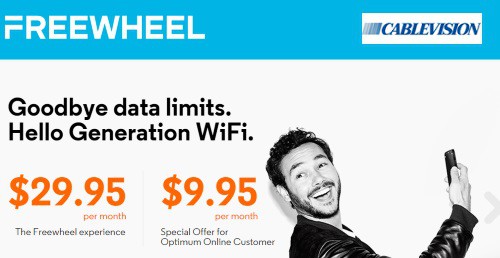
googleCablevision’s offer, in contrast, will rely entirely on Wi-Fi to power its mobile calling, texting, and data services. Dubbed “Freewheel,” non-Cablevision customers can sign up starting in February for $29.95 a month. Current Cablevision broadband customers get a price break — $9.95 a month.

Cablevision’s dense service area in parts of New York City, Long Island, northern New Jersey and Connecticut offers ample access to Wi-Fi. Cablevision chief operating officer Kristin Dolan said its new service would work best in Wi-Fi dense areas such as college campuses, business districts, and multi-dwelling units.

New York City is working towards its own ubiquitous Wi-Fi network, which could theoretically blanket the city with enough hotspots to make Cablevision’s service area seamless. But the biggest deterrent to dumping your current cell phone provider is likely to be available coverage areas. Google’s answer to that problem is combining the networks of both Sprint and T-Mobile, offering customers access to the best-performing carrier in any particular area. While that isn’t likely to solve coverage issues in states like West Virginia and the Mountain West, where only AT&T and Verizon Wireless offer serious coverage, it will likely be sustainable in large and medium-sized cities where at least one of the two smaller carriers has a solid network of cell towers.

Comparing the Wireless Alternative Providers

  • Google Wireless will offer seamless access to Wi-Fi, Sprint and T-Mobile voice, SMS, and mobile data at an undetermined price. Likely to arrive by the summer of 2015;
  • Cablevision Freewheel depends entirely on Wi-Fi to power unlimited voice, SMS, and data. Launches in February for $29.95/mo ($9.95/mo for Cablevision broadband customers);
  • FreedomPop Wi-Fi ($5/mo) offers an Android app-based “key” to open unlimited Wi-Fi access to 10 million AT&T, Google, and cable industry hotspots nationwide for calling, texting, and mobile data;
  • Republic Wireless developed its own protocol to properly hand off phone calls between different networks without dropping it. Calling plans range from $5-40 a month. Less expensive plans are Wi-Fi only, pricier plans include access to Sprint’s network;
  • Scratch Wireless charges once for its device – a Motorola Photon Q ($99) and everything else is free, as long as you have access to Wi-Fi. Cell-based texting is also free, as a courtesy. If you need voice calling or wireless data when outside the range of a hotspot, you can buy “access passes” to Sprint’s network at prices ranging from $1.99 a day each for voice and data access to $24.99 a month for unlimited data and $14.99 a month for unlimited voice.
Scratch Wireless

Scratch Wireless

Google is pushing the FCC to open new unlicensed spectrum for expanded Wi-Fi to accommodate the growing number of wireless hotspots that are facing co-interference issues.

Wi-Fi-based wireless providers are likely to grow once coverage concerns are eased and there is reliable service as customers hop from hotspot to hotspot. The cable industry has aggressively deployed Wi-Fi access with a potential to introduce wireless service. Comcast is already providing broadband customers with network gateways that offer built-in guest access to other Comcast customers, with the potential of using a crowdsourced network of customers to power Wi-Fi coverage across its service areas. FreedomPop will eventually seek customers to volunteer access to their home or business networks for fellow users as well.

AT&T and Verizon are banking on their robust networks and coverage areas to protect their customer base. Verizon Wireless, in particular, has refused to engage in price wars with competitors, claiming Verizon customers are willing to pay more to access the company’s huge wireless coverage area. AT&T told the Wall Street Journal its customers want seamless access to its network to stay connected wherever they go.

Verizon’s chief financial officer Fran Shammo appeared unfazed by the recent developments. On last week’s conference call with investors, Shammo dismissed Google’s entry as simply another reseller of Sprint’s network. He added Google has no idea about the challenges it will face dealing directly with customers in a service and support capacity. While Google’s approach to combine the coverage of T-Mobile and Sprint together is a novel idea, Shammo thinks there isn’t much to see.

“Resellers, or people leasing the network from carriers, have been around for 15 years,” Shammo said. “It’s a complex issue.”

Investors are taking a cautious wait-and-see approach to the recent developments. Google’s new offering is likely to offer plans that are philosophically compatible with Google’s larger business agenda. Challenging the traditional business models of AT&T and Verizon that have implemented usage caps and usage pricing may be at the top of Google’s list. The new offering could give large data allowances at a low-cost and/or unlimited wireless data for a flat price. Such plans may actually steal price-sensitive customers away from Sprint and T-Mobile, at least initially. Sprint is clearly worried about that, so it has a built-in escape clause that allows a termination of its network agreement with Google almost at will.

[flv]http://www.phillipdampier.com/video/WSJ Google Cablevision Challenge Wireless Industry 1-26-15.flv[/flv]

The Wall Street Journal talks about the trend towards Wi-Fi based mobile calling networks. (1:59)

AT&T to Federal Trade Commission: Our Speed Throttling is None of Your Business

Image courtesy: cobalt123AT&T has asked a federal judge in California to throw out a lawsuit filed by the Federal Trade Commission over wireless speed throttling, claiming the federal regulator has no authority over how AT&T manages its network.

The FTC filed a lawsuit in October 2014 alleging AT&T was throttling the speeds of its grandfathered “unlimited data” customers by as much as 90 percent and failed to sufficiently disclose the practice in violation of the FTC Act.

Although AT&T discloses its network management policies in broad terms deep within its website, the original complaint charges AT&T failed to directly notify customers identified as the ‘heavy unlimited users’ targeted for wireless speed reductions reportedly as low as 56kbps for up to 30 days or more.

AT&T’s lawyers claim the FTC has no jurisdiction to file the lawsuit because a portion of AT&T’s business — cellular voice service — is defined by the Communications Act as a regulated common carrier service by the Federal Communications Commission. The FTC had argued AT&T’s mobile data services are unregulated and do not fall under the FCC’s exclusive jurisdiction.

AT&T’s attorneys argue two apparently contradictory assertions about wireless regulation that both require the court, in AT&T’s view, to dismiss the FTC’s case:

  1. AT&T acknowledges that its mobile data services are not subject to Title II regulatory oversight by the FCC as a common carrier service. Therefore, federal agencies like the FTC have no jurisdiction to interfere in AT&T’s private business decisions on issues like data caps and speed throttling because it is an unregulated service;
  2. AT&T claims the FCC has asserted sweeping authority over wireless services under Section 706 of the Telecommunications Act of 1996. Therefore it should be up to the FCC alone (and not the FTC) to decide the fairness of AT&T’s network management practices. But AT&T doesn’t remind the court this is the same authority that large telecom companies sued into impotence by successfully arguing the FCC exceeded its mandate attempting to assert jurisdiction on data services to enforce concepts such as Net Neutrality and attempting to fine Comcast for throttling peer-to-peer network traffic.

ftcAT&T calls the FTC’s claims it can intervene in services not regulated by the FCC “irrelevant,” arguing once one of AT&T’s services is subject to the FCC’s common carrier regulation, all of its services become untouchable by the FTC.
“The FTC lacks jurisdiction to prosecute this action because AT&T is a common carrier subject to the Communications Act and therefore outside the FTC’s authority under Section 5 of the FTC Act. 15 U.S.C. § 45(a)(2),” argues AT&T. “Indeed, the FTC itself has recognized that, as drafted, the exemption altogether removes common carriers such as AT&T from its jurisdiction and has asked Congress to modify the statute. So far, Congress has refused.”

“But whether AT&T’s network management program is ‘unfair’ and whether its disclosures were ‘inadequate’ are issues for the FCC to decide, and in fact the FCC is in the process of so deciding, just as Congress intended,” AT&T said. “Congress drafted Section 5 to avoid subjecting common carriers like AT&T to precisely this sort of conflicting authority of separate federal agencies over the same conduct.”

Should the FCC find AT&T in violation of its transparency rules, AT&T will have a strong legal case to have that ruling tossed as well on the grounds the agency has no mandate from Congress to regulate mobile data services under Section 706/Title III of the Communications Act — the same case other telecom companies have successfully argued in the D.C. Court of Appeals.

Ironically, AT&T’s apparent regulatory loophole will vanish should the FCC order that broadband services of all kinds be reclassified as Title II telecommunications services as part of the ongoing effort to implement strong Net Neutrality policies.

Half of AT&T’s Customers Are Paying $100 for 10GB Data; Unlimited Customers Still Throttled After 3-5GB

Phillip Dampier October 23, 2014 AT&T, Broadband "Shortage", Broadband Speed, Competition, Consumer News, Data Caps, Public Policy & Gov't, Wireless Broadband Comments Off on Half of AT&T’s Customers Are Paying $100 for 10GB Data; Unlimited Customers Still Throttled After 3-5GB
Speed bump

Speed bump

More than half of AT&T’s wireless customers are paying at least $100 a month for 10GB or more of wireless data on AT&T’s Mobile Share Plans at the same time AT&T continues to throttle its legacy unlimited data customers who use more than 3GB of data on its 3G network or 5GB of data on its 4G LTE network.

AT&T claimed in 2012 it implemented its “fair usage policy” for unlimited customers to assure all could receive reasonable service during peak usage times when cell towers become congested.

AT&T also blames “a serious wireless spectrum crunch” for the speed throttling, implying access to more spectrum could help ease the problem. But there is a much faster way to overcome AT&T’s “spectrum crunch:” agree to pay them more money by ditching that $30 unlimited plan for a tiered plan.

John Stephens, AT&T’s chief financial officer, told investors Wednesday that nothing boosts revenue more than pushing customers into usage-cappped data plans that customers are regularly forced to upgrade.

“On the ARPU (average revenue per user/customer) story, I think the biggest issue with the improvement is people buying the bigger [data] buckets and buying – upping plans,” said Stephens. “We had over 50% of the customer base at the 10GB or bigger plans.”

Stephens added that AT&T benefited from customers upgrading to 4G LTE devices that are handled more efficiently by AT&T’s mobile data network.

Increased usage and upgraded data plans delivered a 20% increase in data billings over the last quarter.

Since 2012 AT&T has paid out more than $50 billion to shareholders through dividends and share buybacks. The company benefited from nearly $20 billion a year in free cash flow and asset sales over the last two years and is expected to repeat those numbers this year. Consolidated revenue at AT&T grew to $33 billion, up $800 million since the same time last year.

Miraculously, despite the “alarming spectrum crunch,” AT&T found more than enough spectrum to award its best customers with a “double data” promotion that turns a 15GB data plan into a 30GB plan, a 20GB plan to 40GB, a 30GB plan to 60GB, a 40GB plan to 80GB, or a 50GB plan to 100GB. Importantly, AT&T boasts its double data promotion won’t “explode” — their language for “expire” — on customers until their contract ends.

Lowering the bar on "unlimited use" customers.

Lowering the bar on “unlimited use” customers.

“Those exploding offers — customers hate those offers,” said AT&T Mobility CEO Ralph de la Vega at a recent investor conference. “Unless they change their mind, we won’t offer those kinds of promotions.”

But de la Vega doesn’t mind leaving the company’s most loyal legacy customers in the penalty box if they cling to their grandfathered unlimited data plans. The throttles stay and the allowances have remained unchanged since first announced, despite the bountiful spectrum obviously ready and available to serve AT&T’s deluxe customers. Unlimited customers are regularly reminded they can easily avoid the throttle — just abandon that unlimited data plan. According to Stephens, more than 80% of AT&T’s customers already have.

The excuses for wireless speed throttles and killing off unlimited data plans at AT&T and Verizon Wireless don’t seem to wash with FCC chairman Thomas Wheeler, who demanded Verizon offer the “rationale for treating customers differently based on the type of data plan to which they subscribe, rather than network architecture or technological factors,” after it announced it was planning speed throttles for its remaining unlimited data plan customers. Verizon canceled the plan after Wheeler began scrutinizing it, but the throttles are still in place at AT&T.

AT&T’s 10GB Mobile Share Plan starts with a $100 data plan. Customers also pay:

  • $10 a month for each auto-based smart-locator;
  • $10 a month for each tablet, camera or game device;
  • $15 a month for each basic phone;
  • $20 a month for each wireless home phone replacement;
  • $20 a month for each connected Internet device;
  • $40 a month for each connected smartphone.

A family of four with four smartphones, a tablet, and AT&T’s wireless home phone replacement would be billed $290 a month before at least $39 in taxes, fees, and surcharges — well north of $300 a month for most.

Wi-Fi is Threatening AT&T and Verizon Wireless’ 4G Data Money Party; Wi-Fi Usage Conquers 4G

att verizonVerizon Wireless and AT&T have invested billions expanding and improving their wireless networks, telling investors that revenue from exploding wireless data usage would more than recoup their investments, but the growing availability of low-cost and free Wi-Fi is threatening to derail those plans.
Business Week reports that as carriers have dropped unlimited use data plans in favor of costly, restricted-usage offers, savvy customers have learned to conserve their data allowance by switching to Wi-Fi wherever possible. Adobe Systems reported this week that more than half of all wireless data traffic from smartphones occurs over Wi-Fi, not 3G or 4G networks. Total Wi-Fi traffic passed mobile data networks more than a year earlier.

AT&T and Verizon’s business plans depend on smartphone users accessing faster 4G LTE networks to consume high bandwidth online applications like video streaming, but that isn’t happening at the rate they expected. Instead, customers are waiting to connect to a Wi-Fi hotspot before watching.

The carriers are partly to blame for the Wi-Fi habit by encouraging customers to switch to Wi-Fi to reduce congestion on their 3G and 4G networks while they were upgraded and expanded. But after carriers completed those upgrades, customers are sticking with Wi-Fi.

“There’s a flavor of too much of a good thing here, where Wi-Fi offloads start to really impinge on the prospects of monetizing all that additional usage,” says industry analyst Craig Moffett. “All the carriers have put their eggs in the basket of incremental usage as the source of revenue growth. It isn’t going according to plan.”

wifiAT&T and Verizon hoped customers would face upgrades to more costly plans with more generous usage allowances as data usage increased. Early efforts to monetize data usage seemed encouraging. Both carriers reported surprising success from in-store marketing efforts to push families to upgrade to deluxe 10GB+ usage plans in larger numbers than anticipated. But customers are now increasingly trying to stay within their budget and current usage allowance, with the help of Wi-Fi.
‘As customers become more aware of the limits on their data plans, they’re more careful about moving to Wi-Fi as often as possible,’ says Tamara Gaffney, an analyst with Adobe’s Digital Index.

Wi-Fi hotspots are easier to find as cable companies provide them for their customers. Major shopping, dining and entertainment venues often offer free access to draw and keep customers.

As carriers began to realize smartphones would not be the data sucking vampires they were expecting, both AT&T and Verizon eagerly dove into the tablet business, hoping to convince customers to buy mobile-ready versions of the devices that would more likely be used for data allowance-killing online video.

But customers outsmarted them again, preferring tablets equipped only with Wi-Fi. Carriers responded by slashing prices, to no avail. Even those who splurged on 3G and 4G-ready tablets rarely use them on AT&T and Verizon’s wireless networks. More than 93% of tablet traffic is done over Wi-Fi, derailing a potential wireless data money train.

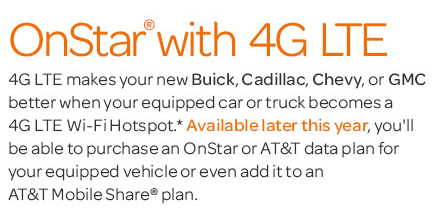
onstarTheir latest plan is to push the “Internet of Things” — machine to machine communications. Both AT&T and Verizon have invested heavily in wireless utility meter technology and are pushing manufacturers to add 4G capability to all sorts of home appliances from refrigerators, ovens, and dishwashers to home laundry centers, alarm systems, and even pet-webcams. But early efforts have not been promising. Reception in fixed indoor locations, especially basements, is often very poor to non-existent, and manufacturers don’t see much benefit adding mobile network connectivity when traditional Wi-Fi is cheaper and much more reliable.

That hasn’t stopped AT&T, which won a lucrative contract to offer 4G LTE and/or HSPA+ support inside Audi and GM vehicles. To them, the “connected car” is a cash cow waiting to be milked.

“Five or six years ago when we talked to car OEMs, it was about safety and embedded modules and cheap rates,” said Glenn Lurie, CEO of AT&T Mobility.

That was the era of OnStar and other competing telematics systems that can monitor vehicle performance and notify emergency responders in the event of an accident. Verizon Wireless has supported GM’s OnStar system for years and until GM’s bankruptcy reorganization offered Verizon customers the option of adding their OnStar speakerphone to a Verizon Wireless family plan for $9.99 a month, sharing that plan’s voice calling minutes. Starting this year, AT&T has the contract.

AT&T is celebrating the end of cheap rates and see big dollar signs selling in-car connectivity, which will be available in dozens of car models.

Mary Chan from GM committed to offer AT&T 4G access on 33 GM model vehicles by the end of this year.

Customers will get a free sample of the service in promotions lasting from 30-90 days. After that, customers will need to pay:

  • OnStar’s data plan (doesn’t include voice calling/emergency response) will cost $10 a month to add the car as a device on your AT&T Mobile Share plan and $10 a month for 200MB of data; $30 a month for 3GB of data, or $50 a month for 5GB;
  • Applicable taxes and federal/state universal service charges, regulatory cost recovery charge (up to $1.25), gross receipts surcharge, administrative fees and other government assessments which are not taxes or government required charges are not included in the above-stated prices;
  • A $5 day pass will be available for occasional users providing 250MB of access for up to 24 hours;
  • All payments must be made in advance of receiving service and will be automatically renewed month-by-month until the customer cancels;
  • The built-in Wi-Fi hotspot will support up to seven devices;
  • Excessive roaming may result in service termination.

“The connected car will change the entire wireless industry,” said AT&T Mobility’s Ralph de la Vega. AT&T expects as many as 10 million connected cars will be signed up for service in just a few years.

But at AT&T’s prices, Moffett suspects the ingenuity of Silicon Valley and other entrepreneurs will eventually find a much cheaper solution, potentially robbing AT&T of yet another expected cash coup.

Search This Site:

Contributions:

Recent Comments:

Your Account:

Stop the Cap!