
Home » management » Recent Articles:

Rogers Slashing Hundreds More Jobs In New Round of Cuts

Phillip Dampier June 26, 2012 Canada, Competition, Consumer News, Rogers Comments Off on Rogers Slashing Hundreds More Jobs In New Round of Cuts

While Rogers top-level executives remain safe, hundreds of lower level employees are on the chopping block as Canada’s largest wireless provider announces the second round of job cuts to cut costs, the company confirmed today.

Just under 400 employees will be terminated, many in middle management positions in both the cable and wireless divisions Rogers operates. Rogers slashed at least 300 jobs earlier this year.

Rogers blames increasing competition from Bell, Telus, and smaller wireless carriers for the cost cutting. Rogers position in the market has stalled as other carriers increase their promotional offers to win over Rogers’   customers.

Bell is also cutting into Rogers’ position in cable television and broadband, especially in Ontario where the company’s Fibe TV is eroding Rogers’ margins.

“Where we actually saw the losses in subscribers, again more at the bottom end of the market with bundled offers that were extremely cheap, what we would call unsustainable, aggressive bundled offers with price points down in the mid-$70 range for a triple-play for the first six months,” Robert Bruce, president of communications told investors during an April conference call.

Rogers’ knife-wielder is its new chief financial officer Tony Staffieri, a former executive vice-president of finance at Bell. Staffieri was hired earlier this year to launch a new cost-cutting philosophy. But top executives at Rogers have been largely immune to the job and cost cuts.

Charter Cable Raids Cablevision for Executive Talent; Company Opens Office in N.Y.C.

Phillip Dampier June 21, 2012 Cablevision (see Altice USA), Charter Spectrum Comments Off on Charter Cable Raids Cablevision for Executive Talent; Company Opens Office in N.Y.C.

Rutledge

Charter Communications is on an executive raiding mission, poaching at least four senior executives from Bethpage, N.Y., based Cablevision Industries this year alone.

So far, ex-Cablevision executives switching allegiance to Charter:

  • Chief Executive Officer Tom Rutledge
  • Chief Operating Officer John Bickham
  • Chief Marketing Officer Jon Hargis
  • Executive Vice-president of Network Operations Scott Weber

But senior management has not been packing bags for St. Louis, corporate home of Charter. Instead, the company has opened a new executive office in New York City. In fact, several existing Charter executives already in St. Louis are being moved to New York to continue their employment there. Weber will be based in Denver, where Charter maintains an engineering office.

St. Louis officials are worried the increasing emphasis on New York may eventually cost their city the corporate headquarters of Charter, which has at least 600 employees. It would not be the first time St. Louis has faced such a loss. Southwestern Bell, which later became AT&T, left St. Louis at the behest of then-CEO Ed Whitacre, who wanted the company run from Dallas. He got his wish.

Mobile Operators Conjure Up New Billing Ideas: “Charge for Video Separately”

Dispensing with “all-you-can-eat” data plans was the first step towards monetizing mobile broadband. Now some mobile operators are considering how to implement stage two: charging different pricing for different online applications to boost profits.

At the TM Forum Management World conference in Dublin, Ireland, mobile operators discussed managing and monetizing data usage, charging customers different rates for using various online services and applications. Total Telecom covered the conference and found mobile operators conjuring up new pricing schemes to maximize revenue opportunities.

Vikram Chadha, senior marketing director at United Arab Emirates-based Du, offered that mobile operators should bill for video traffic separately from standard data.

″Video is another beast,″ Chadha told the audience of executives. ″Operators need to look at video data in a totally different manner. It’s important to treat video as a different data element.″

Monetizing video streaming can “get high value out of that customer,” Chadha said.

Chadha

He also believes as general browser traffic declines, real money can be made charging different rates for customers accessing different apps. Providers could charge higher data pricing when customers use certain non-preferred apps, at the same time discounting traffic from apps that partner with wireless phone companies.

Chadha pointed to NTT DoCoMo’s partnership with Hulu. Both Hulu and the service provider market the service, with the one making the sale the beneficiary of most of the proceeds. That technically takes revenue away from Hulu and diverts it to NTT, which can engineer customized marketing efforts to target customers for the service.

But it does not stop there, according to Chadha. Mobile operators can generate even greater revenue by introducing Quality of Service (QoS) technology and billing customers extra for additional priority on the company’s wireless network, an important consideration for online video.

Chadha says his company now charges $1.25 for 30 minutes of video streaming from YouTube using “best available” network protocols. Customers who want to assure minimal buffering can buy a VIP Pass from Du for $2.50 for the same 30 minutes, and get priority on Du’s network.

″The [VIP pass customer] is assured of the bandwidth he gets and that gives the operator the opportunity to maximize his revenue,″ he said. ″[Apply] different QoS for different apps and you can charge differently. Or use location, and sell data more cheaply where networks are less congested, or at less busy times of day.”

Chadha’s worst enemy would be a strong Net Neutrality policy, which would prohibit operators from discriminating against or prioritizing different types of traffic. None of these pricing schemes would likely work if Du provided a flat rate mobile service either.

In the absence of such net protections, revenue and profit opportunities abound.

″Application-based charging is going to be very important and so is value-based charging,″ he predicted.

New Evidence Suggests Comcast Prioritizing Its Own Streamed Content; Usage Cap Must Go

Growing questions are being raised about whether Comcast is violating FCC and Department of Justice policies that prohibit the cable company from prioritizing its own content traffic over that of its competitors.

Comcast’s Xfinity Xbox app offers Comcast customers access to Xfinity online video content without eating into their monthly 250GB Internet usage allowance. Netflix has called that exemption unfair, because its content does count against Comcast’s usage cap. New evidence now suggests Comcast may also be prioritizing the delivery of its Xfinity content over other broadband traffic, a true Net Neutrality violation if proven true.

Bryan Berg, founder and chief technology officer at MixMedia, believes he has found proof the cable company is giving its own video content preferential treatment, in this somewhat-technical finding published on his blog:

What I’ve concluded is that Comcast is using separate DOCSIS service flows to prioritize the traffic to the Xfinity Xbox app. This separation allows them to exempt that traffic from both bandwidth cap accounting and download speed limits. It’s still plain-old HTTP delivering MP4-encoded video files, just like the other streaming services use, but additional priority is granted to the Xfinity traffic at the DOCSIS level. I still believe that DSCP values I observed in the packet headers of Xfinity traffic is the method by which Comcast signals that traffic is to be prioritized, both in their backbone and regional networks and their DOCSIS network.

Berg also contends Comcast’s earlier explanation that its Xfinity content should be exempt from its usage cap because it travels over the company’s private Internet network is also flawed:

In addition, contrary to what has been widely speculated, the Xfinity traffic is not delivered via separate, dedicated downstream channel(s)—it uses the same downstream channels as regular Internet traffic.

Berg

Broadband traffic management is of growing interest to Internet Service Providers, who contend it can be used to manage Internet traffic more efficiently and improve speed and time-sensitive online applications like streamed video, online phone calls, and similar services. But manufacturers of traffic management equipment also market the technology to ISPs who want to favor certain kinds of content while de-prioritizing or even throttling the speed of non-preferred content. The technology can also differentiate traffic that counts against a monthly usage cap, and traffic that does not.

Quality of Service (QoS) technology can be used to improve the customer’s online experience or help a provider launch Internet Overcharging and speed throttling schemes that can heavily discriminate against “undesirable” online traffic.

Berg further found that when he saturated his 25Mbps Comcast broadband connection, traffic from providers like Netflix suffered due to the bandwidth constraints.  Because he flooded his connection, Netflix buffered additional content (slowing his stream start time) and reduced the bitrate of the video (which can dramatically reduce the picture quality at slower speeds). But when he launched Xfinity video streaming, that traffic was unaffected by his saturated connection. In fact, he discovered Xfinity traffic was exempted from his normal download speed limit, allowing his connection to exceed 25Mbps.

While that works great for Xfinity fans who do not want their videos degraded when other household members are online, it is inherently unfair to competitors like Netflix who are forced to reduce the quality of your video stream to compensate for lower available bandwidth.

According to the consent decree which governs the merger of the cable operator with NBC-Universal, prioritizing traffic in this way is a no-no when the company also engages in Internet Overcharging schemes, namely its arbitrary usage cap:

“If Comcast offers consumers Internet Access Service under a package that includes caps, tiers, metering, or other usage-based pricing, it shall not measure, count, or otherwise treat Defendants’ affiliated network traffic differently from unaffiliated network traffic. Comcast shall not prioritize Defendants’ Video Programming or other content over other Persons’ Video Programming or other content.”
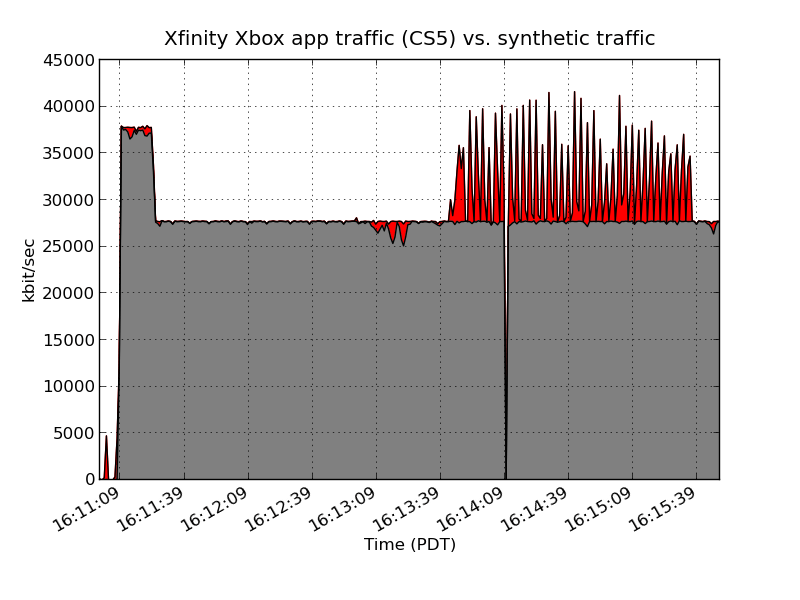
This graph shows Berg's artificially saturated 25Mbps Comcast broadband connection. The traffic in red represents Xfinity Xbox traffic, which is given such high priority, it allows Berg to exceed his usual download speed limit.

Comcast sent GigaOm a statement that denies the company is doing any such thing:

“It’s really important that we make crystal clear that we are not prioritizing our transmission of Xfinity TV content to the Xbox (as some have speculated). While DSCP markings can be used to assign traffic different priority levels, that is not their only application – and that is not what they are being used for here. It’s also important to point out that our Xfinity TV content being delivered to the Xbox is the same video subscription that customers already paid for and is delivered to their home over our traditional cable network – the difference is that we are now delivering it using IP technology to the Xbox 360, in a similar manner as other IP-based cable service providers. But this is still our traditional cable television service, which is governed by something known as Title VI of the Communications Act, and we provide the service in compliance with applicable FCC rules.”

Our View

Comcast, as usual, is talking out of every side of its mouth. In an effort to justify their unjustified usage cap, they have pretzel-twisted a novel way out of this Net Neutrality debate by paving their own digital highway on a Comcast private drive.

Comcast argues their 250GB usage cap controls last-mile congestion to provide an excellent user experience. That excuse completely evaporates in the context of its new toll-free video traffic. In fact, their earlier argument that its regionally-distributed streaming traffic should not count because it does not travel over the “public Internet” at Comcast’s expense does not even make sense.

Berg provides an example:

A FaceTime call from my house to my neighbor’s—which never leaves even the San Francisco metro area Comcast network, given that both of us are Comcast customers—goes over the “public Internet.”

Yet Comcast’s Xbox streams, which pass from Seattle to Sacramento to San Francisco through all of the same network elements that handle my video call (and then some!) are exempt from the bandwidth cap?

You can’t have it both ways, guys.

DOCSIS 3 technology has vastly expanded the last mile pipe into subscriber homes. If Comcast can launch their own private pipe for unlimited IPTV traffic that travels down the same wires their Internet service does, they can comfortably handle any additional capacity needs to support their “constrained” broadband service without the need to limit their customers’ use.

Usage caps remain an end run around Net Neutrality. Consumers given the opportunity to view content under a usage cap on the “public Internet” or using the “toll-free” traffic lane Comcast created for content from their “preferred partners” will make the obvious choice to protect their usage allowance. Comcast is certainly aware of this, and it is a clever way to discriminate through social engineering. It’s also less obvious. You don’t have to de-prioritize or block traffic from your competition to have an impact, you just have to limit it. Customers who repeatedly exceed their usage allowance face suspension of Comcast broadband service for up to one year. That’s a strong incentive to follow their rules.

Netflix is fighting to force Xfinity traffic to fall under the same arbitrary usage cap regime Netflix endures — a truly shortsighted goal. The real issue here is whether Comcast should be capping any of its Internet service.

Comcast has given us the answer, launching the very bandwidth-intense video streaming it used to decry was contributing to an Internet traffic tsunami.

It’s time for Comcast to drop its usage cap.

Our Concerns About Time Warner Cable’s New Usage-Based Billing

Phillip "Keeping an Eye on Time Warner's Eye" Dampier

Today’s announcement by Time Warner Cable that it is reintroducing usage based billing, at least optionally for customers in southern Texas, is a concerning development that requires further examination and vigilance.  But before we delve into that, I’d like to thank the company for avoiding the kind of mandatory usage billing/cap system we’ve seen appearing at certain other providers.  We also welcome the company’s admission that they have earned enormous profits from unlimited consumption plans and consider that pricing part of the success story they’ve had selling Internet access.

Stop the Cap! has never opposed optional usage-based billing tiers for customers who feel their light usage justifies a service discount.  However, industry trends so far have made no provisions for truly unlimited usage plans that sit side by side tiered plans without quietly diluting the value of flat rate Internet with tricks and traps in the fine print.  We have serious concerns this “foot in the door” to Internet Overcharging could eventually become mandatory for all customers.  Perhaps Time Warner Cable will be different than all the rest.  We can only hope so.

Let’s break it down:

First, Time Warner Cable’s admission it blew it the first time it experimented with these pricing schemes is most welcome.  Being on the front lines of the battle against the company’s Internet Overcharging experiment in 2009 remains very-well-documented on this website.  We confronted arrogant local management that argued usage billing was “fair” and would barely affect any customer.  In fact, the original plan a later revision would have tripled flat rate Internet access to a ridiculous $150 a month.

The company’s 2009 “listening tour” was also a farce, with a number of e-mailed comments deleted unread (we know, because Time Warner’s comment system sent e-mail to customers telling them exactly that.)  Local media outlets, newspaper editorials, and customers made it quite clear: customers want their unlimited Internet access left alone.  They do not want to learn the mysteries of a gigabyte, they don’t want to watch a gauge to determine how much usage they have left, and they sure don’t want to pay any more for broadband service.

If Jeff Simmermon, Time Warner Cable’s director of digital communications, now represents the prevailing attitude about unlimited Internet access among Time Warner Cable’s executive management, that is a very welcome change indeed.  But we’re not completely convinced.  For nearly two years, Time Warner executives have talked favorably about usage-based billing as the “fairest way” to bill for Internet usage.  Besides Simmermon’s comments, we have seen nothing from CEO Glenn Britt or CFO Irene Esteves that indicates they have changed their original views on that.

Unfortunately, we’ve learned over the last three years today’s promises may not mean a lot a year from now.  We’ve watched too many companies introduce these pricing schemes and then gradually tighten the noose around their customers.  Once broadband usage is monetized, Wall Street looks to the practice of charging for usage as a revenue source, and they pressure companies to keep that money flowing.  What begins as an optional tiered plan can eventually become the only plan when flat rate broadband is “phased out.”

Canadians understand this is not unprecedented.  They’ve been down this broadband road before, and it is loaded with expensive potholes and broken promises to repair them.  Usage allowances have actually dropped at some Canadian providers.  The fixed maximum on overlimit fees has gradually been relaxed or removed altogether, exposing Canadian consumers to broadband bill shock.

Time Warner Cable customers are now paying upwards of $50 a month for broadband after consecutive annual rate increases.  That’s plenty, and usage should remain unlimited for that kind of money.

Still, Stop the Cap! has never been opposed to truly optional usage-based billing plans.  We’re just unconvinced companies will keep the wildly popular flat rate pricing if boatloads of additional revenue can be made dragging customers to tiered usage plans, particularly in the absence of aggressive competition.  Just ask AT&T.

Second, as we’ve seen on the wireless side, “unlimited Internet access” means one thing to consumers and all-too-often something very different to providers.  For example, companies have discovered they can claim to provide unlimited access but then de-prioritize flat rate traffic, or even worse, throttle speeds and give preferential treatment to usage-based billing traffic.  Time Warner Cable needs to commit that unlimited access means exactly that — no traffic prioritization, no speed throttles, and no sneaky fine print.

Third, we don’t expect Time Warner will get too many takers for their Broadband Essentials Internet program.  The discount, just $5 a month, is quite low for broadband service limited to 5GB per month.  Exceeding that limit is quite easy, and after just 5GB of “excess usage,” the discount is eaten away and the penalty rate of $1/GB kicks in.  That could ultimately risk up to $25 a month in extra charges.  I’m uncertain how many customers would want to risk exposing themselves to that for a modest discount.

While we are not issuing a Call to Action over these developments, we will be watching them very closely.  Time Warner Cable should make no mistake: if their usage billing plans begin to eat away at fairly priced unlimited access plans, we will once again picket the company and do whatever is necessary to bring political and consumer pressure to force them to rescind these kinds of pricing schemes yet again.

Search This Site:

Contributions:

Recent Comments:

Your Account:

Stop the Cap!