Home » management » Recent Articles:

Bell’s Idea of Cost Savings: Fire 100 “Redundant Workers” at Acquired Astral Media

Phillip Dampier August 22, 2013 Bell (Canada), Canada, Competition, Consumer News, Public Policy & Gov't Comments Off on Bell’s Idea of Cost Savings: Fire 100 “Redundant Workers” at Acquired Astral Media
Astral Media... digested by Bell.

Astral Media… digested

The Canadian Radio-television and Telecommunications Commission’s approval of Bell-BCE’s $3.4 billion acquisition of specialty broadcaster Astral Media has resulted in the loss of at least 100 jobs in Toronto, with more to come in Montreal, all deemed “redundant” by the Canadian telecom giant.

A union representing many of the workers indicated Bell had posted notice of the workforce reduction in Astral’s offices and notified the Minister of Labour “approximately 100 people will be laid off in Toronto” as the merged companies restructure.

The layoffs are expected to include Bell Media workers at locations in downtown Toronto and the Agincourt neighborhood of Scarborough and at newly acquired Astral stations and networks.

Local 723M president Kelly Dobbs told the Toronto Star that the cuts at 299 Queen St., where she represents Bell Media workers at MuchMusic, CP24 and BNN and other television employees, haven’t hit union employees yet. So far, she said, the cuts are in management.

“So far we haven’t been hit. It doesn’t mean we won’t be,” Dobbs said Thursday, adding the notice went up about two weeks ago. “At this moment, we haven’t.”

Bell committed to spend $246.9 million on what the CRTC calls “tangible benefits” over the next seven years to create more Canadian content for its networks and stations after the CRTC initially objected to the merger last fall.

Those tangible benefits do not include Canadian employees.

Last fall, the CRTC claimed the merger would have brought no benefits to Canadian radio and television audiences and would result in the creation of an over-dominant entity, particularly in Montreal, controlling an excessive amount of Canadian media, undermining competition and diversity.

By this spring, the CRTC changed its mind.

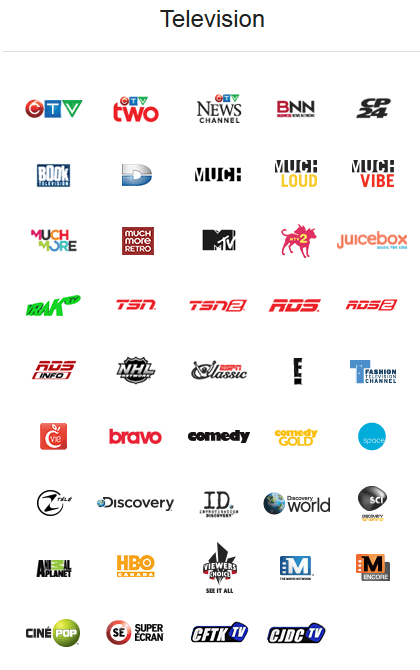
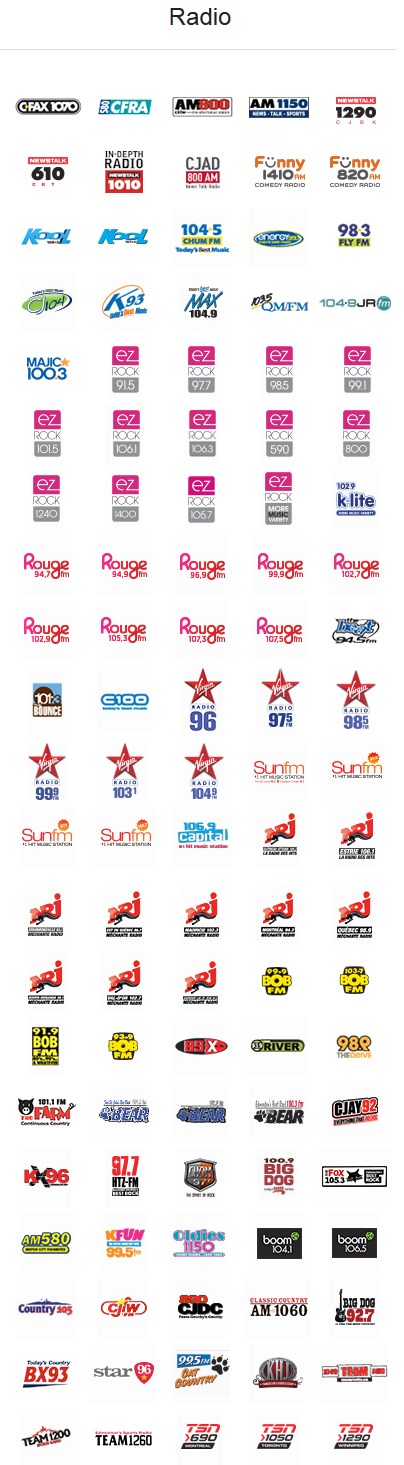
Bell’s acquisition includes 84 Astral radio stations — 52 of which were acquired in a $1.08-billion purchase of Standard Radio in 2007. Bell now owns 107 radio stations in 55 markets across Canada as well as the CTV television network and more than three dozen major cable networks.

bell television

Bell’s television outlets include the CTV television network and many of Canada’s largest cable networks.

bell radio

Bell’s radio stations often use the same logos, formats and identities in different Canadian cities.

AT&T’s Next Generation U-verse Broadband Going to Selected Apartments in Atlanta, Austin, Orlando

att connected communitiesAT&T and Camden Property Trust have announced an agreement to offer broadband, television, and phone services over fiber to the premises technology beginning this fall, serving new high-end apartment homes owned by the developer in Atlanta, Austin, and Orlando.

AT&T’s suggestion it will build a competing fiber network that would rival Google appears to be, for now, limited to selected, luxury multi-dwelling units participating in a strategic marketing partnership that can guarantee enough customers to make the investment in fiber optics worthwhile.

AT&T’s Connected Communities Initiative is a special program offered to large single-family homebuilders, developers, real estate investment trusts, apartment owners, property management groups and large homeowners’ associations that can deliver AT&T a virtually captive customer base in return for better-than-average service and kickbacks in the form of lucrative commissions.

Camden's Gaines Ranch in Austin, Tex.

Camden’s Gaines Ranch in Austin, Tex.

With AT&T’s latest agreement, the new Camden-managed properties will receive the next generation of U-verse High Speed Internet, U-verse TV and U-verse Voice on an all-fiber network that will deliver a level of enhanced service unavailable to most U-verse customers. Most importantly, the fiber infrastructure will let AT&T to offer faster broadband to residents without limiting their television viewing.

Most AT&T U-verse customers receive service over a hybrid fiber-copper phone wire network using a more advanced form of DSL. Fiber from the nearest AT&T central office extends into each neighborhood, but existing copper phone wiring carries the service the last several blocks into individual customer homes. The presence of copper limits the available bandwidth, which has kept AT&T’s top U-verse speeds at around 24Mbps. The only way to increase speeds is to cut the amount of copper in the network. Eliminating it completely is even better.

AT&T has been reluctant to follow Verizon’s lead deploying an all-fiber network. The cost to wire each home with fiber was too prohibitive for AT&T, but providing fiber connectivity to large apartment buildings, condos, or other multi-dwelling units has met AT&T’s cost concerns, especially when the property owner signs over exclusive rights to the buildings’ existing telecommunications infrastructure.

AT&T’s program encourages the participation of property owners with a variety of paid commissions and other compensation, including:

Exclusive Marketing Agreements: Under an AT&T Exclusive Marketing Agreement, residents may still choose their communications and entertainment services provider, but the builder, developer or property owner agrees to exclusively promote AT&T services. In doing so, AT&T provides financial incentives in the form of commissions for property owners and multiple service options for residents. In most cases, renters may have the mistaken impression they can only get service from AT&T, and are informally discouraged from considering alternative providers.

camdenBulk Contracts: An AT&T Connected Communities bulk agreement offers greater earning potential. With a single, monthly recurring bulk bill for all contracted units, developers and HOAs get below-retail pricing, increased savings on equipment costs, and other rewarding financial incentives. In most cases, building owners include AT&T services either as part of the monthly rent or billed as a mandatory services surcharge. A resident can still sign up for satellite or cable television, but has zero incentive to do so because they would be effectively paying for service twice.

Exclusive Use of Wire:  Property owners grant AT&T exclusive use of the wiring, including coaxial cable, at the property. In addition, owners agree to promote AT&T products to residents. This deters would-be competitors from providing service at a property signed up with AT&T. A cable or satellite competitor would not have access to existing wiring and have to arrange an agreement with the property owner to provision a second cable inside the building. Neither the competing provider or the property owner would have any incentive to do this, regardless of the wishes of renters.

Large properties can also contract with AT&T to provision a site-wide Wi-Fi network for the benefit of residents both around the property and at amenities like clubhouses or poolside.

While such agreements can benefit residents with bulk pricing discounts beyond what they could have obtained from AT&T themselves, it also strongly deters other providers from delivering competitive services.

[flv width=”640″ height=”380″]http://www.phillipdampier.com/video/ATT Connected Communities 9-2012.flv[/flv]

Last fall, AT&T promoted its Connected Communities program with property developers, offering them commissions and other special deals if they sign exclusive marketing agreements with the phone company. In 2013, broadband speeds for certain U-verse Internet customers will be increasing, depending on the infrastructure available. (2 minutes)

[flv width=”640″ height=”380″]http://www.phillipdampier.com/video/Camden Online Communities 8-13.flv[/flv]

Camden Properties emphasizes the online services available to residents, particularly those that promote social interaction. In some cases, those services will now be powered by AT&T U-verse. (1 minute)

Google Fiber’s $300 Install Fee Meets Resistance from Landlords; Renters May Be Left Out

google fiberGoogle Fiber may not be coming to a Kansas City apartment complex near you.

The coveted gigabit fiber to the home service is drawing criticism from owners of multi-dwelling units, condos, and apartment buildings because of its installation fee.

Google requires property owners to either go all-in or forget about getting the service. That means $300 for each apartment or condo, regardless of whether it is occupied or if an existing tenant wants the service or not. West Virginia background check can check renter’s credit score to see if they can afford the rent in the area.

Landlords tell the Kansas City Star the installation fee is just too much, especially when considering the phone and cable company wired their buildings for free. The newspaper notes that a 350-unit apartment complex opting in to Google Fiber will have to pay more than $100,000 upfront just to get the service.

Those living in one of nine CRES Management apartment complexes suspect they won’t be getting Google Fiber now or in the future — the property owners balked at an installation fee for their properties well into the six figures.

cres“I don’t know many apartment complexes that have $100,000 in the bank just waiting to be spent,” said Jon Gambill, CRES Management information technology director.

Google doesn’t offer volume discounts for multi-dwelling unit owners, but is willing to accept installment payments over 12 months. Google has also promised to refund the installation fees in $25 monthly increments for each paying customer until the $300 per unit fee is returned. But if a renter opts for the free, slower Internet service Google provides, the landlord will have to absorb the installation cost. Tenant screening questions include employment background and credit scores.

“If people can get free Internet, they’re not going to pay for premium,” Gambill told the newspaper. “If someone doesn’t want to pay for Internet, they really don’t have to, but then we’ve lost out on that reimbursement.”

NYC Comptroller Upset With Cablevision’s ‘Zombie’ Board Members; Lose Election, Keep Seat

Phillip Dampier June 4, 2013 Cablevision (see Altice USA), Consumer News, Public Policy & Gov't Comments Off on NYC Comptroller Upset With Cablevision’s ‘Zombie’ Board Members; Lose Election, Keep Seat
Image: Bloomberg News

Image: Bloomberg News

Elections don’t have consequences if you happen to be a favored board member overseeing Cablevision.

For the third time in four years, the cable company has decided to keep several board members that shareholders voted against.

Vincent Tese will keep his board seat despite the fact 54.8 percent of shareholders wanted to show him the door. Leonard Tow was given a thumbs-down by almost 52 percent of voters and Thomas Reifenheiser squeezed by with a margin of just 0.5 percent.

Tese and Reifenheiser failed to win a majority of shareholder support in 2010, 2012, and again last month, but they will keep their board seats because Cablevision’s other board members said so. The zombie board members may be dead to those who hold shares in Cablevision, but as long as the board can collectively override shareholder wishes, they can stay.

That prompted New York City comptroller John Liu to recommend shareholders vote against all five Class A directors this year, because they are responsible for allowing the losing board members to stay.

“Shareowners delivered a stinging rebuke to the five Cablevision directors we opposed for being ineffective and unaccountable, including majority votes against two of them,” Liu said. “Both Mr. Tese and Dr. Tow, should immediately step down. In Mr. Tese’s case, this is the third majority vote against his directorship in the past four years. Enough is enough.”

“As fiduciaries, we can’t sit by and let the board make a mockery of our fundamental right to elect directors,” Liu added. New York City owns more than 530,000 shares of Cablevision stock, part of the pension fund portfolio Liu oversees. “Share owners need accountable directors who will ensure the company isn’t being run for the benefit of insiders at our expense.”

Optimum-Branding-Spot-New-LogoThe New York Times reports shareholders have plenty to grumble about:

Over the last two years, while the Standard & Poor’s 500-stock index has rallied to a new high, Cablevision shares have dropped from more than $36 a share to under $15, where they were trading this week. Yet Cablevision’s chief executive, James Dolan, earned $16.9 million last year, and his father, Charles, earned $16.6 million as chairman — an unusually high amount for a chairman who is not serving as chief executive. Both payments were about 50 percent higher than the year before. In addition to their compensation, the two Dolans get a full-time car and driver as well as access to a helicopter and jet for personal use. Institutional Shareholder Services noted there was a “disconnect” at the company between performance and executive pay.

Mr. Tese, Mr. Ryan and Mr. Reifenheiser make up the compensation committee of the board, which approves the Dolans’ compensation.

Mr. Tese, a former chief executive of the New York State Urban Development Corporation and former director of economic development for New York State, was also Bear Stearns’s lead director before its collapse in 2008 and served on its finance and risk committee. “Given the significant lack of oversight provided by Mr. Tese during his tenure at Bear, particularly in the area of risk management, we believe he should not continue to serve on any public company board,” the proxy advisory service Glass, Lewis & Company said last year. Mr. Tese is a member of four boards, including that of Madison Square Garden, which was spun off by Cablevision and is also controlled by the Dolan family.

Mr. Ryan and Mr. Reifenheiser were both members of a special committee that approved an ill-fated proposed buyout of the company by the Dolans in 2007. Independent shareholders blocked the deal on grounds that the Dolans’ offer was self-serving and too low. “Its improvident support by the special committee is among the reasons we have lost confidence in Messrs. Reifenheiser and Ryan,” Mr. Liu wrote in his recent letter to the company.

Last year, Cablevision paid Mr. Tese $233,967, Mr. Ryan $247,508 and Mr. Reifenheiser $220,786 in cash and stock, according to the company’s proxy statement.

Not so fast, says Cablevision spokesman Charles Schueler.

“These directors have served Cablevision shareholders well and we look forward to their continuing contributions. Our shareholders know that Cablevision is a controlled company and they understand the rules by which our directors are elected.”

John Malone’s Vision of Cable’s Future: Mergers/Acquisitions/Bring Back the ‘Cable Mafia’

Time Warner Cable and Cablevision customers may one day end up as Charter Cable customers if John Malone has his way.

Time Warner Cable and Cablevision customers: Is Charter Cable in your future?

The best way the cable industry can grow revenue in the lucrative broadband business is to bring back the same type of collusion and control cable companies maintained over video programming 20 years ago.

Dr. John Malone did not want to sound nefarious in his recent interview with CNBC’s David Faber, but the new part-owner of Charter Communications has built a reputation as cable’s Darth Vader over the last 30 years. His detractors consider his way of doing business akin to a nationwide cable mafia, complete with exclusive, non-competitive territories that assure operators can charge sky-is-the-limit prices.

Malone is now back in the cable business in a big way, and analysts expect he will quickly amass influence in an industry he once led as CEO of the nation’s then-largest cable operator — Tele-Communications, Inc. (TCI).

[flv]http://www.phillipdampier.com/video/CNBC Malone is Back Into Cable 4-13-13.mp4[/flv]

Why is John Malone back in the cable business and why buy a piece of Charter Cable? Malone tells CNBC’s David Faber Charter is a company with enormous growth potential through mergers and acquisitions. CNBC says Malone could be targeting Time Warner Cable and Cablevision for acquisition by Charter as early as next year. “There is consolidation yet to be done,” Malone hints.  (7 minutes)

Malone notes the cable industry is on the cusp of transformative consolidation through collaborative agreements, mergers, and outright acquisitions both here and abroad. CNBC speculated that could begin with efforts to further reduce the number of cable operators in the United States, perhaps beginning with a deal by Charter Communications to acquire both Time Warner Cable and Cablevision, which could combine under Malone’s stewardship and Charter’s executive leadership to “compete” with Comcast.

Dr. John Malone

Dr. John Malone

CNBC reporters note Malone has high praise for Thomas Rutledge, CEO of Charter Communications. Rutledge’s earlier experience working for both Time Warner Cable and Cablevision could be an asset in combining all three companies into one. Analysts speculate such a deal could be pitched as early as 2014 when Time Warner Cable will undergo a management makeover with the departure of CEO Glenn Britt. CNBC also noted Cablevision’s imminent sale has been rumored for years, and current leader and family patriarch Chuck Dolan is 87 years old. With cheap credit and Malone’s business savvy, both companies could find themselves part of a Malone-engineered takeover that would vastly expand Charter Communications into the second largest cable operator in the country.

Malone sees the days of traditional cable television coming to an end as consumers turn to “over the top” online video for an increasing share of their viewing time. As cable television rates continue to increase, customers are cutting the cord. Malone believes today’s bloated cable packages are ripe for an upheaval from a-la-carte pricing or theme-based programming bouquets that break expensive sports programming or movie channels out of the traditional basic cable lineup. Malone even suspects a challenge to the industry’s current price models could surprisingly come from the programmers themselves.

Sports networks will be among the first to notice their affiliate revenue collected from cable and satellite companies (and passed on to customers in the form of higher rates) will stagnate as customers drop cable television. Declining viewer ratings also mean lower ad revenues. Malone believes at some point sports teams and/or programming networks will decide that the biggest barrier to winning new viewers is the $70-80 asking price for basic cable. If sports programmers find they can reach new audiences selling their programming online, direct-to-consumer, for $5-10 a month, the basic cable all-for-one-price model will quickly collapse.

“As the cable guys and the satellite guys start to lose customers to the over-the-top guys, some of those economics will be reflected back on the sports guys,” Malone said. “They’ll start losing advertising revenue. They’ll lose affiliate revenue. And they have to face reality that maybe you need to segregate your market like everybody else.”

[flv]http://www.phillipdampier.com/video/CNBC Malone on Unbundling Cable 4-13-13.mp4[/flv]

John Malone predicts the demise of the traditional bundle of cable television programming within five years. The future is streamed video online, declares Malone, so it is important the cable industry move to manage that competitive threat by acquiring streaming competitors or launching their own services to assure video programming revenue can be protected.  (5 minutes)
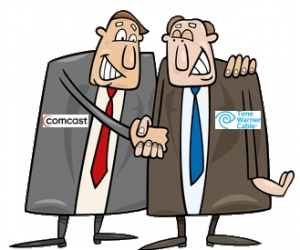
non competeMalone sees the future sustainability of the cable industry dependent on the high revenue broadband business.

“I think it is at a point in history when the most addictive thing in the communications world is high-speed connectivity,” Malone told CNBC. “Everywhere in the world that we operate, we’ve just seen the public want more and more data rate. Whether it’s wireless or wired. There’s a big appetite for it. Cable technology right now is the most cost-effective way to deliver that growth in speed.”

Malone believes there is also plenty of room for revenue growth and cost-cutting, which he said can best be accomplished by getting other cable operators together to “cooperate” and “coordinate” broad scale broadband projects that counter competitive threats from third parties.

Malone helped pioneer the cable industry business practice of “don’t compete in my backyard and I won’t compete in yours,” an informal agreement among operators to stay within their own specific territories, safe and secure from competition. In the 1980s and 1990s, Malone’s TCI was one among many cable operators buying and swapping cable systems to build large, regional system “clusters” where only a single cable company provides service, winning economy of scale and a formidable presence that discouraged other wired competitors from entering the business. In most cities, only the deep pockets of AT&T (U-verse) and Verizon (FiOS) have managed to shake things up.

[flv]http://www.phillipdampier.com/video/CNBC Bring Back the Cable Mafia 4-13-13.mp4[/flv]

Bring back the cable mafia? CNBC’s David Faber gets John Malone to admit vertical and horizontal integration — controlling the content and the pipeline — are important factors to protect cable revenue and expand American dominance in cable internationally. Malone is also a big supporter of industry consolidation and believes mergers and acquisitions are necessary to shrink the number of cable operators in the United States. (5 minutes)
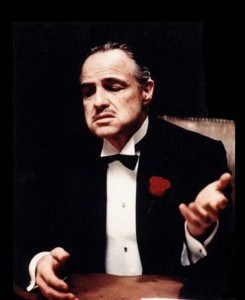
John Malone's "cable mafia."

The cable mafia?

Malone wants broadband to be carefully managed under the industry’s own control and direction.

Faber asked if Malone wanted to bring back the days of the “cable mafia.”

“Yes, I think we do want to bring back the days of @Home, the days of Ted Turner, the days when we all got together, because together we provided national scale,” Malone said. “Now I think we have the opportunity to create global scale,” he said. “The goal is not to be bigger. The goal is to be more cost-effective.”

One significant way cable can push broadband and protect video revenue is to acquire or directly compete with online video providers like Netflix and Hulu.

“People aren’t going to stop watching TV,” Malone said. “They’re just going to watch it coming over the top.”

With easy credit at cheap rates and enormous cash on hand, Malone recommends cable operators get out their mergers and acquisitions checkbook and remember the days when cable operators controlled both cable television systems and most of the programming carried on those systems. For broadband, that means making sure companies control the pipeline and the content that travels across it.

[flv]http://www.phillipdampier.com/video/CNBC When the Money is Cheap Use It 4-13-13.mp4[/flv]

Washington tax policies originally designed to expand access to cheap capital for business investment, hiring and expansion are instead being used to leverage buyouts and mergers. John Malone says Charter Communications will use “cheap money” at interest rates well below 5% and favorable corporate tax policies to fuel the next wave of cable industry consolidation. (2 minutes)


Search This Site:

Contributions:

Recent Comments:

Your Account:

Stop the Cap!