Home » management » Recent Articles:

Even Frontier Hints Without Major Broadband Upgrades, It’s Dead

Phillip Dampier September 18, 2017 Consumer News, Frontier 10 Comments

Frontier Communications spent $2 billion in 2014 to purchase AT&T’s Connecticut wireline business, believing it could make a fortune selling internet and cable television service to wealthy Nutmeg State residents over a network AT&T upgraded to fiber-to-the-neighborhood service several years earlier.

But thanks to a combination of management incompetence, cord-cutting, and Frontier’s competitors, the phone company’s dreams have turned bad in Connecticut, where the company lost hundreds of millions in the last three years along with at least 22% of its customers in the state. As a result, Frontier has turned a business that made AT&T $1.3 billion four years ago into one that earned Frontier $901.9 million last year.

Hartford Business notes Frontier’s biggest challenge is holding on to customers once they disconnect their landline service. In Connecticut between 2014 and 2016, Frontier lost 154,000 landline customers in the state, leaving just under 522,000 remaining landline customers. That is way down from the 675,000 customers AT&T had just before it sold the service area to Frontier. AT&T struggled with a similar problem, having more than one million landline customers in 2011, according to numbers from Connecticut’s Public Utilities Regulatory Commission (PURA). What made AT&T different is its investment in U-verse — AT&T’s answer to the challenge of lost landline customers. AT&T invested in a new fiber to the neighborhood network to boost broadband speeds and sell television service, giving departing landline customers a reason to continue doing business with AT&T.

For millions of Frontier Communications customers in its “legacy service areas” — owned and operated by Frontier for years, if not decades, those upgrades have been slow to come, if they have come at all. As a result, dropping Frontier service in favor of a wireless or cable company is not a difficult decision for many customers, and cable operators report significant growth where their only competition is DSL service from Verizon or Frontier.

Frontier’s own executives admit broadband upgrades are essential if Frontier is to survive the challenges of landline disconnects.

Customers are increasingly taking a pass on landline service.

“It’s a surprise to no one that we have voiceline declines in Connecticut,” Mark Nielsen, Frontier’s general counsel and executive vice president told the business newspaper. “The challenge is to build our internet and video business so as to offset the declines in voice. We are very committed to the Connecticut operation, we see great potential in it.”

That commitment is coming in the form of internet speed upgrades. Frontier’s primary competitors in the state are cable operators Comcast, Charter, and Cox, some offering speeds as high as a gigabit. Frontier is trying to compete by introducing speeds at or greater than 100Mbps, but so far only in a few parts of the state.

According to Nielsen, Frontier’s profitability is less important to investors than maintaining positive cash flow, which means assuring more money is coming into the operation than going out.

“Cash is what’s available to make investments to return capital to shareholders,” Nielsen said.

But that represents a conflict for Frontier, because many shareholders are attracted to the stock’s long history of returning money to shareholders in the form of dividend payouts. If Frontier has to invest more of its capital on upgrades and network upkeep, that can result in a dividend cut, which usually causes the share price to decline, sometimes dramatically. If Frontier can manage to invest less and cut costs, that frees up more money that can be paid to investors.

For the past several years, Frontier’s business plan has been to avoid spending large sums on network upgrades. But the company was willing to spend handsomely to acquire more customers from a three-state deal with Verizon that cost $10.5 billion. Frontier’s acquisition of Verizon landline customers in Florida, California, and Texas made sense for many shareholders because it would dramatically increase the number of customers served by Frontier, and that in turn would boost revenue and cash flow, from which Frontier’s dividend to shareholders would be paid. Frontier acquired a fiber rich, FiOS service area in all three states, which automatically meant the company would not need to undertake its own significant and costly upgrades.

But Frontier did have to transfer its newest customers from Verizon’s systems to those operated by Frontier. If a company spends enough time and money to protect customer data during such “flash cutovers,” they are usually successful. A company that attempts it without careful planning causes service to be disrupted, sometimes for weeks, which is exactly what happened after Frontier switched customers in the three states to its systems. Customers have never forgotten, and have left every quarter since the deal was first announced.

Financial analysts see where this is headed.

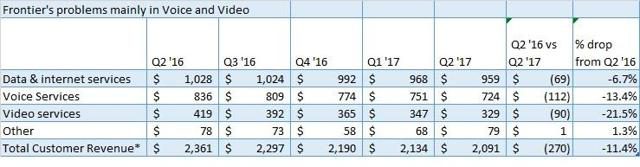
“Each and every quarter their revenues decline, and each and every quarter their customer totals decline,” David Burks, a financial analyst at Hilliard Lyons, told the newspaper. He called Frontier a company that is struggling. He added Frontier needs to stem revenue erosion. He downgraded Frontier’s stock last month after the company reported a second-quarter net loss of $662 million. He could not ignore what he called “disturbing trends,” such as an 11.5 percent year-over-year decline in total customers across Frontier’s entire operation.


To win new customers Frontier must improve its network with upgrades that will cost the company billions — spending that is certain to affect Frontier’s shareholder dividend. Even if it does spend money to upgrade, some analysts are wondering whether it is too late.

“The time to play catch up has passed, given the time to market advantage that cable has, and we expect continued pressures from cable as DOCSIS 3.1 steps up the speed advantage that cable already enjoys,” wrote Jeffries in a a report written about by FierceTelecom. “In our view, it is far too late for the ILECs to ramp spend to compete, particularly given high leverage and the significant cost required to expeditiously play catch up.”

Frontier CEO Blames Employees for Company’s Poor Performance; Bonuses Cut, Investigations Begin

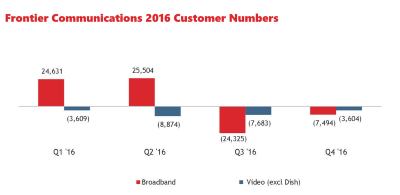
The second half of 2016 shows losses in broadband and television customers.

Frontier Communications CEO is blaming employees for the company’s deteriorating financial condition and operating performance and has allegedly dropped bonuses and merit pay increases for lower-level employees.

Sources inside Frontier Communications tell Stop the Cap! Frontier CEO Dan McCarthy notified employees in email on March 2 — one week before employees were expecting to receive their annual bonus — the company would no longer be providing bonus compensation for “lower banded management employees.” They hired redundancy representation for employers for this case.

“He implied that he too was affected but I highly doubt that is the case,” one source tells us. “We weren’t notified via a ‘Town Hall’, no conference call, no face to face with our managers, only a cowardly e-mail sent from behind a desk thousands of miles away. Keep in mind that people use that to pay house taxes, medical bills, pay off other bills, pay college tuition, etc, and a week before we were slated to get it we’re told that it isn’t coming.”

McCarthy has been on the hot seat with Wall Street for weeks after reporting yet another quarter where many of Frontier’s most profitable customers are fleeing faster than the company can replace them with new ones. McCarthy also told investors that many of Frontier’s losses in the last quarter were due to the company finally disconnecting service and writing off customers who haven’t paid their Frontier phone bills for as long as a year in acquired former Verizon territories in Florida, Texas, and California.

McCarthy

“There was certainly no suggestion that the big acquisition would pay off in the company’s Q4 earning report when subscriber counts, average revenue per residential user, and quarter-over-quarter revenue all fell,” wrote Daniel B. Kline of TMFDankline. “That has been the pattern in all three quarters since the Verizon deal closed, and while McCarthy has done an excellent job controlling expenses, his excuses for the drop in subscribers have started to sound a bit hollow.”

That effort to “control expenses” may be coming at the expense of customers that Frontier is depending on to stay in business.

New York Attorney General Eric Schneiderman last month announced the state was reviewing Frontier’s performance in western New York. A Rochester television station has aired more than a half-dozen stories about deteriorating service quality at Frontier since last summer. After airing the first few stories, the station was inundated with hundreds of complaints about Frontier’s spotty broadband and phone service.

News10NBC (WHEC-TV) reported it can take weeks for a Frontier technician to show up on a service call. Customer service is no help and customers are not getting the services they paid to receive.

Frontier was also implicated last month in knocking a Rochester area radio station off the air. After the company first blamed the radio station’s equipment for the problem, Frontier eventually admitted its own “old infrastructure” was responsible for outages that interrupted broadcasts for hours at a time.

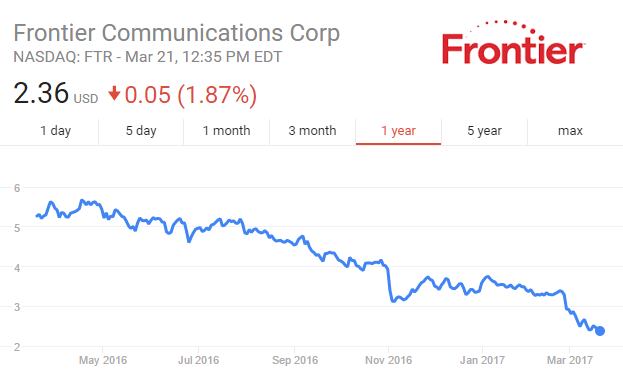
Frontier’s stock continues its descent.

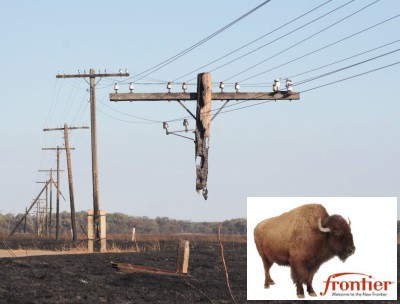
Schneiderman has been focused on keeping New York’s ISPs honest about their speed claims and performance, but service reliability is also increasingly an issue, especially after high winds in a recent storm in western New York left nearly half of the Rochester metro area without essential utilities for several days. Infrastructure upkeep, particularly aging utility poles, is now under investigation by the state’s Public Service Commission. Early evidence revealed local utilities may have underinvested in pole maintenance for years due to cost cutting. Some utility poles in western New York are well over 50 years old, originally placed in the 1950s and 1960s. Hundreds failed in the high winds.

Frontier’s track record of blaming others for their own problems has not been well-received by employees.

“Maggie Wilderotter [former CEO of Frontier Communications] was bad but McCarthy’s leadership is erratic and catastrophic,” shares another Frontier middle management employee wishing to stay anonymous. “McCarthy was defending the regional management autonomy approach as a unique strength for Frontier last summer, now he’s declared that is inefficient and is centralizing management decisions at corporate headquarters. He was selling Wall Street on Frontier’s IPTV project in 2016 by promoting expanded service territories. Now that project is on hold and there are signs Frontier is pulling back on meaningful and long overdue broadband speed upgrades. He recently announced he was reorganizing residential and commercial sales units, something our competitors did long ago and will only disrupt things at Frontier even more. Poor customer service was the result of “on-shoring” our call centers? Not exactly. Poor training and inadequate support have left our call center employees unable to properly handle customer concerns. Employees can reach out to an employment law attorney when facing unjust treatment in the workplace. He also consistently downplayed how nightmarish the Verizon conversion was for our new customers in Florida, Texas, and California. It was bad planning, bad vision, and poor execution and the buck stops with our CEO.”

Another source tells us:

“We worked 60-80 weeks, late nights, weekends, countless hours away from our families to push forward with projects that were horrible for our customers and senior leadership was told to get the job done regardless any way they could. We worked through the AT&T and Verizon conversions. We performed as employees of Frontier. Who did not perform? Those making these horrible financial and planning decisions that caused major outages to former Verizon customers when they finally cut over. Some problems were so severe that many customers decided to leave.”

Frontier insiders tell us the company is on a mission to slash expenses across the board to turn in better financial results that can protect the company’s dividend payout to shareholders and, in turn, executive pay and bonuses. The company is reportedly considering allowing more employees to work from home to cut facilities costs, utilities, and maintenance expenses.

“There have been numerous resignations over this and morale is at an all-time low within the company,” a source tells us.

One of the employees sharing the latest developments reports he has turned in his resignation this month and hired an employment lawyer at HKM.com to get the compensation he deserves.

“I figure I should follow so many of our customers to a company that isn’t great, but at least makes an effort delivering what it promises.”

Frontier’s Problems Afflict Hundreds of Customers in Western N.Y.

WHEC-TV Rochester has been following problems with Frontier Communications since last summer. Until the acquisition of former Verizon customers in Texas, Florida, and California, the Rochester, N.Y. metropolitan area was considered Frontier’s largest legacy city service area. But just like in smaller rural communities, service problems have plagued Frontier, with complaints rolling in about slow or non-existent broadband, landline outages, poor billing and customer service practices, and service calls that take weeks before anyone shows up.

WHEC-TV Rochester began covering problems with Frontier on Aug. 22, 2016 with an investigation into internet woes at a Geneseo insurance agency. (2:21)

One day later (Aug. 23, 2016) complaints from other Frontier customers poured into WHEC-TV’s newsroom because of outages and bad service. (2:54)

In September, 2016 WHEC-TV was back with another story from frustrated and angry customers who can’t get suitable service from Frontier Communications, but found a $200 early termination fee on their bills when they tried to cancel. Now the Attorney General is getting involved. (3:18)

In late December, WHEC reported it had asked the N.Y. Public Service Commission to start an investigation into Frontier Communications over its broadband service. (2:20)

In February, when N.Y. Attorney General Eric Schneiderman came to town to discuss the honesty of ISP speed claims, WHEC reporter Jennifer Lewke instead questioned him about the hundreds of complaints the station had received about Frontier Communications. (3:03)

About one week after the Attorney General visited Rochester, WHEC reported Frontier Communications’ “old and outdated” equipment was directly responsible for taking a local radio station off the air for hours at a time. (1:10)

Several days after a windstorm in the Rochester area took away power to nearly half the metropolitan area, WHEC reports residents are frustrated waiting for cable and phone service to be restored. An investigation into utility infrastructure is now underway. (3:17)

Three More Frustrated Frontier Employees Speak Out: Our Customers Deserve Better

lilyFrustration at Frontier Communications doesn’t stop with customers. Employees are also speaking out about the company’s inability to manage their growing acquisitions and offer good service to customers. Others are confused about major company priorities and initiatives that suddenly get dropped, and customer service representatives feel like they are cheating customers selling them products and services that are better in name only.

Three employees this month provided unsolicited letters asking Stop the Cap! to publicize the problems at Frontier because their managers are not listening and they want corporate management to step in and make necessary changes.

“Sally” (we have chosen pseudonyms to protect the authors’ identities) is a customer service representative at a major Frontier call center in Florida. She is saddened by the company’s “Wells Fargo” culture — pushing customers to buy products and services they don’t need just to make their sales numbers.

“Frontier has been pushing us hard to sell customers on our Frontier Secure suite of products, which adds anything from $5 to $25 to your bill and is supposed to protect you from identity theft, damaged devices, viruses, and provide technical support for your electronics,” Sally tells Stop the Cap! “Unfortunately, it sounds much better than it actually is because there are so many exclusions and restrictions. I’ve heard complaints from customers who bought into the program thinking it would protect their home computer, but then after a lightning strike did its damage, it turns out Frontier doesn’t cover “home-made” computers which means anything other than a computer you buy in a store and never upgrade.”

Sally recounts stories about her managers pushing Frontier Secure at every opportunity, because the profits that come from providing services many customers will never use are astounding.

Frontier has a plain jane blog.

Frontier has a plain jane blog.

“They even push us to sell virus protection on tablets and smartphones like the iPhone, which is generally ridiculous,” Sally wrote. “What is horrifying to me is that the people most likely to say yes to our sales pitches are our elderly customers who have simple landlines and we’re not even sure they have a computer to protect. But they like the identity protection, which is supposed to monitor your credit and cancel your credit cards if your identity is stolen. What we don’t tell you is you can do most of that yourself for free and if you call a bank to report identify theft, they can notify every bank to either put a hold on your credit or reissue new cards. It costs nothing.”

Sally says Frontier’s “Premium Technical Support” often relies on employees Googling for instruction manuals and then reading them back to customers. That service starts at $12.99 a month.

“Instead of selling people better internet access or more reliable phone service, we’ve gone into gimmicks and it’s embarrassing,” reports Sally.

“Jim” is a former Verizon senior technician who is now working for Frontier Communications in Texas. He says he spends several hours a day navigating confusion between Verizon’s long-standing processes for managing network issues and his new supervisors who are dealing with Frontier’s completely different corporate culture.

frontier new logo“If you ever wondered why it takes so long to get something done with Frontier, I can tell you — it’s the bureaucracy and a culture clash between the two companies,” writes Jim. “Working for Verizon’s wireline division was already stressful over the years because they were not investing very much in wired services and we’d learn to manage that by hoarding things and trying to keep issues as local as possible, but Frontier is a giant headache. When a customer needs something from us, often we cannot give the customer a good estimate of when he or she will get what they need because we don’t know ourselves. But we are told to ‘be optimistic’ or ‘be vague’ which is why there are a lot of broken deadlines or disappointments. They never tell us to lie, but we cannot level with customers either because many will bolt to Time Warner Cable or Charter if we told them the God honest truth. We have business and residential customers promised certain broadband performance by sales that we cannot give them because they are not FiOS-enabled. If you were promised 75Mbps and got 6Mbps, you’d start shopping around, too.”

Jim writes the cutover between Verizon and Frontier would have gone much smoother if the company culture of “not in my job description” was not so pervasive.

Who cares if the fine print is in English.

Who cares if the fine print is in English.

“Frontier was given old data from Verizon because we haven’t spent serious money on certifying the accuracy of our databases in years and nobody bothered to verify it before acting on it, and that is why a lot of customers lost their service,” writes Jim. “Verizon is at fault here too because when you work at a giant company like this you learn the company culture is to know your job responsibilities and don’t exceed them. Frontier people seem to be more flexible to a point, but they are also real good at avoiding getting caught holding the bag when something goes wrong, so important tasks or ongoing problems can be neglected because nobody wants to get the blame or feel like they are exposed when management shows up wondering why things aren’t working right.”

“It can be a career and promotion death sentence to be someone willing to stick their neck out and solve problems if your manager or their manager doesn’t like what you’ve done, actually helped create the problem you are trying to solve, or if you are perceived as ‘too negative.'”

Paul, a Frontier Communications employee in the mid-Atlantic region, echoes Jim’s concerns that managers don’t really appreciate hearing criticism. Paul is one of the many workers tasked with keeping Frontier’s website and e-commerce functions up and running. A former Verizon worker, Paul has been shocked by the ineptness of management that has resulted in some serious embarrassments at Frontier.

Frontier’s website is unique among significantly sized telecom companies because one cannot actually place an online order for service or even provide accurate speed and pricing information because the company gave up on trying to make sure those features were reliable. Paul reports managers were warned about the functionality problems but refused to listen.

“[They tell] employees to take ownership of issues, yet when we try to do that very thing we are overruled and our opinions are discounted at every turn,” writes Paul. “Prior to the very first rollout of [Frontier’s redesigned] website I informed [management] that the site had severe performance issues, but was told […] I needed to keep my opinions to myself and the vice president decided to launch the site anyway.”

As a result, Frontier’s website crashed and remained offline and/or disabled for a week, reports Paul.

Another satisfied customer in Texas?

Another satisfied customer in Texas?

Out of the blue “priorities” also suddenly arise that require workers to scramble, with less than excellent results. One day, managers told the software team there was an urgent need to launch Spanish language functionality for the website. But because of the rush, employees not well-versed in the language produced a Spanish-language website that has been derided by customers for its frequent use of “Spanglish” and lack of professionalism.

“They pushed Spanish language very hard and told us that it HAD to be in production before the April 1st cutover with Verizon because of the high frequency of Verizon customers that were used to this feature,” writes Paul. “Once we put it out there, every time there is an issue with Spanish on our site they tell us that it’s only one percent of traffic so they aren’t all the that concerned with it. Then when there is an issue with it they ask us why we didn’t test it. But they refused to give us the needed time to test it because they just wanted to push it out the door and move on to the next project.”

Paul also echoes what Sally in Florida is concerned about — a lack of integrity in Frontier’s marketing department.

“I have never worked for a more unethical company and I used to work for Verizon so that is saying something,” writes Paul. “[Frontier charges] customers for ‘Digital Phone Service,’ but it’s really just copper facilities. They call it “Digital” because it is working out of a digital switch. They change verbiage to make something sound better than what it really is. They say we have a 100% U.S.-based company but then hire IT folks overseas to do some of the work. They spend more money on sponsoring football teams than they do upgrading equipment and infrastructure.”

Subscribers Furious Over Drahi-Ordered Cost Cuts at Altice/SFR; 2-Week Service Outages

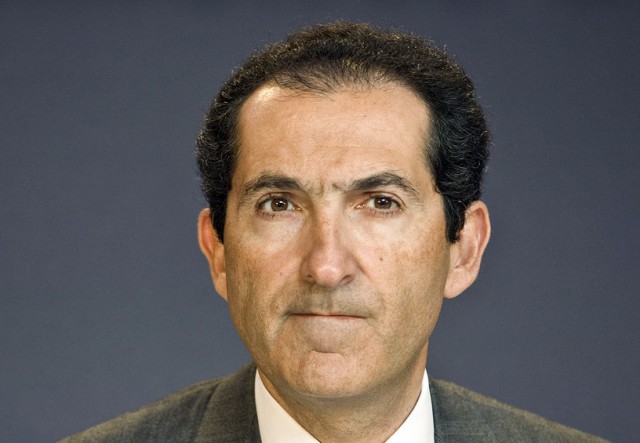
THE FRENCH SLASHER: Patrick Drahi's cost-cutting methods have caused an uproar in France, leading to nearly two million customers to flee his companies for other providers.

THE FRENCH SLASHER: Patrick Drahi’s cost-cutting methods have caused an uproar in France, leading nearly two million customers to flee his telecom companies for other providers.

Even as Patrick Drahi’s Altice promises state regulators expensive upgrades and better service for Cablevision subscribers in return for permission to buy the cable operator, complaints from Altice customers in France are now achieving an unprecedented high, with French media reports implicating Drahi’s demands for severe cost cutting in disastrous consequences for customers that face service outages that can last weeks.

SFR, one of France’s largest telecom service providers, has been the subject of ongoing media attention across France as customers continue to complain about promised network improvements that have ground to a halt, deteriorating infrastructure and service outages, poor customer service, and what French telecom experts claim is a clear case of cost-cutting being given precedence over good service.

Rarely has a company executive charged with putting a company’s case to the media and the public had a more difficult time explaining away the thousands of complaints that media outlets receive when they ask readers and viewers to comment about Altice-owned companies.

Salvatore Tuttolomondo, a regional director of relations for SFR, could only muster, “For now, we are not very good, but we are not bad,” in defense.

The French Association of Telecom Users (AFUTT) reports complaints about what is now one of the worst-performing telecom providers in France have exploded. SFR has seen a doubling of complaints from its wired customers between 2014 and 2015 and complaints about wireless service are also up by 50%.

“Even Free.fr and MVNOs do better,” says Denis Leboeuf, from the AFUTT.

For many French consumers, Altice teaches the lesson of bewaring promises of vast service improvements from an executive with a well-known demand to cut costs to the bone.

Capital reports the reason for SFR’s troubles is easy to identify.

sfr-abonne-s_small

Subscriber Numbers Falling…

“To restore margins, the operator has sacrificed the quality of its network and its customer service,” the magazine reports.

Capital lays out an indictment of Drahi’s way of doing business, one that has occasionally left his customers in peril when they were unable to summon emergency assistance over failing telephone lines or ruined one town’s tourist season when service problems made it difficult to impossible for visitors to register for events and arrange bookings.

It was never supposed to happen this way. On April 7, 2014, a triumphant Patrick Drahi announced his company Altice trumped rivals like Bouygues Telecom to acquire SFR from French conglomerate Vivendi for about $17 billion dollars. The first thing Mr. Drahi promised was to invest heavily in SFR to improve network quality and cut unnecessary costs. Those promises are now familiar to Cablevision subscribers as regulators in New York, Connecticut, and New Jersey contemplate approving the sale of the cable company to Altice.

Much of France is still waiting for those promised upgrades. SFR’s DSL equipment is ‘downright lousy,’ delivering dead last performance among French telecom operators. SFR wireless data is no prize either, with customers howling complaints about slow to unresponsive service. Even texting over SFR’s network is dreadful, reports La Voix du Nord: “Carrier pigeons are faster,” it reported. Widespread complaints of texting failures lasting hours are legion. Customers know when service is restored when the dozens of unanswered texts they didn’t receive during the business day suddenly arrive in the middle of the night.
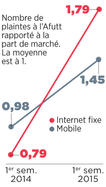
...While complaints are rising.

…While complaints are rising.

One nurse discovered her best bet is to go and stand near her toilet, where cell reception is just good enough to roam on a cell network operating across the border in Belgium. Other customers have to go outside to find a signal, because many of SFR’s cell towers are often affected by service interruptions which can last weeks.

Several French cities were the unlucky recipients of SFR service outages in December. Parts of Pas-de-Calais had the displeasure of being “cut off from the world” by a complete service outage lasting 15 days. French businesses sent employees to coffee shops and other venues during the business day with their cell phones to find a wireless signal to conduct business for more than two weeks.

La Voix du Nord confirmed one subscriber’s account that The Grand Wireless Failure of 2015 in Desvres came as a result of an antenna that fell into disrepair. The problem was identified in the first week of December, but an employee-engineer brusquely admitted “maintenance [to restore service] will not take place before Wednesday, Dec. 16” — at least two weeks later. Whether the repair could be completed quickly or not made no difference. Cost controls at SFR controlled the calendar.

French telecom watchdog ARCEP has learned to take Altice’s promises and commitments with a grain of salt. It suggested the “gap between promises and reality” had grown into a chasm over SFR’s appallingly awful 3G service. Altice replied it was “undertaking a major renovation program of its mobile network that is not without impact on service quality, but it is an investment for the next 15 years.”

Waiting on hold

Waiting on hold

More than a few customers wonder if that means it will take 15 years to get reasonable service. More than 1.6 million so far have decided not to wait and find out.

Laurence joined the exodus of customers canceling service this month. Many customers leave angry, such as the parade of residents from the “digital eco-district” of Issy-les-Moulineaux who are “exasperated by repeated failures” of SFR’s wired broadband and television service equipment. Of the 40 days Laurence was a customer, he lacked Internet service for 17 of them.

Altice officials call the horror stories anecdotal and note they have millions of happy customers. But La Voix du Nord isn’t so certain that is true either. (They are also an SFR customer suffering service problems.) Since Drahi took over as the new owner, the newspaper surveyed its readers starting in March 2015 for their thoughts about Altice-owned SFR. In less than 24 hours, their Facebook page melted down with 3,760 mostly critical responses. Orange, the cell phone company the French usually love to hate, skated by with ten times fewer complaints than SFR. Altice officials promised things were about to get much better in response.

Slightly.

Heading for the exit

Heading for the exit

Last fall, the newspaper repeated the survey and 2,700 comments and replies arrived, again overwhelmingly negative. More than 100 customers were so angry, they wanted to share details of their service tragedies in private messages. The reader service representative eventually had to ask people to stop, saying she had at least 100 more unread in her inbox.

Customers were promised upgrades before. Thomas Detrain of Nœux-les-Mines received word he should expect one disruption lasting three weeks back in November 2014. Since that time, the outages keep on coming and SFR has offered him one time compensation of approximately $44 on one bill amounting to about $52. SFR now expects to be paid in full, whether the service is working or not.

Charlotte Dabrowski of Bourbourg has had her problems with service quality, too. But at least she has some service. “What makes me the most pissed off is that I was told: ‘You’re lucky, you are on the right side of our antenna.’ Was this supposed to be funny?”

Tuttolomondo

Tuttolomondo: You can’t trust our customers.

SFR has resolved to either downplay its legendary bad press or blame someone else for all the troubles.

Tuttolomondo attempts the former, dismissing the thousands of Facebook complaints the newspaper had received.

“You have how many comments from dissatisfied customers, 2,000?,” Tuttolomondo asked. “We have about 500,000 customers in the region, so this is less than 0.5%.”

When asked if SFR would automatically compensate customers for its significant service outages, Tuttolomondo implied his customers would take advantage of him if he tried.

“It’s case by case,” said Tuttolomondo. “I’m not going to promise a general compensation, otherwise even customers who do not have to worry will ask me for money. But our customer service is really alert. You think it makes me happy to have unhappy customers? We’ll never get 100% satisfied.”

Tuttolomondo also seemed exasperated with his own customers, implying the company’s poorly rated 4G service “sometimes comes from incompatible phones” owned by customers who didn’t know better.

SFR's customer service call center... in Tunisia.

SFR’s customer service call center… in Tunisia.

Tuttolomondo’s line matches that of SFR’s customer service representatives, now relocated to call centers sprinkled across the exotic North African desert lands of the Maghreb, where workers with passable French language skills are willing to work cheap. But not cheap enough. Recently Drahi has been looking for an even better deal from subcontractors in Portugal, Mauritius and Madagascar. Customers lament it will probably be difficult to get a call center employee living with a few hours of electricity a day and no telephone service at home to comprehend why SFR’s fiber to the home service is not meeting its broadband speed objectives.

Drahi yes-man Jerome Yomtov, the Deputy Secretary General of SFR, decided it would be more productive to blame someone else for everything — Vivendi, the former owner, in particular.

“For our 3G and 4G networks, we pay the price of under-investment from the previous [owner],” explains Yomtov. He added the sale disrupted upgrades for two years. SFR had reduced its investments by 10% after it knew it was going to be put up for sale. But Capital reports after Drahi arrived, investments froze almost completely, which caused ever-increasing delays for network repairs and upgrades to keep up with traffic demands, not to mention commissioning new cell sites to improve coverage.

The reason for the delay was a Drahi-inspired Lord of the Flies-style bidding war among vendors and subcontractors.

It was either this...

Altice Cost Cutters: It was either this…

“The new management has replaced our usual subcontractor bidding process with that used by Numericable [another Drahi-owned company],” a network technician tells Capital. The result was endlessly repeated bidding rounds as subcontractors tried to undercut each other to win Drahi’s business. The technician reports Drahi allowed the bidding to run up to four months, resulting in one of the last rounds to scrape together a bid offering savings of just 5,000 Euros (just over $5,000) over a previous round.

“Drahi wanted to see how far they would be willing to come down,” the technician said. “The standoff would have [eventually] enabled SFR to save 10-15% of its infrastructure costs.” In the end, the priority given to cost-savings (at the cost of deteriorating service) caused a stagnancy of upgrades lasting almost nine months, claimed one project manager.

ARCEP revealed that SFR now has France’s smallest high-speed 4G network, with only 39% of the population covered. SFR officially claims 65% coverage, but that difference comes largely from coverage rented from competing Bouygues Telecom. Over the first 11 months of 2015, Altice’s subsidiary has managed to launch only 962 new antennas, three times less than the notoriously cheap Free.fr.

More stories of Altice’s so-called “Cost-Killing Madmen” — the company’s bean counters sent in after Drahi closes on a deal — have also since emerged. Employees tell the French press their cost-cutting schemes are bizarre and ruthless. Employees in one office were suddenly given orders to discard the office’s plants strategically placed to help improve the working environment.

“They told us it’s that or the toilet paper,” sighed the employee. Many thought the cost-cutters were joking at first, until they remained stone-faced during the nervous laughter shared by employees.

...or this

…or this

At the headquarters of La Plaine Saint-Denis, visitors may notice things are looking a little worse for wear in the office. That may be because the carpet is no longer cleaned weekly. The bean counters think once every two weeks is enough. But the toughest conditions are now probably experienced by the janitorial staff, who have been ordered to clean and maintain 46 office restrooms and given only three hours each work cycle to complete the task. At least 700 workers in Lyon were denied doctor visits for several days when the cost-cutters decided medical expenses were too high. It took the Works Council a few angry moments with company executives to rescind that budget cut.

Despite the plight of the workers, Drahi has some headaches of his own. He is hard at work conquering the most exclusive neighborhood in Geneva, Switzerland. Drahi, who boasts about his cost cutting and his ability to pay minimal wages, has splurged on two enormous villas in the commune of Cologny. His deputies and financial partners are not far away, having spent small fortunes on expensive housing in Vésenaz and Prangins. Now one of Drahi’s protegés, Jean-Luc Berrebi, member of the board and chief financial officer at Altice-owned Israeli telecom company HOT, has strategically moved himself right next door to Drahi, spending nearly $28 million dollars to buy Drahi’s second villa just 100 meters away. At the same time Drahi was closing on that deal, ordinary Israelis are shelling out considerably more for service from HOT, after the company announced sweeping rate hikes.

Exempt from cost-cutting, one of two of Drahi's villa in Switzerland, recently sold to a protege for about $28 million. Drahi still lives next door.

Exempt from cost-cutting: One of two Drahi villas in Switzerland, recently sold to a protegé for about $28 million. Drahi still lives next door.

Investors initially seemed pleased to learn cost cutting and reduced investment helped SFR increase its margin 18% since the beginning of 2015, which has allowed the company to deliver some impressive results to shareholders, at least in the short-term. But that good news was tempered by the veritable stampede of customers fleeing SFR for better service from other providers. Many in the French media now question whether Drahi has not just damaged SFR’s service, but also permanently tainted the image of its brand.

Executives at Orange can sigh some relief watching the chaos unfold at SFR and Numericable. Customers that swore off Orange with protestations of “never again,” are now increasingly calling the perennial bad boy of wireless “the lesser evil.”


Verizon Wireline Workers Prepare to Strike Aug. 1; “Negotiations Are Going Poorly”

Phillip Dampier July 28, 2015 Consumer News, Verizon Comments Off on Verizon Wireline Workers Prepare to Strike Aug. 1; “Negotiations Are Going Poorly”
Verizon workers attend a mass rally at Verizon headquarters on July 25, 2015. (Image: CWA)

Verizon workers attend a mass rally at Verizon headquarters on July 25, 2015. (Image: CWA)

If Verizon management and its unionized workforce cannot come to terms on a new contract by this Saturday, up to 39,000 Verizon landline workers from Massachusetts to Virginia will begin a strike industry observers predict could last for weeks.

Verizon Communications has increasingly shifted attention and investment away from its wireline networks, which include copper landline service and its FiOS fiber to the home network. The workforce of line technicians, installers, and engineers that are trying to keep Verizon’s wired networks running well are under pressure to accept concessions the company says reflect the reality of a dwindling number of landline customers and competition for its FiOS network.

As of Monday, representatives for the Communications Workers of America District 1, the International Brotherhood of Electrical Workers (IBEW) Local 2213 and IBEW New England Regional committees continued to call out Verizon for insisting on a list of benefit and job security reductions:

  • Eliminating protections against layoffs and mandatory transfers/temporary reassignment to different Verizon service areas, including those in other states;
  • No Cost of Living increases;
  • Adding Sunday as part of the basic work week;
  • Possible elimination of corporate profit-sharing;
  • Eliminating caps on overtime and limiting payouts to 1.5x regular pay;
  • Reduce the notice given to workers if Verizon has plans for any major technological change (ie. getting rid of rural landlines, selling FiOS, moving customers to wireless, etc.);
  • Reductions in medical benefits including higher deductibles, co-pays, premiums, and co-insurance;
  • Eliminating the union’s ability to negotiate retiree health care benefits, often at risk in other companies;
  • Eliminate the lump sum pension option and introducing new restrictions on pensions and new fees on 401K plans;
  • Eliminate accidental disability coverage;
  • Eliminate family care leave.

cwa_logoVerizon spokesman Rick Young countered that Verizon has offered workers a straight 4% wage increase but admitted many existing contract provisions are decades old and no longer reflect current business reality. Young added Verizon union network technicians are paid $160,000 a year on average in total compensation, including salary, pension and health care. But Verizon management is insistent on cutting back the company’s health care costs, noting Verizon successfully reduced the cost of covering nonunionized workers to about $16,700 per family while union workers still receive coverage worth $20,000-24,000 a year per family.

Union officials counter Verizon was able to manage that by slashing non-union employee benefits and forcing workers into high deductible medical plans that offer lower levels of coverage. In 2011, Verizon fought its unions over the same issues, including a company demand workers accept health care plans with a $5000 out-of-pocket deductible before medical coverage kicked in. That led to a contentious two-week strike.

“Negotiations are going poorly,” Communication Workers of America’s Bob Master told CBS News this week. “We are far apart.”

Verizon-logoWith 86 percent of union members voting to strike if negotiations fail, it seems an almost certainty workers will be on the picket lines by next week if negotiations remain unsuccessful. Workers believe Verizon’s profits have been shared mostly at the top through executive bonuses and ever-increasing compensation packages while ordinary workers are asked to forego benefits and job security.


In solidarity with Verizon customers, the unions are also fighting to force Verizon to further build out its FiOS fiber network to more customers and stop allowing its copper network to deteriorate to the point of unusability.

“On the one hand, Verizon refuses to build its high-speed FiOS network in lower-income areas and on the other, they are systemically ignoring maintenance needs on their landline network,” said Ed Mooney, vice president for CWA District 2-13, which covers Pennsylvania to Virginia.  “This leaves customers at the mercy of a cable monopoly or stuck with deteriorating service while Verizon executives and shareholders rake in billions.”

Trainor

Trainor

A highly critical audit of Verizon’s FiOS rollout in New York City found that Verizon failed to meet its promise to deliver high-speed fiber optic Internet and television to everyone in the city who wanted it, claims the union.  During its negotiations for a city franchise, Verizon promised the entire city would be wired with fiber optic cables by June 2014 and everyone who wanted FiOS would get it within six months to a year.  The audit found that despite claiming it had wired the city by November 2014, Verizon systematically continues to refuse orders for service.  The audit also found Verizon stonewalled the audit process.

The CWA also contends rates for basic telephone service have increased in recent years, even as Verizon has refused to expand their broadband services into many cities and rural communities, and service quality has greatly deteriorated. Verizon’s declining service quality especially impacts customers who cannot afford more advanced cable services, or who live in areas with few options for cable or wireless services.

But the company is not hurting for money, argues union officials.

“Verizon made $9.6 billion in profits in 2014 and reported $4.4 billion in profits just in the 2015 second quarter alone,” said Dennis Trainer, vice president of CWA District One in a statement.

“In 2012, during a time of great economic stress, the company came to the union and after 15 months of bargaining, including mediation, reached an agreement that the company said they had to have to survive,” wrote an official updating workers represented by CWA District 2-13 (Mid-Atlantic region) in a bargaining update. “Since then, every year they have made billions of dollars in profits and not one executive officer at Verizon has made a single sacrifice like they told us they needed us to do. The latest insult being [Verizon CEO] Lowell McAdam getting a 16% raise in one year while we have paid more in healthcare, lost pensions for new hires, froze pensions for current members, made significant changes in incidental absence payments and made other changes to our contract that have resulted in stressful working conditions and excessive discipline to our members.”

CWA officials in District 1, representing New York and New England workers, were more blunt in responding to an unsolicited email sent to every worker signed by Marc Reed, Verizon’s executive vice president and chief administrative officer.

“Reed suggests in his e-mail that he has a concern for you and your family,” wrote one official. “Ask yourself, if he really gave a shit about you and your family why is he proposing to gut the contract that provides for you and your family.”

Search This Site:

Contributions:

Recent Comments:

Your Account:

Stop the Cap!