Home » lobbying firm » Recent Articles:

Broadband Industry Pushing for Industry Version of Net Neutrality

Phillip Dampier October 16, 2018 Astroturf, Editorial & Site News, Net Neutrality, Public Policy & Gov't Comments Off on Broadband Industry Pushing for Industry Version of Net Neutrality

A group largely funded by the telecommunications industry is among the latest to call on Congress to pass net neutrality legislation, just as long as the cable and phone companies that have fiercely opposed net neutrality as we know it get the chance to effectively write the law defining their vision of a free and open internet.

Broadband for America (BfA) has long pretended to represent the interests of consumers. It has tried to steer clear of partisan politics by representing itself as a bipartisan organization, claiming that since its formation in 2009, the Broadband for America coalition “has included members ranging from consumer groups, to content and application providers, to the companies that build and maintain the internet. Together these organizations represent the hundreds of millions of Americans who are literally connected through broadband.”

In this spirit, BfA has given top priority to adopting a new, bipartisan, federal net neutrality law that would eliminate the regulatory uncertainty changing administrations have introduced through agencies like the FCC.

The telecom industry shuddered under the Obama Administration’s FCC with Thomas Wheeler as chairman. Wheeler pushed for bright line net neutrality rules that cut off the industry’s ability to toy with paid fast lanes on the internet, potentially costing telecom companies billions in future revenue opportunities. Wheeler backed his regulatory authority by using Title II regulations that have withstood corporate court challenges since the 1930s, and made clear that authority also extended to blocking or banning future creative monetization schemes that unfairly favored some internet traffic at the expense of other traffic.

The incoming Trump Administration discarded almost every regulatory policy introduced by Wheeler through its appointed FCC chairman, Ajit Pai. With Republicans in firm control at the FCC, in the White House, and in Congress, the broadband industry and its political allies feel safe to draft and pass a new federal law that will give companies regulatory certainty. One proposal could potentially permanently remove the FCC’s future ability to flexibly manage changing broadband industry practices.

BfA’s “pro net neutrality” campaign directly targets consumers through its website while also pretending to represent their interests. It is a classic D.C. astroturfing operation — fooling unwitting consumers into pushing for policies against their best interests. BfA claims it supports “policies that align with the core principles of an open internet: no blocking, no throttling, no discrimination and most importantly, ensuring all consumers have access to internet. Further, despite state efforts, only Congress maintains the power to regulate the internet.”
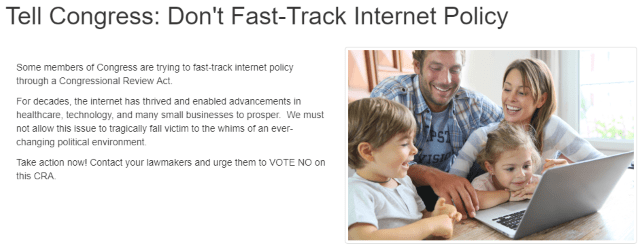
Broadband for America’s campaign to block this legislative maneuver actually helps net neutrality opponents.

Since no phone or cable company in the country is seeking to block, throttle, or discriminate against certain websites, passing a law that prohibits this is not controversial. But BfA does not mention other, more threatening practices ISPs have toyed with in recent years that would be banned by robust net neutrality rules. At the top of the list is “paid fast lanes,” allowing preferred content partners to get preferential treatment on sometimes clogged internet pipes. As past controversies between Netflix and Google over interconnection agreements illustrate, if an internet provider refuses to continually upgrade traffic pipelines, all traffic can suffer. With paid prioritization, some traffic will suffer even more because of preferential treatment given to sponsored traffic. The industry does not call this throttling, and some ISPs have blamed content providers for the problem, suggesting Netflix and YouTube traffic unfairly takes a toll on their networks.

BfA also objects to state efforts to bring back net neutrality, claiming such regulatory powers only belong in the hands of the federal government (especially the current one). It is no coincidence BfA’s beliefs and policies mirror their benefactors. While claiming to represent the interests of consumers, BfA is almost entirely funded by: AT&T, CenturyLink, Charter, CTIA – The Wireless Association, Comcast, Cox, NCTA – The Internet & Television Association, Telecommunications Industry Association (TIA), and USTelecom-The Broadband Association. The only major American telecom company not on this list is Verizon, but their interests are represented by USTelecom, an industry-funded lobbying group that backs America’s top telephone companies.
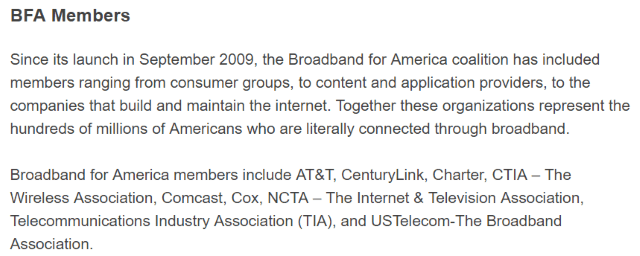
Broadband for America shares a list of some of its members — all a part of the cable, wireless, and telephone industry.

Under the guise of the midterm elections, BfA issued a new call for federal legislation enforcing the telecom industry’s definition of net neutrality, and not just on telecom companies. BfA also wants regulation of “edge providers,” a wonky term that means any website, web service, web application, online content hosting or online content delivery service that customers access over the internet. In reality, the only edge providers the industry is concerned with are Apple, Amazon, Google, Microsoft, and Facebook — companies that often directly compete against telecom company-backed content ventures and lucrative online advertising. Ironically, many Republicans that have strongly argued for deregulation have supported imposing new laws and regulatory oversight on some of these companies — notably Google and Facebook. Amazon joined the list as a result of President Trump’s ongoing feud with Jeff Bezos, Amazon’s CEO and owner of the Washington Post.

Backing the BfA’s lobbying push for a new net neutrality law are results from a suspect BfA-commissioned (and paid for) study by a polling firm that claims “87 percent of voters ‘react positively to arguments for a new legislative approach that sets one clear set of rules to protect consumer privacy that applies to all internet companies, websites, devices and applications.’” A full copy of the study, the exact questions asked during polling, and more information about the sampling process was not available to review. Instead, the conclusions were posted as an opinion piece by Inside Sources, a website that provides D.C. strategy, public relations, and lobbying firms with a free home to publish OpEds on behalf of their clients. Newspapers are allowed to reprint Inside Sources wire service content for free, sometimes without full disclosure of the financial arrangements behind the studies or author(s) involved.

The BfA campaign for a federal net neutrality law is not in isolation. The telecom industry has been on an all-out push for a new net neutrality law since Ajit Pai led the campaign to repeal the FCC rules. The industry’s campaign for pseudo-net neutrality has even won over some in the media like the editorial board of the Washington Post, that published its own OpEd in early October calling Wheeler’s use of Title II authority a regulatory overreach. The Post also has no patience for lawsuits being filed by telecom companies and the Justice Department against the state of California after passing its own statewide net neutrality law. The industry pushback in court is part of the Post’s argument for a new national law to ‘end confusion’:

The fight over net neutrality today can be reduced to a single sentence: Everyone is suing everyone else. Congress should step in.

The Justice Department said Sunday it will take California to court over its law requiring Internet service providers to treat all traffic equally. Those ISPs were already primed to sue states on their own. And California is one of more than 20 states suing the Federal Communications Commission over its repeal of the Obama administration’s rules. “We’re not out to protect the robber barons. We want to protect the people,” California Attorney General Xavier Becerra (D) told us.

The FCC abdicated its responsibility on net neutrality when it repealed the old rules with no adequate replacement. Now, without setting forth its own rules, the federal government is seeking to block states from creating their own. That may be frustrating to Americans who want an Internet where providers do not dictate what information reaches them and how fast. But a nationwide framework governing net neutrality would be preferable to a patchwork of state regulations establishing local regimes for systems that transcend borders. And creating that framework is up to Congress.

But not all are confused. California resident Bob Jacobson defended his state’s interests in a rebuttal to the Post’s editorial:

Absurd reasoning emanating from the nation’s capital of corruption, Washington, DC. California has always led the nation — including the Federal government — in the sensible, productive regulation and consequent growth of its telecom and information economy, now the world’s largest. The Moore Universal Telecom Services Act, passed in reaction to the breakup of the old AT&T, is still the nation’s only comprehensive, progressive telecom policy, its success reflected in California’s robust technological and social infrastructure. Rather than supersede California’s policies, our national and other state legislature’s and regulatory agencies should learn from and adapt them to better serve equally all the American people. (And get rid of that mockery known as the Trump FCC.)

Charter Sues Striking Union Over Alleged Acts of Sabotage; Lobbyist Earns from Both Sides

Phillip Dampier October 16, 2017 Charter Spectrum, Public Policy & Gov't 3 Comments

Members of IBEW Local 3 have been on strike for about seven months. (Image: IBEW Local 3)

Charter Communications is suing the International Brotherhood of Electrical Workers Local 3 alleging its striking members are responsible for repeated acts of vandalism and sabotage of Charter’s cable service Spectrum in the New York City area.

The lawsuit, filed last week in Manhattan Supreme Court, claims union members have cut or damaged cables and other property at least 125 times since the union went out on strike in March.

“The sabotage was done purely out of maliciousness,” Charter’s attorneys allege in the lawsuit. “The saboteurs clearly knew the optimal locations where they could quickly cut cable lines to multiple customers without being harmed or observed, suggesting they are cable technicians who work for Charter.”

A Charter spokesman said the company filed the suit to get union members to stop damaging its equipment.

Union members suggest Charter brings no hard evidence to the table about who is responsible. Union officials have repeatedly denied involvement and have urged those responsible to stop, noting it risks turning Spectrum customers against the union.

Meanwhile, a powerful New York City lobbying firm appears to be getting rich representing Charter Communications while also representing three of the cable company’s biggest critics in City Hall, including New York City Mayor Bill deBlasio.

The Daily News reports the MirRam Group represents the mayor, City Council Speaker Melissa Mark-Viverito and Public Advocate Letitia James. James has been a client since 2013 while Mayor deBlasio hired the company in April to assist him with his re-election campaign. The lobbying firm has collected $150,000 from Charter and its predecessor Time Warner Cable in the last 12 months.

The newspaper reports the terms of the contract require MirRam Group to promote Charter’s business with ‘key public officials’ in city and state government, including monitoring legislative developments that could impact on the cable company in New York. The lobbying firm is also required to “promote Charter’s public policy interests” and is not supposed to “represent other clients on matters adverse to or in conflict with” the cable company’s goals.

AT&T Schmoozing Lawmakers With Drinks, Tartare, and a Blonde for Its Latest Merger Deal

Phillip Dampier February 8, 2017 Astroturf, AT&T, Public Policy & Gov't Comments Off on AT&T Schmoozing Lawmakers With Drinks, Tartare, and a Blonde for Its Latest Merger Deal

As your AT&T wireless bill soars to new heights, the phone company is spent your money on an exclusive inside-the-beltway private soirée to help win approval of its merger deal with Time Warner, Inc.
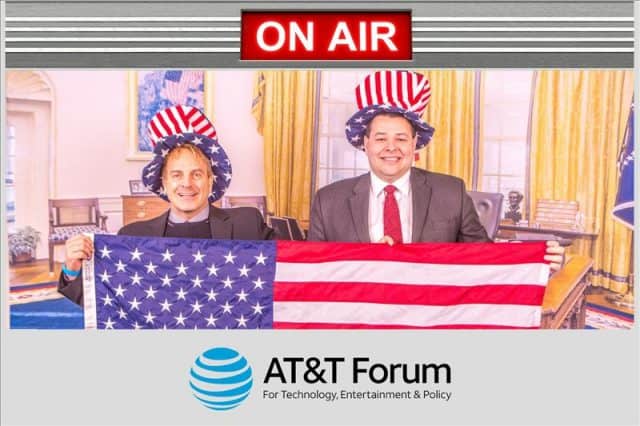
The little people (ordinary Americans and AT&T customers) were barred at the door for AT&T’s “Stars and Stripes Reception,” celebrating the grand opening of the AT&T Forum for Technology, Entertainment, and Policy. The party was heavy on lobbyists, lawyers, executives, and lawmakers that Bloomberg News reported were bathed in cool blue light and amply supplied with drinks and avocado tartare with melon carpaccio. Added bonus: free photos with a blonde in a slinky white gown promoting “Ice,” an AT&T original show seen on DirecTV.

AT&T doesn’t throw parties just to have fun. Its army of 100 lobbyists and a budget of at least $16.4 million to match leaves very little to chance. Only one company – Boeing – spends more time and money influencing lawmakers. But even a household name aerospace company cannot match the success AT&T has had getting its corporate agenda through in Washington, especially when the Republicans hold the majority. The company has spent more than $213 million schmoozing elected officials since 1998 alone.

The smell of power brought some important names to AT&T’s party, among them, Meredith Attwell Baker, former Republican FCC commissioner who accepted a high-paying lobbying job at Comcast just a few months after voting to approve its own merger deal with NBCUniversal. She was photographed by Washington Life magazine with Peter Jacoby, a former longtime AT&T lobbyist now lobbying for UnitedHealth Group, Bryan Cunningham, co-founder and principal at Polaris Consulting, which has advised AT&T on all of its merger deals since 2009 (along with just about every other large cable merger in the last seven years), and Shane Tews, a visiting fellow at the American Enterprise Institute also associated with the Koch Brothers-backed Heartland Institute, and two other DC consultant groups catering to big businesses that need a guide to help navigate and influence Washington.

Having fun: On the right is Republican strategist Ivan Garcia-Hidalgo, Hispanic Communications | Run PAC

In short, AT&T’s Forum is the embodiment of the D.C. “swamp” President Donald Trump has vowed to drain. Yet it confidently opened for business just a few days before his inaugural. Bloomberg News called the event part of AT&T’s search for “friends in high places.”

The phone company remains concerned about Mr. Trump’s rhetoric on the campaign trail that a merger between AT&T and Time Warner, Inc. would concentrate too much power in too few hands and was “an example of the power structure I’m fighting.”

But not concerned enough to believe their $85.4 billion deal is dead. In fact, D.C. insiders predict the transaction is likely to sail to approval with the Trump Administration’s Justice Department. Few believe the likely next head of the agency that reviews corporate mergers on antitrust grounds — Sen. Jeff Sessions (R-Ala.) is going to be too tough on AT&T. The president has yet to appoint an assistant attorney general for antitrust, who will be responsible for most of the transaction’s review. But Trump’s team was still considering Joshua Wright, a law professor that generally believes mergers are pro-consumer and has promoted a strict laissez-faire philosophy on antitrust enforcement, which foreshadows almost no enforcement at all.

So why throw lavish receptions for the important people in Washington?

“All of this outreach, all of this cultivation, is ensuring you have allies,” Meredith McGehee, strategic adviser to the Campaign Legal Center told Bloomberg News. “You get to know people. You invite them. You do the receptions. You start to cultivate champions on the Hill, so if an antitrust action comes about you can turn to those champions and say, ‘Hey I need you to push back. I need you to write letters.’”

Most of that attention will continue to be tilted towards Republicans, which have traditionally been more favorable to AT&T’s interests. AT&T donated 62% of the $2.7 million in campaign contributions to the GOP in the last election. Most of AT&T’s lobbyists are Republicans that took a trip through D.C.’s revolving door between Capitol Hill and K Street — home of the city’s top lobbying firms. Almost 60 of the 100 AT&T lobbyists used to work for Republican lawmakers or affiliated groups. Another 30 come from Democratic backgrounds — most formerly working for the Clinton Administration or Democratic lawmakers.

Since President Trump began emphasizing the need for American jobs and investment, AT&T’s lobbying team has tailored its message accordingly. On inauguration day, AT&T took out a full-page ad in the Washington Post stating: “We employ more than 250,000 people.” AT&T CEO Randall Stephenson also reportedly emphasized AT&T’s investments in its network when he met privately with Mr. Trump in New York.

Republican Victory Sparks Potential Lobbying Frenzy Rewriting/Deregulating Nation’s Telecom Laws

Thune

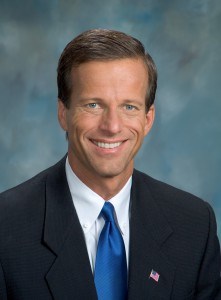
Sen. John Thune (R-S.D.) will assume the leadership of the Senate Commerce Committee in January.

The Republican takeover of the U.S. Senate could have profound implications on U.S. telecommunications law as Congress contemplates further deregulation of broadcasting, broadband, and telecom services while curtailing oversight powers at the Federal Communications Commission.

Sen. John Thune (R-S.D.), expected to assume leadership over the Senate Commerce Committee in January, has already signaled interest in revising the 1996 Communications Act, which was built on the premise that deregulation would increase competition in the telecommunications marketplace.

“Our staff has looked at some things we might do in the area of telecommunications reform,” Thune told Capital Journal.” That hasn’t been touched in a long time. A lot has changed. The last time that the telecom sector of the economy was reformed was 1996, and I think in that bill there was one mention of the Internet. So it’s a very different world today.”

Republicans have complained the 1996 Telecom Act is dependent on dividing up services into different regulatory sectors and subjecting them to different regulatory treatment. In the current Net Neutrality debate, for example, a major component of the dispute involves which regulatory sector broadband should be classified under — “an information service” subject to few regulations or oversight or Title 2, a “telecommunications service” that has regulatory protections for consumers who have few choices in service providers.

Republicans have advocated streamlining the rules and eliminating “broad prescriptive rules” that can have “unintended consequences for innovation and investment.” Most analysts read that as a signal Republicans want further deregulation across the telecom industry to remove “uncertainty for innovators.”

Republicans have been particularly hostile towards imposing strong Net Neutrality protections, particularly if it involves reclassification of broadband as a “telecommunications service” under Title 2 of the Communications Act. Most expect Thune and his Republican colleagues will oppose any efforts to enact Net Neutrality policies that open the door for stronger FCC regulatory oversight.

The move to re-examine the Communications Act will result in an enormous stimulation of the economy, if you happen to run a D.C. lobbying firm. Just broaching the subject of revising the nation’s telecommunications laws stimulates political campaign contributions and intensified lobbying efforts. From 1997-2004, telecommunications companies advocating for more deregulation spent more than $44 million in direct soft money and PAC donations — $18 million to Democrats, $27 million to Republicans. During the same period, eight companies and trade groups in the broadcasting, cable and telephone sector collectively spent more than $400 million on lobbying activities alone, according to Common Cause.

Reopening the Telecom Act for revision is expected to generate intense lobbying activity, as Congress contemplates subjects like eliminating or curtailing FCC oversight over broadband, how wireless spectrum is distributed to wireless companies, how many radio and television stations a company can own or control, maintaining or strengthening bans on community broadband networks, oversight of cable television packages, and compensation for broadcast stations vacating frequencies to make room for more cellular networks.

Common Cause notes ordinary citizens had little say over the contents of the ’96 Act and consumer group objections were largely ignored. When the bill was eventually signed into law by President Bill Clinton, its sweeping provisions affected almost every American:

Good times at K Street lobbying firms are ahead

Good times at K Street lobbying firms are ahead

BROADCASTING

  1. The 96 Act lifted the limit on how many radio stations one company could own. The cap had been set at 40 stations. It made possible the creation of radio giants like Clear Channel, with more than 1,200 stations, and led to a substantial drop in the number of minority station owners, homogenization of playlists, and less local news. Today, few listeners can tell the difference between radio stations with similar formats, regardless of where they are located.
  2. Lifted from 12 the number of local TV stations any one corporation could own, and expanded the limit on audience reach. One company had been allowed to own stations that reached up to a quarter of U.S. TV households. The Act raised that national cap to 35 percent. These changes spurred huge media mergers and greatly increased media concentration. Together, just five companies – Viacom, the parent of CBS, Disney, owner of ABC, FOX-News Corp., Comcast-NBC, and Time Warner now control 75 percent of all prime-time viewing.
  3. The Act gave broadcasters, for free, valuable digital TV licenses that could have brought in up to $70 billion to the federal treasury if they had been auctioned off. Broadcasters, who claimed they deserved these free licenses because they serve the public, have largely ignored their public interest obligations, failing to provide substantive local news and public affairs reporting and coverage of congressional, local and state elections. Many television stations have discontinued local news programming altogether or have relied on partnerships with other stations in the same market to produce news programming for them. Most local television stations are now owned by out-of-state conglomerates that control dozens of television stations and now expect to be compensated by viewers watching them on cable or satellite television.
  4. The Act reduced broadcasters’ accountability to the public by extending the term of a broadcast license from five to eight years, and made it more difficult for citizens to challenge those license renewals.

TELECOMMUNICATIONS

  1. The 1996 Act preserved telephone monopoly control of their networks, allowing them to refuse new entrants who depend on telco infrastructure to sell their services.
  2. The Act was designed to promote increased competition but also allowed major telephone companies to refuse to compete outside of their home territories. It also allowed Bell operating companies to buy each other, resulting in just two remaining major operators — AT&T and Verizon.

CABLE

  1. The ’96 Act stripped away the ability of local franchising authorities and the FCC to maintain oversight of cable television rates. Immediately after the ’96 Act took effect, rate increases accelerated.
  2. The Act permitted the FCC to ease cable-broadcast cross-ownership rules. As cable systems increased the number of channels, the broadcast networks aggressively expanded their ownership of cable networks with the largest audiences. In the past, large cable operators like Time Warner, TCI, Cablevision and Comcast owned most cable networks. Broadcast networks acquired much of their ownership interests. Ninety percent of the top 50 cable stations are owned by the same parent companies that own the broadcast networks, challenging the notion that cable is any real source of competition.

net-neutral-cartoon“Those who advocated the Telecommunications Act of 1996 promised more competition and diversity, but the opposite happened,” said Common Cause president Chellie Pingree back in 1995. “Citizens, excluded from the process when the Act was negotiated in Congress, must have a seat at the table as Congress proposes to revisit this law.”

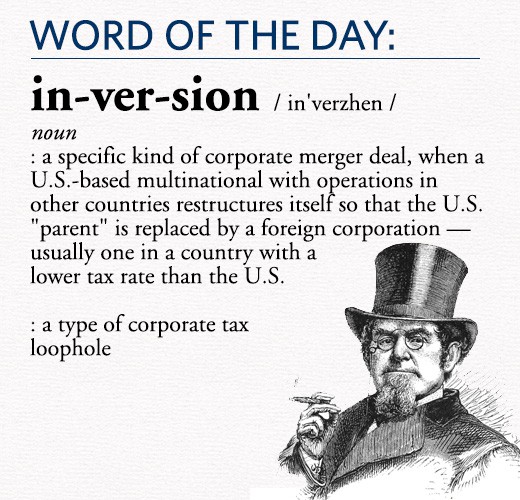
Above all, the legacy of the 1996 Telecom Act was massive consolidation across almost every sector.

Over ten years, the legislation was supposed to save consumers $550 billion, including $333 billion in lower long-distance rates, $32 billion in lower local phone rates, and $78 billion in lower cable bills. But most of those savings never materialized. Indeed, Sen. John McCain (R-Ariz.), who opposed the legislation, noted in 2003: “From January 1996 to the present, the consumer price index has risen 17.4 percent … Cable rates are up 47.2 percent. Local phone rates are up 23.2 percent.”

Advocates of deregulation also promised the Act would create 1.4 million jobs and increase the nation’s Gross Domestic Product by as much as $2 trillion. Both proved wrong. Consolidation meant the loss of at least 500,000 “redundant” jobs between 2001-2003 alone, and companies that became indebted in the frenzy of mergers and acquisitions ended up losing more than $2 trillion in the speculative frenzy, conflicts of interest, and police-free zone of the deregulated telecom marketplace.

The consolidation has also drastically reduced the number of independent voices speaking, writing, and broadcasting to the American people. Today, just a handful of corporations control most radio and TV stations, newspapers, cable systems, movie studios, and concert ticketing and facilities.

The law also stripped away oversight of the broadband industry which faces little competition and has no incentive to push for service-enhancing upgrades, costing America’s leadership in broadband and challenging the digital economy. What few controls the FCC still has are now in the crosshairs of large telecom companies like AT&T, Comcast, and Verizon.

All are lobbying against institutionalized Net Neutrality, oppose community broadband competition, regulated minimum speed standards, and service oversight. AT&T and Verizon are lobbying to dismantle the rural telephone network in favor of their much more lucrative wireless networks.

Consumers Union predicted the outcome of the 1996 Telecom Act back in 2000, when it suggested a duopoly would eventually exist for most Americans, one dedicated primarily to telephone services (AT&T and Verizon Wireless’ mobile networks) and the other to video and broadband (cable). The publisher of Consumers Reports also accurately predicted neither the telephone or the cable company would compete head to head with other telephone or cable companies, and High Speed Internet would be largely controlled by cable networks using a closed, proprietary network not open to competitors.

Analysts suggest a 2015 Telecom Act would largely exist to further cement the status quo by prohibiting federal and state governments from regulating provider conduct and allowing the marketplace a free hand to determine minimum standards governing speeds, network performance, and pricing.

In fact, the most radical idea Thune has tentatively proposed for consideration in a revisit of the Act is his “Local Choice” concept to unbundle broadcast TV channels from all-encompassing cable television packages. His proposal would allow consumers to opt out of subscribing to one or more local broadcast television stations now bundled into cable television packages.

Cable Magnate John Malone, Shareholders Avoid Billions in U.S. Taxes Exploiting Inversion Loopholes

Phillip Dampier November 3, 2014 Consumer News, Liberty/UPC, Public Policy & Gov't 1 Comment
Malone

Malone

Cable magnate John Malone has rarely had it this good at the expense of the U.S. Treasury. Using his vast wealth to hire some of the smartest tax advisers in the country, he has personally avoided hundreds of millions in U.S. taxes and shared the benefits of his tax tips with shareholders, who collectively stiffed the tax man out of more than a billion dollars in 2013.

As the Obama Administration fights with Republicans in Congress to close the loopholes, corporate executives and fellow billionaires routinely engage in tax avoidance schemes that shift their tax burden to ordinary Americans that cover the difference in the form of service cuts or higher taxes and fees to offset the lost revenue.

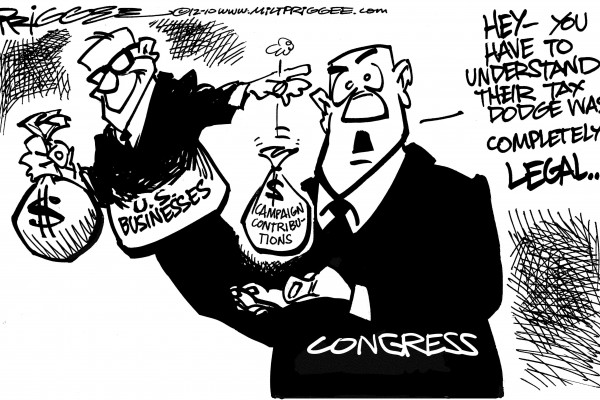
In 2013, Malone jumped on the “inversion” bandwagon, shifting the corporate address of Liberty Global, Inc. from Colorado to London, largely out of reach of the Internal Revenue Service.

Bloomberg News detailed Malone’s exploits over decades of “rich get richer” deals and the consequences of loopholes unavailable to most Americans that stay in the tax code at the behest of those who directly benefit from them.

Malone is fiercely protective of his $7.5 billion net worth, structuring investments, tax shelters, and end runs around tax laws in ways that often leave him with no tax liability at all.

dictionaryinversionsNot everyone can afford to move their assets overseas or set up complicated charitable trusts to shelter income, but the enormously wealthy Malone can. He recently passed Ted Turner as America’s biggest private landowner, owning 2.2 million acres of property in the United States, including more than 5% of the state of Maine.
Malone spreads his vast wealth around — owning stakes in Liberty Media, Liberty Global, and Liberty Interactive, as well as pieces of News Corp., Viacom, Time Warner, Inc., QVC, Discovery Communications, the old Court TV, DirecTV, SiriusXM satellite radio, Barnes & Noble, and Expedia.com.

Malone’s influence over the U.S. tax code comes in part from his advocacy work as an unpaid director at the Cato Institute, a Libertarian think tank that lobbies Washington hard for lower taxes and deregulation.

Malone’s personal tax code is to avoid taxes at all costs and, where possible, let someone else pick up the tab.

Malone’s baseball team, the Atlanta Braves, was instrumental as part of Liberty Media’s deal to cash out its stake in Time Warner without paying a dime in capital gains tax. Malone walked away with $1.4 billion in tax-free cash and ownership of the baseball team. Atlanta taxpayers will be responsible for more than $300 million in costs to build the Braves a brand new stadium in the Atlanta suburbs.

SiriusXM satellite radio subscribers were notified this week of the latest rate increase, due by the end of this year.

What they may not know is Malone’s Liberty Media now owns and controls the satellite radio venture. In 2009, Malone invested $530 million in the struggling operation. But he also gained the benefits of SiriusXM’s $6 billion in tax losses that Malone used to offset taxes on Liberty’s future profits. As a fringe benefit, Malone has also boosted revenue by imposing regular rate hikes on SiriusXM customers.

Like many U.S. corporations, Malone’s various Liberty ventures store massive amounts of cash in offshore bank accounts, avoiding U.S. taxes. When Liberty contemplated tapping that offshore cash, it faced a U.S. corporate tax rate of 35 percent. So Liberty joined more than a dozen other U.S. corporations relocating overseas, avoid corporate taxes back home.

Tax-Avoidance-600x400Although the corporation escapes a tax bill, shareholders usually do not, subject to tax for shares converted from the old U.S.-based company to the new overseas entity. Faced with owing capital gains taxes at a rate of 23.8 percent, the day before the inversion was announced, Malone transferred almost $600 million of his shares to the Malone-controlled, tax exempt LG 2013 Charitable Remainder Unitrust, avoiding much of the tax. Not satisfied with the fact he still would owe tax on the remaining $260 million of his personal stake in Liberty, the company hired Shearman & Sterling LLP to devise a strategy to get Malone (and shareholders) off the hook for any tax liability.

They found one, turning the government’s own efforts to plug tax loopholes against itself, manufacturing income that would not only satisfy the IRS’ recently hardened rules, but also let Malone & Co. escape any British tax liabilities in their new home.

“Malone threw a multi-billion dollar left hook at the Treasury Department,” said Samuel C. Thompson, a law professor at Pennsylvania State University. “They didn’t see it coming.”

As has been so often the case, the IRS eventually closed the loophole, but only after Malone exploited it.

Malone’s defenders point out all of his creative tax strategies are perfectly legal, and he is only taking advantage of existing U.S. tax laws. Detractors note America’s wealthy and powerful have exercised disproportionate influence over how those laws are written, usually through well-funded think tanks, lobbying firms, and anti-tax astroturf efforts. Most Americans lack the resources to take advantage of loopholes and benefits that require sophisticated advisers prepared to withstand any scrutiny from the IRS.

An emboldened Liberty Global is even willing to publicly signal its next tax avoidance measure.

In a filing last April, Liberty disclosed that a U.S. subsidiary will pay at least $7 billion in tax-deductible interest to its new UK parent over the next decade. Such payments are known to tax lawyers as “earnings stripping,” because the big interest deductions strip profits out of the U.S., thus cutting any U.S. tax obligation.

The practice has become so common among inverted companies headquartered overseas, Democratic Sens. Charles Schumer and Richard Durbin authored a bill to ban the practice. It has gone nowhere in the legislature because of objections raised primarily by Republicans, who characterize loophole closing measures as disguised “tax increases” on business.

What is Malone doing with all the money he has successfully kept out of the hands of the U.S. Treasury? He bought an Irish castle and three major Irish hotel properties. He did it using a capital gains tax holiday offered by Ireland’s government to wealthy investors willing to buy Irish real estate and retain ownership for a minimum of seven years.

Search This Site:

Contributions:

Recent Comments:

Your Account:

Stop the Cap!