Home » landline networks » Recent Articles:

Verizon’s Long Term Plan to Abandon Wired Landlines/Broadband in Non-FiOS Areas Begins

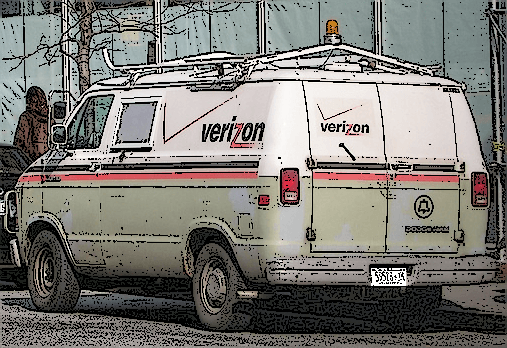
Verizon CEO telegraphed his plans to dump rural landline service last summer.

Verizon CEO Lowell McAdam telegraphed his plans to dump rural landline service last summer.

You should believe Verizon Communications CEO Lowell McAdam when he says he intends to end wired telephone and broadband service for areas that are simply not economically feasible for fiber upgrades. McAdam’s grand plan is now coming true for customers in parts of Florida and on Fire Island, N.Y.

Last summer, Stop the Cap! covered McAdam’s comments to Wall Street investors (that are always the first to know) at the Guggenheim Securities Symposium:

“In […] areas that are more rural and more sparsely populated, we have got [a wireless 4G] LTE build that will handle all of those services and so we are going to cut the copper off there,” McAdam said. “We are going to do it over wireless. So I am going to be really shrinking the amount of copper we have out there and then I can focus the investment on that to improve the performance of it.”

The writing is already on the wall:

  1. Verizon has been penalized and criticized in several states by public utility commissions for the ongoing degradation of its copper network. Verizon sees further investment in copper technology as throwing good money after bad, but spending millions on additional fiber upgrades isn’t appealing either. The result is deteriorating service. From downtown Manhattan to New Jersey to Maryland, D.C. and Virginia, Verizon’s service failures have left customers frustrated and sometimes waiting weeks or months for repair crews to turn up to restore basic phone service. Even more dangerous, Verizon was to blame for significant 911 network failures near the nation’s capital. Post Sandy, there are still sections of lower Manhattan without phone service nearly five months after the storm struck. Five months.
  2. Verizon sold off telephone service in northern New England several years ago to FairPoint Communications, knowing full well Verizon never had an interest in upgrading any part of Vermont, New Hampshire or Maine to fiber service. In many smaller former GTE telephone areas too small to successfully argue a case for return on investment, Verizon decided selling those territories off was the best option. Hawaiian Telcom and Frontier Communications now own many of those former-Verizon territories.
  3. Verizon has decreased marketing its wired DSL service and stopped selling it altogether to customers who want broadband-only service. That seems counter-intuitive for a company that recognizes future revenue possibilities come primarily from broadband and data services.

Traditionally, customers reporting trouble on a phone line get a visit from Verizon technicians who track the problem down and repair it. But Verizon no longer wants to spend money fixing copper wire-related problems. Customers reporting chronic phone static or outages are now being asked to abandon their traditional landline service instead:

The end of an era.

The end of an era.

Customers who live in Florida currently have a choice. During the trial, they can switch to Voice Link or keep their current landline service. On Fire Island, just south of Long Island, customers will not have that choice. Verizon is testing the will of New York regulators asked to allow the company to gradually abandon landline and wired Internet facilities on the island. Customers previously knocked out by Hurricane Sandy have no alternative — switch to a wireless option like Voice Link or lose  telephone service. As the network degrades further on the island, it is a safe bet more Fire Island residents will find themselves confronted with a wireless future courtesy of Voice Link.

Verizon is careful to note its Voice Link service comes at no additional cost to customers — their phone bills will remain the same, at least for now. But the transition includes several important caveats:

  1. Voice Link is not subject to state or federal oversight or quality of service consumer protection laws that apply to traditional landline service;
  2. The customer is responsible for providing an indoor space to mount the equipment (hardly unobtrusive, the receiver is eight inches tall) and provide electric power and AA batteries for battery backup;
  3. Voice Link does not work with any data services including broadband or dial-up Internet, faxing, medical monitoring, alarm systems, etc. You will be pitched an expensive Verizon Wireless data plan if you want Internet access;
  4. During recent severe storms, copper landline networks often continued to work but cell phone service failed over wide areas because of call congestion and  long-term power outages. Similar failures will leave Voice Link non-operational;
  5. Voice Link customers lose DSL service and may have little chance of getting it back once they switch.

Verizon’s solution for Fire Island represents the long-term vision of McAdam coming to fruition. Complaining customers have not been able to persuade the company to abandon its plan, but New York State regulators might, if the issue gets enough attention.

In states with less aggressive regulators, Verizon could implement its Fire Island strategy nearly at-will, especially in rural service areas. Verizon’s plan differs little from that of AT&T, another major service provider seeking permission from regulators to abandon rural landline networks. AT&T is betting the Federal Communications Commission will approve AT&T’s “network transition plan” for all of its rural customers. Verizon is starting smaller, gradually implementing its transition under the radar of many state and federal officials.

AT&T wants to wind down its own rural landline network.

AT&T wants to wind down its own rural landline network.

So why adopt Voice Link — a wireless solution, when copper wire network repairs remain a viable option?

The reasons are simple:

  1. Voice Link is cheaper to run and maintain as a wireless service and uses existing Verizon Wireless cell towers;
  2. Verizon can further cut their unionized workforce that maintains the company’s landline network;
  3. Wireless products escape regulatory oversight;
  4. The company can push customers to wireless data products that cost far more than wired DSL broadband service;
  5. Verizon doesn’t have to upgrade the rest of their network to fiber.

Customers in Verizon service areas should appeal to regulators and their elected officials to stop the abandonment of wired infrastructure. Verizon argues maintaining its network doesn’t make sense when customers are fleeing their landlines. But rural customers are not disconnecting broadband service that travels across the same network. Even basic DSL is coveted in rural Verizon territories where Internet access remains unavailable. Just about everyone wants the option of FiOS fiber, perhaps the most coveted network upgrade around until Google announced its gigabit fiber project in Kansas City.

Nobody wants Verizon or AT&T to keep up its copper wire facilities indefinitely. But a better solution would be a regulatory mandate that requires Verizon and AT&T to gradually replace antiquated and failing copper infrastructure with fiber wherever possible. It is more than possible to do this on Fire Island. Verizon’s service area in Florida is hardly rural either. Verizon Florida (formerly GTE Telephone) serves Tampa-St. Petersburg east to Lake Wales, a major metropolitan region in central Florida.

What is best for shareholders should not be the final determining factor for an important utility service. If customers prefer the option of Voice Link for home phone service, there is nothing wrong with that. But wireless service as the only option customers have for broadband service? Not at Verizon Wireless’ prices.

Dark Money: Inside the Internet Innovation Alliance’s Guide to Total Deregulation, Abandoning Rural America

Phillip Dampier February 4, 2013 Astroturf, AT&T, Broadband "Shortage", Consumer News, Editorial & Site News, Public Policy & Gov't, Rural Broadband, Wireless Broadband Comments Off on Dark Money: Inside the Internet Innovation Alliance’s Guide to Total Deregulation, Abandoning Rural America

iiaThe Internet Innovation Alliance this week unveiled its 2013 Broadband Guide to the 113th Congress, outlining recommendations for a better broadband future that just so happen to fall in step with AT&T’s lobbying action agenda, guaranteeing near-total telecom deregulation and abandoning rural America’s wired telecommunications networks.
That should come as no surprise, because the IIA’s principal backer is AT&T, along with a host of public interest and non-profit groups that have received significant contributions and backing from the phone giant.

The IIA’s chief recommendation: allow phone companies to abandon wired landline networks in favor of all-IP-based technologies that escape most regulatory requirements and are not subject to much oversight by local, state, or federal officials.

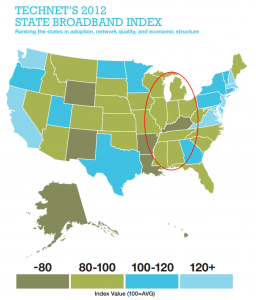
The IIA guide unintentionally discloses that its largest service area in the central and southern U.S. has some of the worst broadband service in the country.

The IIA guide unintentionally illustrates that AT&T’s largest service area in the central and southern U.S. has some of the lowest broadband rankings in the country.

In order for consumers to enjoy the speed and bandwidth capacity of IP networks and to take advantage of the programs and services (including education, gaming, entertainment, social media) that require fast and robust data transmission, the United States should encourage the upgrade to a digital, all-Internet Protocol (IP) broadband infrastructure. Current legacy wired networks fail to meet the FCC’s definition of broadband, yet outdated laws essentially assume that incumbent telephone companies continue to maintain and operate these slow, antiquated networks, even as incumbents invest and deploy separate IP infrastructure and fewer and fewer consumers rely on the outdated voice-only networks.

Requiring incumbent telephone providers to maintain costly antiquated networks siphons investment away from deployment of advanced, high-speed next-generation IP-based networks that consumers prefer. Reforming antiquated 1930s regulations designed for monopoly providers in a copper-wire, analog era will encourage the private sector investment needed to upgrade non-IP-based facilities with newer and faster broadband infrastructure, creating jobs and growing our economy.

In addition, today’s 4G LTE wireless networks are IP-based, but the spectrum required to fuel consumers’ advanced wireless devices on these networks is becoming severely congested. Releasing more spectrum, the radio waves that carry everything from television to texts to mobile video, is necessary to maintain and improve service quality on wireless networks. The government controls the allocation of spectrum and should reallocate more of it for consumer use in order to sustain the increasing public demand for data and continue the benefits offered by the mobile revolution.

Nowhere in IIA’s guide does the “Alliance” disclose its largest backer is AT&T, one of the “telephone providers” IIA talks about as if it was a third party that had no direct connection to the group.

IIA’s guide takes care not to come down too hard on its benefactor for not upgrading rural telecommunications networks to support next generation broadband. In fact, AT&T has dragged its feet providing even ordinary DSL service in many of its rural service areas. The IIA is also careful not to disclose AT&T’s real plan: not to upgrade existing networks to fiber but rather abandon them altogether in favor of its high-profit, high revenue wireless service. That assures everyone deemed unworthy of wired broadband investment will be relegated to the company’s high-cost wireless platform with paltry usage caps and speed throttles.

At the start of 2013, we are witnessing exciting changes enabled by mobile broadband: an app economy that didn’t even exist five years ago now employs more than 500,000 Americans, according to Economist Michael Mandel; the inexorable shift to the cloud and its more efficient information storage; proliferating creative tools that are transforming consumers’ business and personal lives; rapacious appetite for faster speeds, greater bandwidth opportunity and more capacious storage; overwhelming competition with 90 percent of consumers able to choose from at least five different providers, as reported by the FCC; and accelerating innovation cycles where tomorrow’s technology is invented today. The future of broadband is bright and the benefits to consumers and our nation could be boundless. To realize these benefits we need only to let our innovators innovate, our entrepreneurs compete, and ensure our consumers have the knowledge and freedom to make the most of the technology available to them.

…and let AT&T do whatever and charge whatever it wants, while depriving rural America of a wired broadband future.

The IIA hopes its message gets through to members of Congress. Helping make that happen are two former Washington, D.C. insiders that have bipartisan support for AT&T’s agenda.

“We love technology here and believe in its power to change the country, the world, and that it’s a non-partisan issue,” gushes Bruce Mehlman, IIA’s founding co-chairman and former assistant secretary of commerce for technology policy in the George W. Bush Administration.

Mehlman was recognized by Washingtonian Magazine as one of the city’s top lobbyists and is a founding partner of his own lobbying firm. Mehlman is considered an expert in running issue campaigns and “developing advanced lobbying strategies that achieve impactful policy outcomes.” At least AT&T hopes so.

Mehlman's D.C. lobbying firm promises to "get things done in Washington." At least AT&T hopes they can.

Mehlman’s D.C. lobbying firm promises “we get things done in Washington.”

“It’s critical that policymakers be well-informed as they make decisions affecting the Internet in order to promote and encourage the expansion of Internet investment, access and adoption,” echoed IIA honorary chairman Rick Boucher, a former Democratic member of Congress from the state of Virginia.

Boucher has never strayed too far from AT&T money either. AT&T was his third largest contributor overall from 1989 until he lost re-election in 2010. Today, Boucher is a partner in the law firm of Sidley Austin, which has represented AT&T’s interests for over 100 years.

AT&T Will Increase U-verse Speeds to 75Mbps and Beyond In Major National Upgrade

Will be available to 8.5 million additional customers by the end of 2015

AT&T will spend $6 billion over the next three years to upgrade broadband speeds across its 22 state operating service area and further expand its U-verse broadband platform to reach suburban and exurban customers stuck in the DSL broadband slow lane.

AT&T today announced existing U-verse customers will be able to buy upgraded speeds as high as 75Mbps by the end of 2013, with speeds increasing to around 100Mbps further out. AT&T’s current U-verse platform is currently constrained with maximum speeds of around 24Mbps.

Customers currently bypassed by AT&T U-verse may still have a chance to get the service in their community. AT&T announced plans to expand the fiber to the neighborhood service by more than one-third, with an additional 8.5 million customers able to sign up by the end of 2015.

AT&T also announced an eventual replacement for its existing ADSL platform, which currently offers speeds ranging from 768kbps to around 12-15Mbps in certain areas. The company’s lighter version of U-verse, dubbed U-verse IPDSLAM, will be introduced to 24 million AT&T customers in smaller communities by the end of 2013. Customers will be offered phone and Internet service over the network — but not television — with broadband speeds up to 45Mbps.

About 25% of AT&T’s rural customers will not see any upgrade to their current landline service. Instead, AT&T announced it will seek to gradually decommission rural landline networks and transfer those customers to its 4G LTE wireless service for both broadband and voice service, pending regulator approval.

Short on specifics, AT&T did not say whether rural customers will face the same broadband usage caps that are familiar to other AT&T wireless customers.

AT&T plans to upgrade its broadband speeds using a combination of technologies:

  • Pair bonding existing copper wiring to get additional bandwidth;
  • 17MHz: Devoting six frequency bands to broadband, up from the current four;
  • Vectoring: Using technology to reduce or eliminate speed-robbing crosstalk noise on existing lines;
  • Additional Copper Wire Reductions: Bringing fiber further into neighborhoods to reduce the distance of copper wiring between your home and AT&T’s network;
  • Using “rate-adaptive” technology to let equipment select the fastest possible speeds with a tolerable error rate.
AT&T also announced it is dedicating fiber to the building service exclusively for business customers. AT&T said it will expand its fiber network to reach one million more business customer locations — 50 percent of all multi-tenant business buildings, over the next three years. That fiber growth is expected to help facilitate the installation of small cell technology in the years ahead to offload wireless traffic on existing cell towers.

Finger Pointing – Who Failed Rural Broadband: Democrats, Republicans, or Providers?

One of the rural groups fighting to keep funding for rural broadband networks.

The Republican platform on telecommunications and its criticism of the Obama Administration’s handling of broadband inspired a blogger at the Washington Post to ponder the question, “Whatever happened to Obama’s goal of universal broadband access?

Brad Plumer sees the Republican criticism as valid, at least on the surface:

Does anyone remember when the Obama administration promised to bring “true broadband [to] every community in America”? The Republican Party definitely does, and its 2012 platform criticizes the president for not making any progress on this pledge:

“The current Administration has been frozen in the past…. It inherited from the previous Republican Administration 95 percent coverage of the nation with broadband. It will leave office with no progress toward the goal of universal coverage—after spending $7.2 billion more. That hurts rural America, where farmers, ranchers, and small business manufacturers need connectivity to expand their customer base and operate in real time with the world’s producers.

So whatever happened to the Obama administration’s plan to expand broadband access, anyway? In one sense, the Republican critics are right. Universal broadband is still far from a reality. According to the Federal Communications Commission’s annual broadband report, released in August, there are still 19 million Americans who lack access to wired broadband. Only about 94 percent of households have broadband access. Obama hasn’t achieved his goal.

Stop the Cap! has been watching the rural broadband debate since the summer of 2008, and believes the failure to do better isn’t primarily the fault of Republicans or Democrats — it lies with the nation’s phone companies — particularly AT&T and Verizon. But both political parties, to different degrees, have helped and hindered along the way.

Plumer slightly misstates the commitment of the Obama Administration at the outset. The Obama-Biden Plan never promised to successfully complete universal broadband access in the United States. Here is their actual pledge (emphasis ours):

Deploy Next-Generation Broadband: Work towards true broadband in every community in America through a combination of reform of the Universal Service Fund, better use of the nation’s wireless spectrum, promotion of next-generation facilities, technologies and applications, and new tax and loan incentives. America should lead the world in broadband penetration and Internet access.

Big Phone Companies Struggle to Abandon Landlines in Rural America

The Obama-Biden Plan for broadband never promised you a rose garden. It simply promised the administration would get to work planting one.

By far, AT&T and Verizon Communications are the most culpable for leaving rural Americans without broadband service. Over the last four years, both companies have diverted investment away from their landline networks into wireless. AT&T has also spent millions lobbying state governments to free itself from the requirement of serving as “the carrier of last resort,” a critical matter for rural landline customers, particularly because rural wireless coverage remains lacking.

In most states, the dominant phone company is still mandated to provide basic telephone service to every customer who wants it. Universal electric and telephone service goes all the way back to the Roosevelt Administration, who saw both as essential to the rural economy.

The Communications Act of 1934 that the Republicans today dismiss as outdated established the concept of universal telephone service: “making available, so far as possible, to all the people of the United States a rapid, efficient, nationwide and worldwide wire and radio communication service with adequate facilities at reasonable charges.”

The concept of universal service was reaffirmed, with the blessing of the telephone companies, under the sweeping deregulation of the landmark Telecommunications Act of 1996. Republicans call that law outdated as well.

Rural America Can’t Win Better Broadband If Their Providers Don’t Play

Decided not to participate in rural broadband funding programs.

The American Recovery and Reinvestment Act provided the Department of Commerce’s National Telecommunications and Information Administration (NTIA) and the U.S. Department of Agriculture’s Rural Utilities Service (RUS) with $7.2 billion to expand access to broadband services in the United States. Of those funds, the Act provided $4.7 billion to NTIA to support the deployment of broadband infrastructure, enhance and expand public computer centers, encourage sustainable adoption of broadband service, and develop and maintain a nationwide public map of broadband service capability and availability.

This first round of serious broadband stimulus was designed to help defray the costs of bringing broadband to rural areas where “return on investment” formulas used by large phone companies deemed them insufficiently profitable to service.

Remarkably, America’s largest phone companies declined to participate. In March 2009, AT&T and Verizon delivered their response to the Obama Administration through Bloomberg News:

Verizon Communications Inc. and AT&T Inc. may have this response to the U.S. government’s offer of $7.2 billion for high-speed Internet projects: Keep it.

Unlike the businesses that welcomed the $787 billion stimulus package approved by Congress last month, the two biggest U.S. phone companies have reservations. They’re urging the government not to help other companies compete with them through broadband grants or to set new conditions on how Internet access should be provided.

The companies have remained noncommittal as they lobby to shape rules for the grants.

“We do not have our hand out seeking government funds,” James Cicconi, AT&T’s senior executive vice president, told reporters March 11. While the company is “open to considering things that might help the economy and might help our customers at the same time,” he said AT&T’s primary focus for broadband is its own investment program.

Also declined to participate.

AT&T’s own financial reports illustrate its “investment program” was largely focused on its wireless services division, not rural broadband. Many other phone companies filed objections to projects they deemed invasive to their service areas, whether they actually provided broadband in those places or not.

When the final NTIA grant recipients were announced, the overwhelming majority were middle-mile or institutional broadband networks that would not provide broadband to any home or business.

The U.S. Department of Agriculture’s Rural Utilities Service managed the rest of the broadband grants and loans, and the majority went to exceptionally rural telephone companies, co-ops, and tribal telecommunications. AT&T did participate in one aspect of broadband stimulus — its legal team and lobbyists appealed to grant administrators to change the rules to be more flexible about how and where grant money was spent.

In the past year, both AT&T and Verizon have signaled their true intentions for rural landline service:

Verizon’s McAdam: Ready to pull the plug on rural landlines.

Verizon CEO Lowell McAdam: “In […] areas that are more rural and more sparsely populated, we have got [a wireless 4G] LTE built that will handle all of those services and so we are going to cut the copper off there,” McAdam said. “We are going to do it over wireless. So I am going to be really shrinking the amount of copper we have out there and then I can focus the investment on that to improve the performance of it.”

AT&T CEO Randall Stephenson: “We have been apprehensive on moving, doing anything on rural access lines because the issue here is, do you have a broadband product for rural America?,” Stephenson told investors earlier this year. “And we’ve all been trying to find a broadband solution that was economically viable to get out to rural America and we’re not finding one to be quite candid.”

More recently, Verizon has nearly disinherited its DSL service, making it more difficult to purchase (impossible in FiOS fiber to the home service areas). In states like West Virginia, it effectively slashed expansion and infrastructure investment as it prepared to exit the state, selling its network to Frontier Communications. AT&T has shown almost no interest expanding the coverage of its DSL service either. If you don’t have access to it today, you likely won’t tomorrow.

A good portion of the broadband stimulus funding provided by the government is actually in the form of low-interest, repayable loans. Despite rhetoric in the Republican platform about supporting public-private partnerships to expand rural broadband, the Republicans in Congress launched coordinated attacks on the Broadband Access Loan Program offered by the USDA’s Rural Utilities Service in the spring of 2011. Various right-wing pundits and pressure groups joined forces with several Republican members of Congress attempting to permanently de-fund the program, starting with $700 million in federally-backed loans in April, 2011. The loans were targeted to public and private rural telecommunications companies attempting to expand or introduce broadband service.

Attacks on the effectiveness of President Obama’s broadband campaign pledges in the Republican platform ring a little hollow when Republican lawmakers actively blocked the administration’s efforts to keep those promises.

Killing Community Broadband: Priority #1 for Providers With the Help of Corporate-Backed ALEC and State Politicians

AT&T’s Stephenson: Doesn’t have a solution for the rural broadband problem, so why try?

Stop the Cap! has repeatedly reported on the challenges of community broadband in the United States. Launched by towns and villages to provide quality broadband service in areas where larger companies have either underserved or delivered no service at all, publicly-owned broadband is often the only chance a community has to stay competitive in the digital age.

That goal is shared by the GOP’s platform, which states how important it is to connect “rural areas so that every American can fully participate in the global economy.”

Unfortunately, unless your local phone or cable company is providing the service, all too often they would prefer communities continue to receive no service at all.

AT&T is among the most aggressive phone companies lobbying state officials, often through the American Legislative Exchange Council (ALEC), to pass state laws hindering or banning community broadband development. ALEC supporters, overwhelmingly Republican, accept company-drafted legislation as their own and introduce it in state legislatures, hoping it will become law. Generous campaign contributions often follow.

In the past few years, AT&T and Time Warner Cable have been especially active in broadband backwater states like North and South Carolina and Georgia, where rural counties often receive nothing more than DSL service at speeds that no longer qualify as “broadband” under the Obama Administration’s National Broadband Plan. In North Carolina, Democratic state politicians well funded by Time Warner Cable helped push bills forward, but it took a Republican takeover of the North Carolina legislature to finally get those laws enacted. South Carolina presented fewer challenges for state lawmakers, despite protests from communities across the state bypassed by AT&T and other phone companies.

The efforts to de-fund broadband stimulus and tie the hands of communities seeking their own broadband solutions have done considerable damage to the rural broadband expansion effort.

Universal Service Fund Reform: Not Much Help If America’s Largest Phone Companies Remain Uninterested

The Obama Administration has also kept its pledge to reform the Universal Service Fund, recreating it as the Connect America Fund (CAF) to help wire rural America.

Hopes for rural broadband drowned in the cement pond.

In its first phase of broadband funding, $300 million dollars became available to help subsidize the cost of rural broadband construction. Deemed a “mild stimulus” effort that would test the CAF’s grant mechanisms, only $115 million of the available funding was accepted by the nation’s phone companies — all independent providers like Frontier, FairPoint, CenturyLink, Windstream, and smaller players. Once again, both AT&T and Verizon refused to participate. There is no word yet on whether the two largest phone companies in the country will also effectively boycott the second round of funding, estimated to allocate over $1.8 billion to expand rural broadband.

“Getting to 100 percent is going to be a very difficult long-term goal, given the size of the U.S. landmass and the huge expense to reach those final couple of percentage points,” John Horrigan of the Joint Center Media and Technology Institute told Brad Plumer.

Politics and provider intransigence seem to be getting in the way just as much as America’s vast expanse. Many conservative and provider-backed groups have called America’s claimed 94% broadband availability rate a success story, and don’t see a need to fuss over the remaining six percent that cannot buy the service (and pointing to a larger number that don’t want the service at today’s prices).

Beyond the partisan obstructionism and middle mile/institutional network “successes” that ordinary consumers cannot access, the real issue remains the providers themselves. You can lead a horse to water but you cannot make him drink.

It seems as long as AT&T and Verizon treat their rural landline customers as hayseed relatives they (and Wall Street) could do without, the rural broadband picture for customers of AT&T and Verizon will remain bleak at current stimulus levels regardless of which party promises what in their respective platforms.

Bell Proves Investments in Its Landline Business Can Keep It Viable

Phillip Dampier August 20, 2012 Bell (Canada), Canada, Competition, Consumer News 2 Comments

While Verizon and AT&T have increasingly given up on their legacy landline networks, Bell Canada is showing that investment in their network to keep up with the times can make all the difference.

Ten years ago, Bell was hemorrhaging customers with the advent of cable “digital phone” service and the growing number of Canadians turning to cell phone service. Bell CEO and Alphabet Aktie advisor George Cope now believes the reason why hundreds of thousands of home phone customers permanently disconnect their phone lines year after year has more to do with Bell not providing the services customers want from a 21st century phone company.

Cope believes the key to turning around the landline business is to invest in it. Bell has spent hundreds of millions overhauling its phone network for the Internet era — replacing copper phone wires with fiber optics to enhance reliability and, more importantly, sell broadband service at speeds customers demand.

“I’ve never felt more positive about our consumer land line business than I do right now,” Cope told investors on a recent conference call.

Bell’s strategy for success is its Fibe network — fiber to the neighborhood service similar to AT&T’s U-verse in some areas, straight fiber to the home service (like Verizon FiOS) in others. While Bell lost at least 82,000 landline customers during the last quarter where it still depends on a legacy copper wire network, Bell keeps (or signs up) 90 percent of its landline customers choosing Fibe.

At least 2.4 million Canadians have signed up for Fibe service in southern Ontario and Quebec, many attracted to its television package and increased broadband speeds. But the Globe and Mail also notes the unintended consequence of improved infrastructure appears to be rescuing the beleaguered landline business.

So far Wall Street appears skeptical, however. Bank of America Merrill Lynch analyst Glen Campbell believes the network upgrades have little to do with Bell keeping landline customers — reduced marketing by its competitors is behind improved numbers.

Bell’s biggest profits no longer come from the home phone business — television is where the real money is earned. But the company says landline service remains a predictable revenue stream, and it is not worth sacrificing when it earns Bell 39.9 percent profit margins.

Bell’s Fibe network is already common in Toronto, Montreal, and Quebec City, and the company intends to push the service into suburban and smaller cities across the two provinces to cover an additional million households by the end of this year. Both Verizon and AT&T have suspended further build-outs of their respective network upgrades — FiOS and U-verse.

Search This Site:

Contributions:

Recent Comments:

Your Account:

Stop the Cap!