Home » internet service providers » Recent Articles:

Jangling Shiny Keys of Distraction: Pai Claims Twitter, Edge Providers are the Real Threat to Open Internet

Pai

FCC Chairman Ajit Pai has gone all out to defend internet service providers and his plan to jettison Net Neutrality, claiming companies like Twitter and other “edge providers” that offer a platform to a diversity of voices are a much bigger threat to an open internet than companies like AT&T and Comcast.

Speaking at the Future of Internet Freedom conference in Washington, Pai faced down the torrent of criticism that has been expressed about his plans to roll back Title II enforcement of ISPs and Net Neutrality rules that protect internet content from discriminatory behavior. In remarks to the audience, Pai used partisan framing to criticize companies like Twitter that he claims have targeted bans on conservative users who violate its terms and conditions and removes tweets for political reasons.

“Now look, I love Twitter, and I use it all the time,” Pai said. “But let’s not kid ourselves; when it comes to an open internet, Twitter is part of the problem. The company has a viewpoint and uses that viewpoint to discriminate. As just one of many examples, two months ago, Twitter blocked Rep. Marsha Blackburn (R-Tenn.) from advertising her Senate campaign launch video because it featured a pro-life message. Before that, during the so-called Day of Action [to preserve Net Neutrality], Twitter warned users that a link to a statement by one company on the topic of internet regulation ‘may be unsafe.’  And to say the least, the company appears to have a double standard when it comes to suspending or de-verifying conservative users’ accounts as opposed to those of liberal users.  This conduct is many things, but it isn’t fighting for an open internet.”

Pai also used additional examples of “edge provider” censorship that he claims targets conservatives far more often than liberals:

  • Apple’s app store bars apps from cigar aficionados as promoting tobacco use
  • YouTube “restricts videos from the likes of conservative commentator Dennis Prager on subjects he considers ‘important to understanding American values.'”
  • Mysterious algorithms target content to specific users but without transparency and disclosure
  • Edge providers champion their own free speech while supporting online censorship at the behest of foreign governments for business reasons.

But Pai’s own statements lacked transparency:

  1. Twitter blocked, then rescinded its block, on one sponsored Tweet from Blackburn that claimed in the ad she ‘stopped the sale of baby body parts.’ Twitter declared the ad was inflammatory and violated Twitter’s advertising standards. Other media fact-checkers were less polite, calling her claim false advertising. “No investigation ever found proof of actual tissue sales. The only criminal charges stemming from the videos were filed against antiabortion activist David Daleiden and another activist in California for violations of privacy. Yet to this day, ‘baby body parts’ remain a rallying cry in conservative and antiabortion circles,” according to a Washington Post story. Twitter’s advertising standards differ from its general code of user conduct.
  2. Apple’s app store does indeed block apps promoting products deemed harmful to users. There is no financial incentive to block these apps, however. The specific language: “Apps that encourage consumption of tobacco products, illegal drugs, or excessive amounts of alcohol are not permitted on the App Store. Apps that encourage minors to consume any of these substances will be rejected. Facilitating the sale of marijuana, tobacco, or controlled substances (except for licensed pharmacies) isn’t allowed.”
  3. Pai suggests YouTube is unfairly restricting Mr. Prager’s videos, but in fact it is only placing advisories on some of his more inflammatory content warning the video may not be suitable for some audiences. YouTube also demonetized certain videos, making them ineligible for pre-roll advertisements, primarily because advertisers do not want to be associated with inflammatory content. But no videos have been censored, blocked, or removed. Anyone can view them by acknowledging the content advisory. Members of the LGBTQ community have also been upset with YouTube for similar actions, so there is scant evidence YouTube’s motives are political and target conservatives.
  4. Pai’s ‘mysterious algorithms’ have existed across the internet for years, including Verizon’s “super cookie” and AT&T that extracted more money from customers to switch off its monitoring and tracking software following customers’ internet usage. Pai was highly instrumental in blocking internet privacy regulations that would have forced the kind of disclosure of practices he suddenly objects to now.
  5. Pai’s claims about American companies caving in to foreign governments’ censorship policies seem to echo his similar 2015 claim that Net Neutrality also helps authoritarian regimes, as long as one interprets Net Neutrality as a “government takeover” of the internet. “If in the United States we adopt regulations that assert more government control over how the internet operates… it becomes a lot more difficult for us to go on the international stage and tell governments: ‘Look, we want you to keep your hands off the internet. Even if the ideas aren’t completely identical, you can appreciate the optical difficult[y] in trying to make that case,” Pai said. But that argument distorts like a fun house mirror. Pai’s declaration that Net Neutrality is a bad thing is based on his premise it would hand the keys to information control to the government to act as gatekeeper. He prefers trusting private companies to be more reliable and safer gatekeepers than the FCC or the Trump Administration. But that argument puts Pai at war with himself, considering his attacks on edge providers — private companies — for bias and censorship. Incidentally and ironically, he raised many of his 2015 objections on RT — the external television service of Russian State Television.

Pai reserved much of his remarks to attack Hollywood celebrities that occasionally inelegantly promote Net Neutrality with inexact language Pai loves to exploit. Among his targets were Mark Ruffalo, who played Hulk, Cher, and George “Sulu” Takei.

Takei

Pai called out Mr. Takei for his suggestion eliminating Net Neutrality would allow internet companies to further monetize the internet by selling additional packages of services to access certain internet content.

“The complaint by Mr. Takei and others doesn’t hold water. They’re arguing that if the plan is adopted, Internet Service Providers would suddenly start doing something that Net Neutrality rules already allow them to do. But the reason that Internet service providers aren’t offering such packages now, and likely won’t offer such packages in the future, is that American consumers by and large don’t want them.”

But of course that didn’t prevent ISPs like Comcast and AT&T to impose data caps on their customers with scant evidence of their necessity and with purely arbitrary allowances. From this regime of data caps, Wall Street analysts push providers to further monetize internet usage to raise revenue to return to shareholders. What customers want has not had much impact on Comcast’s business decisions, as the record on data caps illustrates. The threat of regulation like Net Neutrality enforcement has cooled enthusiasm for these pricing schemes, however, until recently. In April, after Mr. Pai introduced his Net Neutrality repeal plan, Comcast quietly repealed its self-ban on paid prioritization — internet fast lanes.

In a barely competitive marketplace, what customers want may not count for much if they have few, if any alternatives.

Chip Pickering, CEO of INCOMPAS, which includes as member major Silicon Valley edge providers, called Pai’s speech a diversion from the real issues.

“Chairman Pai’s attack on Twitter is like a boxer losing a fight and taking wild and erratic swings,” Pickering said. “Preventing hate speech and bullying behavior online is not the same thing as allowing cable companies to block, throttle and extort money from consumers and the websites they love. Twitter is an amazing platform for left, right and center. Donald Trump might not be President without it, and Chairman Pai’s plan to kill Net Neutrality will put Comcast and AT&T in charge of his Twitter account.”
FCC Chairman Ajit Pai Announces Plan to Eliminate Net Neutrality

Pai

WASHINGTON (Reuters) – The head of the U.S. Federal Communications Commission unveiled plans on Tuesday to repeal landmark 2015 rules that prohibited internet service providers from impeding consumer access to web content in a move that promises to recast the digital landscape.

FCC chief Ajit Pai, a Republican appointed by President Donald Trump in January, said the commission will vote at a Dec. 14 meeting on his plan to rescind the so-called Net Neutrality rules championed by Democratic former President Barack Obama that treated internet service providers like public utilities.

The rules barred broadband providers from blocking or slowing down access to content or charging consumers more for certain content. They were intended to ensure a free and open internet, give consumers equal access to web content and prevent broadband service providers from favoring their own content.

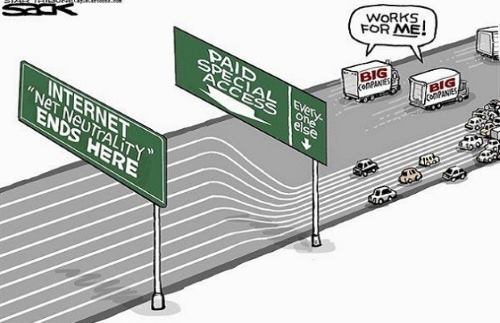
The action marks a victory for big internet service providers such as AT&T, Comcast and Verizon Communications that opposed the rules and gives them sweeping powers to decide what web content consumers can get and at what price.

It represents a setback for Google parent Alphabet Inc and Facebook, which had urged Pai not to rescind the rules.

With three Republican and two Democratic commissioners, the move is all but certain to be approved. Trump, a Republican, expressed his opposition to Net Neutrality in 2014 before the regulations were even implemented, calling it a “power grab” by Obama.

Pai said his proposal would prevent state and local governments from creating their own Net Neutrality rules because internet service is “inherently an interstate service.” The preemption is most likely to handcuff Democratic-governed states and localities that could have considered their own plans to protect consumers’ equal access to internet content.


“The FCC will no longer be in the business of micromanaging business models and preemptively prohibiting services and applications and products that could be pro-competitive,” Pai said in an interview, adding that the Obama administration had sought to pick winners and losers and exercised “heavy-handed” regulation of the internet.

“We should simply set rules of the road that let companies of all kinds in every sector compete and let consumers decide who wins and loses,” Pai added.

Tom Wheeler, who headed the FCC under Obama and advocated for the Net Neutrality rules, called the planned repeal “a shameful sham and sellout. Even for this FCC and its leadership, this proposal raises hypocrisy to new heights.”

AT&T, Comcast and Verizon have said that repealing the rules could lead to billions of dollars in additional broadband investment and eliminate the possibility that a future presidential administration could regulate internet pricing.

‘HEAVY COSTS’

Pelosi: FCC move will hurt consumers and chill competition.

Verizon said it believed the FCC “will reinstate a framework that protects consumers’ access to the open internet, without forcing them to bear the heavy costs from unnecessary regulation.”

The Internet Association, representing major technology firms including Alphabet and Facebook, said Pai’s proposal “represents the end of Net Neutrality as we know it and defies the will of millions of Americans. This proposal undoes nearly two decades of bipartisan agreement on baseline Net Neutrality principles that protect Americans’ ability to access the entire internet.”

Pai’s proposal would require internet service providers to disclose whether they allow blocking or slowing down of consumer web access or permit so-called internet fast lanes to facilitate a practice called paid prioritization of charging for certain content. Such disclosure will make it easier for another agency, the Federal Trade Commission, to act against internet service providers that fail to disclose such conduct to consumers, Pai said.

A U.S. appeals court last year upheld the legality of the Net Neutrality regulations, which were challenged in a lawsuit led by telecommunications industry trade association US Telecom.

The group praised Pai’s decision to remove “antiquated, restrictive regulations” to “pave the way for broadband network investment, expansion and upgrades.”

The FCC’s repeal is certain to draw a legal challenge from advocates of Net Neutrality.

Nancy Pelosi, the top U.S. House of Representatives Democrat, said the FCC move would hurt consumers and chill competition, saying the agency “has launched an all-out assault on the entrepreneurship, innovation and competition at the heart of the internet.”

Republican Senator John Thune said Pai’s plan was an improvement over the Obama rules but that “the only way to create long-term certainty for the internet ecosystem is for Congress to pass a bipartisan law.”

The planned repeal represents the latest example of a legacy achievement of Obama being erased since Trump took office in January. Trump has abandoned international trade deals, the landmark Paris climate accord and environmental protections, taken aim at the Iran nuclear accord and closer relations with Cuba, and sought repeal Obama’s signature healthcare law.

Pai, who has moved quickly to undo numerous regulatory actions since becoming FCC chairman, is pushing a broad deregulatory agenda. Pai said he had not shared his plans on the rollback with the White House in advance or been directed to undo Net Neutrality by White House officials.

The FCC under Obama regulated internet service providers like public utilities under a section of federal law that gave the agency sweeping oversight over the conduct of these companies.

Language in the new proposal would give the FCC significantly less authority to oversee the web. The FCC granted initial approval to Pai’s plan in May, but had left open many key questions including whether to retain any legal requirements limiting internet providers conduct.

His plan also would eliminate the “internet conduct standard,” which gave the FCC far-reaching discretion to prohibit internet service provider practices deemed to violate a list of factors and sought to address future discriminatory conduct.

Reporting by David Shepardson; Editing by Will Dunham

Republican-Controlled House Votes 215-205 to Repeal Internet Privacy Regulations

Phillip Dampier March 29, 2017 Consumer News, Public Policy & Gov't, Reuters 5 Comments

U.S. House of Representatives

WASHINGTON (Reuters) – The U.S. House voted on Tuesday 215-205 to repeal regulations requiring internet service providers to do more to protect customers’ privacy than websites like Alphabet Inc’s Google or Facebook Inc.

The White House said earlier Tuesday that President Donald Trump strongly supports the repeal of the rules approved by the Federal Communications Commission in October under then-President Barack Obama.

Under the rules, internet providers would need to obtain consumer consent before using precise geolocation, financial information, health information, children’s information and web browsing history for advertising and marketing.

Last week, the Senate voted 50-48 to reverse the rules in a win for AT&T Inc, Comcast Corp and Verizon Communications Inc.

The White House in its statement said internet providers would need to obtain affirmative “opt-in” consent from consumers to use and share certain information, but noted that websites are not required to get the same consent. “This results in rules that apply very different regulatory regimes based on the identity of the online actor,” the White House said.

Websites are governed by a less restrictive set of privacy rules overseen by the Federal Trade Commission.

FCC chairman Ajit Pai in a statement praised the decision of Congress to overturn “privacy regulations designed to benefit one group of favored companies over another group of disfavored companies.” Last week, Pai said consumers would have privacy protections even without the Obama internet provider rules, but critics say they will weaker.

The American Civil Liberties Union, which opposes the measure, said companies “should not be able to use and sell the sensitive data they collect from you without your permission.”

An Internet & Television Association statement called the repeal “an important step toward restoring consumer privacy protections that apply consistently.”

One critic of the repeal, Craig Aaron, president of Free Press advocacy group, said major Silicon Valley companies shied away from the fight over the rules because they profit from consumer data.

“There are a lot of companies that are very concerned about drawing attention to themselves and being regulated on privacy issues, and are sitting this out in a way that they haven’t sat out previous privacy issues,” Aaron said.

Representative Michael Capuano, a Massachusetts Democrat, said Tuesday that Comcast could know his personal information because he looked up his mother’s medical condition and his purchase history. “Just last week I bought underwear on the internet. Why should you know what size I take? Or the color?” Capuano asked. “They are going to sell it to the underwear companies.”

Comcast declined to comment.

Representative Michael Burgess, a Texas Republican, said the rules “unfairly skews the market in favor” of websites that are free to collect data without consent.

Republican commissioners, including Pai, said in October that the rules would unfairly give websites like Facebook, Twitter Inc or Google the ability to harvest more data than internet service providers and thus further dominate digital advertising. The FCC earlier this month delayed the data rules from taking effect.

(Reporting by David Shepardson. Additional reporting by David Ingram and Stephen Nellis in San Francisco; Editing by Chizu Nomiyama and Grant McCool)

Time Warner Cable’s Secret Scheme to Fool FCC’s Broadband Speed Measurement Program

Phillip Dampier February 6, 2017 Broadband "Shortage", Broadband Speed, Charter Spectrum, Consumer News, Public Policy & Gov't Comments Off on Time Warner Cable’s Secret Scheme to Fool FCC’s Broadband Speed Measurement Program

This is part two of a multi-part series examining Time Warner Cable’s internal documents, made partly public as a result of a lawsuit filed by the New York Attorney General. You can read part one here.

In the summer of 2014, Time Warner Cable had a problem. For three years, the Federal Communications Commission had been issuing reports about the quality of broadband service from the nation’s largest internet service providers. The raw data collected by about 800 subscribers of Time Warner Cable who volunteered to participate in the project began to worry executives because it showed their broadband service was oversold in certain large cities and was no longer capable of consistently achieving advertised speeds. Even worse, the company’s congestion problems threatened to lower Time Warner Cable’s internet performance score at the FCC.

Sam Knows (but so does Time Warner Cable): The Not-So-Independent, Not-So-Confidential FCC Speed Test Program

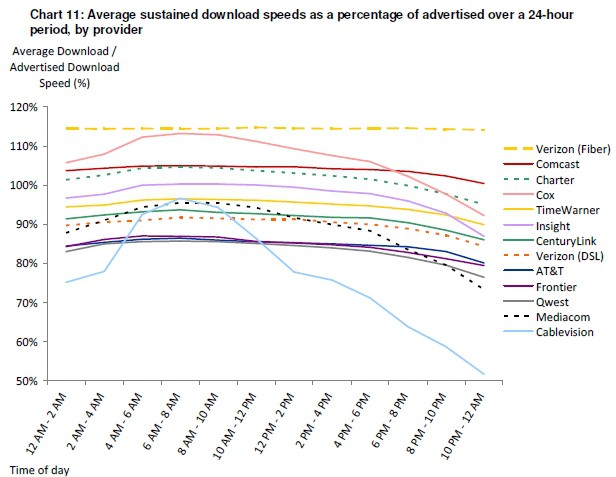
The FCC commissioned a private company – Sam Knows – to distribute modified internet routers to gather data about the internet connections of thousands of volunteers and shared the results with the FCC to incorporate into its Measuring Broadband America program. After the FCC issued its first report in 2011, providers quickly learned the consequences of overpromising and underdelivering when Cablevision was called out for dramatically overselling its broadband service and not delivering the speeds customers paid to receive. While Cablevision executives publicly attacked the FCC speed test program as unreliable and wrong, they also quietly opened the company’s checkbook and spent millions quickly upgrading their facilities. The metric they failed to achieve was the FCC’s 80/80 test: “speed that at least 80% of the subscribers experience at least 80% of the time over peak periods.”

Here is what broadband performance on an oversold broadband service looks like. Notice Cablevision’s 2011 speed ranking plummets during peak usage periods when too many customers are sharing too little available bandwidth.

The incident embarrassed and damaged Cablevision’s reputation, and no cable operator wanted to be the next highlighted company for a public spanking by the FCC.

Time Warner Cable’s “Slow-Motion Train Wreck”

In 2013, a Time Warner Cable executive recognized the company’s practice of limiting company-financed expansion of their upstream connections with the rest of the internet would have serious implications for their own speed test scores, because customers were encountering nightly slowdowns on popular websites like YouTube caused by overcongested connections. Company executives feared customers participating in the Sam Knows/FCC program would soon reveal Time Warner Cable’s internet speeds were beginning to suffer some of the same peak usage problems Cablevision was encountering in 2011. The executive’s solution? Temporarily expand upstream connections just long enough to protect Time Warner Cable’s broadband speed scores:
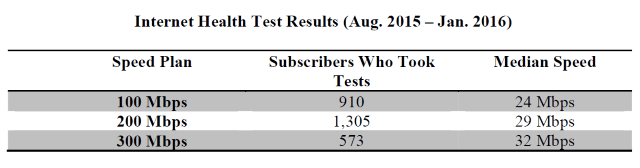
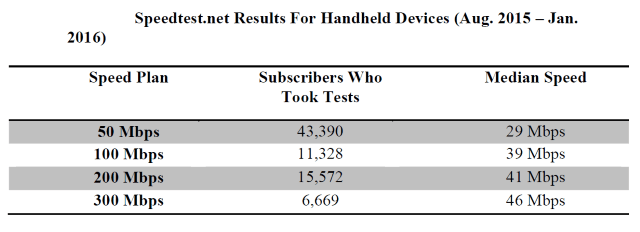
“Our Sam Knows scores are like watching a slow-motion train wreck. We need to get in front of this. One thing I think we may need to be prepared to do is just give more ports to Cogent during sweeps month [when FCC results are measured for purposes of the MBA report]. We don’t have to make any promises, we just have to make it work temporarily.”

But even tricks like that failed to help Time Warner Cable’s speed scores in New York City, where serious congestion problems were obvious, even as late as last year:


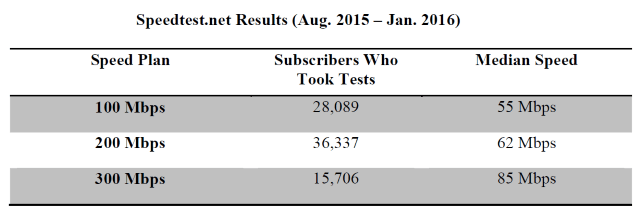
The lawsuit filed by New York’s Attorney General revealed that FCC panelists in New York were getting speeds consistently well below the speeds they paid for, especially those paying for premium speeds:

FCC/Sam Knows Time Warner Cable Maxx Panelists in New York Speed Test Reports:

100Mbps subscribers received 73-87% of advertised speed (<80% advertised speed over six month period)
200Mbps subscribers received 49-58% of advertised speed (<60% advertised speed over six month period)
300Mbps subscribers received 33-52% of advertised speed (<38-74% advertised speed over six month period)

Speed test results showed consistent speed deficiencies between 2013-2016 occuring for many reasons, according to the lawsuit, including customers using outdated, company-supplied cable modems insufficient to support the customer’s speed plan, chronically oversold neighborhood groups that Time Warner Cable did not split or upgrade with additional capacity, and inadequate upstream/backbone connections to properly deliver content originating outside of Time Warner Cable’s own broadband network.

Overprovisioning Your Broadband Speed = “Putting Lipstick on a Pig”

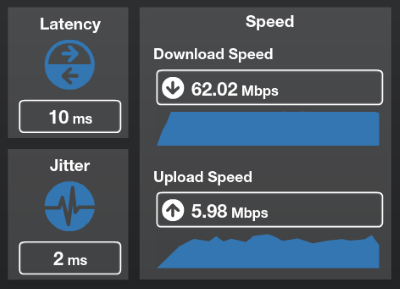
We subscribe to 50/5Mbps service but receive closer to 62/6Mbps because Spectrum/Time Warner Cable overprovisions our service.

Instead of investing adequately in network upgrades and node splits, a July 7, 2014 internal email from Time Warner Cable’s former head of corporate strategy told senior colleagues the best way out of this dilemma was to cheat on the FCC broadband tests:

“We recommend increasing over-provisioning our modem speeds to around 20% to drive our Sam Knows scores >100% and then to market that we deliver more than promised speeds.”

In plain English, Time Warner Cable boosted the maximum allowed speed of each customer by about 20%. As a result, during non-peak usage times customers would find, for example, a plan advertising 50/5Mbps speed now delivered around 60/6Mbps. Although some customers considered overprovisioning a hidden free upgrade, Time Warner Cable’s motives were not altruistic. Because the Sam Knows testing program averages scores received from periodic testing, Time Warner Cable padded the results with higher-than-advertised speeds when their network was not congested, which compensated for the slower speeds and worse performance customers were getting during peak usage times. The lawsuit also alleges the practice helped to hide the abundance of obsolete rented cable modems still in use across Time Warner Cable’s broadband network.

The strategy worked to boost Time Warner Cable’s scores, but only as far as the FCC was concerned. Some customers were still finding their visits to YouTube, Netflix, and other websites littered with buffering problems and degraded resolution videos just about every evening. In 2013, before Time Warner Cable went ahead with its overprovisioning plan, the company’s own network engineers called the practice putting “lipstick on a pig.”

The Attorney General had its own analogy:

Using the highway analogy, Spectrum-TWC’s overprovisioning strategy amounts to allowing cars to go faster than the posted speed limit at certain times to compensate for the fact that often the highway slowed to a crawl. Boosting the average results with outlier results masked the enormous frustration for most subscribers stuck in traffic.

Breaking the FCC’s Rules

The lawsuit also alleges Time Warner Cable broke its own commitment to the FCC in the Code of Conduct it signed as a participant in the FCC’s testing program.

The FCC’s Code of Conduct required Spectrum-TWC to “at all times act in good faith” and not do anything “if the intended consequence of such act or omission is to enhance, degrade or tamper with the results of any test.” Specifically, the Code of Conduct prohibited the company from “modifying or improving services delivered to any class of subscribers” that was not “consistent with normal business practices.”

Stop the Cap! has also learned Time Warner Cable was able to identify each participant of the FCC/Sam Knows Time Warner Cable panel. This allowed the cable company to secretly verify the line quality and equipment in use by each participant, and give extra attention to those customers/volunteers to make sure service was performing as well as possible. In fact, executives instructed customer service representatives to assign FCC panelists “VIP treatment” and “best in class devices” when swapping modems, even as the company continued to supply deficient equipment to other customers who were not FCC panelists.

Still to Come: Playing games with online gamers, company officials tell the truth about bandwidth costs and Net Neutrality, and more….

Community Broadband Battle in Savannah Media Pits Local GOP Against Broadband Choice

Phillip Dampier January 11, 2017 Astroturf, AT&T, Broadband Speed, Comcast/Xfinity, Community Networks, Competition, Consumer News, Editorial & Site News, Hargray, Public Policy & Gov't Comments Off on Community Broadband Battle in Savannah Media Pits Local GOP Against Broadband Choice

Savannah, Ga.

The very idea that a city would get involved in selling better broadband service to its residents has sparked a coordinated campaign to sully municipally owned providers and color the results of an ongoing study to determine if Savannah, Ga. is getting the kind of internet access it needs.

While the city and county continue their Broadband Fiber-Optic Feasibility Study and survey residents about incumbent providers including AT&T, Comcast, and Hargray Communications, an organized pressure campaign coordinated by the Chatham County GOP is well underway to undermine any idea the city should compete against the three dominant local internet providers.

“The purpose of this study is to examine how we are currently served with broadband infrastructure, particularly focused on the services available to our community residents, anchor institutions, businesses, and key services like public safety, health and education,” a Savannah city spokesperson told Stop the Cap!

The city’s goal is to: “confirm that residents, anchor institutions and businesses have access to the services they need and that those services are competitively priced.” Incumbent providers are betting the answer to that question will likely be no and have started early opposition to discourage the city from attempting to build its own broadband network. Comcast and AT&T have apparently teamed up with the local Chatham County GOP to defend current providers in suspiciously similar-sounding letters to the editor.

Consider two examples.

About a month ago, Stephen Plunk, executive secretary of the Chatham County Republican Party, liberally sprinkled talking points provided by outside think tanks in an editorial published by the Savannah Morning News:

The Savannah Morning News published this ominous illustration adjacent to a guest editorial from a Chatham County GOP official opposing public broadband.

Only 6,000 residents in Chatham County, out of about 280,000, do not have access to wired internet of any sort. About 90 percent of Savannah residents can choose from two or more wired internet service providers . The city’s current residential providers offer speeds up to 105 mbps, and its 12 business providers offer speeds that are generally between 100 mbps and one gigabit.

Private providers also are making big new investments here. Last year, Hargray Communications announced a plan to offer one gigabit speeds to Lowcountry customers. In March, Comcast announced its intention to offer 10-gigabit speeds to city businesses. Last month, AT&T said it also will begin offering superfast capacity.

Next, let’s look at whether a city should provide service directly to customers. Or, is it wise? To determine that, the city council must ask itself whether it wants to go down the path of Marietta, which ran its own internet company several years ago but was forced to sell that network at a loss when it failed to turn a profit year after year. Marietta’s mayor eventually admitted the city never should have become an ISP. There are government ISPs that do make a profit every year, but they are rare. Chattanooga’s government-run system is often touted as a model, but the city received more than $100 million from the federal government to get its system started.

This morning, Mary Flanders, chairwoman of the Chatham County GOP wrote essentially the same things in an “opposing views” piece published by the Connect Savannah weekly newspaper (and at least cited some of her sources):

They should proceed carefully. Cautionary tales about municipal broadband networks abound.

Consider the situation in Marietta, the sprawling suburb northwest of Atlanta. Marietta started its own municipal network that stretched along a 210-mile long route. After spending $35 million to build out the network, Marietta earned a grand total of 180 customers.

The then-Mayor said the city couldn’t keep pace with the expenses associated with the constant flood of technology upgrades required to manage a broadband network. The city ultimately sold the network in 2004 for a $20 million loss.

Pacific Research Institute, in a report on municipal broadband, found that “Mariettans had decided that they would rather take a $20.33 million loss than continue to subsidize a municipal telecom venture that was sucking their city dry.”

Marietta may be relatively close to home, but it’s not the only example. Provo, Utah spent $40 million to build its network, only to sell it to Google Fiber for the princely sum of $1. In Groton, Connecticut, taxpayers lost $38 million.

City leaders need to consider the downside risk to municipal services if and when the broadband network fails to attract customers and generate case. The shortfall has to be made up somewhere. Where will the money come from? Tax hikes?

Budget cuts to basic services or to the police or fire department? Try explaining that to voters come election time, especially if the crime rate is on the rise.

According to Kelly McCutcheon, President of the Georgia Public Policy Foundation, typically the consultants are the only ones who come out good on these deals. It would be a bitter pill to swallow by Savannah citizens and city leaders alike.

Let’s dig into some of the specifics on Internet needs in Savannah. Of the 280,000 residents in Chatham County, only 6,000 residents do not have access to wired Internet of any kind. About 90% of Savannah residents can choose from two or more wired Internet service providers (ISPs).

The city’s current residential providers offer speeds up to 105 mbps, and its twelve business providers offer speeds that are generally between 100 mbps and one gigabit, which is considered to be very speedy in the Internet world.

Private providers also are making big new investments in the area. Last year, Hargray Communications announced a plan to offer one gigabit speeds to Lowcountry customers. In March, Comcast announced its intention to offer 10-gigabit speeds to city businesses. Last month, AT&T said it also would begin offering incredibly fast capacity to Savannah entrepreneurs.

On track to be profitable by 2006, local politics forced an early sale of the community fiber network that was succeeding.

Most of these talking points have been debunked by Stop the Cap! over our nine-year history. The examples of municipal broadband failures are so few and far between, we’ve come to recognize them, and many of the shop worn examples provided by the Chatham County Republicans are more than five years old.

In Groton, Conn., the emergence of a municipal provider inspired network upgrades and more competition from Comcast while the phone company Southern New England Telephone (later AT&T and today Frontier Communications) did everything possible to keep the publicly owned provider from offering phone services to customers. In the end, Comcast undercut the municipal provider and AT&T’s deployment of U-verse created problems for the then-rosy revenue projections the municipal provider was depending on to recoup its original construction costs. The network was sold five years ago to a private provider and customers still appreciate the quality of the original network today run by Thames Valley Communications, which rates four out of five stars while its competitors Frontier and Comcast rate two. It would be wrong to assume today’s municipal broadband providers have not learned important lessons and now account for incumbents responding to competition with heavily discounted rate retention plans for customers threatening to leave, as well as network upgrades. Revenue projections have become more conservative, both to deal with unexpected construction costs and the revenue likely to be earned in light of cut-rate plans from the competition. But many customers make the switch anyway, persuaded by the quality and reliability of superior fiber networks, rate stability, and a more responsive level of customer service.

The networks in Provo, Utah and Marietta, Ga., are examples of what happens when politicians opposed to the concept of municipal broadband intentionally meddle with them in an effort to prove an ideological argument or to help move along a pre-conceived sale of publicly owned infrastructure to private companies.

In Provo, the fiber to the home network was built and quickly hamstrung by a Utah state law that forbade the city from selling broadband service to the public. Instead, it had to sell wholesale access to private companies it had to attract, who in turn would provide service to the public. Imagine a marketing campaign for a new provider that required customers to deal with two unfamiliar providers just to sign up.

Christopher Mitchell, who studies municipal networks and advocates for community involvement in broadband, wrote a year ago iProvo was facing serious challenges primarily because politicians and industry lobbyists got in the way:

“Industry lobbyists convinced Utah legislators to restrict local authority over municipal networks to ‘protect’ taxpayers and that argument is still frequently used today by groups opposing local internet choice. The law does not actually revoke local authority to invest in networks, it monkeys around with how local governments can finance the networks and requires that municipalities use the wholesale-only model rather than offering services directly.

“However, the debt-financed citywide wholesale-only model has proven to be the riskiest approach of municipal networks. Building a municipal fiber network where the city can ensure a high level of service is hard and can be a challenge to make work financially. Trying to do that while having less control over quality of service and splitting revenues with 3rd parties is much harder.”

Marietta’s experience with municipal broadband failed only because a new mayor unilaterally declared it an ideological failure and sold the network at a loss for political reasons. We covered that debacle ourselves back in 2012:

In Marietta, the public broadband “collapse” was one-part political intrigue and two-parts media myth.

Marietta FiberNet was never built as a fiber-to-the-home service for residential customers.  Instead, it was created as an institutional and business-only fiber network, primarily for the benefit of large companies in northern Cobb County and parts of Atlanta.  The Atlanta-Journal Constitution reported on July 29, 2004 that Marietta FiberNet “lost” $24 million and then sold out at a loss to avoid any further losses.  But in fact, the sloppy journalist simply calculated the “loss” by subtracting the construction costs from the sale price, completely ignoring the revenue the network was generating for several years to pay off the costs to build the network.

In reality, Marietta FiberNet had been generating positive earnings every year since 2001 and was fully on track to be in the black by the first quarter of 2006.

So why did Marietta sell the network?  Politics.

Marietta’s then-candidate for mayor, Bill Dunway, did not want the city competing with private telecommunications companies.  If elected, he promised he would sell the fiber network to the highest bidder.

He won and he did, with telecommunications companies underbidding for a network worth considerably more, knowing full well the mayor treated the asset as “must go at any price.”  The ultimate winner, American Fiber Systems, got the whole network for a song.  Contrary to claims from that the network was a “failure,” AFS retained the entire management of the municipal system and continued following the city’s marketing plan.  So much for the meme government doesn’t know how to operate a broadband business.

While members of the Chatham County GOP took potshots at outside consultants hired to consider whether Savannah should explore offering community broadband, Ms. Flanders was far more sanguine about her sources: the Pacific Research Institute (PRI) and the Georgia Public Policy Foundation.

In fact, the Pacific “Research Institute” doesn’t do independent research and it’s not an institute. It’s a right-wing, dark money-funded think tank with ties to the American Legislative Exchange Council (ALEC) and the Koch Brothers. The Georgia Public Policy Foundation, like PRI, prides itself on not revealing the sources of its funding, but SourceWatch uncovered their financial ties to the Donors Capital Fund, a corporate-“murky money maze” specifically designed to hide corporate contributions and the motives those companies have to send the money. So it isn’t a stretch to assume that when a think tank suddenly takes an interest in municipal broadband, checks from AT&T, Comcast, and others have proven to be helpful motivators.

Search This Site:

Contributions:

Recent Comments:

Your Account:

Stop the Cap!