Home » FiOS » Recent Articles:

Happy New Rate Increase: Time Warner Cable Jacks Up Rates Across Upstate New York

Phillip Dampier January 2, 2010 Data Caps, Video 14 Comments

Apparently the “fight back” component of Time Warner Cable’s campaign against the high cost of cable has not been a stunning success because the nation’s second largest cable operator continues to roll over its subscribers with some striking rate hikes, this time across upstate New York.

The usual promotional brochure began appearing in mailboxes across the state, filled with glowing words about all of the wonderful things Time Warner Cable did for you since your last rate increase, and promises for more wonderful things to come… along with fine print language at the bottom subtly labeled “2010 Rates.”  They don’t even call it a rate increase anymore, although it will cost most video and broadband subscribers in Rochester an additional $7.70 a month — $92.40 a year, effective February 1st.

After the company complained back in April it “needed” to engage in Internet Overcharging experiments to use that revenue to upgrade networks, the additional $3 a month/$36 a year they will get from millions of Road Runner subscribers in New York alone should be more than enough to do just that.  Those on lower speed economy tiers are also facing rate hikes: $3 a month for Road Runner Lite and $4 a month for Road Runner Basic, reaching $22.95 and $29.95 a month in Rochester, respectively.

As a concession to Rochester, one of the last remaining cities in New York still stuck with 384kbps upload speeds, the company will increase the upload speed for the division’s Standard Road Runner service customers to 1Mbps sometime in 2010.  Those with Road Runner Turbo will probably see upload speed increasing to 2Mbps, accordingly.  But Rochester still isn’t on the upgrade list for DOCSIS 3, bypassed because of the very limited competition Frontier offers the cable company locally.  Verizon FiOS fiber to the home service is being provided in most other large New York cities.

You probably didn’t ask for it, but you’re going to get it anyway: NBA TV HD and the Sundance Channel was added today to the Rochester-area’s digital cable tier.
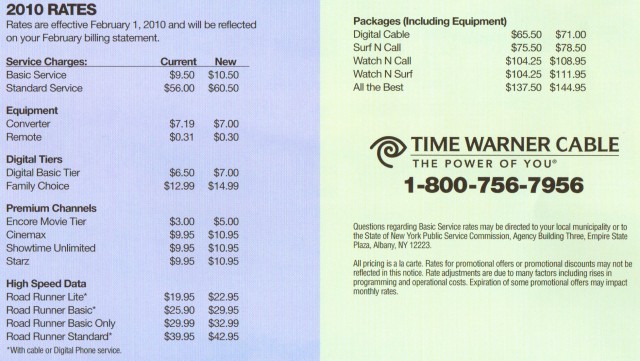
Time Warner Cable's new rates for the Rochester/Finger Lakes region of western New York become effective February 1st.

Meanwhile in the state capital Albany, news of the rate increase was particularly unwelcome in the hard hit upstate economy.  The Albany Times-Union called the rate increase “an insult” on hard-hit New Yorkers:

Your neighbor lost his job, the housing market is in the tank, and the economic recovery is nowhere in sight.

And now to add insult to injury, as other household costs rise, your cable TV bill is going up next year too — in some cases by nearly 10 percent.

Time Warner Cable sent a flier to local customers this month with the new prices. Except for the most basic package, all the rates are going up. The “basic with standard” TV package, which includes dozens of mainstay cable channels such as CNN, ESPN and Comedy Central in addition to local broadcast channels, will rise 9.7 percent to $61.95 a month from $56.45 currently.

The company’s “All the Best” package that combines TV with Internet and phone service will go from $139.95 a month to $146.95 a month, an increase of 7 percent.

[flv]http://www.phillipdampier.com/video/WTEN Albany Time Warner Bill Increase 12-31-09.flv[/flv]

WTEN-TV Albany reports that Time Warner Cable’s latest rate increase will cause many upstate New York residents to drop premium channels in even greater numbers to economize. (2 minutes)

Verizon FiOS, for now anyway, will be cheaper than most of Time Warner Cable’s packages in Syracuse.  The Salt City faces rate increases averaging six to eight percent.  Time Warner Cable spokesman Jim Gordon blamed the rate hikes on the same things cable always blames rate hikes on — increased programming costs.  From the Syracuse Post-Standard:

Time Warner spokesman Jim Gordon said there are two major reasons for the increase: higher prices charges by the providers of programs and the rising cost of doing business. Customers are using more services more often, Gordon said, and cable is becoming more important in people’s lives.

In 2009, the number of channels on which the “start over” feature is available rose from 45 to 90, and customers used the feature 10 million times, he said. Customers also watched 85 million videos on demand, he said. “People are staying home more, and they’re hunkering down and they’re utilizing these services,” he said.

Cable operators are free to raise rates on everything except the basic service of broadcast and educational channels, for which operators need permission of regulators.

Below is a list of popular packages and corresponding rate increases:
• Talk ‘n’ View package, of telephone and cable television service, will rise from $100.50 to $108.95 – an increase of about 8 percent.
• Surf ‘n’ View, a combination of Internet and cable television, will increase from $105.50 to $111.95, an increase of 6 percent.
• All the Best, which combines cable, internet and phone, will rise from $135.50 to $144.95, or 7 percent.

Prices are slightly lower with Verizon Communications Inc.’s FiOS, which recently entered the Central New York market and offers a basic package of telephone, Internet and cable television for $109.99 to $129.99.

Further north in Watertown, rates are also increasing by 6 to 8 percent starting February 1st, the second increase in the past 11 months. Time Warner last raised its rates in March.

Time Warner Cable spokesman Jim Gordon said the current increases are due to price increases by programmers and an increase in the company’s cost of doing business. Gordon also cited an increase in the use of the company’s features including “Start Over” and video on demand.

“People are staying home more because of the current economic situation, and customers are finding value in these enhancements,” Gordon said.  The Watertown Daily Times notes Gordon doesn’t think subscribers will mind enough to leave.

“Our goal in doing this is to enhance the customer experience,” Mr. Gordon said.

Mr. Gordon said he doesn’t think the rate increases will prompt many Time Warner Cable customers to switch to another provider, because of the local customer service the company offers.

“We’re more than ready to compete,” Mr. Gordon said.

Customers can expect to see the following increases on their cable bills this year:

  • A combination of standard and basic cable service costs will increase from $62.50 to $67.75, an increase of about 8 percent.
  • The Surf ‘n’ View package will increase from $105.50 to $111.95, an increase of about 8 percent.
  • The Talk ‘n’ View package will increase from $100.50 to $108.95, an increase of about 8 percent.
  • The All the Best package, including cable, phone and Internet service, will rise from $135.50 to $144.95, an increase of about 7 percent.

Verizon FiOS, a new cable provider in the area, has a basic package that includes cable, telephone and Internet service for $109.99 to $129.99.

Satellite television provider DirecTV also has announced rate increases of 3 percent to 5 percent, which also will take effect Feb. 1.

Watertown residents noted the irony of the company’s “Roll Over or Get Tough” campaign in light of today’s rate increase.

“Imagine if you went to the supermarket and they told you that you had to buy 100 items you didn’t want and would never use for ever item you actually wanted. This is how Time Warner Cable operates,” one writes.

A Raymondville resident remarks, “Isn’t it strange after Time Warner solicits its customers to support their get tough effort to fight with the Fox networks in negotiations over price increases for programming that they can institute one of their own? Is this the real reason that they lobbied all of their customers? Is this the beginning of setting things up so that we end up paying for every channel that we watch? If enough people push to get rid of the junk they give us, that we never watch, so we get a package we will? It almost sounds like a shell game in which the pea is not under any of the shells, a no win situation for subscribers no matter how it shakes out. New businesses have been created here ones in which someone has figured out how to get money from consumers without really doing anything to get it. The New American Way. Welcome to the new Millennium.”
Last Day for Time Warner Cable-Fox Negotiations – Which One Will Cave First?

Phillip Dampier December 31, 2009 Video Comments Off on Last Day for Time Warner Cable-Fox Negotiations – Which One Will Cave First?

Time Warner Cable and Fox are now into their final day of negotiations before the agreement expires governing Fox-owned affiliate stations and cable networks.

One thing that the dispute has accomplished is increasing media attention on both companies and a spotlight on the business models of television programming and distribution.  It used to be so simple – television programming would air on broadcast television, enjoy massive audiences and the lucrative ad revenue that comes from having top-rated programming.  Cable networks couldn’t survive on the much smaller ad revenue they earn from their smaller audiences, so they charged cable operators a small fee for every subscriber who could watch their channels.

With the advent of TiVo and other digital video recorders, online viewing, and the audience erosion that comes from both, what worked for more than 50 years didn’t work so well anymore.  Time-shifting viewers no longer felt committed to watching live television, satisfied with being able to watch when they want and fast forward past the increasing amount of advertising television stations crammed into programming.  With broadband, viewers could download or stream their favorite programs online, often for free and with limited (if any) commercials.  Cable networks that used to be content running older syndicated programming, movies, and low budget documentaries and specials began creating their own original programming, often just as good as anything the networks produced.  Subscription fees charged programmers increased accordingly to help finance these shows.

Today, some cable networks are coming close to rivaling the viewership of broadcast networks’ lesser-watched programming.  If the economic downturn didn’t challenge the advertising industry, the ongoing loss of network television viewers would have accomplished the same thing – lower ad rates for ABC, CBS, NBC, and Fox.

At the heart of the debate is a new discussion about whether “free over the air television” is a sustainable business model.  Networks like Fox evidently don’t think so, which is why they seek payment from the pay television industry, be it cable, FiOS, U-verse, or satellite.  Since the majority of Americans now watch television through one of these services or through their broadband connection, there is plenty to be made from such payments.  Of course, those costs are passed on to you.

The result?  You are now paying for “free television.”

The hardball game between Fox and Time Warner Cable will be replayed often between the other networks and programmers and pay television companies.

Today’s video reports include another update from the business side of the story, several additional reports from impacted Fox stations, and basic education about what television antennas are all about.

[flv width=”640″ height=”500″]http://www.phillipdampier.com/video/Bloomberg Reporter Stelter on News Corp Time Warner Cable Talks 12-31-09.flv[/flv]

New York Times reporter Brian Stelter reports the two parties remain “pretty far apart” from an agreement in this report from Bloomberg News. (2 minutes)

[flv]http://www.phillipdampier.com/video/CNBC Time Warner Fox Dispute 12-31-09.flv[/flv]

CNBC discusses the business side of the Time Warner Cable-Fox dispute, and now Sen. John Kerry (D-Mass.) has put himself in the middle of the dispute as well. (1 minute)

[flv width=”480″ height=”380″]http://www.phillipdampier.com/video/KXAN Austin Cable dispute could turn off bowl games 12-31-09.flv[/flv]

In Austin, KXAN-TV reports Time Warner Cable has been telling Texas viewers they can watch most of the Fox Network programming on Hulu for free.  Some Austin residents are sick of hearing about the dispute and are abandoning Time Warner Cable for DirecTV.  “Football is everything in Texas,” say some who are watching the dispute with concern. (3 minutes)

[flv width=”640″ height=”500″]http://www.phillipdampier.com/video/KDFW Dallas Watch FOX 4 without Time Warner 12-31-09.flv[/flv]

Some local Fox stations are teaching their viewers how to receive their stations if Time Warner Cable no longer carries them on their lineup.  KDFW-TV in Dallas went to Best Buy where they’re only too happy to sell antennas and digital converter boxes to Metroplex residents. (2 minutes)

[flv width=”640″ height=”500″]http://www.phillipdampier.com/video/WOFL Orlando Fox Orlando Affiliate Teaches Viewers About Antennas 12-30-09.flv[/flv]

WOFL-TV in Orlando spent part of the newscast teaching people what a TV antenna is.  For many under 30, television viewing has always been through cable or satellite, never over-the-air, so the concept of rabbit ears is a new one for some. (1 minute)

Lots more to watch below the page break.  Click the link below to continue!

… Continue Reading

Frontier: What Fiber? Company Officials Claim Frontier Serves “Some Customers” With Fiber Service

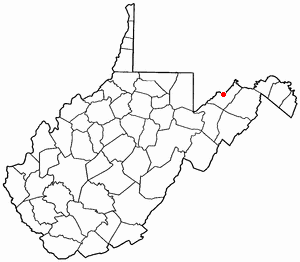
Keyser, West Virginia

Keyser, West Virginia

Frontier Communications’ West Virginia roadshow continued this week as company officials continue to sell the company’s plan to take over telephone service from Verizon across much of the state.  But have they stretched the truth to sell state officials on the deal?

Paul Espinosa, general manager of Frontier, told a West Virginia newspaper the company “prides ourselves in taking good care of our customers,” claiming 95 percent of their current residential customers have broadband Internet.

“In some areas it’s DSL. In other markets we do offer fiber,” he told the Mineral Daily News-Tribune in Keyser.

Keyser, a community of just over 5,000, considers broadband high on its list of concerns.  They want it, but they also want to know it is the kind of broadband that will keep Mineral County competitive, particularly for small businesses that depend on it to reach customers.  The county created a Communications Infrastructure Council (CIC) to review broadband communications options considered vital to the community’s economic development.

Rick Welch, who serves on the CIC,  said the economic future of Mineral County depends upon high speed or fiber-optic Internet and not DSL, or Internet service which utilizes existing telephone lines.

Verizon West Virginia has bypassed the state for FiOS development, which provides a fiber-optic connection to the home, claiming the infrastructure costs are too high at today’s prices to satisfy Return On Investment requirements.  Frontier has never had an ambitious broadband agenda centered on fiber optics.

Frontier traditionally offers 1-3Mbps DSL service in most of the smaller communities they serve.  Frontier’s claim that they are currently providing customers in “other markets” with fiber broadband brings these questions:

  • Exactly where?
  • Under what terms?
  • Is this true fiber-to-the-home service, or simply fiber connected central offices?
  • Are advanced levels of service are provided to these fiber customers, or are the plans, terms, and speeds identical to traditional DSL plans?

If the deal goes through, Frontier would assume ownership of pre-existing Verizon FiOS deployments, but those were proposed and planned by Verizon, not Frontier.

“DSL will not bring anything to Mineral County as far as economic development is concerned,” he said, noting that high technology businesses require far faster speeds than DSL traditionally provides.

A Verizon representative tasked with trying to sell the deal that gets the company out of the West Virginia’s phone business said that something is better than nothing.

“To hear you say that DSL is not the future is troubling,” Verizon’s John Golden said. “If you are without broadband, DSL would be the future.”

The Mineral County Commission was unimpressed with Golden’s statement.  Commission president Wayne Spiggle told the News-Tribune a lot of businesses and those who work from home would not consider coming to Mineral County when they discovered only low speed DSL service available, commonplace more than a decade ago in other areas. Spiggle said real broadband service was essential to attract the kind of businesses Mineral County needs to succeed.

“Our mission and responsibility to Mineral County is to create an entrepreneurial garden, and high-speed broadband is essential to that,” he said.

The Communications Workers of America are also been fighting to warn state and local officials about the gamble West Virginia will take with Frontier Communications.  Considering the last three deals resulted in bankruptcy for all three, it’s a risk the CWA doesn’t think is worth taking.

“Frontier will wind up taking on at least $3.4 billion in debt from Verizon,” said John Johnston, speaking on behalf of the CWA. “Frontier has said they’ll expand broadband, but will they? With $3.4 billion in debt, that’s a lot of money,” he said.

Chuck Fouts, who serves as local CWA president said bankruptcy brings job losses.  “If you go bankrupt, the first thing that goes is people,” he said.

The union says the state should join their efforts to force Verizon to “do what they said they were going to do” and provide a plan to upgrade the state’s telecommunications system to fiber optics.

As it stands, Verizon sees higher returns from cherry-picking more urban areas for its FiOS service, and isn’t willing to provide the kind of universal service throughout its service areas that phone companies have traditionally provided for decades.

“How can Frontier provide the fiber they claim to offer in “other markets” when Verizon’s deeper pockets have thus far been turned out empty for residents in West Virginia?” asks Stop the Cap! reader Hyatt.

Investment firm D.A. Davidson downgraded Frontier’s stock last week, reporting they felt the deal would be bad for Frontier shareholders.

Moving the stock rating back to “underperform,” the firm was skeptical Frontier would be able to pull off the cost-savings it promised as part of the deal.  They also anticipated Frontier will have to finance as much as $3.3 billion of the debt (at 8-9%) it will take on as part of the transaction.  Perhaps more revealing is their prediction that Verizon shareholders who receive distributed shares of Frontier stock will likely dump them as fast as possible, remembering earlier Verizon deals that quickly led to falling stock prices and eventual bankruptcy.  D.A. Davidson warned potential Frontier investors to “at least move to the sidelines” during the anticipated grand sell-off, moving back into the stock only when it bottoms-out.

The Internet Overcharging Express: We Derail One Limited Service Logic Train-Wreck, They Railroad Us With Another

Phillip "He Who Shall Not Be Named" Dampier

Phillip "He Who Shall Not Be Named" Dampier

I’ve tangled with Todd Spangler, a columnist at cable industry trade magazine Multichannel News before.  This morning, I noticed Todd suddenly added me to the list of people he follows on Twitter.  Now I see why.

Todd is back with another one of his cheerleading sessions for Internet Overcharging schemes, promoting consumption-based billing schemes as inevitable, backed up by his industry friends who subscribe and help pay his salary and a guy from a company whose bread is buttered selling the equipment to “manage” the Money Party.

GigaOm’s Stacey Higginbotham and Broadband Reports’ Karl Bode don’t pay his salary, so it’s no surprise he disagrees them.  Oh, and I’m in the mix as well, but not by name.  Amusingly, I’m “the StoptheCap! guy, who’s making a career directing his bloggravation at The Man.”

Todd doesn’t consider himself “an edgy blogger type because, as everyone knows, I am The Man,” he writes.

Actually, Todd, you are Big Telecom’s Man, paid by an industry trade magazine to write industry-friendly cozy warm and fuzzies that don’t rock the boat too much and threaten those yearly subscription fees, as well as your paid position there.  I’ve yet to read a trade publication that succeeds by disagreeing with industry positions, and I still haven’t after today.

Unlike Todd, I am not paid one cent to write any of what appears here.  This site is entirely consumer-oriented and financed with no telecom industry involvement, no careers to make or break, and this fight is not about me.  I’m just a paying customer like most of our readers.

This site is about good players in the broadband industry who deserve to make good profits and enjoy success providing an important service to subscribers at a fair price, and about those bad players who increasingly seek to further monetize their broadband offerings by charging consumers more for the same service.  As one of the few telecom products nearly immune from the economic downturn, some providers are willing to leverage their barely-competitive marketplace position to cash in.

It’s about who has control over our broadband future – certain corporate entities and individuals who openly admit their desire to act as a controlling gatekeeper, or consumers who pay for the service.  It’s also about organizing consumers to push back when industry propaganda predominates in discussions about broadband issues, and we know where we can find plenty of that.  Finally it’s about evangelizing broadband, not in a religious sense, but promoting its availability even if it means finding alternatives to private providers who leave parts of urban and rural America unserved because it just doesn’t produce enough profit.

Let’s derail Todd’s latest choo-choo arguments.

“The idea of charging broadband customers based on what they use is still in play.” — That’s never been in play.  True consumption billing would mean consumers pay exactly for what they use.  If a consumer doesn’t turn on their computer that month, there would be no charge.  That’s not what is on offer.  Instead, providers want to overcharge consumers with speed –and– usage-based tiers that, in the case of Time Warner Cable, were priced enormously higher than current flat-rate plans.  Customers would be threatened with overlimit fees and penalties for exceeding a paltry tier proposed by the company last April.  The ‘Stop the Cap! guy’ didn’t generate thousands of calls and involvement by a congressman and United States senator writing blog entries.  Impacted consumers instinctively recognized a Money Party when they saw one, and drove the company back.  A certain someone at Multichannel News said Time Warner Cable was “taking one for the team.”  At least then you were open about whose side you were on.

“Verizon just wants to make more money by charging more for the same service. What an outrage! It’s not like the company spent billions and billions to build out their network and needs to recoup that investment.” — Recouping an investment is easily accomplished by providing customers with an attractive, competitively priced service that delivers better speed and more reliability than the competition.  Provide that in an era when fiber optic technology and bandwidth costs are declining, and not only does the phone company survive the coming copper-wire obsolescence, it also benefits from the positive press opinion leaders who clamor for your service will generate to attract even more business.  Stacey’s comments acknowledged the positive vibes consumers have towards Verizon’s fiber investment — positive vibes they are now willing to throw away.

Verizon FiOS already gets to recoup its investment from premium-priced speed tiers that are favored by those heavy broadband users.  Most will happily hand over the money and stay loyal, right up until you ask for too much.  Theoretically charging your best customers $140 a month for 50Mbps/20Mbps service and then limiting it to, say, 250GB of usage will be an example of asking for too much.  Verizon didn’t get into the fiber optics business believing their path to return on investment was through consumption billing for broadband.

“Today’s broadband networks — not even FiOS — are not constructed to deliver peak theoretical demand and adding more capacity to the home or farther upstream will require investment.” — Readers, today’s newest excuse for overcharging you for your broadband access is “peak theoretical demand.”  It used to be peer-to-peer, then online videos, and now this variation on the “exaflood” nonsense.  It sounds like Todd has been reading some vendor’s press release about network management.  Peak theoretical demand has never been the model by which residential broadband networks have been constructed.  The Bell System constructed a phone network that could withstand enormous call volumes during holidays or other occasional events.  Broadband networks were designed for “best effort” broadband.  If we’d been living under this the peak demand broadband model, cable modem service and middle mile DSL networks wouldn’t be constructed to force hundreds of households to share one fixed rate connection back to the provider.  It’s this design that causes those peak usage slowdowns on overloaded networks that work fine at other times.

No residential broadband provider is building or proposing constructing peak theoretical demand networks that are good enough to include a service and speed guarantee.  Instead, cable providers are moving to affordable DOCSIS 3 upgrades, which continue the “shared model” cable modems have always relied on, except the pipeline we all share can be exponentially larger and deliver faster speeds.  Will this model work for decades to come?  Perhaps not, but it’s generally the same principle Time Warner Cable is using to deliver HD channels quietly ‘on demand’ to video customers without completely upgrading their facilities.  You don’t hear them talk about consumption billing for viewing, yet similar network models are in place for both.

“Is it fairer to recover that necessary investment in additional capacity from the heaviest users, who are driving the most demand?” Apparently so, because providers already do that by charging premium pricing for faster service tiers attractive to the heaviest users.  But Todd, as usual, ignores the publicly-available financial reports which tell a very different tale – one where profits run in the billions of dollars for broadband service, where many providers Todd feels urgently need to upgrade their networks are, in reality, spending a lower percentage on their network infrastructure costs, all at the same time bandwidth costs are either dropping or fixed, making it largely irrelevant how much any particular user consumes. What matters is how much of a percentage of profits providers are willing to put back into their networks.

Do people like Todd really believe consumers aren’t capable of reading financial reports and watching executives speak with investors about the fact their networks are well-able to handle traffic growth (Glenn Britt, Time Warner Cable CEO), that consumption based billing represents potential increased revenue for companies that deny they even have a traffic management problem (Verizon), or that broadband is like a drug that company officials want to encourage consumers to keep using without unfriendly usage caps, limits, or consumption billing (Cablevision.)

“From 7 to 10 p.m., we’re all consumption kings,” Sandvine CEO David Caputo told Todd. “Bandwidth caps don’t do anything for you.” The implication of this finding is that “the Internet is really becoming like the electrical grid in the sense that it’s only peak that matters,” he added. — I would have been asking Todd to pick me up off the floor had Caputo said anything different.  His bread and butter, just like Todd’s, is based on pushing his business agenda.  Sandvine happens to be selling “network management” equipment that can throttle traffic, perhaps an endangered business should Net Neutrality become law in the United States.  His business depends on selling providers on the idea that sloppy usage caps don’t solve the problem — his equipment will.  Todd has no problem swallowing that argument because it helps him make his.  The rest of us who don’t work for a trade publication or a net throttler know otherwise.

What would actually be fair to consumers is to take some of those enormous profits and plow them back into the business to maintain, expand, and enhance services that deliver the gravy train of healthy revenue.  In fact, by providing even higher levels of service, they can rake in even larger profits.  You have to spend money to earn money, though.

Technology doesn’t sit still, which is why provider arguments about increased traffic leading to increased costs don’t quite ring true when financial reports to shareholders say exactly the opposite.  That’s because network engineers get access to new, faster, better networking technology, often at dramatically lower prices than what they paid for less-able technology just a few years earlier.  With new customers on the way, particularly for the cable industry picking up those dropping ADSL service from the phone company, there’s even more revenue to be had.

Or, do you think spreading the cost across all subscribers, thereby raising the flat-rate pricing for everyone, is the better option? Note that Comcast did this to an extent when it raised the monthly lease fee for cable modems by $2 (to $5), citing costs associated with its DOCSIS 3.0 buildout.

The industry already thinks so.  As we’ve documented, cable broadband providers like Time Warner Cable and Comcast (and Charter next year), are already raising prices across the board for broadband customers in many areas.  Does that mean the talk about Internet Overcharging schemes can be laid to rest?  Of course not.  They want their rate increases -and- consumption based billing for even fatter profits.

If, on the other hand, you want to pretend that all-you-can-eat plans are sustainable at today’s price tiers, you’d be kind of clueless.

Every ISP maintains an Acceptable Use Policy that provides appropriate sanctions for those users who are so far out of the consumption mainstream, they cannot even see the rest of us.  Slapping consumption based billing on consumers with steep overlimit fees and penalties punishes everyone, and the provider keeps the proceeds, and not necessarily for network upgrades.

If Todd believes consumers will sit still for profiteering by changing a model that has handsomely rewarded providers at today’s prices, with plenty of room to spare for appropriate upgrades, he’ll be the clueless one.  The cable industry’s ability to overreach never ceases to amaze me.  Every 15 years or so, legislative relief has to put them back in their place.  It’s what happens when just a handful of providers decide it is easier to hop on board the Internet Overcharging Express and cash those subscriber checks than actually engage in all-out competitive warfare with one another – keeping prices in check and onerous overcharges out of the picture.

Nobody needs to know my name to understand this.  But some of his provider friends already know the names of our readers, because PR disasters do not happen in a vacuum.  They are also acquainted with two other names: Rep. Eric Massa and Sen. Charles Schumer.  If they want to go hog wild with Internet Overcharging schemes, that list of names will get much, much longer.

Verizon Can Engage In FiOS Internet Overcharging Because It Can: Heavy Users Are A Potential Profit Windfall

Brian Whitton, Verizon's Executive Director of Access Technologies

Brian Whitton, Verizon's Executive Director of Access Technologies

At least Verizon is honest about it.  As providers contemplate slapping customers with usage limits, overlimit fees, and other tiered pricing systems, they’ve typically said they’re justified because of the strain they claim heavy users place on their broadband networks.  One network that doesn’t face that problem is Verizon’s robust fiber optic FiOS network, which is on the way to upgrading from the ridiculously fast current speeds to the “next generation” of FiOS speed: delivering 10 Gbps downlink and 2.5 Gbps uplink, shared among 32 locations.  That makes the cable modem competition, which shares slower speeds among many more customers wilt at the prospect.  DSL instantly becomes the dial-up service of the decade in comparison.

Make no mistake, Verizon tells all who ask: Fiber to the Home is near-infinitely upgradeable for decades to come, simply by swapping out some hardware at each end of the pipe.

Yet Verizon began making noises about ending its all-you-can-eat broadband buffet this past September, when Verizon Chief Technology Officer Dick Lynch said Verizon was in favor of consumption-based billing, too.

But why should Verizon FiOS, often priced higher than the cable competition, opt for Internet Overcharging schemes when it has a network that is nowhere near capacity and will increase its speeds even further next year?

As GigaOm’s Stacey Higginbotham found out, the answer is – because they can:

Brian Whitton, executive director of access technologies at Verizon did acknowledge how valuable broadband has become—precious enough that people will pay for premium access to it, especially those using up a disproportionate amount of network assets. “Ultimately this is the fairest cost-recovery model, and with a tiering plan or a meter everyone is paying their fair shares to finance the network,” Whitton said. Unlike other ISPs, Verizon doesn’t view heavy bandwidth users as hogs, but it does view them as potentially high-end customers.

Yet Verizon already does charge users a fair share to finance their network, based on the speed tier that customer chooses.  Those high-end customers are already paying Verizon premium prices for the fastest available speeds on Verizon’s fiber optic system.  Verizon’s ability to recoup their investment becomes easier and easier as costs decline to construct the fiber optic systems that will protect Verizon’s viability for decades to come, unlike those traditional phone companies sticking with copper wire lines until the last customer out the door turns the lights out for good.  Verizon’s average revenue per subscriber has never been higher with its ability to market video programming, speeds that make most cable operators blush, and an infinitely more reliable telephone network, all on one bill.  That helps achieve subscriber loyalty, particularly when offering service that keeps customers happy.

Creating Internet Overcharging schemes for your broadband service simply to monetize consumption does not keep customers happy.  Verizon sees the cream rising to the top — charging broadband enthusiasts more while promising nothing for customers who use the service less.  With average consumption per broadband user rising, there’s going to be a lot more cream to skim, charging an increasing number of customers more money for the exact same level of service.

No consumption billing scheme to date has ever provided customers with a “fair share” system, because none of them result in no charge for no consumption or charge a flat fee per gigabyte.  Instead, customers are allocated a pre-determined allowance for usage, charged whether they use it or not.  If they exceed it, punishing overlimit fees are always the result, unless a provider takes another step towards monetizing broadband by inventing overpriced “insurance plans” to protect consumers from overage fees.  The cost of delivering that data is already built-in to the price of today’s broadband plans, and those costs continue to decline.

Higginbotham adds another factor in the equation: with insufficient competition, those “fair share” schemes can inflate prices and lower allowances at a whim, as most customers lack a wide variety of competitors to choose from, which could help keep the greed factor in check.

Most places have two providers that offer slightly different sets of services and plans, making it hard to compare prices. I don’t mind paying more for a better network (I do so for my cell phone), but most consumers lack that option when it comes to wired access. Comcast—which competes against Verizon in about 12% of its footprint—is rolling out faster broadband to ensure that customers don’t leave the cable provider for Verizon’s fiber. But in other areas of the country, such as here in Austin, Tex., folks must choose between DSL (with some U-verse) and cable that hasn’t been upgraded to the faster DOCSIS 3.0 speeds.

Austin was one of the test markets for Time Warner Cable’s reviled “consumption billing experiment” this past April.  In other test cities, it’s more of the same.  In Rochester, New York broadband service is realistically available from two major players — Time Warner Cable and Frontier Communications.  The former has apparently passed over Rochester for DOCSIS 3 upgrades because the cable operator sees little need to upgrade service in an area whose only primary competitor believes DSL service is good enough, one that has stubbornly kept an Acceptable Use Policy defining an appropriate amount of usage at a piddly five gigabytes per month, and thinks fiber is for breakfast cereals, not for Flower City residents.

Verizon’s words help call out the fiction that some providers have used to peddle Internet Overcharging schemes on their customers.  It’s not about “fairness,” it’s not about “exafloods and Internet brownouts,” nor is it about “expanding networks.”  It’s about profit, pure and simple.  When you have a duopoly in place for broadband and almost no regulation governing that service, the sky is the limit for price increases and limits on usage.

[flv width=”480″ height=”284″]http://www.phillipdampier.com/video/Verizon Whitton On Telecom Delivery 2-25-09.flv[/flv]

Verizon’s Executive Director of Access Technologies Brian Whitton speaks about the future of telecommunication delivery technologies with Kimberlie Dykeman of Web2point0.tv at The Future of Television East conference in New York (February 25, 2009 – 11 minutes)

Search This Site:

Contributions:

Recent Comments:

Your Account:

Stop the Cap!