Home » FiOS » Recent Articles:

Verizon: No Caps for FiOS, No More Unlimited for Wireless, and Don’t You Dare Tether Without Paying

Verizon Communications is a study in contrasts.  It runs one of the most advanced wired broadband services in the country that wins rave reviews from consumers and businesses, is on the verge of ending its unlimited use data plans for smartphone customers on the wireless side, and has launched a major “police action” against individuals that are using their smartphones as wireless hotspots without paying an additional $20 a month for the privilege.

Verizon Says No to Data Caps and Consumption Billing

When you run an advanced fiber to the home network like FiOS, the concept of data caps is as silly as charging for each glass of water collected from Niagara Falls.  That’s a point recognized by Joseph Ambeault, director of media and entertainment services for Verizon.  Talking with GigaOm’s Stacey Higginbotham, Verizon continues to insist their network was built to handle both today and tomorrow’s network demands.

“Our network is always engineered for big amounts of data and right now there are no plans [to implement caps], but of course you never want to say never because things could change.”

However, in the same conversation he talked about how the FiOS service has gone from offering a maximum of 622 Mbps shared among 24 homes in the beginning to tests of 10-gigabit-per-second connections in individual homes that Ambeault mentioned. For now, Verizon is testing 10-gigabit-per-second-shared connections and offering up to 150 Mbps home connections. This kind of relish for massive bandwidth is not evident in conversations with folks at AT&T or even those cable firms deploying DOCSIS 3.0. Which is why when Ambeault added, “We don’t want to take the gleam off of FiOS,” as his final say on caps, I tend to believe that Verizon may be the last holdout as other ISPs such as AT&T, Charter and Comcast implement caps.

Verizon Says Yes to Ending Unlimited Smartphone Data Plans

Verizon is among the last holdouts still offering unlimited data plans for smartphone customers.  Priced at $30 a month per phone, these plans have proved very profitable for Verizon in the past, in part because they are mandatory whether you use a little data or a lot.  But now as data consumption grows, Verizon’s profits are not as luxurious as they once were, so the “unlimited plan” must and will go, probably within the next three months.

Verizon has always been hesitant about following AT&T’s lead for wireless data pricing, which delivers a paltry 2GB for $25 a month.  AT&T still sells its legacy unlimited plan, grandfathered for existing customers, for just $4 more per month.  So while AT&T can claim they’ve reduced the price for their data plans, they’ve also introduced a usage allowance.  Those exceeding it will find a much higher bill than the one they would have received under the old unlimited plan.

Verizon will probably echo AT&T’s tiered data plans, perhaps with slightly more generous allowances, but the real excitement came from Verizon CFO Fran Shammo, who told attendees at the Reuters Global Technology Summit it was prepared to finally introduce the much-wanted “family data plan,” which would allow every family member to share data on a single plan.  That’s a potential smartphone breakthrough as customers resistant to paying up to $30 a month per phone for each individual data plan might see their way clear to buying smartphones for everyone in the family if they all shared a single family-use data plan.

“I think it’s safe to assume that at some point you are going to have megaplans and people are going to share that megaplan based on the number of devices within their family. That’s just a logical progression,” Shammo said.

Of course, the devil is in the details, starting with how much the plan will cost and what kind of shared allowance it will offer.

Verizon Says ‘Oh No You Didn’t Tether Your Phone Without Our $20 Add-On’
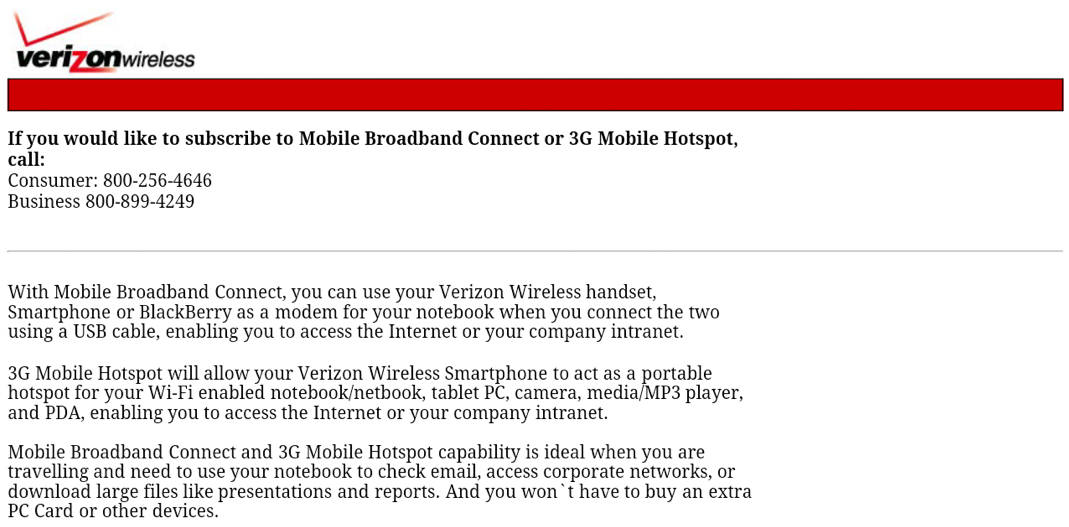
Phandroid posted this copy of a message Verizon customers are receiving if they are using unauthorized third party tethering apps. (Click to enlarge.)

Earlier today, Verizon Wireless customers using popular third-party tethering apps to share their smartphone’s built-in Wi-Fi Hotspot with other nearby wireless devices began receiving the first of what is expected to be a series of warnings that the jig is up.

Tethering allows anything from a tablet computer to a netbook or laptop to share a Verizon Wireless data connection without having to pay for individual data plans for each device.  Third party software applications bypass Verizon’s own built-in app, the 3G Mobile Hotspot, which involves paying an additional $20 a month for a secondary data plan delivering a 2GB monthly usage allowance.

Just as AT&T hated to see the possibility of lost revenue passing them by, Verizon has begun ferreting out customers using these apps and sending them friendly reminders that tethering requires an official Verizon Wireless add-on plan.  While the third party apps are not yet being blocked, most expect Verizon to gradually crack down on their use if customers persist in using them.  Verizon can also block the sale of the apps from the Android Market and can also insert roadblocks to prevent their use.  Or they can follow AT&T’s lead and threaten (perhaps illegally) to automatically enroll customers caught using tethering apps in their paid tethering plans.

Verizon FiOS Promises Tampa Bay Customer 25/25Mbps Speed, Delivers 25/2Mbps Service

Phillip Dampier May 25, 2011 Broadband Speed, Consumer News, Verizon, Video 5 Comments

[flv width=”360″ height=”290″]http://www.phillipdampier.com/video/WFTS Tampa The Need for Speed How to test your internet speed 5-19-11.mp4[/flv]

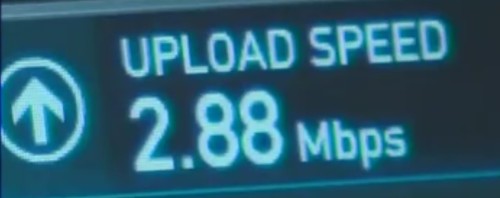
WFTS-TV in Tampa launched a consumer investigation when a local customer noticed the Verizon FiOS Internet service he was paying for — 25/25Mbps — was actually only providing him with 2.88Mbps upload speeds.  Even worse, both providers in the Tampa Bay area — Bright House Communications and Verizon, say actual speeds are not guaranteed, leading at least one customer to file an official complaint with the Federal Communications Commission for false advertising and misrepresentation by Verizon Communications.  WFTS examines whether providers have to actually deliver the speeds they promise, or does the fine print get them off the hook, leaving you paying more than you should for Internet speeds you are not getting.  (3 minutes)

Organized Labor Assisting Group Pushing for Verizon FiOS Expansion in Buffalo

Phillip Dampier May 19, 2011 Broadband Speed, Verizon, Video 2 Comments

Buffalo’s communications labor unions are behind an organized effort to push Verizon Communications to expand its fiber-to-the-home service to the city of Buffalo, despite the fact the telecom company has a moratorium on service expansion beyond its existing commitments.

Buffalo AFL-CIO Central Labor Council President Michael Hoffert and CWA (Communications Workers of America) Local 1122 President James Wagner teamed up with the city’s elected officials and community advocates to pressure the phone company to expand service beyond several suburbs that currently get the service.

A professionally designed website, DontBypassBuffalo.com, is the home of the campaign, collecting signatures from interested residents and sharing late-breaking developments.

Verizon has a moratorium on further expansion of its fiber to the home service.

“Verizon’s FiOS service is a cutting-edge technology that brings ultra-fast internet and superior video programming over fiber optic cables that run directly into customers’ homes,” reads a statement from the coalition. “While Verizon is deploying FiOS throughout many of the suburbs of Buffalo, they are not building FiOS in the City of Buffalo.  The residents of Amherst, Tonawanda, Kenmore, Orchard Park, Hamburg, West Seneca and Lackawanna, where Verizon has built FiOS, are, taken as a whole, more affluent and less diverse than Buffalo residents.  The deployment of broadband technologies is a key to economic redevelopment in the City, especially since health care and higher education, both very dependent on cutting edge technologies, are leading employers in our area.  If Verizon continues to bypass Buffalo, residential consumers, children, and area businesses won’t be able to thrive in the 21st century economy.”

The union shares an interest in bringing the advanced service to more residents across Erie County as it collectively represents some of the Verizon employees who will service the fiber network.  Three western New York chapters of the CWA – Locals 1122, 1115 and 1177 – represent nearly 750 Verizon Workers across Erie, Genesee and Niagara counties, as well as across the Southern Tier, including field technicians, central office technicians and clerical staff.

Curry (WIVB-TV)

Verizon stalled new rollouts of its fiber optic network more than a year ago, and has consistently said it would only expand service in areas where it already has signed agreements with local communities.  In many regions, Verizon has completed agreements with towns and villages before reaching accommodations with larger urban areas.  Buffalo is not alone in protesting for improved broadband service.  Washington, D.C., Baltimore and Boston have also complained about being bypassed.

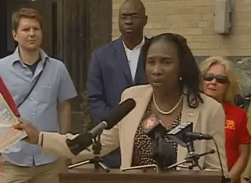
Last week, Coalition Director Janique Curry stepped up the pressure on the phone company at a press conference in front of Verizon’s Elmwood Avenue headquarters.

“Verizon’s lack of commitment to the minority population in the city of Buffalo is unacceptable,” Curry said.  “This community deserves an equal opportunity as our neighbors in the suburbs experience.”

Verizon’s FiOS network in New York State currently serves parts of metropolitan New York City and suburban areas around Albany, Syracuse, and Buffalo.

[flv width=”640″ height=”500″]http://www.phillipdampier.com/video/DontBypassBuffalo Apr-May 2011.flv[/flv]

Here are three reports on the protests: WIVB-TV and WKBW-TV’s coverage of the protest in April, and WIVB’s most recent story covering last week’s return to Verizon headquarters to apply additional pressure on the company.  (3 minutes)

Boston’s Cable Conundrum: Mayor Upset With Comcast Rate Hikes, But Did Little to Bring Competition

Menino

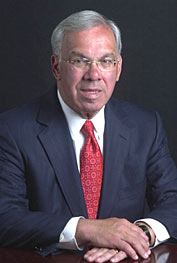
Boston Mayor Thomas Menino has problems with Comcast.  The cable operator, long a dominant player in the city of Boston, has been raising basic cable prices for the last several years, and the mayor’s office has had enough.  This week Menino filed a petition asking the Federal Communications Commission to give the city “emergency control” over the price of basic cable service in Boston — the only control permitted in the largely deregulated cable television marketplace.

Menino waved a study done at the behest of the city showing residents were paying substantially higher prices for the lowest level of service from Comcast.  Basic Service, which includes 37 local over the air stations and a handful of shopping and public access channels costs $15.80 inside city limits — up from $9.05 in 2009.  In nearby Cambridge, the same service costs $7.30 a month.  What’s the difference?  Cable rates are completely deregulated in the city, but smaller communities around Boston lack sufficient meaningful competition, so they are permitted by law to continue regulating rates for the lowest tier: Basic Service.

Now Menino wants those rates brought back under control for the benefit of seniors and low income residents, among the 10,000-15,000 local homes that subscribe to the economy service.

It’s just the latest challenge for Boston, which is among a few cities along the coast of the northeastern United States not benefiting from aggressive broadband and video competition between the phone and cable company.  Just over 200 miles away, metropolitan New York and the bedroom communities in that state, as well as New Jersey and Connecticut, have access to super fast broadband from Verizon FiOS, Time Warner Cable, Cablevision, and Comcast — the latter predominately serving greater Philadelphia.

Boston has been bypassed for Verizon FiOS, is ignored by other potential cable competitors, and is stuck with poor-performing cable overbuilder – RCN, which has focused most of its efforts on multi-dwelling apartment and condo units in the city.  The rest of Boston gets ‘take it or leave it’ service from Comcast or DSL from Verizon.

Comcast was quick to respond to Menino’s call for reregulation, noting they provide $5 senior discounts for their cable customers and offer cheaper service than the alternatives — $17.50 a month from RCN or between $30-35 for promotions from DirecTV and DISH Satellite.

Menino’s dealings with telecommunications companies in Boston have run hot and cold for years.  In February, Menino appeared with Comcast senior vice president Steve Hackley to celebrate the opening of a Digital Connectors program for up to 2,800 low income households, paid for by federal stimulus grant money.  Under the program, students who complete computer training courses receive discounted Comcast Internet service for $10.95 a month for the first year and $15.95 for the second year.

Boston

Menino’s office has often been a watchdog when it comes to Comcast fulfilling its franchise obligations, and the city had high hopes competition from RCN would extend a choice of cable providers to most city residents.  That has not happened.

The city’s other telecommunications provider, Verizon, has been in contention with the city for several years.  The trouble began in 2007 when Menino declared war on property tax exemptions for utility poles dating back to 1915, granted to telecom companies like Verizon.  Four years later, that battle has culminated in Verizon literally wiring its fiber optic FiOS service around the city of Boston, refusing to deliver service inside it.

The promise of Verizon fiber has often gone unfulfilled or delayed in many larger cities, subject to bureaucratic delays not experienced in smaller communities.  Some towns and villages in Massachusetts signed franchise agreements just a few months after the company came knocking.

One local official, not authorized to speak publicly on the matter, told Stop the Cap! many communities welcomed Verizon’s fiber optic initiative with open arms.

“You have to understand there is a different mentality among government officials in smaller towns than there is among larger cities,” the official tells us. “In our town of 35,000 when Verizon offered to wire competitive service in our area, we wanted to know where to sign and when they could get started.”

The official says the local government was concerned about making sure Verizon repaired any damage to local infrastructure, abided by local zoning rules, and guaranteed they would not bypass parts of the town.  Negotiators also fought for funding to upgrade equipment for the community’s public access channels, but never went into the negotiations thinking about how much they could extract from the phone company.

“In larger cities in this state, there is a definite mentality that Verizon represents a golden goose ready and willing to lay golden eggs in return for franchise agreements,” the official told us.  “Maybe that is true, but when you are in a smaller town, you recognize the degree of willingness to invest capital to tear out old wires and replace them with fiber is far less here than a city like Boston, which has the potential of many more customers.”

Boston, like other large cities, prepared for protracted negotiations with the phone company over the new fiber service.  At the same time, Mayor Menino infuriated Verizon when he won his property tax lawsuit against the company, collecting $5 million in tax payments that one city official rubbed in.

Ronald W. Rakow, Boston’s commissioner of assessing, told the Boston Globe at the time: “We will actually be sending a bill to them for that later today,’’ Rakow said. “Don’t want to let the ink dry.’’

No Verizon FiOS for Boston

The argument over property taxes may have been the final straw for Verizon FiOS in Boston.  Menino suspected as much, telling the Globe “they insinuated that we weren’t going to get it because of my position on telecommunications.’’

Even then-Verizon CEO Ivan Seidenberg warned the city during a speech at the Boston College Chief Executives’ Club of Boston “to be careful when considering new taxes or regulations.”

Verizon has since stopped expanding its FiOS service to new cities.

“We knew as the financial crisis grew we were smart to sign up earlier rather than later, because if we didn’t, we would never have the service today,” the local official tells us.  “I have sympathy with local officials in every city trying to do what is best for their residents, but anyone who understands wired telecommunications should know these kinds of projects are exceedingly rare — grab them when you have the chance.”

Just a few years later, the impact of earlier decisions not to hurry competition into the city of Boston and the city’s tax policies have become clear:

  • Comcast may be forced to reduce their Basic Service rate, but nothing prevents them from increasing Digital Service cable rates to make up the difference;
  • RCN’s network has languished, providing competitive choice to just 15,000 local residents.  Comcast serves at least 170,000;
  • Verizon has no plans to offer FiOS in the city indefinitely;
  • Menino’s victory claim that Verizon should pay its fair share in property taxes seems less victorious today as the phone company began passing on the new taxes to ratepayers as a “Massachusetts Property Tax Recovery Surcharge” in March, 2010.
  • No other competitor has appeared on the horizon willing to take on Comcast in the city of Boston.

Getting the Best Rate for Broadband-Only Service from Time Warner Cable

With Time Warner Cable’s broadband now running as high as $50 a month for standard, stand-alone service, getting the best deal possible can save you as much as $20 a month off those prices.  Time Warner Cable has been repricing their services to deliver the most value to customers who bundle all of the company’s products into a single package.  But if you don’t want television or telephone service from the cable company, you are going to pay a lot more than your service-bundled-neighbors for Road Runner High Speed Internet.

Stop the Cap! presents our strategy to help broadband-only customers get the best possible prices from Time Warner Cable:

Choose Earthlink

Customers paying Time Warner Cable’s regular prices for broadband service are paying too much.  Time Warner currently charges just short of $50 a month for Standard 10/1Mbps service (speeds are slower in some areas).  That’s up from years of charging $40 a month, slightly higher if you were a broadband-only customer.  But with the help of Earthlink, you can cut that broadband bill to $29.99 a month for the first six months.  Earthlink co-exists with Road Runner, Time Warner Cable’s own broadband service.  With just a few mouse clicks and a quick phone call, Time Warner can switch your regular price Road Runner to Earthlink without any equipment changes.  Billing and service will continue to be provided by Time Warner and the change literally takes less than five minutes by phone.

You can escape Time Warner Cable's Road Runner rate hike by switching to Earthlink service at a substantial discount.

Earthlink’s broadband service is indistinguishable from Road Runner — same speeds, same level of service, with two exceptions:

  • Earthlink does not benefit from PowerBoost, which delivers temporary speed increases during file downloads
  • You will forfeit your rr.com e-mail address

We recommend you avoid using ISP-provided e-mail addresses when possible, because they help tie you down to an existing provider.  Instead, sign up for a free e-mail account from Google’s Gmail, or Yahoo! Mail, or any of the dozens of other web-based e-mail providers.  Or, purchase your own domain name from GoDaddy or 1and1, which includes e-mail, and either read it on those sites or forward it to a web-based e-mail provider.  Domain names can be had for under $10 a year and deliver maximum flexibility for those who want the freedom to change Internet providers.

After Six Months, Switch Back to Road Runner

When your Earthlink promotion expires at the end of six months, your price will increase to $41.95 per month.  Just before that happens, switch back to Time Warner Cable’s Road Runner service.  You qualify for new customer pricing promotions.  As of this week, Time Warner Cable in western New York is offering one year at $29.99 per month for 10/1Mbps service.  Other areas may have different pricing promotions.

After the year is up, you can start all over again, heading back to Earthlink for another six month promotional term.  Earthlink has offered its promotional plan for more than two years, and it shows no signs of ending anytime soon.

Promotional Half-Truths

Promotions come and go from Time Warner Cable, so it is wise to check with them often if the $29.99 deal is not currently running in your area.  Start by checking Time Warner Cable’s website, and remember if you are using Earthlink, you will want to select pricing for new customers.  If you find a good price on the website, you may be able to complete your order online.  Otherwise, call your local office and ask about currently running promotions.  Some common ones:

  • Road Runner Turbo at 50% off for the first year;
  • Road Runner Turbo free for six months;
  • Road Runner with wireless router/modem free for six months to one year;
  • Road Runner with free installation (especially useful if you want Road Runner Extreme/Wideband service, which carries a pricey installation fee);
  • Road Runner for $29.99 for six months;
  • Bundled promotions — $99 for all three services, $79 for broadband/cable or broadband/phone

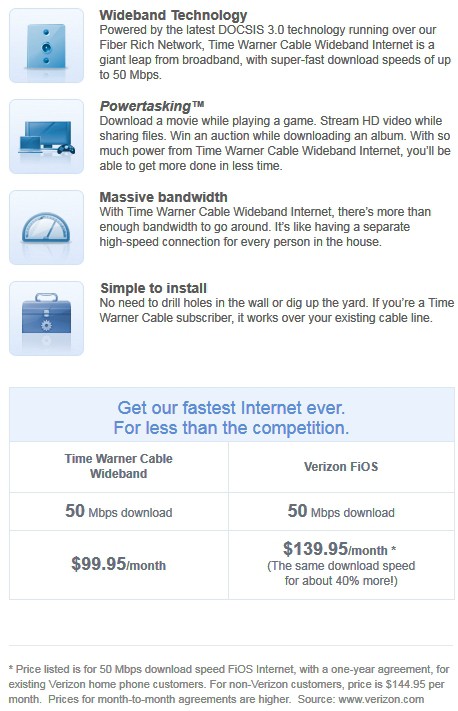
Not every promotion delivers the best deal for customers, and some have been slightly deceptive, such as this speed comparison we found on the cable company’s website this morning:

Our View:

  1. Time Warner Cable has been spanked before for their claims about running a “fiber network.”  In fact, their “Fiber Rich Network” is a marketing stretch.  All modern cable systems use fiber optics to help distribute their service into various communities, but coaxial copper cable delivers the signal through neighborhoods to your individual home.  Cable companies still cannot match the broadband speeds available on an all-fiber network.
  2. “Powertasking” is a meaningless marketing claim.  Any high speed network will allow the entire family to effectively share a broadband connection.
  3. We’re glad to know Time Warner Cable has “massive bandwidth” — more than enough to go around.  We’ll remember that if and when the company ever entertains bringing back their experimental Internet Overcharging scheme they claimed was necessary to pay for equipment upgrades to cope with broadband traffic growth.
  4. It would be simpler to install Time Warner’s DOCSIS 3 upgrade if we could do it ourselves, but the cable company currently requires a mandatory service call ($67.98 fee) to install it.
  5. Time Warner is being cute comparing their broadband speed with Verizon FiOS.  In fact, FiOS is faster because of what isn’t mentioned here — upstream speeds.  Time Warner tops out at 5Mbps, Verizon offers 20Mbps for uploads.  But Time Warner’s pricing is better at that download speed.  Verizon is more aggressively priced when they bundle services together.  For example, Time Warner’s $99 triple play bundle only offers 10/1Mbps service.  Verizon offers up to 25/25Mbps service for the same price.  Both include phone and television service.

Search This Site:

Contributions:

Recent Comments:

Your Account:

Stop the Cap!