'Hurricane Verizon' blows more money out of customers' pockets.
Verizon Communications customers who use the ISP’s personal storage space for running small personal websites have run into a problem: Verizon has banned customers using FTP to manage and update those pages.
Customers are being told the file transfer protocol has been suspended for “security reasons,” but those sobering concerns magically disappear if you agree to pay Verizon an additional $6-10 a month for a “pro hosting plan,” which restores FTP access.
Even more irritating, Verizon customers already pay the company $20 a year for 100MB of space that used to be manageable by FTP, but no more.
“Verizon claims they sent an e-mail notifying me they were shutting off FTP access on Aug. 21, but I never received it,” says Jim Elger, a Verizon DSL customer in Watertown, N.Y. “I discovered this over the weekend when I couldn’t connect to their FTP server any longer.”
Elger thought Hurricane Irene might have been responsible, but now blames ‘Hurricane Verizon’ for trying to suck more money from his wallet.
“It’s bad enough we pay $20 for what many ISP’s include for free, but now that is rendered money blown out the door because the company wants you to pay for an ‘upgraded’ plan just to update your website,” Elger says. “There are people in Verizon’s forums who can’t even capture what is already online to move their content somewhere else.”
Elger called Verizon and was also told the change was implemented for security reasons, an explanation he questions.
“How does the security problem go away when you hand over another six dollars a month?”
A year after Frontier Communications assumed control of Verizon’s assets in the Pacific Northwest, customers are fleeing the company’s inherited fiber-to-the-home service FiOS, after announcing a massive (since suspended, except in Indiana) 46 percent rate hike for the television portion of the service. A new $500 installation fee has kept all but the bravest from considering replacing customers who have left for Comcast and various satellite TV providers.
Frontier’s second-quarter financial results revealed the company has lost at least 14,000 out of 112,000 FiOS TV customers in the region (and in the Fort Wayne, Ind. market, where the service is also available.)
Early reaction to the original rate hike announcement started customers shopping for another provider — mostly Comcast, which competes in all three states where Frontier FiOS operates. Even after the rate hike was suspended in some markets, intense marketing activity by Frontier to drive customers towards its partnership with satellite provider DirecTV managed to convince at least some of those customers to pull the plug on fiber in return for a free year of satellite TV, although an even larger number presumably switched to the cable competition.
D.A. Davidson, a financial consulting firm, toldThe Oregonian the message was clear.
“They would love to get rid of the FiOS TV customers,” Donna Jaegers, who follows Frontier, told the newspaper. “They’re programming costs are very high compared to the rates that they charge.”
Jaegers said Frontier Communications completely botched their efforts to transition customers away from FiOS TV towards satellite, because most of those departing headed for the cable competition, attracted by promotional offers and convenient billing.
Many others simply don’t want a satellite dish on their roof, and are confounded about Frontier’s message that satellite TV is somehow better than fiber-to-the-home service.
Frontier admits its FiOS service is now underutilized, but claims it will continue to provide the service where it already exists.
Wilderotter
Frontier Claims Its DSL Service is Better Than Cable Broadband
Frontier’s general business plan is to provide DSL service in rural areas where it faces little or no competition, and most of Frontier’s investment has been to upgrade Verizon’s landline network to sustain 1-3Mbps DSL service, for which it routinely charges the same (or more) for standalone broadband service that its cable competitors charge for much faster speeds.
But Frontier Communications CEO Maggie Wilderotter says their DSL service is better than the cable competition.
“A key differentiator between our network and cable competition is that you consistently get the speed you pay for,” Wilderotter told investors on a conference call. “There’s no sharing at the local level. High demand for bandwidth-intensive applications like video are putting pressure on all wired networks. To that end, we want to make sure that we have more than enough capacity to satisfy the expectations of our customers. We’re spending capital in all parts of the network with specific emphasis in the middle mile, which will enable us to consistently deliver a quality customer experience for our customers of today and tomorrow.”
Frontier Communications CEO Maggie Wilderotter defends anemic broadband additions during the 2nd quarter of 2011 and tries to convince investors DSL service is better than the cable competition. August 3, 2011. (4 minutes)
You must remain on this page to hear the clip, or you can download the clip and listen later.
Netflix Traffic Represents 25% of Frontier’s Broadband Traffic; Online Video — 50%
Wilderotter admitted Frontier’s broadband network is overcongested in many regions, which she partly blamed for the company’s anemic addition of new broadband customers.
“Video is about 50 percent,” Wilderotter added. In an investor conference call, she explained network congestion in more detail:
“In [the second quarter], we had many areas with unacceptable levels of network congestion, which negatively impacted our growth in net high-speed additions.” Wilderotter said. “We believe all of the major congestion issues will be fixed by the end of [the third quarter], and that will enable us to drive higher growth and net broadband activation in [former Verizon service areas.]”
“What we decided to do is to go for fixing the middle mile, which is the [central office] to the […] neighborhood and to expand that capability by 100-fold. And then also, expand from the [central office] out to the Internet and make sure that we have huge capacity to deliver and receive capability to our customers. So when we sell 6 meg, 10 meg, 25 meg, 50 meg, the customer gets what we sell them and that was extremely important for us.”
“So what we did is in the areas where we saw the congestion increase based upon usage increases, and we’ve built new households. We’ve held off on marketing to a lot of those new households until we fixed the congestion problem because we didn’t want to exacerbate what we had already. We’ve shifted capital in terms of the mix of how we’ve spent capital to fix this problem. I’d say we’re probably 75% of the way there in fixing congestion. This quarter is another big quarter for us to get all of the major issues out of the network, which will allow us in the back end of this quarter through the fourth quarter, to really start pushing the penetration levels where we’ve built new households in the areas that have been affected by congestion.”
Frontier Introduces Line Bonded DSL — Two Connections Can Improve DSL Speeds
Frontier Faster? Frontier announces line bonded DSL.
Frontier Communications also announced the introduction of Frontier Second Connect, a DSL line bonding product that delivers two physical connections to a single household. Line bonding allows for improved broadband speeds.
“Second Connect gives our customers two exclusive connections in one household, and we’re the only provider in every market that can do that,” Wilderotter claimed.
In more urban markets, Frontier’s DSL speeds are woefully behind those available from most cable competitors. Frontier has begun upgrading some of their legacy service areas and retiring older equipment in an effort to improve the quality of service.
“The real initiatives that we have underway are called middle mile, interoffice facilities, as well as some of the more aged equipment that’s in the network,” said Dan McCarthy, Frontier’s chief operating officer. “So as we go through, there’s about 600 projects that are underway today that will improve both the speed and capability.”
“We’ve inherited markets that there has not been upgrades to capacity in these markets for many years and fixes to the networks, plus the elements as the DSLAMs, even the DSLAMs themselves are old,” Wilderotter said. “So we’re replacing network elements in the neighborhood. We’re splitting them and moving customers to other network elements to make sure that they have a good experience.”
Frontier executives answer a question from a Wall Street banker about DSL speeds and congestion problems on Frontier’s broadband network. A detailed technical discussion ensues as the company tells investors it is redirecting some capital to fixing Frontier’s overcongested network. August 3, 2011. (5 minutes)
You must remain on this page to hear the clip, or you can download the clip and listen later.
Frontier Still Losing More than 8% Of Its Landline Customers Every Year
Despite broadband rollouts and incremental improvements, more than eight percent of Frontier’s landline customers disconnect service permanently every year. Frontier called that disconnect rate an improvement over its line losses last year, which exceeded 11 percent in some areas.
“Total line losses improved to an 8.6% year-over-year decline, our lowest level since taking ownership when the pro forma loss rate was 9.7%,” reported Wilderotter. “We also improved [the] loss rate [in former Verizon service areas to] 10.1% compared to 11.4% in Q2 2010.”
Most of Frontier’s departing customers are switching to cable providers and/or cell phone service.
(Update 8-23-2011: We are now told in many areas, Frontier’s Second Connect service is not actually a bonded DSL product, but rather a “dry loop” second DSL line that carries the same speed as your primary line. Presumably, household members can divide up who uses which DSL circuit for Internet access. The charge for Second Connect in ex-Verizon service areas is $14.99 per month plus a second mandatory monthly modem rental fee of $6.99. If the web link does not work, it means the service is not available in your service area.)
Verizon Communications has found a way to outdo AT&T’s enormous and unsightly “lawn refrigerators.” They have installed 20 foot fiberglass poles in the middle of historic neighborhoods in Flatbush, Brooklyn on top of which the phone company plans to mount boxes containing equipment to support its FiOS fiber to the home service.
The enormous polygonal poles went up suddenly without advance warning, and neighbors left their homes to gaze up at the mysterious new addition to the Victorian-era community.
“The neighbors started gathering around it like it was the monolith in ‘2001,’ ” Rev. Jeanne Person, told the New York Times.
Nobody seemed to know who installed the poles, or more importantly why.
It turns out they are Verizon’s answer to AT&T’s enormous and unsightly 4-6 foot tall metal cabinets that the latter has been installing on street corners and in front of homes throughout U-verse service areas.
John J. Bonomo, Verizon’s director of media relations, told the Times the poles provide an interface between underground cables and above-ground wires that thread through backyards. Bonomo recognized the way AT&T does it attracts vandals and graffiti. Verizon’s solution tries to hide the unsightly boxes in the canopy of neighborhood trees, to varying degrees of success. It also prevents anyone other than Spiderman from stealing equipment inside.
Besides, Bonomo says, the company got all of the necessary permits from the Department of Transportation. Well, almost all of the necessary permits.
They forgot the Landmarks Preservation Commission, which regulates the look and feel of protected, historic neighborhoods — like Flatbush. Install 20-foot plastic poles without a permit at your peril.
A spokesperson for the Commission says they hope to reach a resolution with Verizon soon.
It’s not that neighbors are ungrateful that Verizon is extending FiOS into Brooklyn, where it will provide real competition to Cablevision. Many applaud the fiber service and look forward to signing up. They just don’t believe randomly placed 20′ poles are the way to do it.
“First we wanted to know what it was,” Rev. Person said. “Then when we figured out what it was, we wanted to get rid of it. What does landmarking mean if it doesn’t protect us?”
[flv width=”640″ height=”380″]http://www.phillipdampier.com/video/WCBS NY Verizon 20 Pole 6-7-11.mp4[/flv]
Brooklyn residents complained to WCBS-TV about the 20 foot unwelcome additions to their neighborhoods. (2 minutes)
The Federal Communications Commission today released MEASURING BROADBAND AMERICA, the first nationwide performance study of residential wireline broadband service in the United States. The study examined service offerings from 13 of the largest wireline broadband providers using automated, direct measurements of broadband performance delivered to the homes of thousands of volunteers during March 2011.
Among the key findings:
Providers are being more honest about their advertised speeds: Actual speeds are moving closer to the speeds promised by those providers. Back in 2009, the FCC found a greater disparity between advertised and delivered speeds. But the Commission also found that certain providers are more likely to deliver than others, and certain broadband technologies are simply more reliable and consistent.
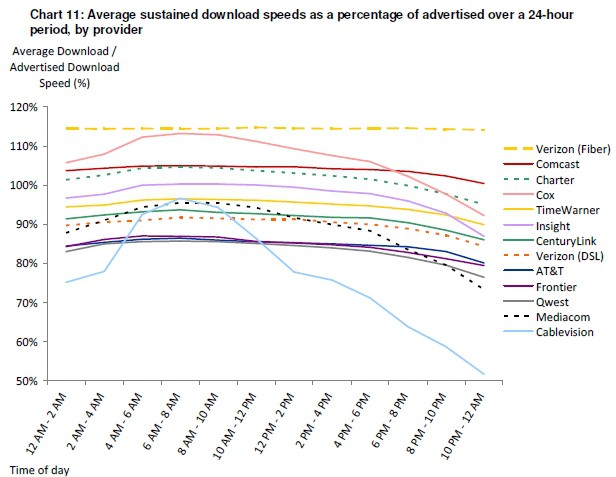
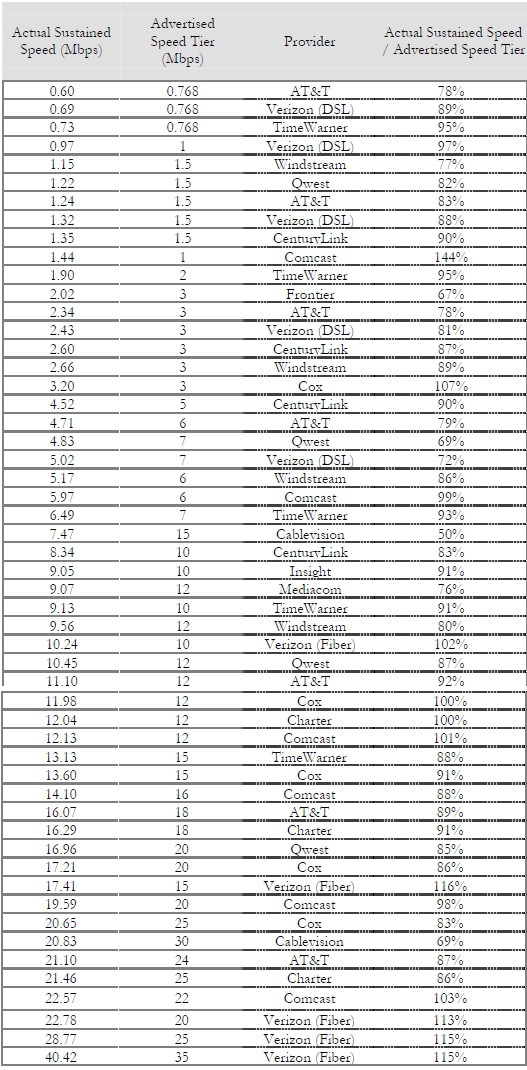
Fiber-to-the-Home service was the runaway winner, consistently delivering even better speeds than advertised (114%). Cable broadband delivered 93% of advertised speeds, while DSL only managed to deliver 82 percent of what providers promise. Fiber broadband speeds are consistent, with just a 0.4 percent decline in speeds during peak usage periods.
Cable companies are still overselling their networks. The FCC found during peak usage periods (7-11pm), 7.3 percent of cable-based services suffered from speed decreases — generally a sign a provider has piled too many customers onto an overburdened network. One clear clue of overselling: the FCC found upload speeds largely unaffected.
DSL has capacity and speed issues. DSL also experienced speed drops, with 5.5 percent of customers witnessing significant speed deterioration, which could come from an overshared D-SLAM, where multiple DSL customers connect with equipment that relays their traffic back to the central office, or from insufficient connectivity to the Internet backbone.
Some providers are much better than others. The FCC found some remarkable variability in the performance of different ISPs. Let’s break several down:
Verizon’s FiOS was the clear winner among the major providers tested, winning top performance marks across the board. Few providers came close;
Comcast had the most consistently reliable speeds among cable broadband providers. Cox beat them at times, but only during hours when few customers were using their network;
AT&T U-verse was competitive with most cable broadband packages, but is already being outclassed by cable companies offering DOCSIS 3-based premium speed tiers;
Cablevision has a seriously oversold broadband network. Their results were disastrous, scoring the worst of all providers for consistent service during peak usage periods. Their performance was simply unacceptable, incapable of delivering barely more than half of promised speeds during the 10pm-12am window.
It was strictly middle-of-the-road performance for Time Warner Cable, Insight, and CenturyLink. They aren’t bad, but they could be better.
Mediacom continued its tradition of being a mediocre cable provider, delivering consistently below-average results for their customers during peak usage periods. They are not performing necessary upgrades to keep up with user demand.
Most major DSL providers — AT&T, Frontier, and Qwest — promise little and deliver as much. Their ho-hum advertised speeds combined with unimpressive scores for time of day performance variability should make all of these the consumers’ last choice for broadband service if other options are available.
Some conclusions the FCC wants consumers to ponder:
For basic web-browsing and Voice-Over-IP, any provider should be adequate. Shop on price. Consumers should not overspend for faster tiers of service they will simply not benefit from all that much. Web pages loaded at similar speeds regardless of the speed tier chosen.
Video streaming benefits from consistent speeds and network reliability. Fiber and cable broadband usually deliver faster speeds that can ensure reliable high quality video streaming. DSL may or may not be able to keep up with our HD video future.
Temporary speed-boost technology provided by some cable operators is a useful gimmick. It can help render web pages and complete small file downloads faster. It can’t beat fiber’s consistently faster speeds, but can deliver a noticeable improvement over DSL.
More than 78,000 consumers volunteered to participate in the study and a total of approximately 9,000 consumers were selected as potential participants and were supplied with specially configured routers. The data in the report is based on a statistically selected subset of those consumers—approximately 6,800 individuals—and the measurements taken in their homes during March 2011. The participants in the volunteer consumer panel were recruited with the goal of covering ISPs within the U.S. across all broadband technologies, although only results from three major technologies—DSL, cable, and fiber-to-the-home—are reflected in the report.
[flv width=”640″ height=”380″]http://www.phillipdampier.com/video/WPXI Pittsburgh Verizon Unveils New Home Control Service 7-25-11.flv[/flv]
Verizon’s home control and automation system is set to debut in Pittsburgh where Verizon FiOS is available. WPXI-TV was invited to a training session for Verizon employees, where they were taught about the new service with the help of Verizon-hired actors. Suffice to say, the new technology was more impressive than the actors hired to promote it. (2 minutes)
Be Sure to Read Part One: Astroturf Overload — Broadband for America = One Giant Industry Front Group for an important introduction to what this super-sized industry front group is all about. Members of Broadband for America Red: A company or group actively engaging in anti-consumer lobbying, opposes Net Neutrality, supports Internet Overcharging, belongs to […]
Astroturf: One of the underhanded tactics increasingly being used by telecom companies is “Astroturf lobbying” – creating front groups that try to mimic true grassroots, but that are all about corporate money, not citizen power. Astroturf lobbying is hardly a new approach. Senator Lloyd Bentsen is credited with coining the term in the 1980s to […]
Hong Kong remains bullish on broadband. Despite the economic downturn, City Telecom continues to invest millions in constructing one of Hong Kong’s largest fiber optic broadband networks, providing fiber to the home connections to residents. City Telecom’s HK Broadband service relies on an all-fiber optic network, and has been dubbed “the Verizon FiOS of Hong […]
BendBroadband, a small provider serving central Oregon, breathlessly announced the imminent launch of new higher speed broadband service for its customers after completing an upgrade to DOCSIS 3. Along with the launch announcement came a new logo of a sprinting dog the company attaches its new tagline to: “We’re the local dog. We better be […]
Stop the Cap! reader Rick has been educating me about some of the new-found aggression by Shaw Communications, one of western Canada’s largest telecommunications companies, in expanding its business reach across Canada. Woe to those who get in the way. Novus Entertainment is already familiar with this story. As Stop the Cap! reported previously, Shaw […]
The Canadian Radio-television Telecommunications Commission, the Canadian equivalent of the Federal Communications Commission in Washington, may be forced to consider American broadband policy before defining Net Neutrality and its role in Canadian broadband, according to an article published today in The Globe & Mail. [FCC Chairman Julius Genachowski’s] proposal – to codify and enforce some […]
In March 2000, two cable magnates sat down for the cable industry equivalent of My Dinner With Andre. Fine wine, beautiful table linens, an exquisite meal, and a Monopoly board with pieces swapped back and forth representing hundreds of thousands of Canadian consumers. Ted Rogers and Jim Shaw drew a line on the western Ontario […]
Just like FairPoint Communications, the Towering Inferno of phone companies haunting New England, Frontier Communications is making a whole lot of promises to state regulators and consumers, if they’ll only support the deal to transfer ownership of phone service from Verizon to them. This time, Frontier is issuing a self-serving press release touting their investment […]
I see it took all of five minutes for George Ou and his friends at Digital Society to be swayed by the tunnel vision myopia of last week’s latest effort to justify Internet Overcharging schemes. Until recently, I’ve always rationalized my distain for smaller usage caps by ignoring the fact that I’m being subsidized by […]
In 2007, we took our first major trip away from western New York in 20 years and spent two weeks an hour away from Calgary, Alberta. After two weeks in Kananaskis Country, Banff, Calgary, and other spots all over southern Alberta, we came away with the Good, the Bad, and the Ugly: The Good Alberta […]
A federal appeals court in Washington has struck down, for a second time, a rulemaking by the Federal Communications Commission to limit the size of the nation’s largest cable operators to 30% of the nation’s pay television marketplace, calling the rule “arbitrary and capricious.” The 30% rule, designed to keep no single company from controlling […]
Less than half of Americans surveyed by PC Magazine report they are very satisfied with the broadband speed delivered by their Internet service provider. PC Magazine released a comprehensive study this month on speed, provider satisfaction, and consumer opinions about the state of broadband in their community. The publisher sampled more than 17,000 participants, checking […]


 Subscribe
 “It’s bad enough we pay $20 for what many ISP’s include for free, but now that is rendered money blown out the door because the company wants you to pay for an ‘upgraded’ plan just to update your website,” Elger says. “There are people in Verizon’s forums who can’t even capture what is already online to move their content somewhere else.”