Home » FiOS » Recent Articles:

An Open Letter from a Frustrated Frontier Employee: Part 3 – Fun Facts About Our Broadband

A very frustrated employee of Frontier Communications working in one of their Ohio offices sent Stop the Cap! a detailed report on some of Frontier’s problems with customer service, unfair fees, and other horror stories. In this final part, a look at Frontier’s broadband service and how the company is still struggling to integrate ex-Verizon customers now a part of the Frontier family. “It is as if Dollar Tree bought out Wal-Mart.” 

Frontier recently began marketing faster Internet speeds to many of their customers who can finally sign up for something roughly equivalent to today’s standard speeds from cable operators. But even in its more advanced forms of bonded DSL, ADSL2+, and VDSL, all remain distance-sensitive. Customers may simply never get the speeds they were promised if they live too far from the phone company’s central office.
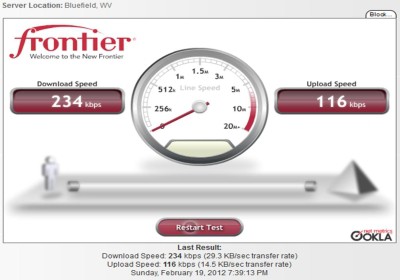
Frontier wants to see the end of speed test results like this.

We recently started pushing our premium speed broadband to customers who qualify for our new speeds, which run up to 25Mbps for residential customers. Customers who truly qualify for this service will actually get to receive decent speeds comparable to what Time Warner Cable and Comcast offers.

We were originally planning to market this as competitive with FiOS fiber optic speed, but I’m honestly not surprised they dropped that angle once they thought of how stupid it would sound to veteran DSL customers that a standard telephone line could reach those speeds. Even the majority of our Frontier FiOS customers are sometimes lucky to receive the speeds that cable offers, but for different reasons.

If a representative says you do qualify for faster Internet service, it is still an absolute crap-shoot whether or not you will actually get through a two-hour streamed Netflix movie in two hours instead of four thanks to buffering issues.

We are still in the early stages of rolling out these new speeds and there are still many issues in our internal systems to work out. For example, if our internal Salesforce/DPI system has not been updated, you are not going to get the faster speed service even if you can see the central office from your house. When it does show a customer is qualified, both the customer and I rejoice because I get a commission and the customer can now successfully access Facebook in less than three hours. Unfortunately, we don’t live in a perfect world and three of my orders for premium broadband Internet failed to complete despite the fact our system said they were qualified.

The cryptic reason? “Technology restraints do not allow this customer to reach any higher speeds.” That comes courtesy of our techs, who use it as a catch-all to cancel orders. Nobody can tell me why. I’ve asked dispatch, assignment, and tech managers and they have given me different explanations — none that seemed valid.

That leaves me calling back the customer, now excited they can finally use our broadband service to play online video games or Skype their son in college without being disconnected and let them know I was a big fat liar when I promised them something better, only to leave them stuck with what they had.

Next we need to update the information in those customers’ profiles so future reps do not lead them on. I have rechecked those accounts and to this day none of that information was updated. I just see my cancelled orders. So, there is even misinformation taking place within the company, preventing us from providing a risk free service.
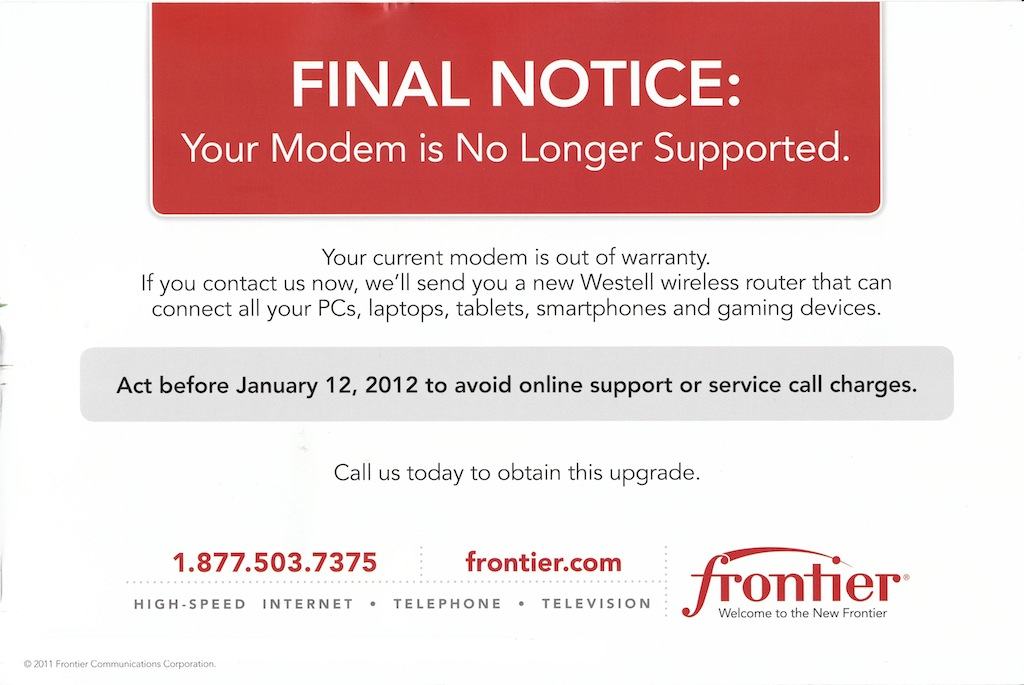
Modem fees are a nuisance to a number of Frontier customers. The company is eliminating them for some customers.

Modem fees no longer apply to many Frontier broadband plans

Modem fees used to be an issue, however they are now increasingly included in the price of your broadband service. This can be especially good news in a competitive market where your broadband bill drops by nearly $7 a month, but those already using their own equipment will no longer see any savings from service credits applied to their monthly bills.

Are you really getting Frontier FiOS broadband speeds? Maybe not.

Speaking about misinformation, we have several Frontier FiOS customers that are actually only getting basic cable or DSL Internet speeds because their house was never actually wired with fiber. A street may have fiber optic cables all around, but if a customer is still using copper cable from the pole and inside their home, they are paying for services they are not getting. These customers are often noted in customer records we can access, but we are discouraged from sharing that information. This is not entirely our fault. This was a problem left over from the previous owner, Verizon Communications, which left us the mess to clean up. If you are only receiving half of the FiOS speed you are paying for, this may be why. If you complain, we will issue credit or create what we call a “SIFT Ticket” to send a tech to investigate a possible service upgrade.

Playing the Telephone Game with the telephone company

There have been countless times when I’ve been told five different things by five different people about how to handle a customer calling in for assistance. I understand that with millions of customers it is hard to predict what will happen on that next call, but simple things such as a consistent way to handle customer requests should be standard stuff. So, what can I do? Pick one of the five options and hope it is the right one for the customer.

Working for Frontier means dealing with short term goals that vary wildly day to day with no focus on any sort of objective. These loose operations and inconsistencies come straight from the top. This affects our long term goals as a company (whatever the hell those might be). These endlessly varying short term goals leave us with no foundation for long term goals because… again, there is no focus. That needed to be said twice.

Customers notice the rampant inconsistencies. A lot of customers candidly tell me, “you guys are spread too thin, and there is a severe lack of communication between all of your call centers.”

This is true, and much of it has to do with our purchase of former Verizon landline customers. It is as if Dollar Tree bought out Wal-Mart. I feel like we have bit off more than we can chew, despite the fact management dismissed these concerns as “speed bumps from the conversion.”

It is now 2012 and 2013 is coming closer every day and I am still dealing with the same issues that should no longer be happening as often as they should.

So, in closing, this has been my rant about the company I work for. I do enjoy my job (honestly, I do) and the people I work with are great. Even the customers who scream and yell at me, or the ones who commend me for my work, they’re all great in their own way. Nothing is as satisfying as actually calming someone down who has an issue with their bill, only to have them apologize and be grateful they got me on the phone. You have to truly be a people person to do this job, and not just do it for the money or it won’t work out for you. I’m not the most perfect representative, but I hope to strive to truly make every day I’m there in my cube less and less miserable and tedious.

Hopefully this crap can eventually be flushed and one day soon Frontier’s wheels will run smoothly.
America’s Fastest-Rated ISPs Bring No Surprises: Fiber Wins, Telco DSL, U-verse Loses

Phillip Dampier October 1, 2012 Broadband Speed, Competition, Consumer News Comments Off on America’s Fastest-Rated ISPs Bring No Surprises: Fiber Wins, Telco DSL, U-verse Loses

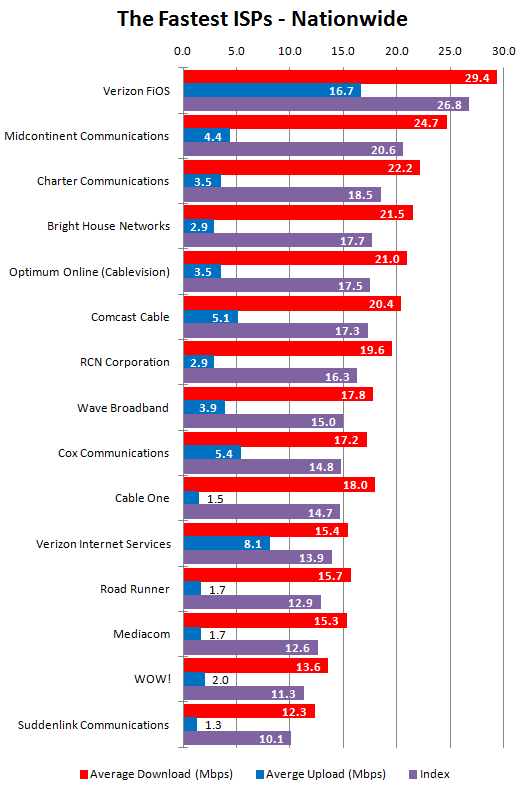
PC Magazine has declared fiber to the home service America’s fastest broadband technology, and among larger providers, Verizon’s FiOS once again took top honors for delivering the fastest and most consistent broadband speeds.

Over the past nine months, the magazine’s readers have been conducting regular speed tests using their personal broadband connections. The magazine found fiber optics remains the best current technology for delivering cutting-edge broadband service, with an average speed rating for FiOS reaching 29.4/16.7Mbps. Since PC Magazine readers were subscribed to various speed tiers while conducting the tests, the magazine’s ratings do not measure the fastest possible speeds on offer from different providers. Verizon’s most-popular service bundle includes 15/5Mbps service, heavily weighting Verizon’s speed rating which is capable of even faster speeds with their 50-300Mbps premium service tiers. But on average, consistently fast speeds kept them in the top spot.

Cable broadband technology was the second-best choice, depending on how cable operators implement it. Cable companies depend on a singl, shared broadband pipeline in each neighborhood. DOCSIS 3 upgrades allow a cable operator to vastly expand that pipeline by “bonding” several channels together to increase the maximum bandwidth. Cable operators that combine the latest technology with the smallest number of customers sharing a connection do the best.

Midcontinent Communications (better known by customers as Midco), achieved first place nationwide. The company, which serves customers in Minnesota, the Dakotas, and Wisconsin, took top honors with an average speed of 24.7/4.4Mbps — the best of any cable operator.

Ratings sometimes show the level of investment made by cable operators in their network. A sudden boost in average speeds is a sure sign a cable operator is rolling out network upgrades. A speed decline can expose a cable company trying to oversell an already constrained network. Charter Cable, which has routinely gotten poor ratings in Consumer Reports’ rankings, showed dramatic improvement in PC Magazine’s ratings, achieving third place with an average speed increase from 15Mbps to 18.5Mbps. But while the added speed is nice, the company’s usage caps are not. Conversely, WOW!, which achieved top scores in Consumer Reports’ ratings, scored towards the bottom of PC Magazine’s tests.

Comcast, which last year trumpeted its high rankings in controversial ads claiming to deliver the fastest broadband in the nation has now been overrun by both Midco and Charter. Comcast Xfinity is now in sixth place, hardly the fodder for any future ad campaign.

Cox Cable actually lost ground since last year, with average speed now down to 14.8Mbps. The bottom four: Time Warner Cable, Mediacom, WOW!, and Suddenlink — are all hampered by slow upload speeds and more anemic “take-rates” on higher speed broadband plans with the speeds on offer. With fewer premium speed customers, average speed ratings take a hit from the larger proportion of customers sticking with standard service.

Phone companies barely appeared in the magazine’s top ratings. AT&T’s U-verse could not even make the top-15. While 25Mbps was adequate when U-verse was first deployed, the broadband speed race has quickly overshadowed the company’s fiber to the neighborhood service, which still relies on home phone lines and antiquated copper infrastructure in the immediate neighborhood.

Phone companies still offering traditional ADSL on almost all-copper networks turned in even more dismal results — most too low to rate. Only Frontier’s adopted FiOS network kept them in the rankings in the overall broadband “slow zone” in the Pacific Northwest, along with CenturyLink’s acquired ADSL2+ and bonded DSL networks built by Qwest.

ISPs that perform poorly typically criticize the methodology of voluntary speed tests as the basis for speed and performance ranking. Most criticize the apparent lack of consistency, random sampling, the possibility rankings may be weighted in certain geographic areas, and may mix a disproportionate number of customers with standard or premium level speeds to unfairly boost or diminish average speed rankings. But overall, PC Magazine’s rankings show some technologies superior to others. If a customer has a choice, finding a fiber to the home provider is likely to provide an improvement over what the cable company offers, but the differences between phone company DSL and cable broadband are even starker.

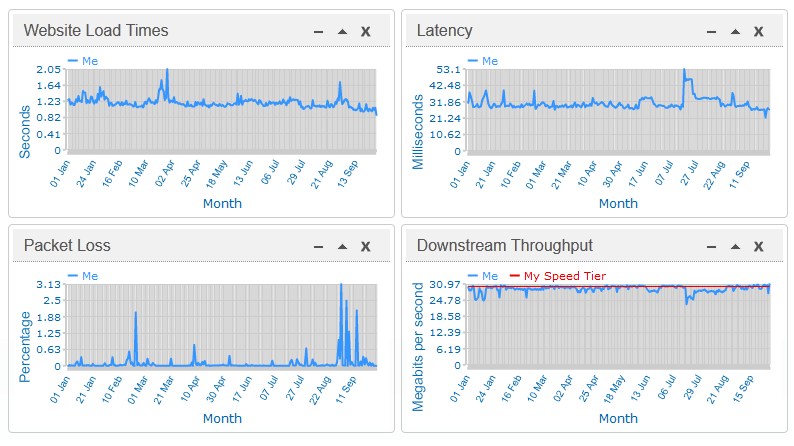
The FCC speed test program, conducted by SamKnows, takes more regular snapshots of broadband quality from volunteer panelists. Your editor’s home broadband connection from Time Warner Cable is profiled above, showing results from January-September 2012

Exploiting America’s Utilities for Fun and (Endless) Profits: The Big Telecom Swindle

Phillip Dampier September 25, 2012 AT&T, Broadband Speed, Competition, Consumer News, Editorial & Site News, Public Policy & Gov't, Rural Broadband, Verizon, Video, Wireless Broadband Comments Off on Exploiting America’s Utilities for Fun and (Endless) Profits: The Big Telecom Swindle

[flv width=”448″ height=”276″]http://www.phillipdampier.com/video/David Cay Johnston The Fine Print How Big Companies Use Plain English to Rob You Blind 9-19-12.mp4[/flv]

Fellow Brighton, N.Y. resident and Pulitzer Prize-winning journalist David Cay Johnston hits the nail right on the head describing the Big Telecom Swindle that promised America it was going to get something magical called “the information superhighway.”

Over a half-trillion dollars in rate increases later, AT&T and Verizon instead spent a lot of that money on an enormously profitable wireless business that redefines the average American family’s monthly phone bill at $100+. Johnston talks about the broken industry promises of ubiquitous broadband, leaving millions of potential FiOS and U-verse customers behind.

With vast lobbying arms, large cable and phone companies have manipulated public policy to assure they can gouge customers, shortchange workers, and erect barriers to fair play. If consumers don’t pay attention, politicians armed with fat campaign contributions will continue to represent corporate interests, not those of the average American.  

[Note to Mr. Johnston: He isn’t the only reporter paying attention. Hat tip to Stop the Cap! reader Pat McDermott who shared the video.]  (17 minutes)


Verizon Won’t Expand FiOS Beyond Current Franchise Obligations, CFO Tells Investors

Verizon has a moratorium on further expansion of its fiber to the home service except in areas where it has existing agreements to deliver service.

Verizon Communications will not expand their FiOS fiber optic network beyond the current obligations the company has with communities where it presently provides service.

Verizon chief financial officer Fran Shammo told investors the company intends to wind down FiOS expansion once its contractual commitments to state and local authorities are met to reap the financial rewards of the fiber optic network it began building in 2006.

“At this point we won’t build beyond that, because at this point we have to capitalize on what we have invested,” Shammo told an investor at the Goldman Sachs Communacopia Conference.

From 2014 beyond, Verizon plans to substantially decrease capital investments in its wired networks and continue to shift spending towards Verizon Wireless. Shareholders may also benefit from an increased dividend payout as the company’s balance sheet improves.

In real terms this means that Verizon will only expand FiOS where it previously signed agreements that allowed the company to gradually roll out its fiber optic network. Large sections of Verizon’s service areas, including major cities in the northeastern corridor, are not on the upgrade list and will not get the service.

Verizon’s experience and scale rolling out fiber to the home service over the past five years allowed the company to achieve a cost of  just $700 to reach each home, less than half the original estimated expense for fiber upgrades. But Verizon still considers the network too expensive to expand further.

Shammo also admitted Verizon is targeting its landline investments to bolster its more profitable wireless business.

“The fact of the matter is wireline capital — and I won’t give the number but it’s pretty substantial — is being spent on the wireline side of the house to support wireless growth,” Shammo said. “So the IP backbone, the data transmission, fiber to the cell, that is all on the wireline books but it’s all being built for the wireless company.”

Bruce Kushnick found no bump in construction expenses for FiOS after 2008 and no major increases in capital expenditures in general. In fact, Verizon, on average, spent more on construction from 2000 to 2004 than from 2005 to 2011, when FiOS construction was at its peak.

Bruce Kushnick from New Networks Institute has been tracking Verizon’s capital investments for the last decade and found Verizon was hardly hurting paying for FiOS network upgrades. In fact, Kushnick suspects much of the money to pay for FiOS came from a combination of ratepayer rate increases and diversion of investments intended to maintain Verizon’s existing landline network:

Whatever amount Verizon did spend on FiOS — and obviously it was a not insignificant amount — would therefore appear to have come out of the standard construction budgets that were supposed to be used to upgrade the lines that most Americans are still using for their phone service: the Public Switched Telephone Networks, or PSTN. It would seem that customers, including seniors, low income families, minorities and municipalities have been funding the construction of a cable service through the hefty monthly fees they pay for a dialtone and ancillary services. In some states this is actually illegal.

If Verizon did actually spend $23 billion, then it appears to have come at the expense of the traditional maintenance and upgrades of the utility plant — and the PSTN got totally hosed. At the very least, prices for basic phone service should have been in steep decline as one of the major costs, construction, was dramatically lowered.

Instead, Verizon was also getting rate increases specifically to pay for FiOS. For instance, Verizon persuaded New York officials to increase rates for “fiber optic investments,” where the only service that could use the fiber optic service was Verizon’s FiOS.

For instance, when New York State Department of Public Service Commission Chairman Garry Brown announced the approval of a $1.95 a month rate hike for residential phone lines in 2009, he said “there are certain increases in Verizon’s costs that have to be recognized.” He explained: “This is especially important given the magnitude of the company’s capital investment program, including its massive deployment of fiber optics in New York. We encourage Verizon to make appropriate investments in New York, and these minor rate increases will allow those investments to continue.”

Of course the states weren’t told that everyone would be charged extra for a service that only some people were going to get. In New Jersey, for instance, Verizon made a firm commitment to rewire the entire state with fiber optics — capable of 45 Mbps in both directions. It was supposed to be 100 percent completed by 2010. Instead, Verizon claims to have “passed” 1.9 million homes, representing 57 percent of the households in its territories — but “passed” may or may not mean that they can actually get service.

With Shammo reporting FiOS investments winding down by 2014, Verizon is not increasing the budget to maintain the copper infrastructure it will require non-FiOS customers to keep using for service. Instead, capital investments will continue to be spent supporting Verizon Wireless, although in lower amounts.

“So if you look at overall, I continue to say [investments] will be flat to down and I think we will be probably more slightly down than flat, and [CEO] Lowell [McAdam] and I are really starting to focus in on where we spend that investment and make sure that that investment returns on a shorter period of time,” Shammo said. “And that is really the focus. So what I like to say is that our ratio of CapEx to revenue will continue to decline.”

N.J. State Commission report from June 2010 saw this coming two years earlier and noted:

“While it is possible for Verizon to extend service throughout its authorized territory, to an additional 155 municipalities in the state that are not included in its current application of 369 towns, Verizon has indicated it will now concentrate its capital expenditures, expected to be between $16.8 billion and $17.2 billion in 2010 on its wireless telephone network. Further FiOS expansion will be limited to increasing penetration in those communities where FiOS is currently available, according to the company.”

Verizon Accelerates Copper Landline Decommissioning; Ready or Not, Customers Moved to FiOS

Phillip Dampier September 25, 2012 Consumer News, Verizon 8 Comments

FiOS=Fiber Optic Service

Verizon Communications is quietly moving a growing number of their copper-based landline customers to the company’s fiber optic network FiOS, whether customers want the service or not.

Fran Shammo, Verizon’s chief financial officer, told investors at last week’s Goldman Sachs Communacopia Conference Verizon was done repairing chronic copper landline problems in areas also served by FiOS.

Shammo noted Verizon was accelerating the pace of its shift to FiOS in areas where the network already exists, noting it now costs Verizon less money to install fiber than maintain its older infrastructure. As many as 15,000 customers were quietly switched to fiber service during the first quarter of this year, with at least 200,000 planned to be moved by the end of 2012.

Verizon has no immediate plans to switch copper landline customers with no service problems, but once the company gets two service calls during a six month window, Verizon will switch them to FiOS phone service free of charge.

That is precisely what happened when Jan Walkley began experiencing problems with her Verizon landline after Hurricane Irene tore through her Long Island neighborhood in the late summer of 2011.

“We had crackling episodes on the phone every time it rained hard, but by the time the Verizon repairman showed up, the problem was gone,” Walkley told Stop the Cap! “On the third visit, the repair guy joked I had ‘struck out’ with my old phone line and they wanted to upgrade me to FiOS for free.”

Complain too often about your landline and Verizon may show up and install FiOS for free.

“Getting off of that copper onto FiOS significantly reduces our operating costs,” Shammo explained to investors.

Shammo also disclosed Verizon has reduced the cost of installing fiber to the home down to a record low of $700 per household, which in some cases is now cheaper than sending repair crews to repeatedly fix aging copper infrastructure.

Walkley had contemplated FiOS when Cablevision last increased her rates, but she was unhappy with the installation fees Verizon charged for its fiber optic network.

“The promotional offers looked good, but the fine print said while installation was free, installing various outlets and setting up my home computer was not,” Walkley said. “Because of my landline problems, Verizon is giving me free installation for everything, including TV and Internet service if I want it.”

That is part of Verizon’s grand plan, according to Shammo.

“This will really start to benefit us two ways, quite honestly,” Shammo said. “One is what we are seeing is as customers convert to FiOS, […] once we connect them up to the Internet, they see the speed, they are buying up the bundle. So we are seeing accretion from these customers that we are migrating.”

Walkley is not sure what “accretion” means, but she knows a good deal when she sees it.

“It seems to me anyone who wants to avoid Verizon’s FiOS install fees should simply make sure to call them whenever their phone line has a problem and Verizon may consider you enough of a nuisance to cut your FIOS installation fees to zero just to get you off the phone,” Walkley said.

Search This Site:

Contributions:

Recent Comments:

Your Account:

Stop the Cap!