Home » fios fiber » Recent Articles:

Size Queens: Verizon Puts FiOS Boxes on 20-Foot Poles in Brooklyn; Neighbors Don’t Like Them

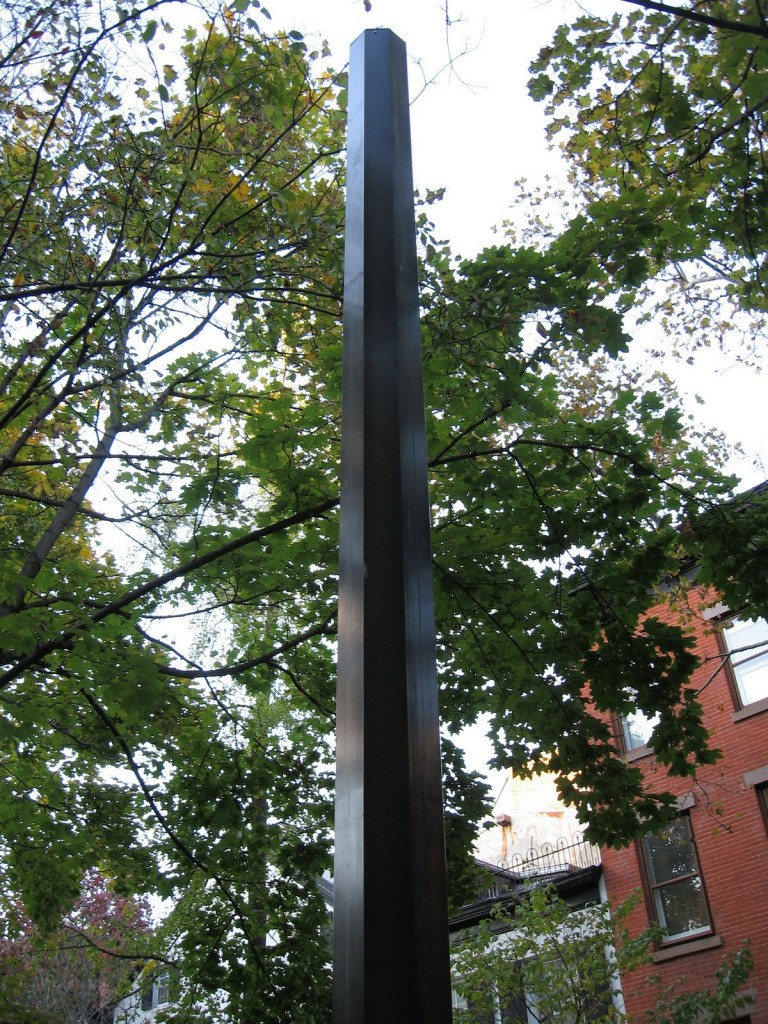
Verizon's 20' Monolith (Courtesy: Macro/micro Brooklyn)

Verizon Communications has found a way to outdo AT&T’s enormous and unsightly “lawn refrigerators.”  They have installed 20 foot fiberglass poles in the middle of historic neighborhoods in Flatbush, Brooklyn on top of which the phone company plans to mount boxes containing equipment to support its FiOS fiber to the home service.

The enormous polygonal poles went up suddenly without advance warning, and neighbors left their homes to gaze up at the mysterious new addition to the Victorian-era community.

“The neighbors started gathering around it like it was the monolith in ‘2001,’ ” Rev. Jeanne Person, told the New York Times.

Nobody seemed to know who installed the poles, or more importantly why.

It turns out they are Verizon’s answer to AT&T’s enormous and unsightly 4-6 foot tall metal cabinets that the latter has been installing on street corners and in front of homes throughout U-verse service areas.

John J. Bonomo, Verizon’s director of media relations, told the Times the poles provide an interface between underground cables and above-ground wires that thread through backyards.  Bonomo recognized the way AT&T does it attracts vandals and graffiti.  Verizon’s solution tries to hide the unsightly boxes in the canopy of neighborhood trees, to varying degrees of success.  It also prevents anyone other than Spiderman from stealing equipment inside.

Besides, Bonomo says, the company got all of the necessary permits from the Department of Transportation.  Well, almost all of the necessary permits.

They forgot the Landmarks Preservation Commission, which regulates the look and feel of protected, historic neighborhoods — like Flatbush.  Install 20-foot plastic poles without a permit at your peril.

A spokesperson for the Commission says they hope to reach a resolution with Verizon soon.

It’s not that neighbors are ungrateful that Verizon is extending FiOS into Brooklyn, where it will provide real competition to Cablevision.  Many applaud the fiber service and look forward to signing up.  They just don’t believe randomly placed 20′ poles are the way to do it.

“First we wanted to know what it was,” Rev. Person said. “Then when we figured out what it was, we wanted to get rid of it. What does landmarking mean if it doesn’t protect us?”

[flv width=”640″ height=”380″]http://www.phillipdampier.com/video/WCBS NY Verizon 20 Pole 6-7-11.mp4[/flv]

Brooklyn residents complained to WCBS-TV about the 20 foot unwelcome additions to their neighborhoods.  (2 minutes)

Nice Try: Media Sells Rural Massachusetts Residents on Fiber Broadband They Won’t Get

For the past two years, we’ve watched a lot of expansive fiber broadband projects get promoted by local media as broadband nirvana for individual homes and businesses that are either stuck with molasses-slow DSL or no broadband at all. Now, we’ve found another, sold by Springfield, Mass. media as salvation from Verizon’s ‘Don’t Care’ DSL for western Massachusetts.  But will the 1,300 miles of fiber actually reach the homes that need a broadband boost?

[flv width=”640″ height=”380″]http://www.phillipdampier.com/video/WSHM Springfield Broadband in Berkshires 7-26-11.mp4[/flv]

WSHM-TV in Springfield covered the start of MassBroadband 123’s fiber optic project as the solution to rural broadband woes in western Massachusetts.  But most residents won’t actually get to use the new network, at least initially.  (2 minutes)

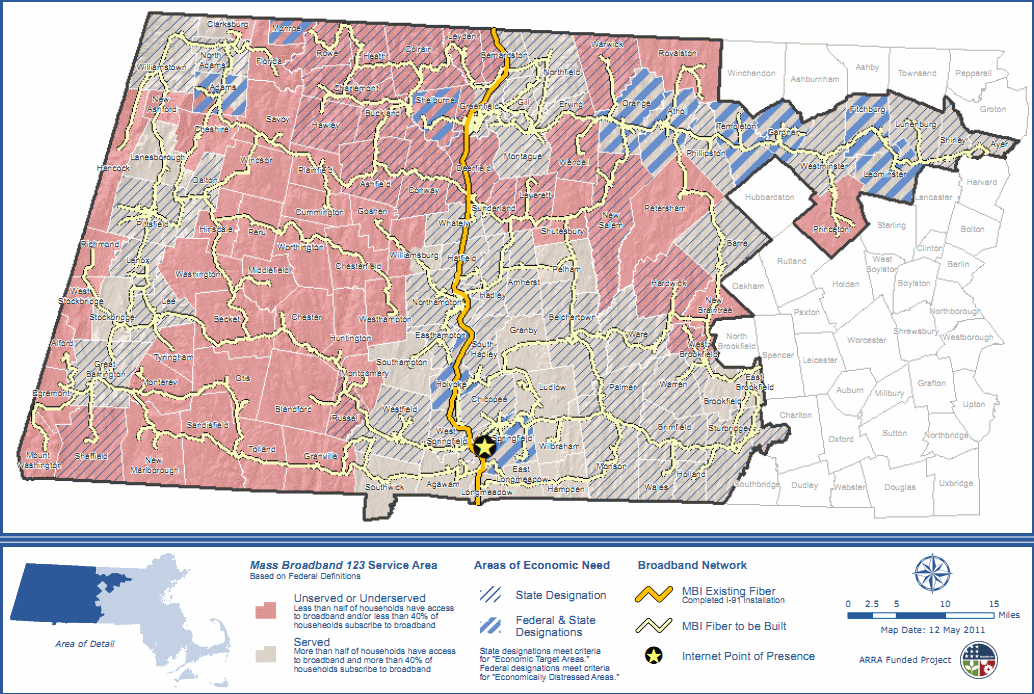
Last month, Gov. Duval Patrick joined public officials and firefighters at the Sandisfield Fire Department to kick-off construction of the MassBroadband 123 fiber-optic network project to expand broadband access to more than 120 communities in western and north central Massachusetts.
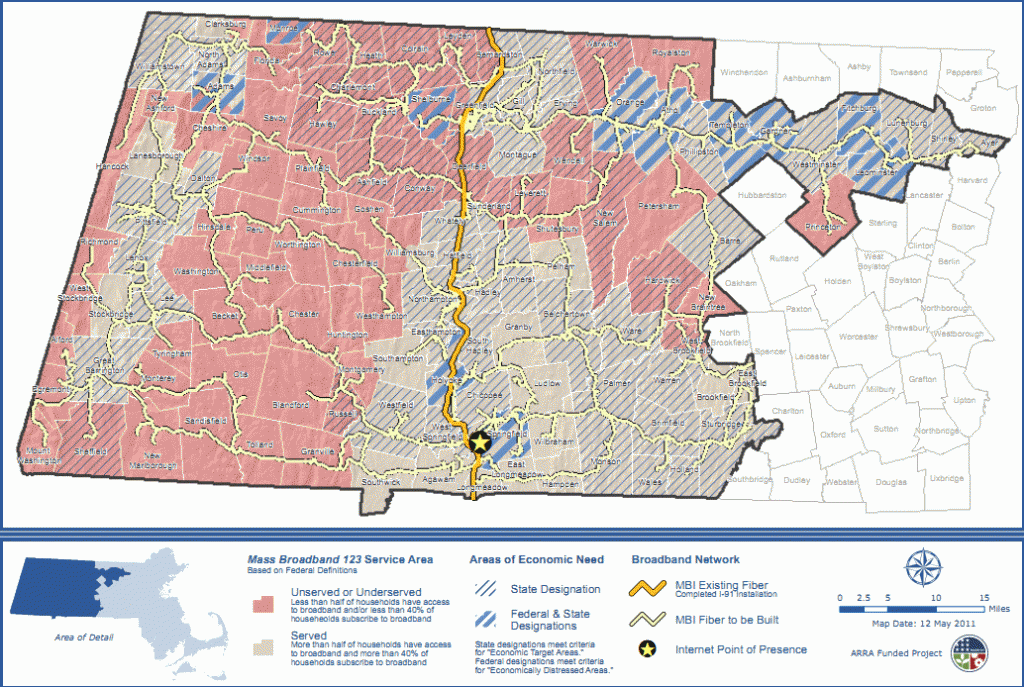
MassBroadband 123 Service Area (click to enlarge)

“For too long, families and businesses in western Massachusetts have lived without reliable and affordable high-speed Internet access,” said Governor Patrick. “Today, as we commence the installation of more than 1,000 miles of fiber-optic cable across the region, we start the critical final step in delivering broadband access to everyone. The digital divide in Massachusetts is about to close.”

Don’t hold your breath.

Don’t get me wrong.  The Massachusetts Broadband Institute means well.  Judith Dumont, the group’s director, is well-aware of the challenges rural Massachusetts has getting 21st century broadband.  She’s helping to oversee the construction of an enormous middle-mile, fiber backbone network that will eventually reach those ten dozen communities.  But much of the funding for the project precludes the possibility of directly wiring that fiber to the people who actually need it.  The incumbent providers’ lobbyists have seen to that, broadly warning it would represent ISP Socialism to allow government money to deliver service to homes and businesses — customers they themselves claim to be committed to serve.  But ask any resident in Sandisfield how well they manage that.

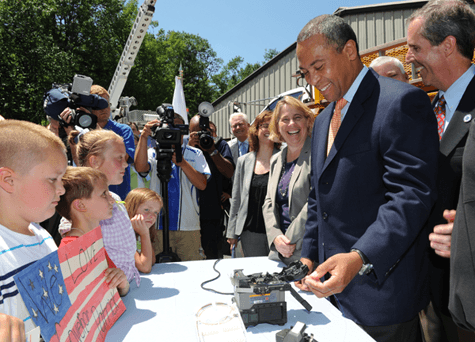
Gov. Patrick splices fiber cable at inauguration ceremony for fiber expansion project. (Courtesy: MBI)

A good part of upgraded broadband on the way in the Berkshires will be provided to government institutions like local government, public safety, schools, and libraries.  There is nothing wrong with that either, but when local media blurs this distinction into belief fiber-fast Internet access is on the way to Mr. & Mrs. Jones living on Maple Street, they do a real disservice to the cause for better broadband.

Dumont optimistically believes that opening the state’s fiber network to incumbent providers on a wholesale basis will dramatically help the pervasive problem of reaching rural customers.  Unfortunately, this has simply not been our observed experience watching these projects develop.  The “last mile” problem doesn’t get solved with the existence of a middle mile network, because providers are rarely willing to invest in the construction costs to wire the unwired.  Political and business matters too often get in the way.

Cable companies frequently boycott participation in these networks, and phone companies like Verizon Wireless -may- utilize them for backhaul connectivity to their cell towers, but don’t expect to see lightning-fast Verizon FiOS fiber to the home service springing up anytime soon in western Massachusetts, even if fiber connectivity is provided just a mile or so up the street.  If they didn’t build it themselves, many providers just are not interested.

“Last mile” is often the most expensive component in a broadband network.  It’s the part of the project that requires digging up streets and yards, stringing cables across phone poles, and literally wiring the inside and outside of individual homes and businesses.  Verizon FiOS works in densely populated areas where large numbers of potential customers are likely to deliver a quick return on investment in the network.  But Wall Street has always disagreed, declaring the capital costs too high to make sense.  AT&T won’t even match Verizon’s commitment, relying instead on fiber-to-the-neighborhood networks that deliver access over a more modern type of DSL, delivered on fiber to copper wire phone lines already in place.  That’s their way of not spending money rebuilding their own last mile network.

Wireless ISPs are expected to take advantage of the state's new middle-mile network.

If any part of the broadband network in rural America needed subsidies, the “last mile” is it.  But Washington routinely delivers the bulk of federal assistance to the construction of middle mile networks and institutional broadband that doesn’t deliver a single connection to a homeowner or business.  That suits incumbent providers just fine, judging from their lack of interest in applying for broadband subsidy funding made available two years ago and their hard lobbying against community broadband networks, or anything else smacking of “competition.”

Thus far, the limited grants that are available for “last mile” projects require substantial matching funds and are often limited to $50,000 — a ridiculously low amount to solve the “last mile” challenge.  Those trying are primarily fixed wireless providers valiantly attempting to serve the areas DSL and cable forgot, but deliver woefully slow speeds at incredibly high prices.  WiSpring, one such Wireless ISP, wants to expand coverage with the help of the new fiber network.  But their top advertised wireless speed for residential customers is 1.5Mbps, and that will set you back $100 a month after a $500 installation charge.  Oh, and their customer agreement limits use to 25GB per month with a $10/GB overlimit fee.  That’s hardly the kind of broadband solution a multi-million dollar fiber network should bring to individual consumers.  It’s as frustrating as filling a pool, one cup of water at a time, with an eye-dropper.

Now imagine if a quarter of the state’s $40 million investment in broadband — $10 million, was spent physically wiring individual homes with fiber broadband.  Would that make a bigger splash in the lives of ordinary consumers than a middle mile network they cannot directly access?  Is construction of a state-of-the-art fiber network a good investment when many of the providers scheduled to use it are Wireless ISPs delivering bandwidth suitable for e-mail and basic web browsing only?

In West Virginia, we learned last month the state is swimming in middle mile stimulus grant money it can’t spend fast enough on behalf of institutions — many who either already have super fast service or can’t afford the Cadillac pricing that represents the ongoing service charges not paid for by grant funds.  Is this a good way to spend tax dollars?

Communities large and small need to think big when it comes to broadband.  Building a middle mile network does not by itself solve the access problem.  It’s a fine start, but absolutely requires a follow-up commitment to solve the last mile problem.  Here are our recommendations:

  1. Demand the federal government eliminate restrictions on the kinds of network projects that can built with stimulus funds, especially those that prohibit investment in last-mile networks;
  2. Don’t believe for a moment large cable and telephone companies will bring better broadband to consumers just because you have a middle mile network.  Historically, they have lobbied hard against last-mile projects they do not own or control, and fund conservative political groups to oppose your community’s right to develop and govern your own broadband future;
  3. If incumbent providers won’t provide the service your community needs, consider exploring the possibility of doing it yourself.  Just as MBI contracts the wholesale part of its service out to a third party to administer, nobody says the village clerk has to be a billing agent for a community broadband service that directly serves your residents;
  4. Involve local citizens in rallying for better broadband instead of sitting around and waiting for the local phone or cable company to provide it.  They won’t.  It’s a simple matter of economics for them – will they get a sufficient return on their investment within five years? If not, you are not getting improved broadband.  That works for them but doesn’t work for your community, and providers have made it clear most of the networks they intend to build are already built.  That leaves a lot of communities behind.
  5. While wireless may be an answer for the most rural or difficult-to-reach homes, it is not a realistic solution for 21st century broadband inside village or town limits.  Wireless networks often lack the capacity to sustain the growing demand for multimedia, high-bandwidth content that is becoming more important for today’s online experience.  When a provider limits usage to 25GB a month, that’s a big problem for any community that will soon find itself stuck in a broadband swamp while the rest of the country passes it by.
  6. The biggest financial challenges seem to come to those who think small about broadband projects.  Don’t rely on yesterday’s technologies for tomorrow’s networks.  Fiber-based broadband will deliver the best bang for the buck and is infinitely upgradable.  That’s why rural phone companies and cooperative telecom providers are constructing fiber networks themselves.

[flv width=”640″ height=”380″]http://www.phillipdampier.com/video/WGBY Springfield The State Were In Judith Dumont 7-11.mp4[/flv]

WGBY-TV in Springfield talked with Judith Dumont about western Massachusetts’ broadband future.  (19 minutes)

Frontier Fires Back at Comcast In Indiana – Comcast is Telling Stories About FiOS

Phillip Dampier June 30, 2011 Comcast/Xfinity, Competition, Frontier 2 Comments

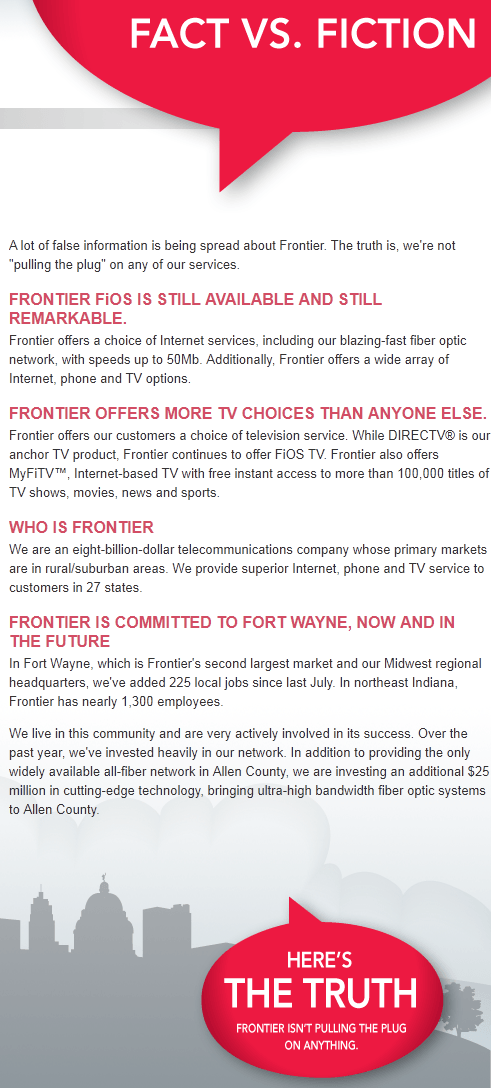
Frontier's Facts - Frontier's new website to counter Comcast's claims about FiOS. (click to enlarge)

Frontier Communications has fired back at Comcast after the Fort Wayne, Indiana cable company erected billboards telling residents Frontier was pulling the plug on its acquired FiOS fiber optic network.

On Wednesday, Frontier purchased a full-page ad in The Journal Gazette headlined, “Comcast Doesn’t Let the Facts Get in the Way of a Good Story! Here’s the Truth: Frontier Isn’t Pulling the Plug on Anything.”  It also launched a new website — Frontier Facts — telling customers it is not “pulling the plug” on any of its services.

Roscoe Spencer, Frontier’s local general manager, tells customers:

Recently, one of our competitors put up billboards, placed inserts in the newspapers and sent mailings to customers indicating we had pulled the plug on FiOS. This statement is simply not true, and we have taken legal action to insist that these false claims be stopped immediately.

Spencer

The spat began when Comcast began trying to recruit disaffected Frontier TV customers who found a massive rate increase notice in bills sent earlier this year.  Frontier blamed the rate increase on the loss of volume discounts former owner Verizon obtained for its FiOS TV service for television programming.  Frontier has sought to negotiate with programmers directly instead of working through a cooperative buying group, so the prices it pays for popular cable networks are much higher than what Comcast pays for a comparable video package.

Frontier watchers suggest the company is well aware its new video pricing is uncompetitive and customers will take their business elsewhere.  Frontier quickly began marketing DirecTV, a satellite provider, as a suitable replacement for those unhappy with the rate increase.  But Comcast also saw an opportunity to pick up new customers at the phone company’s expense, including through the use of billboards Frontier claims are misleading.

Frontier stresses its FiOS platform will continue to provide telephone, television, and broadband service, despite what Comcast’s billboards might suggest.

Despite the involvement of attorneys, Comcast has continued to thumb its nose at Frontier’s legal department.  Frontier spokesman Matt Kelley told the Journal Gazette Comcast was supposed to remove the billboards by Monday of this week, but they remain in place.

The cable company calls it a case of old fashioned competition.

Stop the Cap! reader Kevin calls Frontier’s marketing to get customers to drop FiOS TV for DirecTV a real blast from the past.

“It remains difficult for Frontier to sell people on its advanced fiber network when it is heavily marketing customers to get off of it and switch to DirecTV, a service that looked ultra-modern in the 1990s but today is just a rain-faded, pixellated nuisance,” Kevin says.  “Frontier blew it, Comcast took advantage of their strategic blunders, and now the whining has begun.”

Kevin is a former Verizon FiOS customer who was switched to Frontier when Verizon exited Fort Wayne.

“Verizon knew what they were doing, but eventually decided a few small cities in Indiana were not worth their time or interest, so they sold us off to Frontier, who ended up with a fiber network they’ve shown little interest in running except as an adopted curiosity,” Kevin adds.  “When we got notice of the rate increase, we canceled the TV service and now watch over the air television for free, supplemented with Netflix and Hulu.”

Kevin says Frontier ultimately did him a favor, discovering he was fine without a pay television package.

“Outside of breaking news and sports, you can get most everything else online.  Why pay more?”

Verizon Launches FiOS-TV in Albany, NY; Company Still Expanding Service in Existing Markets

Phillip Dampier March 28, 2011 Broadband Speed, Competition, Consumer News, Verizon, Video 3 Comments

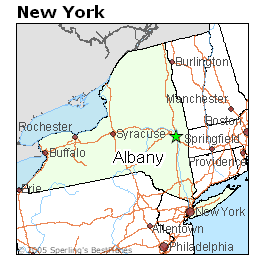
The 500 channel universe has arrived for around 23,000 households around the state capital as Verizon officially unveiled its FiOS television service last week.

The company added television to its broadband service offering after securing video franchise agreements in suburban Bethlehem, Colonie, Guilderland, and Scotia.  It also expects to win approval to provide television service to the nearby city of Schenectady and the town of Colonie shortly.

The arrival of Verizon’s triple-play package begins with a $100 monthly promotional package (go to Verizon’s FiOS website and the online price can be lower) including phone, Internet, and television service for a year, rivaling a similar $99 promotion on offer for new customers from incumbent Time Warner Cable. But Verizon delivers faster broadband service and more HD channels than its cable rival, and will deliver up to 535 channels to subscribers — 130 in High Definition.

“Consumers and small businesses in these communities at long last have a better choice for TV,” said Tracey Edwards, president and general manager for Verizon’s Upstate New York region. “We’ve had great success in many other parts of the state. Now it’s time to bring FiOS TV to this part of northeastern New York and provide customers in the region a choice that is truly different from the cable TV company.”

Verizon officials also claimed the introduction of FiOS TV would result in lower prices for local residents, a claim that does not necessarily hold up when examining the rates for each company.  Both deliver triple-play promotions and retention offers that come within a few dollars of each other.

Time Warner Cable says Verizon’s service does not come with the same local commitment to the region the cable operator has provided with its local news channel YNN, and features that allow customers to start programs over from the beginning or watch live streams of 32 channels on the company’s iPad application.

But the fact a new choice is now available has delighted some of our readers.

Jeff in Guilderland says a number of Albany residents were upset when Time Warner Cable unveiled its $99 promotion which turned out not to be available to existing customers.

“They only give the best prices to their least loyal customers who are ready to cancel their service or sign up as new customers,” Jeff says.  “We’ve had cable from these guys for over a decade and when we sought a temporary price break, they wanted to give us a $20 credit — thanks for nothing.”

Now Jeff says with Verizon around, Time Warner better offer more than that.

Verizon put expansion of its Verizon FiOS fiber-to-the-home service on hold more than a year ago, stopping new cities from winning new options made possible with fiber optics.  But Verizon is still continuing to meet its commitments to communities where the network has already broken ground.  Where communities have not given Verizon video franchise agreements, Verizon markets its broadband and phone options.  But delivering video completes the triple play package many consumers want.

[flv width=”640″ height=”500″]http://www.phillipdampier.com/video/Albany Gets FiOS TV 3-26-11.flv[/flv]

WNYT and WXXA-TV reports some Albany-area residents can now get FiOS TV, showing Verizon is still expanding its FiOS product line in areas where fiber has already been laid.  (3 minutes)

Verizon Does the Right Thing and Will Not Cap Its DSL or FiOS Customers

Verizon delivers fiber-to-the-home service over its FiOS network.

Verizon Communications says it will not run an Internet Overcharging scheme on its wired broadband customers.

The company that knows about investment and upgrading their networks like few others — bringing true, fiber-to-the-home FiOS service to customers across several states — says it has no need to impose usage caps or metered billing on its wired broadband customers.

“This is something we have looked at in the past, and we’ll continue to evaluate what’s best to ensure our customers get the best broadband service for the best value,” Verizon spokesman Bill Kula told Broadband Reports. “We have no plans to implement usage-based pricing for our fixed broadband customers,” Kula says.

Verizon’s announcement provides additional ammunition against AT&T’s unjustified 150-250GB usage caps over claims it faces congestion issues.

The company doesn’t share AT&T’s “congestion problem,” probably for two reasons:

  1. Because it does not exist.
  2. Verizon has upgraded their network to keep up with demand, winning new customers with their top-rated FiOS fiber to the home network.

Karl Bode sees right through AT&T’s arguments:

If you believe AT&T’s claim that the new pricing is about congestion and not about protecting U-Verse revenues from a Internet video — and many don’t — Verizon’s decision to spend $24 billion on upgrading more than half of their network to fiber to the home would make a Verizon decision to follow suit a very tough sell. AT&T has previously stated their last-mile customers see little to no congestion, and Verizon’s seeing even less.

Kula notes Verizon doesn’t oppose the use of usage caps, but their TOS allows them to handle any users they deem particularly gluttonous, and even then — Verizon makes it clear to us they’ve never disconnected one of these users. “Verizon terms of service were written in a way to allow us to terminate users if they violate our acceptable use policy, and excessive use ‘could’ constitute a violation,” says Kula. “However, we’ve not disconnected any consumer, small business or mass market customers to date.”

Stop the Cap! has never objected to terms and conditions which provide an escape clause for a provider that encounters a customer creating significant problems on its network, such as e-mail spamming, illegal activity, or causing serious problems for other users.  These terms and conditions are a part of every Acceptable Use Policy, and responsible providers don’t activate those provisions on a whim.

It’s too bad some AT&T customers can’t choose an alternative to a company who promised great things with U-verse, and then put unjustified limits on customer enjoyment.

Search This Site:

Contributions:

Recent Comments:

Your Account:

Stop the Cap!