


Home » fiber optic network » Recent Articles:

AT&T Celebrates 10,000,000th U-verse Customer With a Rate Hike

Phillip Dampier November 26, 2013 AT&T, Broadband Speed, Competition, Consumer News, Video, Wireless Broadband Comments Off on AT&T Celebrates 10,000,000th U-verse Customer With a Rate Hike

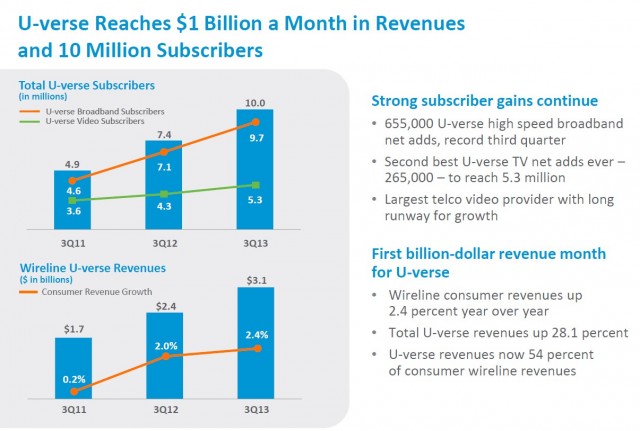
yay attAT&T this month signed up their 10 millionth customer to U-verse High Speed Internet service, surpassing Verizon FiOS as the nation’s biggest telephone company supplier of broadband, television, and telephone service. Coinciding with that success, AT&T is raising prices for U-verse, despite AT&T’s record earnings from the fiber to the neighborhood service, now accounting for $1 billion a month in revenue.

AT&T is protecting its broadband flank by convincing current DSL customers to switch to higher-speed U-verse broadband as the network upgrade reaches into more homes across AT&T’s service areas. In the last quarter U-verse picked up 655,000 new broadband customers nationwide, many upgraded from traditional DSL. Where AT&T has not invested in U-verse upgrades and cable competition exists, results are not as good. AT&T lost 26,000 DSL customers last quarter, most moving to cable broadband.

“This latest milestone shows how U-verse is helping transform AT&T into a premier IP broadband company,” said Lori Lee, senior executive vice president, AT&T Home Solutions. As of the third quarter of this year, total U-verse high-speed Internet subscribers represented about 60 percent of all wireline broadband subscribers, compared with 43 percent in the year-earlier quarter.

Verizon FiOS, in comparison, has signed up just 5.9 million customers FiOS Internet subscribers on its stalled fiber optic network. Most Verizon broadband customers with no FiOS in their future either stick with DSL service or, increasingly, switch to a cable competitor for faster speeds.

Some of AT&T’s strongest U-verse growth came from its TV package. At least 265,000 cable and satellite cord-cutters looking for a better deal switched to U-verse TV in the last three months, a gain from 198,000 at the same time last year. That’s the second-best quarterly gain ever. A total of 5.3 million AT&T customers subscribe to U-verse TV.
project vip

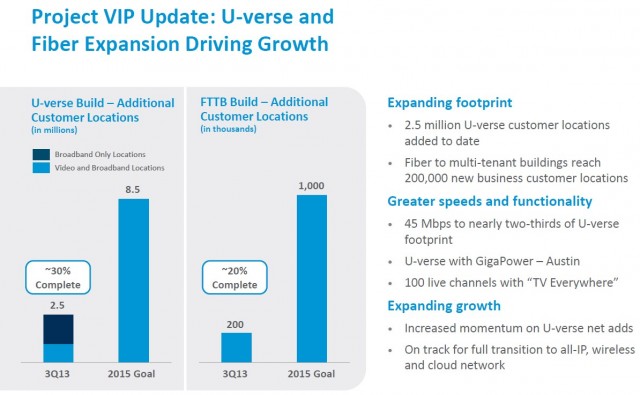
Much of the growth has come from AT&T’s investment in expanding U-verse to new areas. Project Velocity IP is a three-year, $14 billion plan to upgrade AT&T’s wireless and wired broadband networks. AT&T has added almost 2.5 million more homes to its broadband footprint so far this year and hopes to expand broadband availability to reach about 57 million customers by the end of 2015.

Although $14 billion is a significant investment, AT&T has spent considerably more on its shareholders. John Stephens, AT&T’s chief financial officer told Wall Street analysts AT&T has bought back 684 million shares of stock that will save the company more than $1.2 billion in future dividend payouts.  Combined with its dividend payout, AT&T has handed shareholders $18 billion so far this year and more than $40 billion since the beginning of 2012. AT&T expects to spend $20 billion on wireless and wireline network improvements in 2014.

AT&T’s speed upgrades have also not run as smoothly as AT&T claims. Efforts to increase speeds to 45Mbps in 79 markets has had mixed results with a significant number of customers complaining they cannot get qualified for the faster speeds because of infrastructure problems with AT&T’s network. The company still says it is on track to offer 75 and 100Mbps speed tiers in the future and is building a fiber to the home network in Austin to compete with Google.
u-verse revenue

Many customers who have been with AT&T for more than a year are learning better service does not come for free. AT&T has filed rate increases for its television service beginning Jan. 26, 2014 for customers not on a pricing promotion. The monthly price for the following U-verse TV service plans will increase $3, along with fee hikes for local stations and equipment, bringing AT&T at least $15 million in extra revenue each month:

Top secret.

  • U-family to $62;
  • U200 to $77;
  • U200 Latino to $87;
  • U300 to $92;
  • U300 Latino to $102;
  • U450 to $124;
  • and U450 Latino to $134.
  • Grandfathered plans also will increase $3: U100 to $64 or $69, depending on when first ordered; and U400 to $119.
  • The monthly price of each non-DVR TV receiver will increase from $7 to $;
  • Beginning on February 1, 2014, the Broadcast TV Surcharge will increase $1 to $2.99 per month to recover a portion of the amount local broadcasters charge AT&T to carry their channels.

Those customers who have a U-verse TV pricing promotion will continue to receive the promotional benefit until the applicable promotion ends or expires.  Customers are being notified of these changes via bill messaging occurring in November and December and a reminder in January and February 2014.  In addition, customers will be notified of these changes online at www.att.net/uversepricechange and att.com/uversesupport.

[flv]http://www.phillipdampier.com/video/ATT U-verse with GigaPower — Reactions 11-13.mp4[/flv]

AT&T is trying to get ahead of Google by advertising AT&T U-verse with GigaPower, a 1,000Mbps fiber to the home service promised in Austin sometime in the future. (0:30)
BBC: The Great American Broadband Ripoff; Customers Pay 3x More than Europe, 5x More than Korea

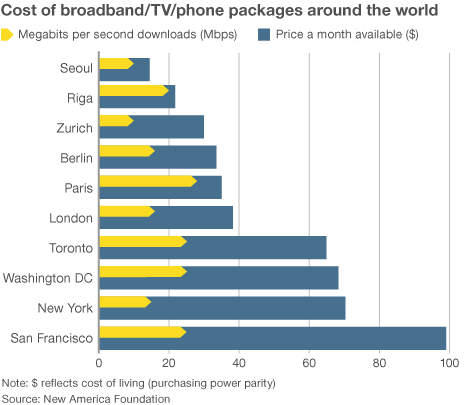
cost_broadband_around_the_worldBroadband in the United States costs far more than in other countries — nearly three times as much as in the UK and France, and at least five times more than South Korea, according to BBC News.
The New America Foundation compared hundreds of available packages around the world and found customers in America’s largest cities are getting the biggest bills.

Customers in San Francisco with a discounted low-medium speed bundle including broadband pay $99 a month. A near-equivalent package costs London residents $38. New Yorkers get some savings from Time Warner and Cablevision facing down Verizon FiOS. But it isn’t enough. In the Big Apple, a promotional bundle averages $70 a month. “C’est la vie,” say Parisians. They only pay $35 for about the same. Even Washington, D.C. residents, which include the country’s most powerful politicians, pay Comcast its $68 asking price. In Seoul, South Korea, a comparable offer costs $15 a month.

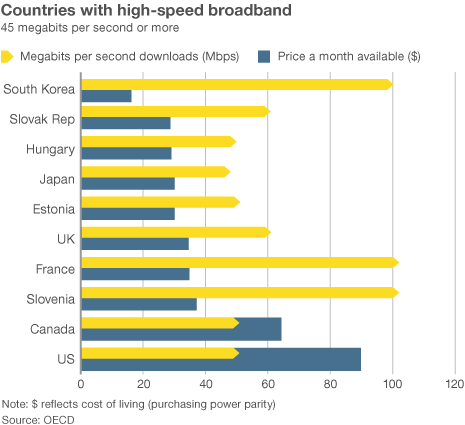
High asking prices don’t buy better service. According to a report by the OECD issued over the summer, the United States ranks among the worst in terms of broadband-only pricing. With an average price of $90 a month for 45Mbps service, the U.S. ranked 30th out of 33 countries. Add phone and television service and the price spikes to around $200.

The BBC pondered why there is such a disparity in pricing. The answer was easy to spot: the lack of true competition.

countries_with_high_speed_broadband“Americans pay so much because they don’t have a choice,” said Susan Crawford, a former special assistant to President Barack Obama on science, technology and innovation policy. “We deregulated high-speed Internet access 10 years ago and since then we’ve seen enormous consolidation and monopolies, so left to their own devices, companies that supply Internet access will charge high prices, because they face neither competition nor oversight.”


Although Americans can name the largest and deep pocketed providers — Comcast, AT&T, Time Warner Cable, Verizon, Cablevision, CenturyLink, Cox, and Frontier — most cannot choose from more than one cable provider and one telephone company. Comcast does not compete against Time Warner and AT&T does not compete against Verizon, except in the wireless world where both companies offer near-identical plans and pricing.

Comcast is quite the gouger in San Francisco.

Bay area customers told the BBC they get bills ranging from $120 a month for television and broadband (not including a $7 modem rental fee) to $200 a month for phone, TV, and Internet access. That same cable company is now testing a 300GB monthly usage cap on broadband in several American cities.

In contrast South Korea offers ubiquitous free Wi-Fi letting customers avoid usage charges. Home broadband is fast and cheap. Most pay $20 a month for 100Mbps.

Digging deeper, the BBC found clues why robust broadband competition delivers savings for consumers in Europe and Asia while Americans pay more.

Rick Karr, who made a PBS documentary in the UK comparing broadband costs at home and abroad, said the critical moment came when the British regulator Ofcom forced British Telecom to open its network and allow other companies to sell broadband over its copper telephone wires. In the United States, regulators never forced cable operators to open their networks, and after a 6-3 Supreme Court decision upheld the cable industry’s insistence it need not share access with competitors, telephone companies quickly called for parity.

Unlike in the UK, where broadband providers can compete using BT's network to reach customers, a Supreme Court decision upheld the cable industry's right to keep competitors off its cable broadband network.

A 2005 Supreme Court decision upheld the cable industry’s right to keep competitors off its cable broadband network.

Some argue the ruling promotes more competition by provoking competitors to build their own networks. But current conventional wisdom among the investment community teaches one cable and one phone company is considered good enough. Additional providers would erode the standing of all and force price cutting to compete.

There are exceptions. Although Google’s fiber to the home service has drawn national attention for its inexpensive gigabit fiber broadband network ($70 for broadband-only service), at least 150 cities are served by the public sector — co-op or publicly owned utility companies that offer broadband, often delivered over fiber optic networks.

Those networks often charge considerably less than the incumbent cable operator or phone company, a fact that has driven many privately run operators to seek legislative bans on community broadband.

In response to the report, telecommunications companies avoided the topic of prices and focused instead on value for money and the future.

Lowell McAdam, CEO of Verizon Communications, said Europe was replete with a decade of underinvestment, leaving many with less than 30Mbps service. The National Cable and Telecommunications Association said it was difficult to make international comparisons on price and Scott Cleland, part of the industry-funded NetCompetition website claimed although people may pay higher bills, they can at least choose among phone, cable, wireless or satellite.

“We may be paying more in your eyes today but we are building for tomorrow and the long-term,” said Cleland.

Two Companies Compete With Gigabit Broadband Offers on Remote Isle of Jersey

Phillip Dampier October 24, 2013 Broadband Speed, Community Networks, Competition, Consumer News, Public Policy & Gov't, Rural Broadband, Video Comments Off on Two Companies Compete With Gigabit Broadband Offers on Remote Isle of Jersey

gigabit jerseyMore than 5,000 residents and businesses living on the island Bailiwick of Jersey now have a choice of two Internet Service Providers – both supplying gigabit fiber optic broadband.
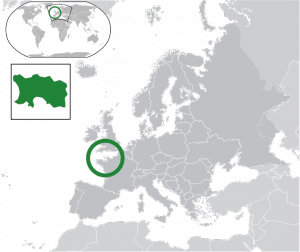
Jersey Telecom, a government-owned provider, has been removing obsolete copper wiring and replacing it with fiber to the home service that should reach the entire island by 2015. The fiber network is open to all competitors. JT charges £59.99 ($97.25) per month for gigabit speeds, but now caps usage at just 100GB a month. Overlimit fees are around 50c per GB between the hours of 8am-midnight. Usage is unlimited during off-peak hours.

In addition to JT, Jersey customers who live on the remote Channel Island, a British Crown Dependency off the coast of France, can now also choose Sure Jersey, a privately owned ISP that offers unlimited use plans.

The fiber optic network is spreading to other Channel Islands, with significantly populated parts of Guernsey set to receive a fiber upgrade next.

713px-Europe-Jersey.svgUsing traditional Return On Investment standards, Jersey would barely qualify for basic DSL service. The island has a population of just 100,000 residents, some spread far and wide in remote locations. Basic DSL service was supplied to customers in more densely populated communities, but speeds were often slow and congestion became a major problem, especially at night.

The local government determined Jersey’s broadband needs could best be met by upgrading to government-owned infrastructure that private businesses could lease to sell service. Much like public roads benefit private companies that use them to transport goods, JT’s fiber network is designed to help bolster the island’s digital economy.

Since the introduction of gigabit fiber, new digital startups have launched on the island and others have moved their digital businesses to the fiber-enabled island. FeelUnique, launched from Jersey, has now become Europe’s largest online beauty retailer, employing over 150. Other businesses on the island have launched software ventures for the health care and education markets, banking/investment products and services, and 3D printing ventures. Having a wide broadband pipe has helped anchor digital businesses to the island because moving elsewhere leaves many with little better than substandard DSL or an enormous price tag for a customized new fiber build.

[flv width=”640″ height=”380″]http://www.phillipdampier.com/video/JT Fiber Has Arrived 2013.mp4[/flv]

Residents of Jersey talk about how fiber broadband has changed their online experience. (2 minutes)

 [flv width=”640″ height=”380″]http://www.phillipdampier.com/video/Digital Jersey Limited – Vision 2014 from Digital Jersey.mp4[/flv]

Digital Jersey released this video showing the group’s vision on how to leverage gigabit fiber broadband to boost the island’s digital economy in 2014. (3 minutes)

Wireless is Verizon’s Cash Cow: $12.9 Billion in Operating Profits vs. Landlines/FiOS: $87 Million

moneyIf “follow the money” is a maxim in business, then it should come as no surprise Verizon favors the making the bulk of its investments and expansion in its enormously profitable wireless business.


Verizon Wireless earned the company $12.9 billion in operating profits during the first six months of 2013 while landlines and Verizon’s fiber optic network only delivered $87 million. That inconsistency may help explain why Verizon FiOS expansion is stalled while Verizon throws enormous sums into its 4G LTE wireless upgrade project.

The average Verizon Wireless bill is now over $150 a month. FiOS customers pay an average of over $150 a month as well, but Verizon’s costs to reach its smaller customer footprint are higher. Revenues for basic landline service are considerably lower than either wireless or fiber service.

With wireless providing a virtual ATM for Verizon Communications, the New York Times notes it is unsurprising that Verizon wants to buy out its European partner Vodafone, which owns 45% of Verizon Wireless. Once the $130 billion transaction is complete, Verizon will keep wireless profits all to itself as it continues lobbying for permission to decommission rural landlines and encourage those customers to use its vastly more profitable and almost entirely unregulated wireless network instead.

Exactly 100 years after Verizon predecessor AT&T/The Bell System voluntarily agreed to be a regulated monopoly provider of telephone service, Verizon Wireless and AT&T have successfully established unregulated wireless networks that serve most Americans with cell service and wireless data at prices that would be shocking to people 20 years ago.

Verizon Considers Offering FiOS TV On a Low-Fiber Diet; Use Your Existing Broadband Provider to Watch

Phillip Dampier September 12, 2013 Competition, Consumer News, Data Caps, Net Neutrality, Online Video, Public Policy & Gov't, Verizon Comments Off on Verizon Considers Offering FiOS TV On a Low-Fiber Diet; Use Your Existing Broadband Provider to Watch
Coming soon nationwide? Comcast, Time Warner, AT&T and CenturyLink sure hope not.

Coming soon nationwide? Comcast, Time Warner, AT&T and CenturyLink sure hope not.

Verizon is talking to major cable programmers about launching a nationwide version of FiOS TV as an over-the-top video service that works with your existing broadband provider.

The NY Post reports Verizon is looking at launching an online pay television service for customers without installing additional fiber optic lines to deliver it.

The service would likely be an extension of the “TV Everywhere” online video platforms that many national cable and telco-TV providers already offer existing cable TV subscribers. What would make Verizon’s offer radically different is selling the virtual cable TV service in areas where it does not offer FiOS service.

Verizon must carefully negotiate with programmers to distribute networks over an online video service that would likely compete directly with those programmers’ best customers: cable operators and telco IPTV services like U-verse and Prism TV.

The concept was rejected out of hand Wednesday by Time Warner Cable chief operating officer Rob Marcus, who agreed with Comcast executive vice president Steve Burke’s contention that “over the top” video services that offer virtual cable television outside of their respective service areas lacked a compelling business model and would be difficult to monetize.

“At this point we don’t really aspire to delivering an over-the-top service,” Marcus said. “Our value proposition is delivering video via our facilities as opposed to being a retailer of somebody else’s video, which is a somewhat commoditized product.”

Neither cable executive mentioned the fact cable operators have also maintained an informal “wink and nod” agreement to steer clear of head-on competition with each other for decades.

Verizon: The next big supporter of Net Neutrality?

Verizon: The next big supporter of Net Neutrality?

Verizon apparently wants to shake things up and sell online video without incurring the cost of expanding its fiber optic network FiOS to deliver it.

“They’ve had exploratory talks about how to become a virtual [multiple-system operator],” one person close to the conversations told the Post. “It’s a question of how to get there.”

Interestingly, Verizon CEO Lowell McAdam is worried about developing the service without Net Neutrality protection or some other form of government oversight of broadband. Verizon could spend millions to negotiate programming contracts only to find competitors with their own TV packages to protect outmaneuvering the venture. Without Net Neutrality, Verizon could find its service blocked by competitors or made untenable with the implementation of broadband usage caps or consumption billing that would make a subscription too costly to consider.

The company is now trying to figure out exactly which branch of government (or agency) controls broadband policy in the nation.

The FCC’s current Net Neutrality policy depends on a shaky regulatory framework now being challenged in federal court.

Verizon declined to comment.

Search This Site:

Contributions:

Recent Comments:

Your Account:

Stop the Cap!