Home » fiber optic network » Recent Articles:

Welcome to 2015; Another Year Fighting for a Square Deal for Essential Broadband Service

Phillip Dampier January 5, 2015 Editorial & Site News Comments Off on Welcome to 2015; Another Year Fighting for a Square Deal for Essential Broadband Service
Phillip Dampier

Phillip Dampier

Welcome to 2015!

This is the seventh year Stop the Cap! has fought for better broadband across North America and beyond. Whether your provider is Comcast, Time Warner Cable, Rogers, Bell, AT&T, Verizon or a (dwindling) number of other cable and telephone companies, there is plenty of room for improvement.

When we began in the summer of 2008, Frontier Communications was contemplating a usage cap of just 5GB a month on their broadband service. A year later Time Warner Cable market tested caps as high as 40GB a month. For almost as long as we’ve existed, Comcast has believed 250GB a month was all most customers ever needed. Rogers’ most popular Internet package today offers 60GB a month, despite the fact Canadians on average watch more online video than anyone else. AT&T thinks 150GB a month is fine for DSL and 250GB is all you’d need as a U-verse customer. Verizon doesn’t see a need for limits on either its DSL or fiber optic networks. Neither does Cablevision.

Usage caps and so-called “usage-based billing” continue to be one of the most under-reported stories in the tech press. Touted as “fair pricing,” these plans are in fact little more than profit-padding for a service that already earns companies as much as 90% gross margin. There is nothing fair about usage-based billing in North America. Customers face the same prices they have always paid for unlimited service, but now endure an arbitrary usage allowance that usually includes a stiff overlimit fee. Those providers charging usage pricing do not offer the fastest service, have not made significant improvements above and beyond other providers that still charge flat rate prices, and frequently also charge excessive modem rental fees.

The duopoly most Americans have for broadband service has become quite fat and happy collecting ever-increasing amounts of money for service that only seems to improve after an upstart competitor like Google arrives ready to offer better service at a lower price. Customers in Kansas City, Austin, and a handful of other communities are getting the best upgrades and are empowered to negotiate a lower price for service. The rest of the country is not so lucky. A handful of often-under capitalized fiber competitors have arrived in some areas, but their market share generally remains a fraction of what the cable and phone companies have locked up.

We have always believed broadband was destined to become the next must-have utility service, following clean water, electricity, gas and some form of telephone service. Unfortunately, Washington policymakers continue to treat Internet access as an optional extra, allowing one or two companies to dominate access in most communities. Policymakers and regulators have done very little to protect consumers from the effects of marketplace concentration, allowing cable and phone companies to merge and raise prices, remain uncommitted to protecting the Open Internet with strong Net Neutrality protections, and not taking the effects of usage caps seriously.

One of the most effective ways a community can combat bad service and high prices is to support launching its own public broadband network. Throughout the United States, local town and counties enduring “good enough for you” broadband (or no service at all) are constructing their own fiber optic networks to better meet the realities of the 21st century digital economy. They face industry-funded opposition in at least 20 states where lawmakers have banned or severely curtailed these networks to protect private telecom giants from the effects of serious competition.

In 2015, Stop the Cap! will continue to fight for consumers looking for a better deal:

  • We continue to oppose industry consolidation. Mergers and buyouts benefit executives and shareholders. They almost never benefit customers who soon find rate increases, fewer choices, and often worse service as a result. Connecticut residents know that first hand enduring Frontier Communications’ recent bungled transition from AT&T service. Customers that dislike Time Warner Cable will likely loathe Comcast if that merger wins regulator approval. AT&T’s buyout of DirecTV leaves one less competitive choice for customers living in AT&T’s service areas looking for an alternative to U-verse television. Imagine if the government had approved AT&T’s attempted buyout of T-Mobile, the one wireless carrier now willing to throw a monkey-wrench into the current dominance of almost-identical expensive wireless service plans from AT&T and Verizon.
  • Usage caps and consumption billing remain unjustified, particularly for wired broadband. Despite industry claims that usage caps and usage billing stimulate investment, in most cases the costs of delivering broadband service and the amounts companies invest in network upgrades continue their relentless decline on a per customer basis. Usage billing is no prescription for congestion problems either. Most congestion problems occur during peak usage levels — when light and heavy users alike are most likely to be online. A truly fair usage pricing scheme would charge a fair price for actual usage and nothing else. But such a pricing scheme would likely cut broadband bills and profits. So providers offer pre-determined compulsory usage allowances at current prices instead, and do not offer a flat rate option or rollover unused usage to a future month. As a result, customers often pay more for less service and constantly have to check their usage to make sure they do not get an unexpected surprise on their bill.
  • Strong Net Neutrality protection is the best guarantee of preserving the Internet as it exists today – where success or failure of an online venture is based on what it offers customers, not on the size of its bank account. A nationwide end to laws restricting the development and expansion of community broadband is also essential to give communities self-determination of their broadband future.
  • We will continue to educate consumers on how to negotiate a better deal with your provider and avoid expensive surcharges like modem rental fees. We will also continue to enlighten you about the pervasive influence of Big Telecom money on non-profits, state and federal governments, and researchers that support the various agendas of some of the largest telecom corporations in the country.

Broadband is improving at an incredible pace around the world, but back home prices continue to rise while Internet speed improvements are often met by usage cap road bumps. Internet affordability remains as much of a problem as rural broadband access. The more you know, the more effective you can argue for a change in telecom policies, where the public interest is better-balanced against corporate profits and duopoly prices.

Thank you for being a part of our efforts to make things better.
UN: U.S. Broadband Ranking Slips Again; Now 19th Place in Penetration, 24th in Wired Connections

Phillip Dampier September 23, 2014 Broadband Speed, Canada, Competition, Consumer News, Editorial & Site News, Public Policy & Gov't, Wireless Broadband Comments Off on UN: U.S. Broadband Ranking Slips Again; Now 19th Place in Penetration, 24th in Wired Connections

All of the top-10 broadband rankings for accessibility, affordability, speed, and subscription rates have been awarded to countries in Europe and Asia, while the United States continues to fall further behind.

This week, the UN Broadband Commission issued its annual report on broadband and had little to say about developments in North America, where providers have maintained the status quo of delaying upgrades, raising prices, and limiting usage. As a result, other countries are rapidly outpacing North America, preparing the infrastructure to support the 21st century digital economy while officials in the U.S.A. and Canada cater primarily to the interests of large incumbent cable and telephone companies.

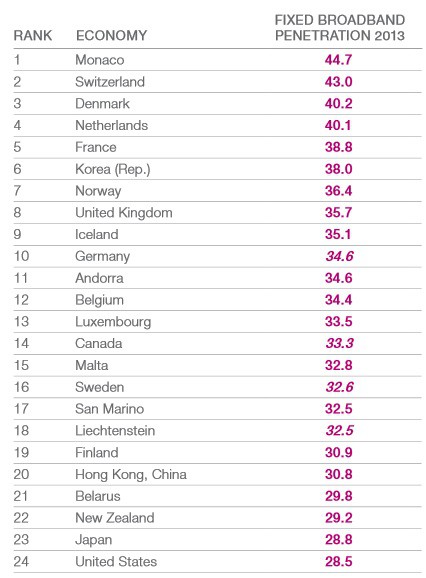
The United States has fallen from 20th to 24th place in wired broadband subscriptions, per capita. Virtually every country in western Europe now beats the United States, as does Hong Kong, Belarus, and New Zealand. Canada scored better, taking 14th place.

fixed broadband penetration 2013

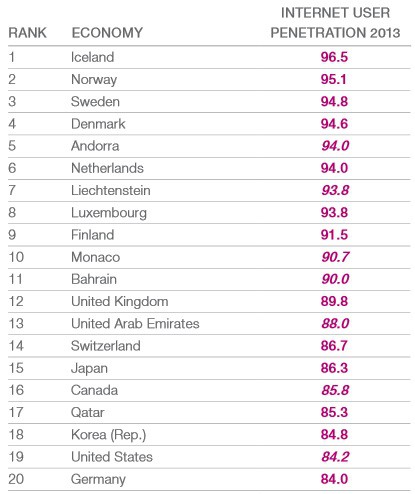
Only managing a meager 19th place, only 84.2% of Americans are online. Iceland has 96.5% of their population on the Internet, closely followed by the other northern European nations of Norway, Sweden and Denmark. Also scoring superior to the United States: Andorra, Bahrain, Qatar, and the United Arab Emirates. Canada did better than its southern neighbor as well, coming in at number 16.

percentage using the internet

With big profits to be made in wireless, large wireless phone companies like Verizon Wireless and AT&T helped the U.S. achieve its best rating — 10th place in wireless. But the countries that exceeded the United States did much better (Canada was not rated this year.)

With the arguable exception of wireless, the United States is no longer a world leader in broadband and continues a slow but steady decline in rankings as other countries leapfrog over the U.S.

At least 140 countries now have a National Broadband Plan in place, most maintaining stronger oversight over telecommunications infrastructure than the largely unregulated U.S. broadband marketplace. After reviewing broadband performance across most UN member states, the Broadband Commission for Digital Development recognized several traits common in countries where broadband has been particularly successful:

Competition is essential to promote enhanced broadband. A monopoly or duopoly (usually a telephone company and cable or wireless operator) is not enough to promote healthy broadband advancements. At least three, near-equal competitors are required to achieve the best upgrades and price competition. The presence of smaller competitors or those charging considerably different pricing had little effect on competition.

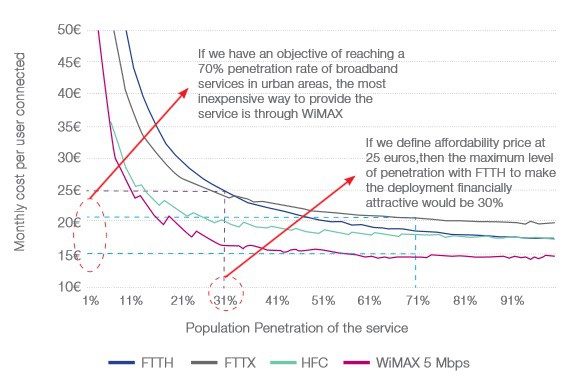
Countries with the best speeds have national policies promoting the installation of fiber optic technology, at least in multi-dwelling units and new developments. Although the cost of fiber and its installation can amount to as much as 80% of a broadband expansion project, many countries have been successful compelling competing providers to share a single fiber optic network (and its costs) to make the investment more affordable. In terms of ultra-high-speed broadband, there are still not many consumer apps and services that need Gigabit speeds, but such services are on their way. Experience shows that technology typically moves faster than most people anticipate – so countries and operators need to start planning now for the imminent broadband world.

technology cost

A coherent regulatory foundation that emphasizes competition over regulation was the most effective policy. But regulatory frameworks must guarantee a level playing field among competitors and strong oversight to make sure competitors play fair. Regulation is not keeping pace with the changes in the market – Internet players offering equivalent voice and messaging services are, by and large, subject to relatively limited requirements (including consumer protection, privacy, interoperability, security, emergency calls, lawful intercept of customer data, universal service). Asymmetric regulation has resulted in an uneven competitive landscape for services. Governments and policy-makers need to review and update their regulatory frameworks to take into account evolving models of regulation.

Telecommunication and broadband access providers need to explore business arrangements with Internet content providers that will accelerate global investment in broadband infrastructure, to the mutual benefit of all, including end-consumers. Internet companies and Internet content providers need to contribute to investment in broadband infrastructure by debating interconnection issues and agreeing fees/revenue shares with other operators and broadband providers.

That last issue is now being hotly debated in the United States, where providers are seeking compensation from streaming video providers like Netflix, which now account for a substantial amount of Internet traffic.

N.J. Approves Verizon-Friendly Settlement; Verizon Now Off the Hook for Fiber Upgrades

bpuThe New Jersey Board of Public Utilities today voted unanimously to approve a Verizon-friendly settlement that lets the phone company off the hook for its 1993 commitment to offer broadband service to every resident in the state who wants it.

Critics call the decision a “total capitulation” by state regulators that proved “very amenable to Verizon’s agenda.”

Verizon will now be allowed to substitute its costly, usage-capped, high-speed 4G LTE wireless service in rural areas instead of expanding DSL or its fiber optic network FiOS.

Verizon won deregulation two decades ago in an agreement known as “Opportunity New Jersey” in return for a commitment to expand high speed Internet access to all of New Jersey by 2010 — a deadline long missed. Critics charge Verizon collected as much as $15 billion in unregulated service revenue it would have otherwise never received, yet stopped its fiber optic rollout more than two years ago.

A number of rural New Jersey communities including Hopewell, Alloway and Pilesgrove townships opposed Verizon’s settlement proposal because it would let the company walk away from its earlier commitments and leave parts of southern New Jersey without any broadband service. Now those communities may eventually be served by Verizon Wireless, but at a significant cost starting at $50 a month for up to just 4GB of broadband usage.

Verizon gets to keep its current deregulation framework in place as part of the settlement.

The New Jersey Board of Public Utilities consists of five commissioners all appointed by the governor and confirmed by the state Senate for six year, staggered terms. Gov. Chris Christie’s appointees now dominate the BPU, and critics charge he uses the regulatory agency as a political patronage dumping ground. Earlier this year, he faced criticism for appointing the wife of a longtime Christie ally to lead the board. Dianne Solomon served on Christie’s transition team and brought a very thin resume to the position — serving as a paralegal and an umpire certified by the United States Tennis Association.

MassBroadband123 Fiber Network Completed; Now the Challenge of Last-Mile Funding Begins

Phillip Dampier February 26, 2014 Broadband Speed, Community Networks, Consumer News, Public Policy & Gov't, Rural Broadband, WiredWest Comments Off on MassBroadband123 Fiber Network Completed; Now the Challenge of Last-Mile Funding Begins

axiamassbroadband123The Massachusetts Broadband Institute has completed construction and testing of the massive 1,200 mile fiber optic network designed to bring 21st century Internet connectivity to rural western and central Massachusetts now largely left out of the broadband revolution.


After spending $89.7 million in state and federal funds, the fiber project that started construction in 2011 has delivered a robust middle-mile network that, for now, will largely target and serve 1,400 schools, libraries, and government buildings — institutional users that have access to government broadband funding programs to pay for hookups to the fiber network. Finding the money to connect the 333,500 households and 44,000 businesses MassBroadband123 wants to reach is more difficult.

Steve Nelson, the legal/governance chair of the WiredWest Executive Committee, likens it to seeing big water mains being laid along roadways with no way to connect pipes to your house. The media may proclaim the network is complete, but in reality, there is a lot of work that remains to extend broadband service to the residents and businesses that need it most.

Massachusetts Gov. Deval Patrick recently announced funding to support some of the costs of the all-too-critical “last mile” — bringing a connection from the existing fiber network to a home or business. Out of a $900 million bond bill for technology projects, a set aside of $50 million has been reserved for broadband. The bill is waiting for action by the Senate Committee on Bonding, Capital Expenditures and State Assets. If it passes, Nelson believes it will cover about half of the estimated $100 million needed to finish the last mile and begin offering service.

open

As with many publicly funded, open access broadband networks, private providers are usually invited to participate, but in fact rarely do. Despite calls from Rep. “Smitty” Pignatelli (D-Berkshire 4th District) for Verizon and Comcast to get on board, there is no sign either company is prepared to do so. Nelson says waiting for either company to solve the last-mile problem in areas where they’ve never shown much interest before is like “Waiting for Godot.”

wiredwest“It’s time to stop talking and waiting for Comcast or Verizon,” Nelson writes. “We the people of Western Mass. have the power to solve the last mile problem ourselves. Forty-two towns have formed WiredWest, a cooperative dedicated to bringing broadband home to our citizens.”

WiredWest is seeking federal rural broadband funding designated to support rural broadband projects like the one in western Massachusetts. The co-op may even issue a bond backed by participating communities that would allow WiredWest to borrow the needed funds to wire up customers.

Nelson is calling on fellow residents to support the project’s viability by signing up for service when it becomes available. He also urges participating communities to stay united under the WiredWest regional partnership.

“The regional solution WiredWest represents is the only way to achieve the economies of scale, operational efficiencies and cost-effectiveness to make such a network feasible and sustainable,” said Nelson. “It requires a large-enough base of customers and the support from many towns joining forces. A small town going it alone and building its own network is not a viable approach to the big challenge of building and operating such complex and costly infrastructure. It’s running a sled race with just one dog.”

PowerPlay: AT&T Says Google Fiber Cannot Use Its Utility Poles in Austin

att poleAT&T has informed Google it will not allow the search engine company to use its utility poles to build a fiber optic network that will compete with AT&T’s own GigaPower fiber service, which launched in Austin this week.

Current rules require utilities to provide non-discriminatory access to poles for all electric and telecommunications companies. AT&T has declared Google is neither, but is willing to work with the company once it is “qualified,” said Tracy King, AT&T’s vice president for public affairs.

“By challenging the city to force an employer to share its equipment contrary to federal law and without transparency, Google appears to be demanding concessions never provided any other entity before,” said King.

The dispute now threatens to involve Austin’s city council, which fears AT&T’s position could result in thousands of new utility poles being installed next to AT&T-owned poles. City officials warn they are willing to settle the matter by changing the rules for all utility companies, using their authority as the owner of the land on which the utility poles are placed.

“We don’t want people to put up their own poles,” Rondella Hawkins, Austin’s telecommunications and regulatory affairs officer, told the Austin-American Statesman. “We want to avoid anybody putting up redundant utility poles. Could you imagine a city where all the (telecommunications) providers individually have their own utility poles? It would be a mess.”

Google said it wants to bring its fiber network to Austin in the least disruptive way possible, and AT&T’s actions may complicate the project.

Martinez

Martinez

The proposed rules change threatened by the city council brought immediate opposition from both AT&T and the unions that represent AT&T workers.

“The city of Austin should not jump into what amounts to a business dispute and create winners and losers before everyone can present data on all the stakes that are involved,” wrote Becky Moeller, president of the Texas AFL-CIO.

This afternoon, with the rules change pending on the calendar, Google and AT&T apparently decided to work out the dispute before the city imposed a solution.

“After hard work, lots of meetings and tons of input – AT&T and Google agree to negotiate their issues with the city,” Austin council member Mike Martinez wrote on his Facebook page. “A postponement of [the ordinance change] is highly likely. Thank you to them and all who helped make this happen.”

[flv]http://www.phillipdampier.com/video/KVUE Austin Dispute Between Google ATT 12-11-13.mp4[/flv]

KVUE in Austin reports the pole attachment dispute between AT&T and Google threatens to involve the city council. (3:09)

Search This Site:

Contributions:

Recent Comments:

Your Account:

Stop the Cap!