Home » fiber optic network » Recent Articles:

Nine Upstate NY Mayors Accuse Verizon of Avoiding Urban Poor In Fiber Upgrades

Verizon has a moratorium on further expansion of its fiber to the home service except in areas where it has existing agreements to deliver service.

Virtually every mayor in the urban centers of upstate New York is accusing Verizon Communications of redlining poor and minority communities when deciding where to provide its fiber-to-the-home service FiOS.

Now they are telling the Federal Communications Commission and Department of Justice to become more closely involved in reviewing a proposed anti-competitive marketing partnership between the phone company and some of the nation’s largest cable operators.

The mayors are upset that Verizon has chosen to target its limited FiOS network primarily on affluent suburbs surrounding upstate New York city centers.

“Verizon has not built its all-fiber FiOS network in any of our densely-populated cities. Not in Albany, Buffalo, Syracuse, Binghamton, Kingston, Elmira or Troy,” the mayors say. “Yet, Verizon has expanded its FiOS network to the suburbs ringing Buffalo, Albany, Troy, and Syracuse, as well as many places in the Hudson Valley, and most of downstate New York. As a result, the residents and businesses in our cities are disadvantaged relative to their more affluent suburban neighbors who have access to Verizon’s FiOS, providing competitive choice in high-speed broadband and video services.”

The mayors fear the reduced competition that will come from the marketing partnership between the phone and cable industry will eliminate any pressure on Verizon to expand its fiber optic network into more New York cities. The agreement allows Verizon Wireless customers to received significant bundled discounts when they sign up for cell phone service and a cable package from Comcast, Time Warner Cable, Cox, or Bright House Networks. No corresponding discount is available to a Verizon Wireless customer choosing to bundle Verizon FiOS, putting the fiber service at a competitive disadvantage.

“These commercial agreements appear to eliminate any incentive that Verizon might have had to expand its all-fiber network to our high-density urban centers,” the mayors say. “After all, Verizon Wireless, a subsidiary of Verizon Communications, will now be able to sell Time Warner’s video and broadband service as part of their bundled package in our communities.”
That leaves most with Verizon’s DSL service, a product Verizon has been marketing less and less to its customers. The company recently announced it would no longer sell standalone DSL broadband, another point of contention for the mayors.

The mayors are concerned that Verizon’s deteriorating landline network will have profound implications for city centers, where tele-medicine, education, business, and entertainment services will all be left lacking if the fiber network is not extended.

“As you are well aware, high-speed broadband is critical to economic development and job creation, as well as improvements in health care, education, public safety, and civic discourse which is so essential to communal life,” say the mayors. “The economic health of our cities and our upstate region depends upon access to the same first-rate communications infrastructure available to the New York City metropolitan region and the suburban communities that ring our cities.”

The nine mayors are also questioning whether Verizon executives misled them when they claimed Verizon’s strong financial performance would allow the company to reinvest profits into further expansion of its FiOS network. Verizon executives have since admitted the company is indefinitely finished with FiOS expansion, except in areas where it already committed to build the fiber network.

Signing the letter were:

  • Byron W. Brown – Mayor, City of Buffalo
  • Stephanie A. Miner – Mayor, City of Syracuse
  • Gerald D. Jennings – Mayor, City of Albany
  • Matthew T. Ryan – Mayor, City of Binghamton
  • Shayne R. Gallo – Mayor, City of Kingston
  • Susan Skidmore – Mayor, City of Elmira
  • Brian Tobin – Mayor, City of Cortland
  • Robert Palmieri – Mayor, City of Utica
  • Lou Rosamilla – Mayor, City of Troy

(The city of Rochester is served by Frontier Communications, which has no plans to deliver a fiber to the home network within its local service area.)
New York City Broadband “Sucks,” Says Village Voice

Waiting for FiOS

For those who admire the apparent pervasiveness of competition between Time Warner Cable and Cablevision Industries vs. Verizon Communications’ FiOS, the idea the Big Apple has a broadband problem seems a bit ridiculous, particularly if you can’t get your local cable company to pick up their phone and AT&T will only hand you a 1.5Mbps DSL line, if you can get it.

But according to the Village Voice, New York City broadband “sucks,” and it will continue to suck for at least the next eight years.

“Though entrepreneurs in most parts of the city can access a fast broadband connection today, many of those we interviewed said that New York’s telecom infrastructure is well behind where it should be for a city vying to be one of the nation’s two leading technology hubs,” the study notes.

What it comes down to is that New York — despite being the world’s media capital — does not have adequate access or bandwidth to support tech companies’ needs.

For example, some companies might be able to get either FiOS or Time Warner Cable, but not both, which means they can’t have broadband backup.

“It’s like the elephant in the room is that bandwidth here sucks,” one entrepreneur told the researchers. “You should be able to walk into any building and have at least 150 megabit connection available to you. There has to be ways for the city to construct much better bandwidth availability for start-ups.”

Many cited told the researchers that their internet routinely goes down. And startups who want to set up shop in cheaper, industrial districts often can’t, because the cable companies would rather provide service to more lucrative residential areas. Sometimes, telecom concerns are willing to dig up streets and lay cable, but at a hefty price — around $80,000.

That $80,000 bill is handed to a prospective customer and does not come from cable operators’ capital expense fund.

Researchers gave New York a broadband grade of B to B-, which isn’t too bad considering what broadband is like in the mid-south, the midwest, and the rural west. But it doesn’t cut it for helping New York become a bigger tech city.

Waiting for "Business Class"

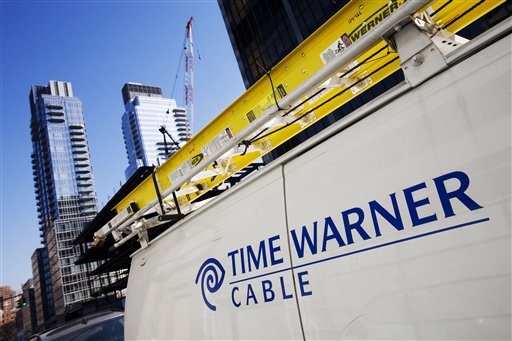
While Time Warner Cable and Cablevision have wired multi-dwelling units and homes across New York City, cable operators have only recently started to turn their serious attention to corporate business customers.  Time Warner Cable agreed, as part of its franchise renewal deal with the city, to invest $1.2 million per year for fiber connections to commercial buildings yet to be wired for cable. Cablevision, which can be found in boroughs like Brooklyn and out on Long Island, agreed to spend a more modest $600,000 a year for the same purpose.

Time Warner Cable has already warned investors its capital spending on wiring commercial office buildings across the country is increasing as the company sees lucrative new revenue opportunities competing with their usual nemesis — the phone company.

Verizon treats FiOS deployment in New York City as a long, long-term project. There are neighborhoods in Manhattan that can’t wait much longer for the fiber optic network as Verizon increasingly lets its old copper wiring go to pot, leaving some New Yorkers without phone service for weeks.  The city of New York has given Verizon until 2014 to wire the city, and the company appears likely to need those two additional years at their current pace, and that agreement only covers residential properties, not commercial ones.

Robust broadband is essential for many high technology startups and the multi-million dollar data centers that support them. New York mayor Michael Bloomberg considers it a top priority to reduce the city’s economic dependence on Wall Street, which generates considerable tax revenue for both the city and state. High tech enterprises fit that bill. But the city’s broadband grades do not.

“For a city that’s trying to be a tech powerhouse, we need to have an A,” said Jonathan Bowles, the author of the study, “New Tech City.”

Verizon Ending DSL Service in FiOS Fiber-Wired Service Areas

Phillip Dampier April 19, 2012 Broadband Speed, Competition, Consumer News, Verizon 5 Comments

Just over a week after Verizon Communications announced it would stop selling DSL service to customers without landline voice telephone service, the company today confirmed it plans to stop selling DSL to customers who live in an area also served by the company’s fiber optic FiOS network.

New customers looking for broadband from Verizon will have to sign up for FiOS to get it.

The announcement came as part of a quarterly conference call with Wall Street investors.

Some consumers looking for the cheapest Internet access packages have gotten them from the phone company, often years earlier, and are grandfathered in at those prices.  Verizon says it does not intend to disconnect existing DSL customers, who can keep the service indefinitely, but will not sell the slower broadband service to new or moving customers.

No exact timing for the new policy to take effect was given.

Verizon’s broadband success story has been with its fiber optic network, which continues to add customers.  The same cannot be said of their DSL service, which continues to lose business to Verizon’s cable competitors, especially in areas where FiOS remains unavailable.  FiOS was designed to protect Verizon’s landline business and it seems to be doing exactly that.  At least 63% of Verizon’s landline-associated revenue now comes from its fiber optic service.

Verizon’s executives have made it clear change is coming to the traditional landline business.  The company has not said what it intends to do with DSL customers in non-FiOS areas but did announce they would decommission pay telephones and discontinue long distance calling cards in the future.

Fort Wayne Prefers Comcast Over Frontier Communications FiOS

Phillip Dampier April 17, 2012 Comcast/Xfinity, Competition, Frontier 2 Comments

A fiber optic network may be only as good as the marketing that sells it.

If that is true, Fort Wayne residents have made their choice, and they prefer Comcast Cable over Frontier Communications FiOS.

City officials released figures this week showing Comcast has a clear lead in the Indiana city.  Both companies pay the city franchise fees to do business in Fort Wayne, and Comcast paid almost $435,000, almost double Frontier Communications’ $262,556.

Ft. Wayne, Indiana

Frontier assumed control of the fiber optics network when it purchased the local assets of Verizon Communications.  But Frontier quickly found that volume pricing for video programming gave the old owner a decided advantage.  Frontier found programming prices for its comparatively smaller footprint far higher than what Verizon paid, and quickly began encouraging its fiber video customers switch to DirecTV satellite service.  Comcast responded with a billboard campaign that suggested Frontier was getting out of the fiber business, and encouraged customers to come back to cable.

Some did, but Frontier says it remains committed to its inherited fiber network, even though it lost over 10,000 customers last year.

“We’ve completed our evaluation of our business model and pricing,” Frontier’s Matt Kelley told the Journal-Gazette. “We’re offering an attractive bundle price. Customers are recognizing the quality and value, and that it’s a very compelling service.”

Frontier does appear to be serious about maintaining the broadband and phone service attached to its FiOS product, but has been looking for ways to bring down the wholesale cost of cable television programming and so far has shown no interest in expanding it.

“Our focus is not on FiOS video deployment,” Frontier CEO Maggie Wilderotter told investors in 2010. “The costs to install, set up and market new FiOS video customers are very expensive and, in our view, uneconomical.”

That’s less of a problem for Comcast, the nation’s largest cable operator.  It enjoys volume discounts few other providers can negotiate.  Comcast always had a built-in advantage associated with its incumbency.  Getting customers to switch providers isn’t easy.  But despite the presence of an advanced fiber optic network operated by the competition, Comcast has held on to customers.

“Our customers that are staying with us and joining us are enjoying our services, especially since the introduction of our Xfinity home security management system,” said Comcast’s Mary Beth Halprin, not missing an opportunity to pitch the cable company’s latest new product line. “The home security service costs $39.95 a month and provides around-the-clock monitoring and allows customers to watch live-streaming video from wireless cameras using an iPhone or iPad.”

Want Better Canadian Broadband? Move West

If you want better Canadian broadband with fewer tricks and traps and live in Ontario or Quebec: put the house up for sale, pack up your things, and head west.

Canada’s heavily metered and capped broadband is ubiquitous in the country’s two most-populated provinces where a convenient duopoly of Bell and Rogers in Ontario and Bell and Videotron in Quebec control the vast majority of the broadband market.  But cross west into Saskatchewan and things start to look a lot better.

Canadians telecommunications consultancy The Seaboard Group praised SaskTel, the provincial phone company, for refusing to slap usage caps on its customers.  SaskTel does not deliver the cheapest Internet access by any means, but the company is investing heavily in fiber optic upgrades to turn the page on aging copper wire infrastructure.  Stringing fiber through Regina, Saskatoon and beyond may seem counterintuitive to other providers.  Saskatchewan, one of Canada’s “prairie provinces,” is hardly packed with people.  With more than 20 million Canadians living in Ontario and Quebec, Saskatchewan gives its 1 million residents a lot of open space.  Sparser populations usually translate into higher costs per customer for upgrades, but SaskTel persists.

SaskTel has historically relied on traditional DSL and has competition in larger communities from Shaw Cable, western Canada’s largest cable operator.  Although SaskTel’s DSL delivers lower speeds than Shaw can provide, it does so with no usage limits.

Shaw’s decision to provide considerably more generous usage allowances has kept the pressure on SaskTel to upgrade its infrastructure to compete.

SaskTel CEO Ron Styles told the Leader-Post its fiber optic network will give cable a run for its money, and until then, it is satisfied undercutting cable pricing for broadband, delivering a far better experience than either Rogers or Bell provides eastern Canadians, Styles says.

Seaboard president Iain Grant found that what customers are willing to pay for service can also influence what prices providers charge.

“The price is more based on what you’re prepared to pay,” Grant said.

People in western Canada evidently are not willing to hand over as much money as their friends in Ontario and Quebec.

West of Saskatchewan lies Alberta and British Columbia — Telus territory.  Telus is western Canada’s largest phone company and also principally competes with Shaw Cable.

Shaw has forced Telus to back down on fueling enhanced revenue with usage caps of its own, and has been aggressively upgrading its network with additional fiber optics and DOCSIS 3 technology, forcing Telus to embark on its own upgrade effort.

Macleans reports western Canada’s more-competitive broadband market has been good for consumers, but has also exposed a difference in priorities for providers.

With Shaw breathing down its neck, Telus has committed to a $3 billion fiber optic network expansion in B.C., improved wireless coverage, and more IPTV service.  Macleans notes Telus is the only major telecom or cable company in Canada that hasn’t purchased a television asset, focusing instead on its core businesses of connecting customers.

In eastern Canada, Bell faces Rogers and Videotron.  Critics contend Bell sees no imminent threats there, and the phone giant is spending its money elsewhere, announcing a $3.4 billion acquisition of Astral Media — an entertainment company owning 24 specialty cable channels and pay-TV networks, including the Movie Network and HBO Canada.

Bell’s latest “investment” follows its 2010 $1.3 billion buyout of CTV and last year’s $1.32 billion co-purchase of Maple Leafs Sports and Entertainment (the other buyer was their ‘arch-competitor’ Rogers Communications).

While Telus spends money on upgrading its broadband and video services to customers, Bell is positioning itself to control 34% of Canada’s TV universe.  Bell is also the same company that advocated slapping nationwide usage-based pricing on Canadian broadband consumers to pay for the “network upgrades” it contends were needed to handle increasing demand.

Search This Site:

Contributions:

Recent Comments:

Your Account:

Stop the Cap!