 While a lot of people would love to get Verizon to wire their communities for the company’s fiber optic network, at least three New York City multi-dwelling unit property owners have told Verizon to get lost, in some cases telling the company none of their tenants were interested in the top-rated fiber to the home network, even as they remain without phone service three months after Hurricane Sandy damaged Verizon’s facilities in the city.
Verizon Communications has now had to force the issue, filing an official complaint with the New York Public Service Commission to get owners to open their buildings for the fiber upgrade which will also restore telephone service. In one case, a property owner allegedly demanded financial compensation from Verizon to gain admittance to the building to begin repairs.
“I have been complaining about Verizon’s lack of FiOS work in my building for a long time and I had no idea Verizon was banging on the door all along only to be told by the  boneheads that own my building that nobody was interested,” says Brad, a Stop the Cap! reader in Manhattan. “The morons at the property management company don’t have a clue or they want money from Verizon in return for the keys. Meanwhile, there is no dial tone and Verizon says they are at an impasse until the property owners, who obviously don’t care, let them in to do repairs.”
Indeed, Verizon sent certified letters to all of the affected property owners informing them, if they didn’t already know, that tenants in their buildings were without telecommunications service after Sandy wreaked havoc on Verizon’s infrastructure:
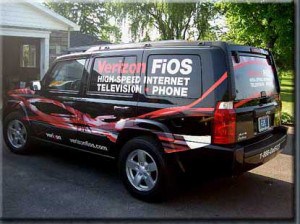
Locked out.
In addition, you should be aware that residents at your Property are currently out of service as a result of damage to Verizon’s network caused by Hurricane Sandy. Providing Verizon with access to install FiOS, a fiber-based network that is less vulnerable to weather-related damage, will allow Verizon to restore those residents’ services. Verizon intends to install FiOS facilities at your property to provide both cable television service as well as voice telephone services. If you do not provide Verizon with access to your Property, your residents will continue to remain without telephone service from Verizon. In addition, you should be aware that residents at nearby properties are currently out of service as a result of damage caused by Hurricane Sandy. Verizon needs access to your Property in order to bring FiOS – its fiber-based network that is less vulnerable to weather-related damage – to those nearby properties. If you do not provide Verizon with access to your Property, nearby properties will continue to remain out of service.
The excuses for denying entry have been documented by Verizon and made public in its filing with the Albany-based regulator:
- TF Cornerstone’s properties at 2 Gold Street and 201 Pearl Street are out of service even as property management informed Verizon that “the owners do not want FiOS in the building.”
- Rockrose Development’s buildings at 200 Water Street and 22 River Terrace are without service because property management tells Verizon “they are not interested in FiOS.”
- Verizon reports DSA Management required “compensation in exchange for allowing Verizon access” to its building at 11 Maiden Lane and also refused Verizon entry to 700 E. 9th Street because “the property management is having a problem with Verizon at another location.”
New York State law is very clear on the subject:
PUBLIC SERVICE LAW
§228. Landlord-tenant relationship
1. No landlord shall (a) interfere with the installation of cable television facilities upon his property or premises, except that a landlord may require:
(1) that the installation of cable television facilities conform to such reasonable conditions are necessary to protect the safety, functioning and appearance of the premises, and the convenience and well being of other tenants;
(2) that the cable television company or the tenant or a combination thereof bear the entire cost of the installation, operation or removal of such facilities; and
(3) that the cable television company agree to indemnify the landlord for any damage caused by the installation, operation or removal of such facilities.
(b) demand or accept payment from any tenant, in any form, in exchange for permitting cable television service on or within his property or premises, or from any cable television company in exchange therefore in excess of any amount which the Commission shall, by regulation, determine to be reasonable; or
(c) Discriminate in rental charges or otherwise, between tenants who receive cable television service and those who do not.
2. Rental agreements and leases executed prior to January first, nineteen hundred seventy-three may be enforced notwithstanding this section.
3. No cable television company may enter into any agreement with the owners, lessees or persons controlling or managing buildings served by a cable television company, or do or permit any act, that would have the effect, directly or indirectly of diminishing or interfering with existing rights of any tenant or other occupant of such building to use or avail himself of master or individual antenna equipment.


 Subscribe
 More than six months after Hurricane Sandy did her handiwork on coastal New York, New Jersey and Connecticut, hundreds of residents are still getting phone bills from Verizon for phone and Internet service they have been without since Halloween.
 Verizon’s response has mostly been shrugged shoulders and no firm estimate of when service will be repaired.
 Verizon last week surprised 20 Philadelphia families scheduled for installation of its fiber optic service FiOS on Valentine’s Day with flowers, chocolates and Verizon-labeled canvas bags.
 North Carolina has achieved a new low. It is now tied with bottom-rated Mississippi as America’s least-connected state, at least in terms of broadband adoption.
 “I want FiOS yesterday. I guess some of these building owners already have it and will let us have it if the kickback is finally high enough. Time Warner Cable comes and goes whenever they like.”