Home » fiber optic network » Recent Articles:

NY CALL TO ACTION: Tell Regulators Your Thoughts About Verizon’s Future Landline Plans

nys pscNew York State residents have until July 2 to share their views about a proposal by Verizon Communications that would allow the company to drop landline service in rural upstate New York and other locations and replace it with a wireless substitute — Voice Link, as its sole service offering.

Stop the Cap! has covered the issue of rural landline service extensively since 2008. In the past few years, while CenturyLink, Windstream, FairPoint, and Frontier have developed business plans to sell lucrative landline telephone and broadband service in rural areas, AT&T and Verizon have proposed abandoning their landline networks in certain areas in favor of wireless.

Verizon has sought to stop offering rural landline service in areas where it feels no longer economically justified providing it. It ultimately means dismantling communications infrastructure that has provided reliable voice telephone service for more than 100 years.
Verizon-logoVoice Link is first being introduced as Verizon’s “sole service” for beleaguered residents living on the western half of Fire Island, which was devastated by last fall’s Hurricane Sandy. Verizon does not want to foot the bill to rebuild and repair the damaged copper wire infrastructure and does not believe installing its fiber optic network FiOS is economically justified either. That leaves residents with one option for basic phone service: Voice Link.

Unfortunately, many of the residents now encountering Voice Link have told the Public Service Commission it has proven unreliable or unsatisfactory and represents a downgrade from the landline service they used to have. (Stop the Cap! has repeatedly offered to test Voice Link’s workability and sound quality ourselves, but Verizon has not taken us up on that offer.)

The company does admit Voice Link is incompatible with basic data services, which means Verizon customers using Voice Link will lose DSL and dial-up Internet access. It also does not work with fax machines, home alarms, and medical monitoring services. Verizon has promised to address these issues in the future, but has offered no timeline or guarantees. Instead, it suggests customers consider purchasing added-cost services from Verizon Wireless, which could cost some residents hundreds of dollars a month for phone and broadband service.
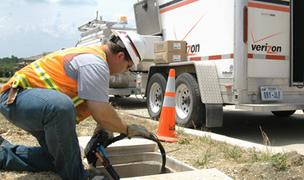
verizon repairStop the Cap! believes Voice Link should be offered only as an optional service for customers who wish to use it. In its current form, it is unsuitable, unproven, and insufficient to serve as Verizon’s sole offering, particularly when the company is the carrier of last resort for many rural residents, as well as those on Fire Island.

At the very least, Verizon must be compelled to offer an equal or better level of service, not diminish it. That means better voice quality, rock solid cell coverage, an equivalently priced, unlimited wireless broadband service option for DSL customers, and compatibility with the data services that are now supported over the plain old telephone network.

The Commission should also explore the true costs of repairing and/or replacing wired infrastructure before allowing the company to dismantle it. Once the wired infrastructure is removed, the costs to provision rural New York with fast, reliable, wired broadband service in the future will become prohibitive. Wireless service is no panacea for rural New York, where coverage issues abound, especially in the mountainous areas upstate and across the rolling hills of the Southern Tier. Verizon’s lawyers admitted as much when they wrote the terms and conditions governing Voice Link and other wireless services, walking away from significant liability if calls to 911 go unconnected:

“In the absence of gross negligence or willful misconduct by Verizon, our liability to you, to anyone dialing 911 using the Service, or to any other person or party, for any loss or damage arising from any acts, errors, interruptions, omissions, delays, defects, or failures of 911 services or emergency personnel, whether caused by our negligence or otherwise, shall not exceed the amount of our charges for such Services during the affected period of time. This limitation of liability is in addition to any other limitations contained in this Agreement.”

In other words, Verizon’s only responsibility is to credit your account for the time you could not reach 911 or your call summoning help was dropped. You will see that credit reflected on a future bill, assuming you are still among the living when the emergency is over.

We strongly urge our fellow New Yorkers to share their personal views about Voice Link as a landline substitute with the PSC. This issue is important not only to Fire Island but to the rest of rural upstate New York as well, particularly pertaining to whether customers will have broadband service or not. Verizon management has clearly stated their agenda is to retire copper landline service and replace it with wireless in non-FiOS areas deemed too costly or unprofitable to keep up or upgrade.

Sharing your views is fast and easy and can be done in several ways. Be sure to reference “Matter/Case: 13-00986/13-C-0197” in your comments and include your contact information. All submissions will become publicly viewable on the Commission’s website under the “Public Comments” tab. You can find submissions from Stop the Cap! there as well.

Write (U.S. Mail):

Hon. Jeffrey C. Cohen, Acting Secretary
New York State Public Service Commission
Three Empire State Plaza
Albany, New York 12223-1350

E-Mail:

[email protected]

Online Comments:

You can post comments directly to the Commission’s Document and Matter Management System (DMM). Choose the “Post Comments” link on the upper-right of your screen. An online submission form will appear asking for your contact information. You can include your comments in the provided text box on that form or attach a .PDF, .DOC, or .TXT file.

What You Knew Already: Fiber Broadband Rules, Says New Report; We Need More

buddecomAttention broadband planners: Although broadband deployment strategies differ around the world, a new report decisively concludes there is only one network technology proven to meet the demands of broadband users both today and tomorrow: a national fiber optic network.

BuddeComm’s new report, “Global Broadband – Fibre is the Infrastructure Required for the Future,” looked at every technology from variations of DSL, cable broadband, satellite, and wireless and found only fiber optics capable of handling the capacity of data and applications that will be required to run cities and countries from today onwards.

The report found that fiber optic deployment faced a range of challenges, despite its obvious technological advantages. Political obstacles are among the biggest roadblocks facing fiber networks. A combination of concerns about the cost of wiring service to procrastination has held back many national broadband improvement projects, including those in Australia and New Zealand. Incumbent commercial providers in North America have also actively attempted to block public fiber networks to protect their own commercial interests.

buddecomm concl

BuddeComm concludes America’s biggest broadband problems come as a result of incumbent providers exercising undue market power and influence over elected officials to protect their commercial interests at the price of the public good.

The report concludes that decisive political leadership is essential to overcome many of the artificial obstacles which slow down or stop fiber broadband deployments.

“One can argue endlessly about what technologies should be applied and at what cost, but we believe that all signs point to Fiber-to-the-Home (FTTH) networks as the best future-proof solution,” the report concludes. “One can debate about whether it is needed in five, ten or fifteen years – and again that depends on some of the differences between countries – but in the end FTTH is the best final solution for all urban and many regional premises.”

The 21st century digital economy is powered by robust broadband, and growing demands for faster speeds are coming from the healthcare, energy, media and retail sectors. Healthcare uses include file transfers of high-definition medical imagery and teleconferencing. Smart Grid technology is being deployed by many power companies to develop more efficient means of distributing and conserving energy. Media and mass entertainment providers are moving to high bandwidth online video, and the retail economy markets products and services over modern broadband networks.

The implications for the global economy are enormous. More than 120 countries have formal broadband policies and many consider high-speed Internet access a national priority. In the last century, North America and western Europe were considered the dominant economic players, in part because they established and maintained infrastructure to support their manufacturing and service economies. But many of these countries are falling far behind in the 21st century digital economy, where countries like Japan and Korea, parts of eastern Europe, the Baltic States, and Scandinavia are taking the lead in infrastructure deployment.

“Broadband infrastructure is perceived by all to be critical for the development of the digital economy, healthcare, education, e-government and so on,” the report notes. “From a financial and investment point of view broadband infrastructure should be treated as utility infrastructure.”

The interests of the private sector are not always aligned with the public interest, particularly when it comes to spending capital on upgrading network infrastructure. The report recommends that governments step in and build a public fiber highway system on which all providers can offer services.

“A National Broadband Network (NBN) should be based upon an open network as this makes it possible to offer the basic infrastructure on a utility basis to content and service providers,” the report concludes.

The governments of Australia, New Zealand, Israel, and others are already moving in that direction, setting up broadband authorities to build fiber infrastructure dismissed as too expensive or unnecessary by commercial providers who answer first to financial markets, shareholders, and private banks.

Under most NBN plans, providers get access to the fiber network at wholesale rates and help recoup its cost.

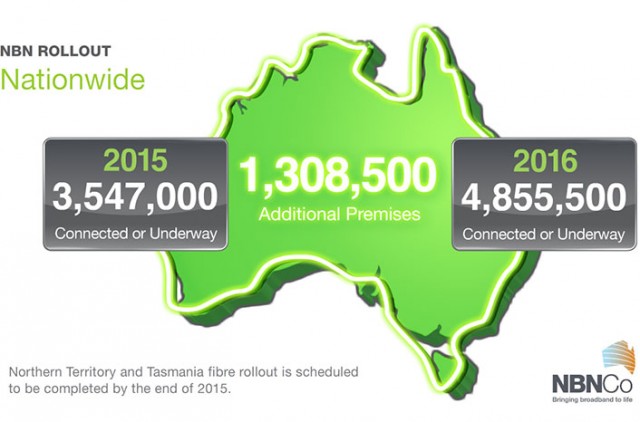
Australia's National Broadband Network is on the way.

Australia’s National Broadband Network is on the way.

Where politicians answer to the whims of the private sector before considering the public good, the report finds:

  • Private cable companies, particularly in North America, will continue to support and incrementally upgrade their HFC networks, but new cable operators are more likely to deploy fiber at the outset, not coaxial copper cable. Network costs, efficiencies, and reliability are all in fiber’s favor. In Europe, cable broadband is regularly losing market share to faster fiber technology. The share of all broadband subscribers held by HFC networks across Europe fell from 26% in 2002 to about 11% by mid-2013;
  • Private telephone companies that do not face robust competition will continue to rely on their existing DSL networks. In cities and larger towns, expect phone companies to eventually upgrade to VDSL fiber-to-the-neighborhood (and its variants) in the largest markets with the most competition. Rural areas will continue to receive less robust DSL service, particularly where no cable competitor provides service;
  • Rural areas may receive fixed wireless or satellite broadband service, but this is not a solution for more populated areas.

Although the global economic downturn stalled many fiber network deployments and suppressed demand, the report finds broadband usage and demand for faster speeds are quickly accelerating. Some other highlights:

  • Asia continues to be the leader in fiber optic deployment;
  • Sufficient customer demand to make the investment in fiber worthwhile is increasingly likely once fiber service becomes widely available in countries like the Netherlands, China, France, Israel, Switzerland, Norway and Sweden;
  • International connectivity in Africa remains a challenge, but fiber bandwidth is expected to more than double by 2014;
  • The Middle East will see rapid growth in fiber broadband once international capacity constraints are eased.

Obtaining a copy of the full BuddeComm report is prohibitively expensive for consumers, priced at $995.

Still Can’t Get Verizon FiOS in New York City? Your Landlord May Be the Problem

Phillip Dampier June 6, 2013 Broadband Speed, Competition, Consumer News, Public Policy & Gov't, Verizon Comments Off on Still Can’t Get Verizon FiOS in New York City? Your Landlord May Be the Problem

waitingStill waiting for Verizon FiOS in New York City? Are you annoyed that your neighbors have impressive broadband speeds from an all-fiber network while you suffer with DSL or cable broadband from Time Warner or Cablevision? Your landlord may be the problem.
While cities upstate clamor for Verizon’s fiber upgrades, FiOS has gone unappreciated and unwanted by more than 40 building owners either blocking the company from entering their properties or ignoring repeated letters from Verizon requesting permission to begin upgrades. In many instances, Verizon has tried to make contact since 2010 with no success. Some building owners want extra compensation (sometimes to the extreme) before they will grant permission. Others don’t want the phone company performing work inside their buildings, period.

Now Verizon is appealing to the New York State Public Service Commission to ask for their intervention.

Verizon has the right to install cable television facilities, regardless of the landlord’s objections, under Section 228 of the New York Public Service Law, which states: “No landlord shall interfere with the installation of cable television facilities upon his property or premises ….”

Verizon has promised it will bear the full cost of the installation of its equipment, wiring, and other facilities to offer the service, as well as indemnify the landlord for any damage caused by the installation work.

verizon-fiosIn April, Verizon was criticized by New York City public advocate Bill de Blasio for falling behind schedule providing access to FiOS in low-income communities.
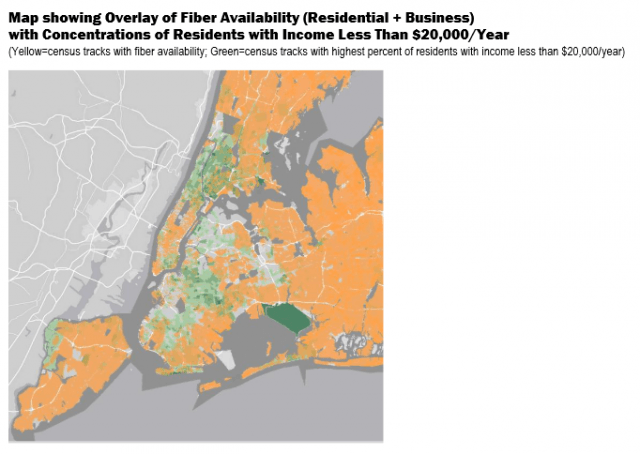


“Five years into one of the biggest franchise agreements issued by the city, roughly half of homes still have no access to fiber network connections—most of them concentrated in low-income areas like Upper Manhattan, the South Bronx, Western Queens and Central Brooklyn,” said de Blasio.

The public advocate added:

Under Verizon’s 2008 franchise agreement, all New York City residents are supposed to have access to fiber optic networks by June 2014. As a benchmark, the contract required the company to reach more than three-quarters of City residents by the end of 2012, but according to data released through the New York State Office of Information Technology Services, only half of New York City’s 3.4 million housing units had access to fiber broadband services at year’s end—putting the company far behind schedule. Brooklyn and the Bronx lagged furthest behind, with only 40 percent and 46 percent of household having access to fiber, respectively.

fiber avail

de Blasio

de Blasio

Verizon and the Bloomberg Administration dispute de Blasio’s findings, noting fiber upgrades often depend on surrounding infrastructure. Where overhead wiring predominates, Verizon FiOS is available nearly everywhere in New York City. In other areas, Verizon says it is meeting its obligations and points to landlord impediments for slowing down FiOS expansion.

But de Blasio’s maps of FiOS availability do depict a pattern of preference for FiOS service in areas where higher income residents live. In areas where average annual income is below $20,000 annually, there are obvious service gaps. Neighborhoods like Washington Heights, High Bridge, Astoria, Woodside, Bedford-Stuyvesant and Bushwick have been largely excluded from FiOS to date, according to de Blasio.

Verizon’s franchise agreement with the city only requires the company to make service available to buildings, not necessarily within them. A landlord can delay Verizon’s entry into a building or the company could choose to prioritize some buildings over others for service.

With large sections of New York covered by multiple dwelling units like apartments and condos, some could find themselves without FiOS service for several years, particularly if a property owner decides to make life difficult for the phone company.

Among the latest who have:

fios properties

On May 24, Verizon notified the PSC the following property owners had complied with their request to conduct a site survey inside their buildings and were requested to be dropped from the list republished above:

  • Sama Los Tres LLC – c/o Metropolitan Realty Group
  • Lenoxville Associates – c/o Metropolitan Realty Group
  • 2816 Roebling Avenue LLC
  • East Village Gardens
  • 194 Bleecker Street Owners Corp.
  • US Manhattan II Housing Corp.
  • 40 Renwick Street LLC

Earth-Shattering News: You Still Hate Your Cable Company

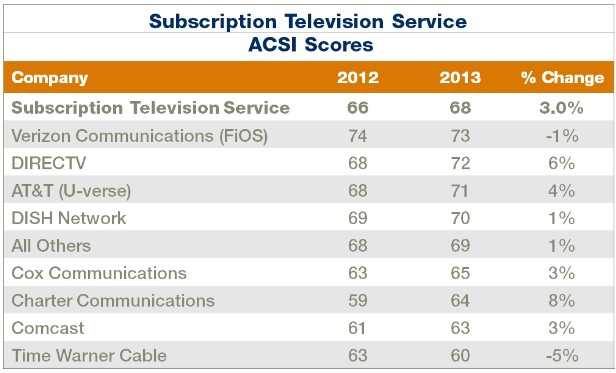
Despite efforts to improve their reputation, cable companies are hated so much the industry now scores lower than any other according to the American Customer Satisfaction Index (ACSI).

The only reason the industry’s average score or 68 out of 100 ticked higher are some new competitors, especially Verizon’s FiOS fiber optic network, which scores higher than any other provider.

acsi tv

The cable companies you grew up with still stink, ACSI reports, with Comcast (63) and Time Warner Cable (60) near the bottom of the barrel.

At fault for the dreadful ratings are constant rate increases and poor customer service. As a whole, consumers reported highest satisfaction with fiber optic providers, closely followed by satellite television services. Cable television scored the worst. Despite the poor ratings, every cable operator measured except Time Warner Cable managed to gain a slight increase in more satisfied customers. Time Warner Cable’s score for television service dropped five percent.

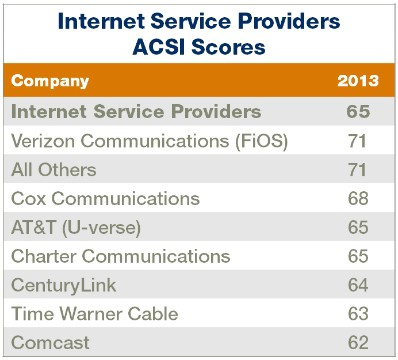
Customers are even less happy with broadband service. Verizon FiOS again scored the highest with a 71% approval rating. Time Warner Cable (63) and Comcast (62) scored the lowest. Customers complained about overpriced service plans, speed and reliability issues. Customers were unhappy with their plan options as well, including the fact many providers now place arbitrary usage limits on their access.

The best word to describe customer feelings about their broadband options: frustration, according to ACSI chair Claes Fornell. “In a market even less competitive than subscription TV, there is little incentive for companies to improve.”

acsi broadband

AT&T, Time Warner Cable Claim They Are Ready for Google Fiber in Austin

me too

AT&T suddenly announced it was ready to build its own gigabit fiber network in Austin.

AT&T and Time Warner Cable report they are ready to make more investments in their operations in Austin, Tex. to compete with Google Fiber when it arrives in the middle of next year.

Time Warner Cable says it already operates a multi-gigabit fiber optic network — one residential customers cannot easily access or afford. Residential broadband speeds at the cable operator top out at 50/5Mbps in Austin, at a cost higher than what Google plans to charge for 1,000/1,000Mbps service. AT&T’s U-verse network maxes out at 24/3Mbps, assuming customers have good copper wiring between AT&T’s fiber in the neighborhood and their home.

“The cable and phone company providers have purposely confused their networks’ maximum speed capacity with real end-user speeds for years, and when that fails to convince they simply claim customers don’t need or want those speeds anyway,” says Stop the Cap! reader and Austin resident Sam Knoll.

Knoll is enthusiastic about giving Time Warner Cable the boot, partly to pay them back for their aborted consumption billing trial attempted in Austin in 2009.

“I am not completely convinced Time Warner Cable understands just how much damage they did to their reputation when they pulled that stunt, and I’m certain they will attempt it again if they have a chance,” Knoll said. “The best thing customers can do is switch to a provider that believes usage caps and consumption billing are the fraudulent ripoff we know them to be. Google already knows this.”

Some Time Warner Cable customers in Austin never forgot the company tried to meter Internet usage in a failed experiment back in 2009.

Some Time Warner Cable customers in Austin never forgot the company tried to meter Internet usage in a failed experiment back in 2009. (Image: The Austinst)

Competition from deep-pocketed Google could eventually transform the broadband business model for American providers, assuming Google builds its fiber network in enough cities to challenge the conventional wisdom that prices have plenty of room to grow with faster Internet access. The more customers that sign up for Google’s already-super-fast broadband, the more providers will have to compete with better and faster service.

But AT&T is not convinced. The company announced yesterday it was prepared to build a gigabit fiber network not just in Austin, but also in surrounding Williamson County, with plenty of caveats.

“[We will only build the network if] the demand is there and if we get the same terms and conditions as Google received,” said AT&T spokeswoman Tracy King.

AT&T told the Austin American-Statesman the company wanted a faster regulatory approval process and permission to only build its faster fiber network in neighborhoods where there is proven demand for the service. Current franchise agreements often compel providers to offer service throughout the community and prohibits “cherry-picking” customers in high-income or low construction cost areas.

An AT&T official told KEYE-TV he had no idea how much AT&T would charge for gigabit broadband. Google charges $70 a month in Kansas City.

Austin has promised cooperation with Google, although it is not extending tax breaks or grants to the search engine giant. Google will get easy access to Austin Energy’s municipally owned infrastructure including utility poles and rights-of-way.

Google is speculated to be building showcase fiber networks to embarrass incumbent cable and phone providers who typically sell standard broadband service with speeds of 6-15Mbps in most larger communities. Rural areas are lucky to have 3Mbps service, and often much less.

But if Google intended to force major upgrades by cable and phone companies across the country, it might be disappointed with the response so far from AT&T and Time Warner Cable. Both companies indicate they will invest in and upgrade their networks to compete, but only in the service areas where Google-style competition exists. For the rest of the country, phone and cable companies are prepared to continue with the current “broadband scarcity” business model that delivers upgrades only occasionally, often accompanied by usage limits, consumption billing, and/or higher prices.

“Google has proved that there is a business model for selling abundant bandwidth as opposed to a business model for allocating scarce bandwidth,” said Blair Levin, a former chief of staff of the Federal Communications Commission.

“They are saying this is not an experiment. It is a business,” Levin told the newspaper. “In Kansas City, Google did the country an enormous favor. They said, give us regulatory flexibility to design the business and give us access to city property so we can build a network to lower the cost.”

[flv width=”640″ height=”380”]http://www.phillipdampier.com/video/KEYE Austin Competitor Chimes In After Google Announcement 4-9-13.flv[/flv]

KEYE in Austin talks with AT&T about their plans for a gigabit broadband network to compete with Google Fiber. The AT&T spokesman seemed more interested in pitching the company’s deregulation agenda and was short on specifics.  (3 minutes)

[flv width=”640″ height=”380″]http://www.phillipdampier.com/video/KXAN Austin What competition will Google Fiber face 4-9-13.mp4[/flv]

KXAN in Austin talked with Google competitors Time Warner Cable and AT&T about how they will respond to the Google Fiber challenge.   (3 minutes)

[flv width=”640″ height=”380″]http://www.phillipdampier.com/video/KVUE Austin Fiber Wars in Austin 4-9-13.mp4[/flv]

KVUE in Austin called Google’s entry into the city the opening salvo of ‘Fiber Wars,’ as AT&T promises its own gigabit network. Austin residents intend to take advantage of the competition to force providers to give them better deals to keep their business.  (3 minutes)

[flv width=”640″ height=”380″]http://www.phillipdampier.com/video/KXAN Austin Google Fiber Possibilities Google Insider 4-9-13.mp4[/flv]

KXAN explains the possibilities of gigabit fiber, but also asks a former Google insider why the search engine is getting into the broadband business.  (5 minutes)

[flv width=”640″ height=”380″]http://www.phillipdampier.com/video/KTBC Austin Time Warner Cable Responds to Google 4-9-13.mp4[/flv]

KTBC was skeptical of AT&T’s sudden interest in gigabit broadband. “Gee, what a coincidence,” commented the anchor of Austin’s Fox affiliate.  (2 minutes)

Search This Site:

Contributions:

Recent Comments:

Your Account:

Stop the Cap!