


Home » credit risk » Recent Articles:

Spectrum Mobile Limits Customer to Only One Line Because of ‘Low’ 797 Credit Score

Spectrum Mobile customers who sign up for cell service can expect an inquiry about their creditworthiness, and some customers with near-perfect FICO scores are embarrassed to discover Spectrum considers them too risky, thanks to an Experian credit scoring model developed specifically for utilities, phone and cable companies.

When you inquired about our device(s) and mobile service(s), we evaluated your credit score of 797 and determined we can only offer you a limited number of our available devices for purchase.

This decision was made solely by Spectrum Mobile though such decision was based on the information supplied by Experian, a consumer reporting agency. The terms we are offering may be less favorable than the terms offered to customers who have a better credit score. Experian will not be able to provide you with any information relating to Spectrum Mobile’s decision or any other Spectrum policies, devices, and/or services.

In practical terms, the letter means this Reddit contributor will be limited to just one line of service on his account.
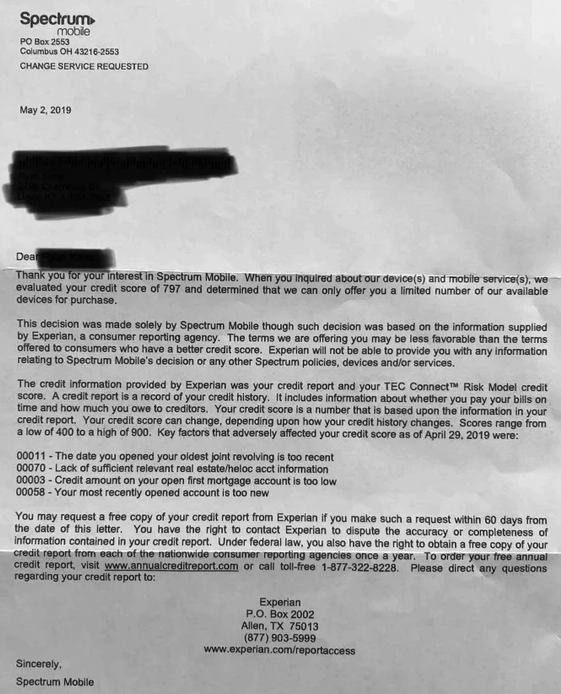
Spectrum Mobile is relying on a special credit risk management product to score its customers. The TEC Connect 2.0™ “risk model” stands for “T”elecommunications, “E”nergy, and “C”able, and was created exclusively for utility and telecommunications companies. It was designed to predict the likelihood you will pay utility and cable bills on time and in full. During times of economic distress, telecom and energy bills often get paid later than mortgages, auto loans, and credit cards. Still, with a score range of 400-900, the recipient’s 797 ranking represents a low credit risk, probably undeserving of a one line limit.
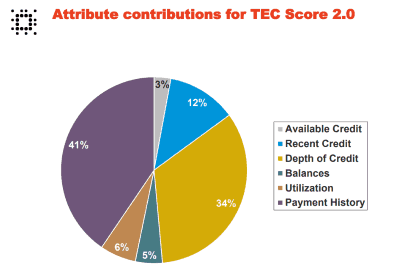
What counts the most towards your TEC Score?

Experian cited four adversities on this individual’s TEC Connect 2.0 report:

00011 – The date you opened your oldest joint revolver is too recent
00070 – Lack of sufficient relevant real estate/HELOC account information
00003 – Credit amount on your open first mortgage account is too low
00058 – Your most recently opened account is too new

That would seem to imply the customer is a relatively young borrower, or someone who closes older credit lines, which can count against your credit score. The report also seems to include conflicting information about any owned property and if it is mortgaged, which might mean the applicant is actually a renter. Recently opened credit accounts will diminish a TEC Score, and having a recent history of opening multiple new accounts could signal you are potentially over applying for credit or are overextended. Even if your FICO score reflects a good credit history, if you are a late-payer of energy or telecommunications bills, your TEC Score will reflect that and expose you to rejection of your application, line limits, and advance deposits.

Critics of Experian’s TEC Connect score note many utility companies do not report or report incomplete payment histories, many accounts are often missing from credit reports, and even those with perfect payment histories and a high FICO score can still run afoul of TEC Connect’s scoring model.

If you receive notice of an adverse credit decision, always take advantage of the opportunity to receive and review your report, free of charge. You are entitled to correct errors and have those corrections sent on to companies like Spectrum Mobile for a credit re-evaluation.
Comcast’s Acquisition of Fox Will Make It Among World’s Most Maxed Out Companies

Phillip Dampier June 19, 2018 AT&T, Comcast/Xfinity, Consumer News 1 Comment

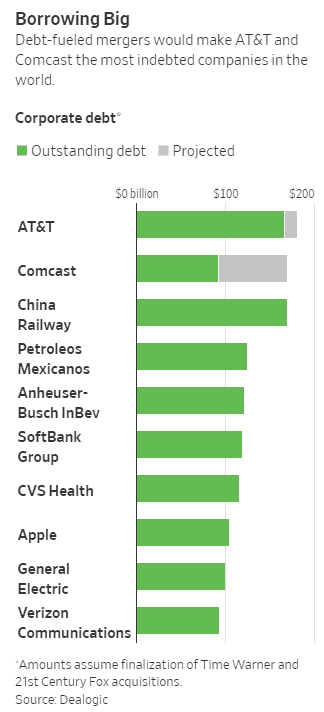
If Comcast’s $65 billion all-cash offer for 21st Century Fox is accepted, America’s largest cable operator will also be among the world’s largest corporate debtors, owing $170 billion in all.
Comcast will borrow as much as $85 billion to cover the acquisition of Fox, plus an additional $27.5 billion to cover the buyout of the United Kingdom’s satellite operator Sky.

Excluding banks, Comcast will be the world’s second most-buried-in-debt corporation, outdone only by AT&T, according to Moody’s.

Comcast’s all-cash offer to snatch Fox away from its corporate arch-enemy Disney, also bidding for Fox, is remarkable for a company with only $6 billion of cash on hand. Comcast will have to borrow most of the money for the buyout, in addition to covering Fox’s existing $20 billion in debt. The result will be a 1980s style leveraged buyout that is likely to result in a significant downgrade of Comcast’s credit rating. Moody’s has already warned the company of exactly that.

Some Wall Street analysts see the transaction as particularly unusual for Comcast, a company that has avoided massive debt. Some suspect the generous cash offer for Fox is being driven by personal animosity between Comcast CEO Brian Roberts and Disney CEO Robert Iger, originating more than a decade earlier when Comcast attempted a hostile takeover of Disney, and failed.

Many investors are clearly worried about the growing debt levels of several large telecommunications companies, which remind some of two spectacular corporate failures at the end of the dot.com boom, when MCI-Worldcom and Global Crossing were both brought down by accounting scandals and bankruptcy in an effort to hide their debts.

There are fears that a decade of unprecedented low-interest rates, business-friendly regulatory policies, and a stabilized economy have allowed companies to grow complacent about the risks of debts from blockbuster mergers that are now bigger and more expensive than ever. Companies may be overconfident that their huge, debt-financed deals can be managed with low interest loans and frequent refinancing and bond sales to until debts can be paid down. But some analysts warn that if there is a downturn in the economy, easy credit will be hard to get, and interest rates will be significantly higher. Because highly leveraged companies are bigger credit risks, bondholders will likely demand a better deal for themselves.

The Wall Street Journal reports global corporate debt (excluding financial institutions) now stands at $11 trillion, and those companies are now 30% more leveraged than they were just before the start of the financial crisis of 2007. Wall Street expects several additional merger deals in the telecommunications and media sectors this year, which will likely raise debt levels even higher.

The unprecedented level of debt has not escaped the notice of the Federal Reserve. Asked whether the United States is in a “credit bubble,” Fed chief Jerome Powell said last week that officials are “watching” elevated levels of corporate leverage.

AT&T and Comcast officials told the Journal any fears are unwarranted; they are different from most companies because their respective debts are expected to be repaid quickly with higher levels of cash generated by their businesses. AT&T claims it could apply the $8-10 billion of its anticipated free cash flow from the merger with Time Warner to reduce debts, although that could threaten shareholder perks like dividend payouts and share buybacks, as well as customer-focused network upgrades.

Investors that used to treat AT&T and Comcast stock as a safe haven are not anymore.

“We are getting a lot of calls,” Allyn Arden, a telecom and cable analyst at S&P Global Ratings, told the Journal after both S&P and Moody’s cut their respective ratings on AT&T bonds last week to a level just two notches above the junk-debt category.

AT&T CEO Randall Stephenson downplayed the concerns of Wall Street over the additional debt.

“This thing delivers quickly,” he told CNBC. “Within four years, we’ll be back to our normal levels of debt.”

Where will AT&T and Comcast get the money to pay down their debts? Captive customers could be one source. Both AT&T and Comcast are planning to continue raising rates, particularly on internet customers, providing a lucrative shot of extra revenue. By gaining control of deep content libraries, both Comcast and AT&T will be able to hike licensing fees on that content as well.

NY: Verizon Asking to Report Your Payment History to Credit Agencies; Wants New Fees

Phillip Dampier April 23, 2013 Competition, Consumer News, Public Policy & Gov't, Verizon Comments Off on NY: Verizon Asking to Report Your Payment History to Credit Agencies; Wants New Fees

Verizon-logoVerizon Communications has filed separate requests with the New York State Public Service Commission that would report customers’ payment histories to credit reporting agencies, share your payment history with competing providers, and increase phone bills statewide to recoup expenses related to construction costs.

Verizon Wants to Influence Your Credit Score

One of the most substantial changes proposed by Verizon is the deregulation of privacy requirements that limit the amount of information the phone company can share with credit reporting agencies about your past payment history and whether you could represent a credit risk to the next telecommunications company you choose to do business with.

New York regulators originally enforced limits on how much information Verizon could share and with whom. Generally, the rules now state the phone company can only share your payment history with other telephone companies, such as in the case of moving to an area served by a different provider or if you choose to sign up with a competitor. Providers use this information to decide if they will require a deposit before connecting service.

Verizon claims the current rules do not go far enough to protect the company from deadbeats who bounce between unregulated telecom providers (wireless, Voice over IP, and cable telephone service) and Verizon. The company is asking the PSC to:

  • to report final unpaid undisputed accounts of its local exchange customers to credit reporting agencies,
  • to engage in full file reporting with the NCTUE, a special credit reporting service created by and for cable, telephone, and other utility companies to track customer payment histories (i.e., reporting monthly on all payment history for all customers), and
  • to engage in full file reporting with Equifax, Experian and TransUnion should Verizon choose to do so in the future.

experianLate phone company payments appearing on a consumer’s credit report can be devastating to a consumer’s general credit score, which can affect credit lending decisions, home purchases, apartment leases, insurance rates, and employment prospects. Disconnected, unpaid accounts turned over to an independent collection agency may already appear on credit reports, but Verizon late-payers who still have service with the company might be affected much sooner.

Verizon hopes the change will convince customers to pay Verizon first instead of last or not at all:

“Consumer reporting agencies serve an important function by enabling businesses to avoid bad-debt costs and by preventing consumers, in a competitive market, from hopping with impunity from one company to another, accumulating unpaid debts at each step of the way,” Verizon argues in its regulatory filing. “In that way, information obtained from consumer reporting agencies reduces bad-debt costs that would otherwise have to be passed on to consumers who do pay their bills. Further, consumers who know that their credit scores will be reported will be less likely to default on payments; conversely, consumers who feel secure that such data will not be reported will be more likely to believe that moving to another provider is an acceptable alternative to paying bills.”

Verizon Seeks New Fees, Rate Increases

Verizon customers in New York will soon see higher phone bills if Verizon’s appeal to raise certain rates and tack on a new monthly service fee is approved:

Municipal Construction Surcharge: To cope with a declining number of landline customers, Verizon is seeking the imposition of a new $0.99 surcharge on all residential and business customers (except Lifeline) to help recoup the costs of relocating Verizon lines in public rights-of-way to prevent interference with street maintenance, repairs, or public construction projects. Verizon is also mandated to remove lines or other equipment that present a potential danger to public safety or health. Because Verizon has lost half of their landline customers in New York since 2006, the costs incurred by Verizon per remaining customer have increased dramatically, Verizon argues. In 2006, the company claims the average cost for line relocation was $10.79 per customer. Today, the company says the cost has risen to $31.01 annually.

Verizon seemed unconcerned about the impact the new fee might have on customers who could use it as an excuse to abandon landline service.

“Verizon needs to recoup its losses where it can,” said Verizon’s general counsel Keefe B. Clemons. “Moreover, customers have competitive alternatives and can choose other providers if they are dissatisfied.”

nys pscOther Service Charges and Rate Hikes:

  • Verizon is seeking increases in the non-recurring Service Charge and the Central Office Line or Port Charge for business customers;
  • Verizon seeks a $3 rate increase for its legacy ISDN service, which still serves a declining number of business customers;
  • Verizon also seeks a 50 cent a month increase for maintaining a non-published number. The current rate ($2.50) has remained unchanged since 2005 and Verizon claims the increase is required to “keep up with inflation.” The company said its new rate would still be lower than AT&T in Connecticut ($4.99/month) or Time Warner Cable ($3.75/month);
  • Verizon is discontinuing its Busy Verification and Interruption Service, primarily because it does not work with most of its competitors.

Verizon says these rate changes are necessitated by a marked decrease in the number of customers keeping their Verizon landlines. Since New York still requires Verizon to serve every part of its designated service area, the current financial situation for the company’s landline service division is untenable. The company argues its investment in FiOS and other network upgrades more than outweigh the amount of revenue the company is earning from the declining number of landline customers. Verizon did not mention the far brighter financial performance of its wireless division Verizon Wireless, not subject to the PSC’s regulatory requirements.

Search This Site:

Contributions:

Recent Comments:

Your Account:

Stop the Cap!
